Gold…such a simple, four-letter word that conveys the absolute best. And, of course, gold raises a necklace or a bracelet to a higher level, as it does with Native American jewelry.
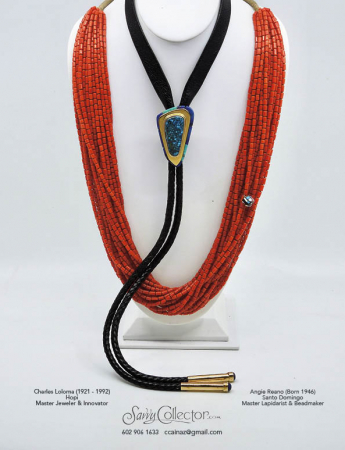
In the late 1960s and early 1970s, dealers and gallery owners like Lovena Ohl, the Waddell family and Joe Tanner, along with artists like Preston Monongye, Lee Yazzie and the great Charles Loloma responded to the clarion call for Native American jewelry—in gold, please.
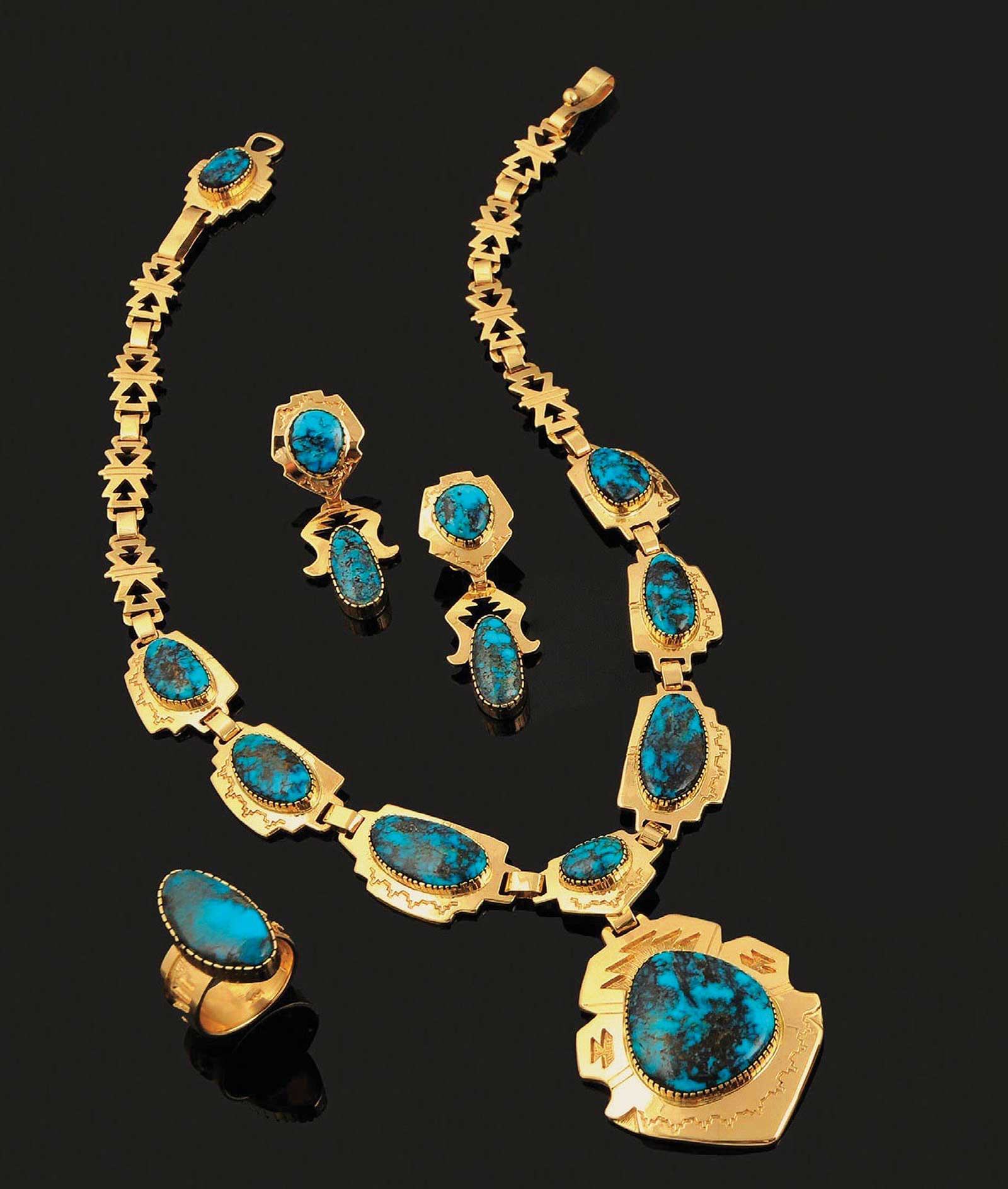 Dina Huntinghorse (Wichita), 14k gold necklace with Apache Blue turquoise. Image courtesy Dina Huntinghorse.
“Charles [Loloma] was really known for making wonderful gold pieces, and then he just used the best materials. He used the best turquoise…he used coral, lapis, sugalite, but it was always the best quality,” says jewelry dealer Gene Waddell. “As I remember, Charles was the one of the first ones that used gold. And, as a result, other artists of the time used gold. One was Preston Monongye.”
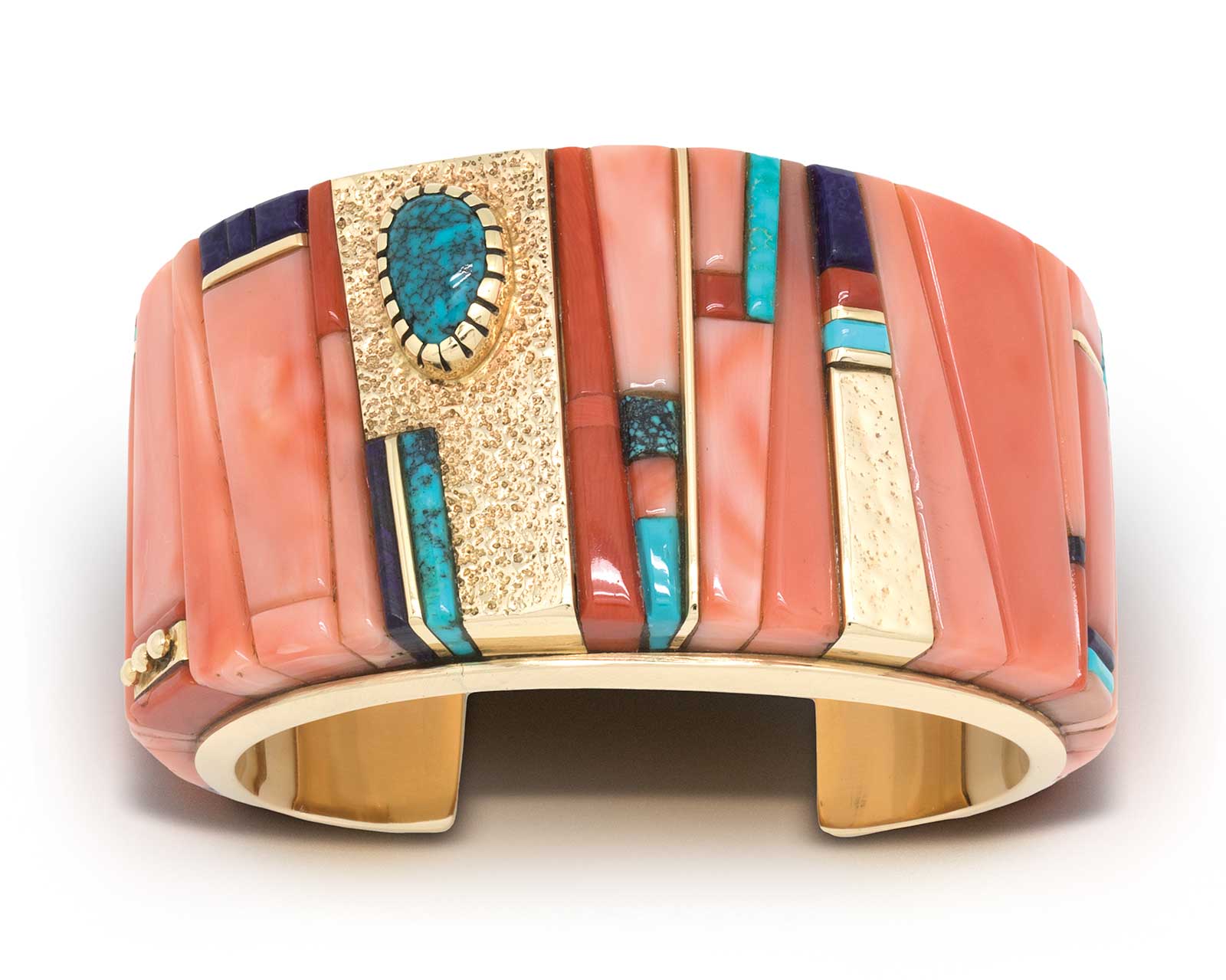 Sonwai (Hopi), gold bracelet with stone inlay. Image courtesy Waddell Gallery.
“We were always promoting the best of the best, and we had people asking for gold, so we began to do it,” recalls Joe Tanner. Joe’s daughter Emerald Tanner, says Monongye had an eye for color. “He would drop a penny in every now and then, or he’d drop a type of metal to kind of warm the color,” she says. “So this is 14-karat gold, but we call it Preston’s signature mix, because it has that kind of warmer feel, that likely is a drop or two of a penny.”
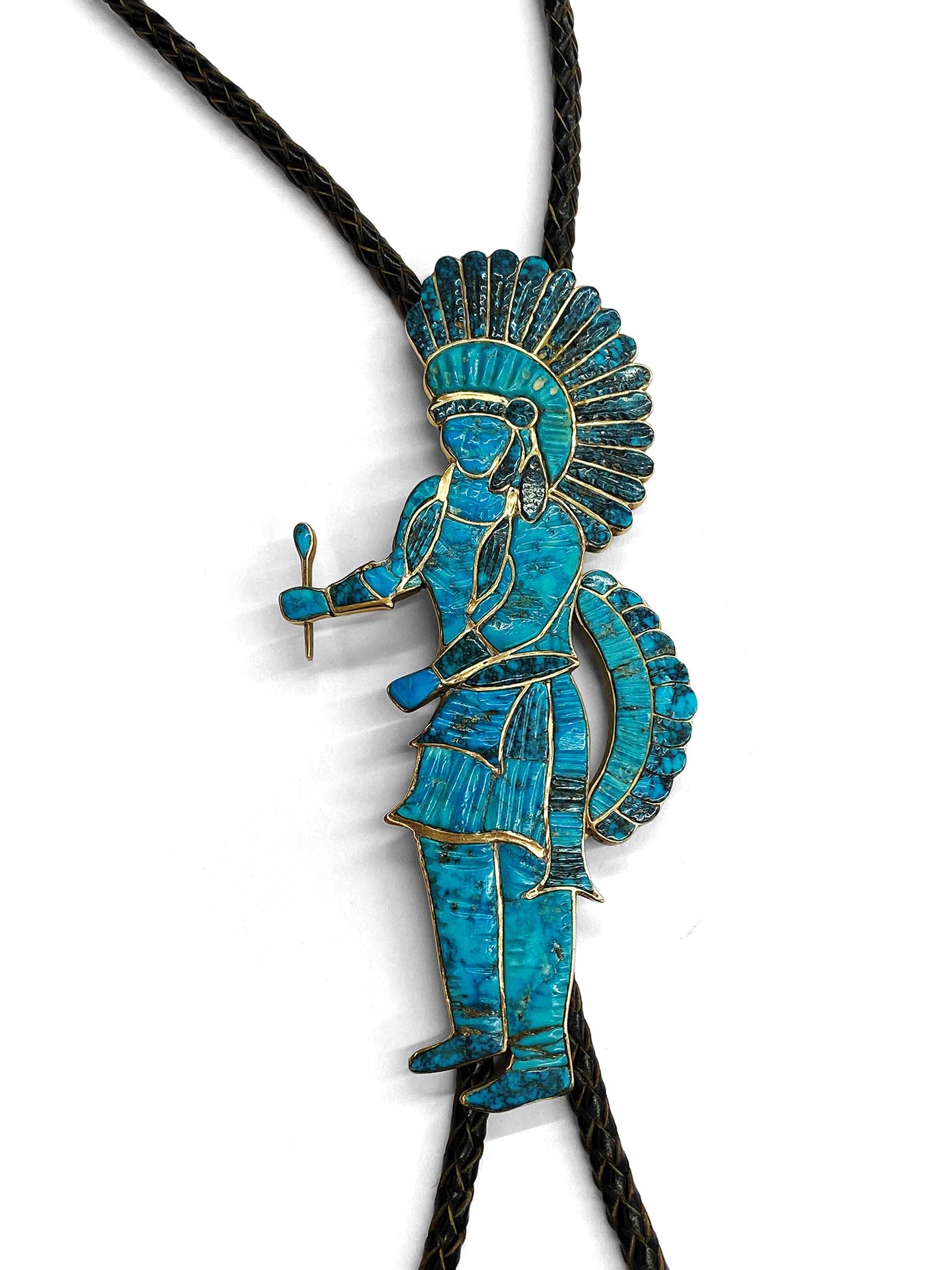 Edward Beyuka (Zun, 1920-2002), gold and turquoise bolo. Image courtesy Tanner’s Indian Arts.
“What we’ve always done is furnish the material for talented and incredible people, and enabling them to be the best that they could be, with our partnering,” says Joe Tanner. As this modern-day “gold rush” ramped up, Monongye and Yazzie were both working at Tanner’s Indian Arts in Gallup, New Mexico.
One memorable piece is pure Yazzie. An East Coast collector stopped in, and Tanner introduced him to Lee. “And they got to talking,” says Joe’s wife, Cynthia, “and he wanted a kachina inlay bracelet, so we referenced back to some of the drawings we had in our collection…Lee first created the cuff that has about 8 ounces of gold in it!”
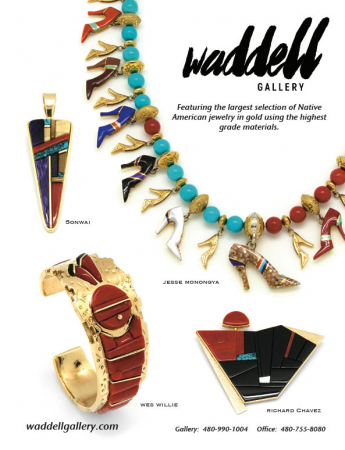
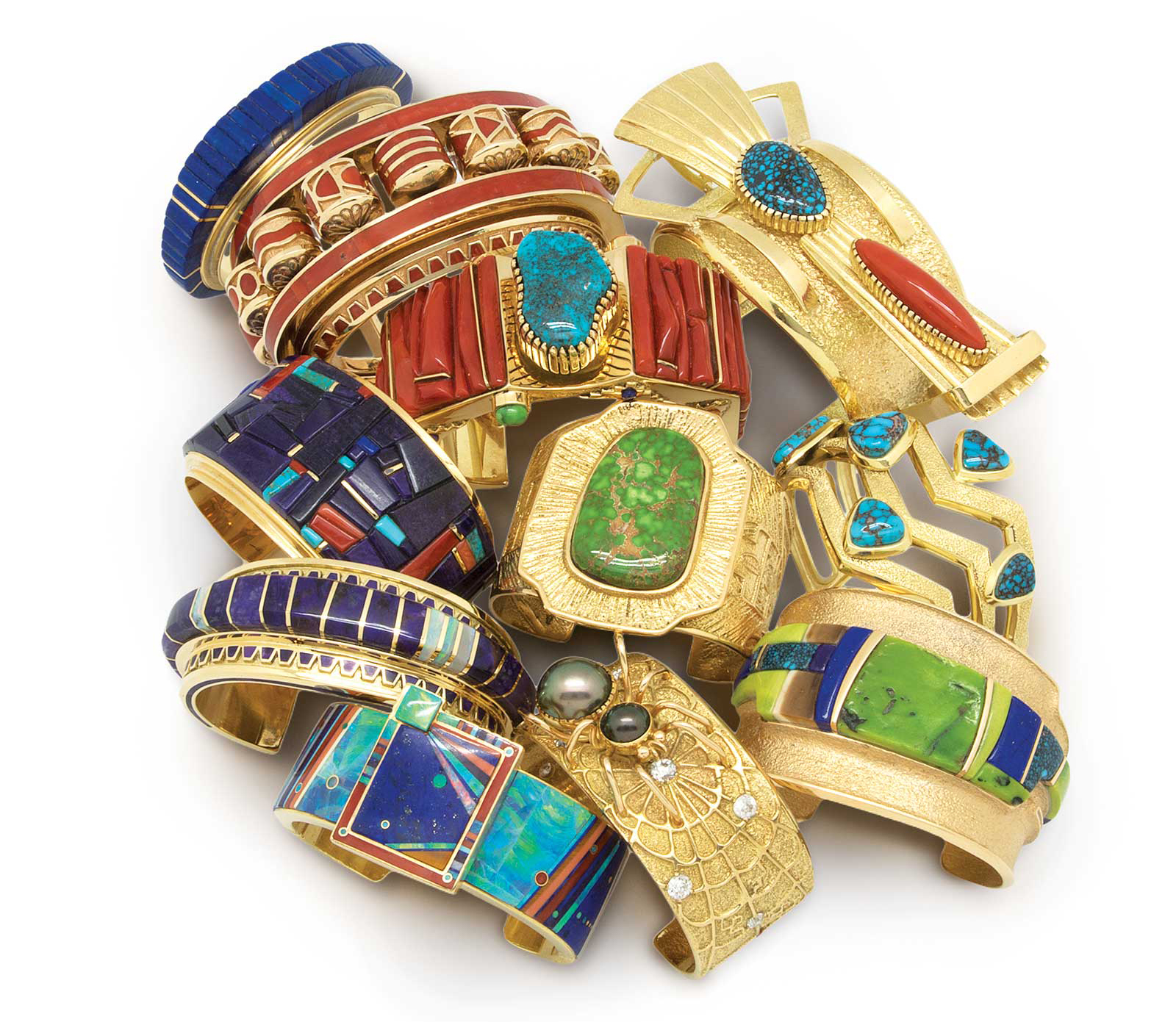 Various gold pieces from Waddell Gallery.
Yazzie remembers he didn’t want to do it at first. “I felt like I wasn’t that kind of silversmith, or metalsmith…I don’t really accept myself as an artist, or as a true artist. I classify myself as a good craftsman,” he says. “I went through a lot of prayers and asked for help because I just felt like I was trying to do something I wasn’t capable of…so I kept trying.”
The katsina came next. “I did the background on it first, and then I make the template, the outline of the figure…then I made the head first,” says Yazzie. “It allowed me to come face to face with that being, with that katsina. And we were talking to each other. I just told him that I want his help to give him life.”
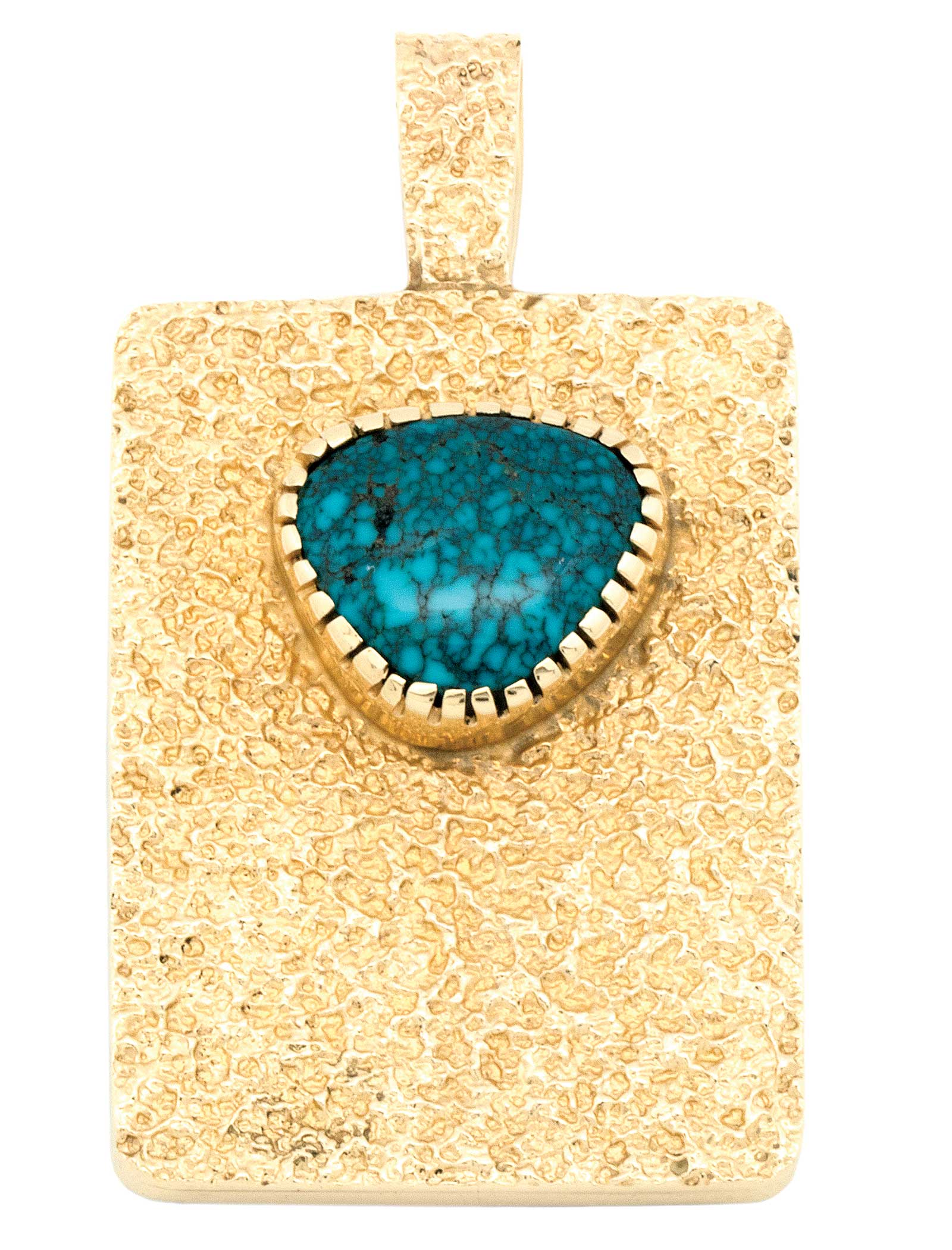 Charles Loloma (Hopi, 1921-1991), 18k gold reversible pendant with inlay of sugilite, coral, lapis and high-grade Lone Mountain turquoise. Image courtesy Waddell Gallery.
The three-dimensional figure was formed with all-natural Bisbee turquoise, jade, Mediterranean coral, jet, Arizona ironwood and serpentine. Finished in 1979, Yazzie says it proved something to himself: “That’s the reason I really appreciate that piece. That’s something I put everything I have in it. I came up with more than I put in.”
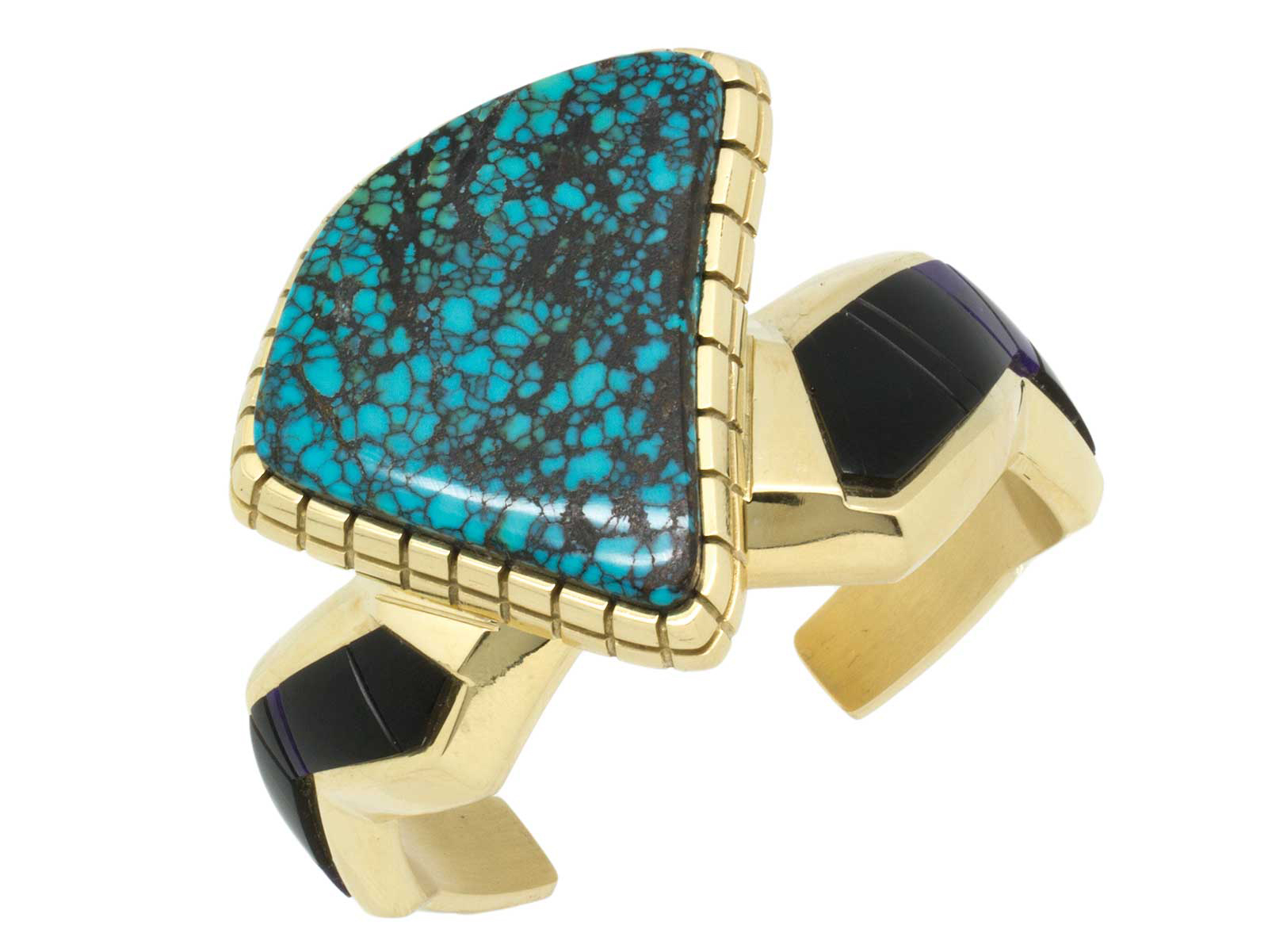 Don Supplee (Hopi), 18k gold bracelet set with a rare large gem-quality Indian Mountain turquoise cab, inlaid with black onyx and gel sugilite. Image courtesy Waddell Gallery.
Four years later, Yazzie was challenged as to what he could do with a gemstone material called Newlander Royal Web from Nevada. The idea came while shucking an ear of corn. “I was turning it over,” he remembers, “admiring the pattern and different color combinations.” Yazzie mentioned to his mother how beautiful it would look bent around her wrist, and an image came to him: a three-dimensional framework with ribs coming around and cross-pieces in-between…all in gold.
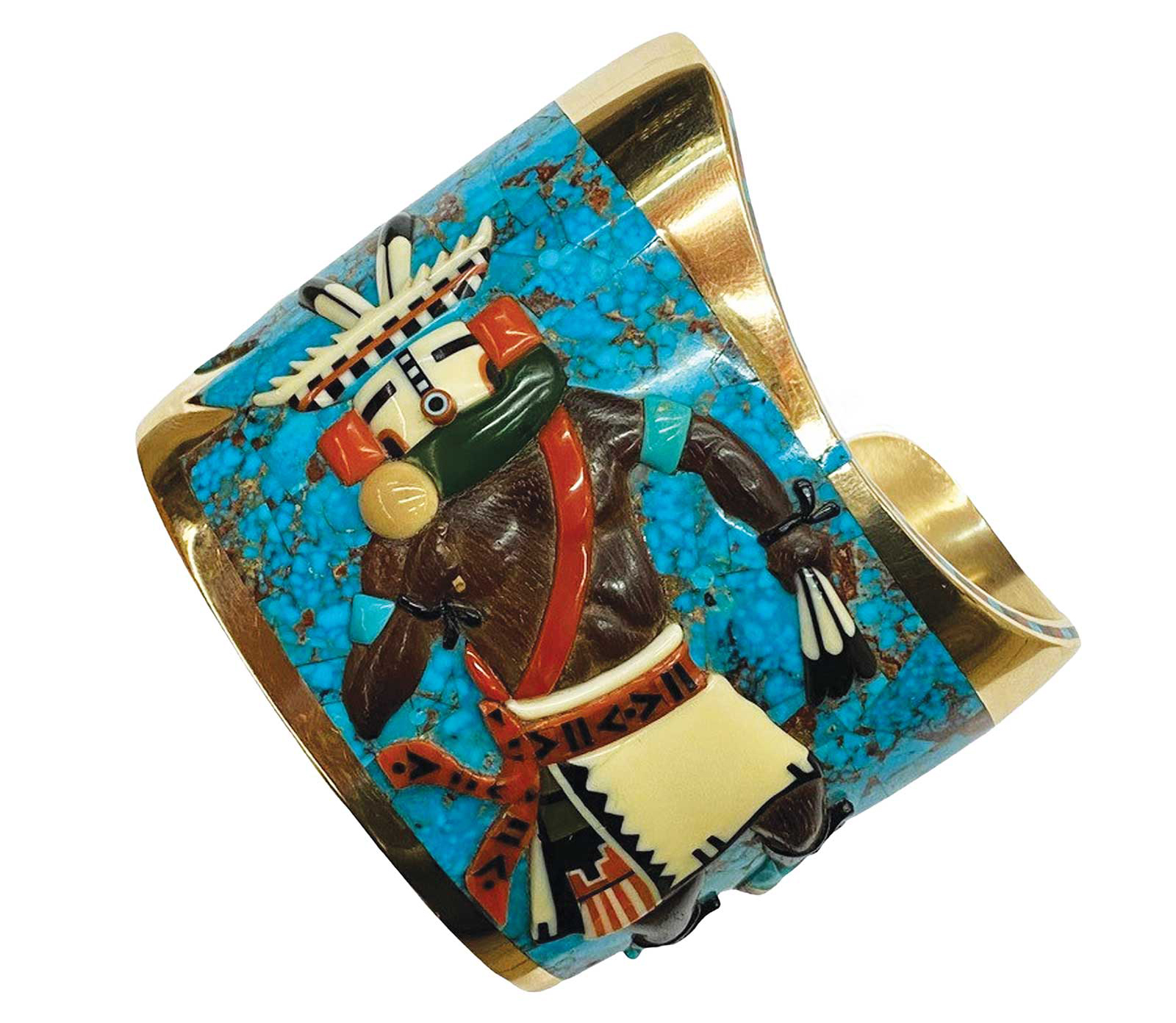 Lee Yazzie (Navajo), Kachina Dancer Cuff, gold with stone inlay. Image courtesy Tanner’s Indian Arts.
“I remember the first time Joe saw that. He just flipped,” Yazzie speaks warmly of the memory. “When I showed him the framework, and what I was going to do with it…and I had a part of it inlayed already, he took it outside and looked inside, and (was) running around with it, just so excited about it.”
“It’s the most significant piece of American Indian jewelry ever made,” Joe Tanner says. “It’s total Lee Yazzie genius. He did every facet…he made the metal bridgework, and then he cut every stone exactly to fit. An engineering masterpiece!”
Yazzie says everything he’s done since then is because of what both projects taught him. He later taught his younger brother, Raymond Yazzie, who became a brilliant artist himself. Waddell affirms that: “Lee Yazzie and Raymond Yazzie are two of the great Navajo silversmiths and goldsmiths of our time.”
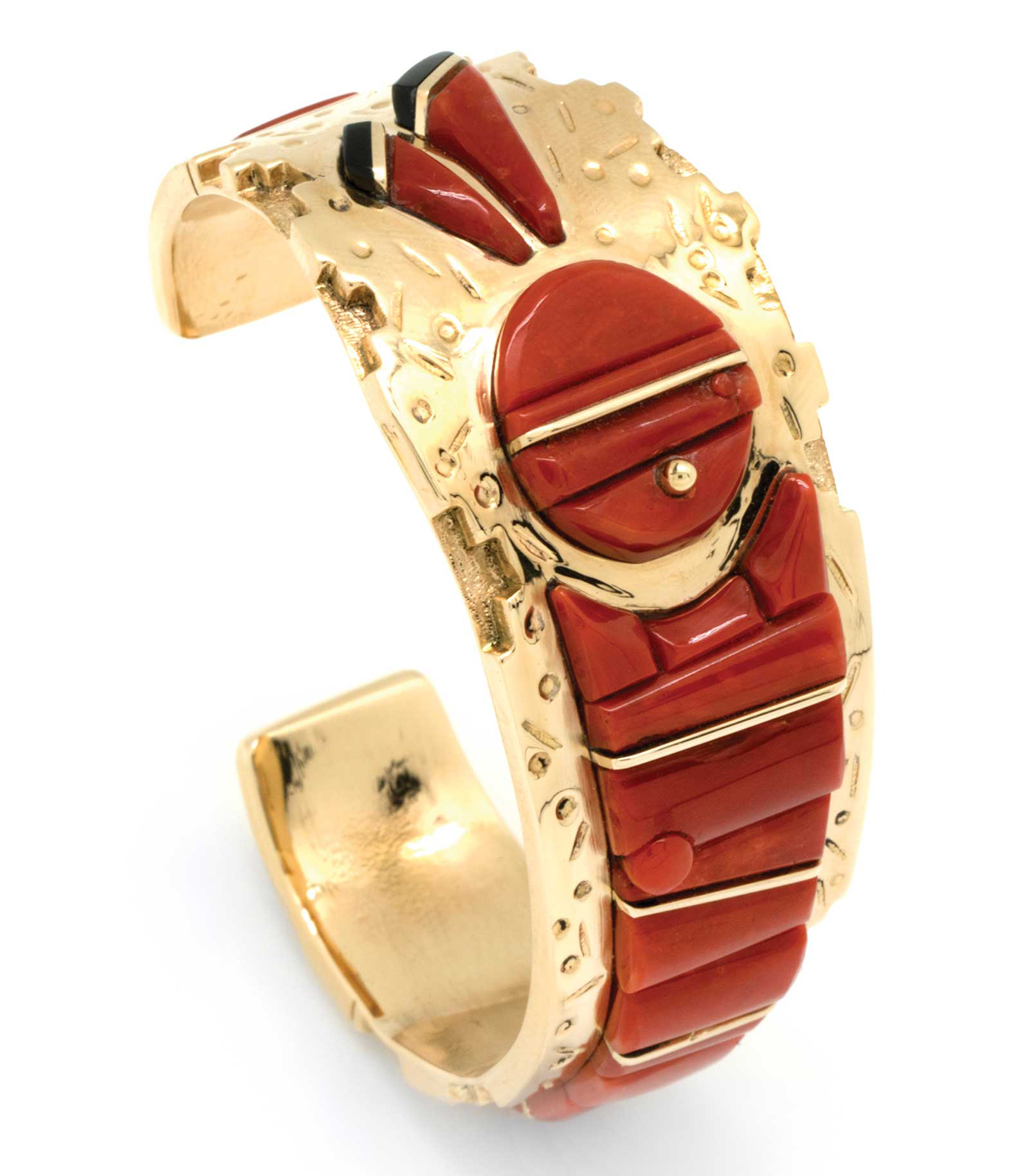 Wes Willie (Navajo), 18k gold Yei bracelet inlaid with deep red Mediterranean coral and accents of high-grade Candelaria turquoise, opal and black jet. Image courtesy Waddell Gallery.
The late artist Charles Supplee apprenticed under master jeweler Pierre Touraine in the 1980s. His younger brother, Don, recalls how Charles showed him how to make a design different by first overdrawing it. “Almost cartoony,” he said. “My brother would design these things that were so flamboyant, then tone them back down.”
Waddell had a shop in Tempe where Charles worked for a while, and where Don started out, helping his brother. Charles later went out on his own, and came into his own with his simple, elegant style. Don became immersed in Scottsdale’s Arts District, working with friends of his brother’s and other skilled jewelry craftsmen. He started using gold almost immediately.
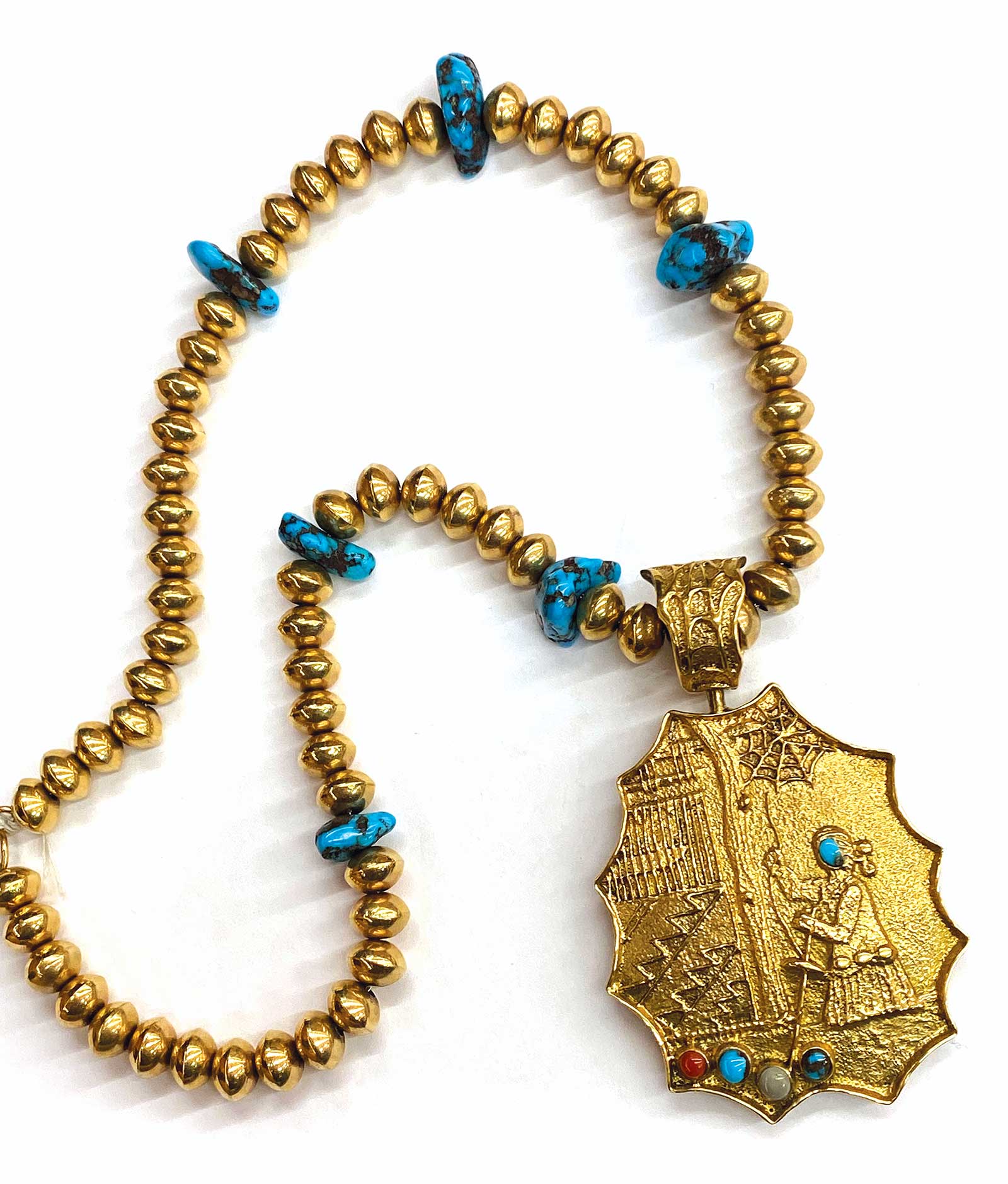 Philander Begay (Hopi), Spider Woman, ca. 2010, 18k gold, Candalaria Nevada, villa grove coral and Mediterranean coral. Image courtesy Waddell Gallery.
“It was a real unique thing for Natives to be doing contemporary stuff in gold,” says Don. “And then the market started getting bigger and bigger. We had people from Europe and Japan and Asia and India…coming here and looking. To them, 14 karat, it’s like 10 karat here…not even worth buying.”
“We had a lot of Europeans coming in the gallery, and things were in 14-karat gold, and Europeans would not buy it,” recalls gallery owner Bill Faust. “Because to them, their gold standard was 18 karat.”
Artist Wes Willie recalls similar experiences. “Today people are asking for 18-karat gold, so 14 karat is on the back burner for now,” he says. “A lot of artists use gold. [So] two things changed: A lot more artists are using it, and the customers are asking for it.”
Artist Alvin Yellowhorse was asked by a customer to make a belt buckle incorporating an Alaskan gold nugget the customer had. Yellowhorse created a sterling silver background with the gold nugget in the middle, but “if you flip the buckle over, there’s actually a drawing or carving of a mineshaft, and you can see the other side of the gold in a tunnel…(with) railroad tracks leading up to it.”
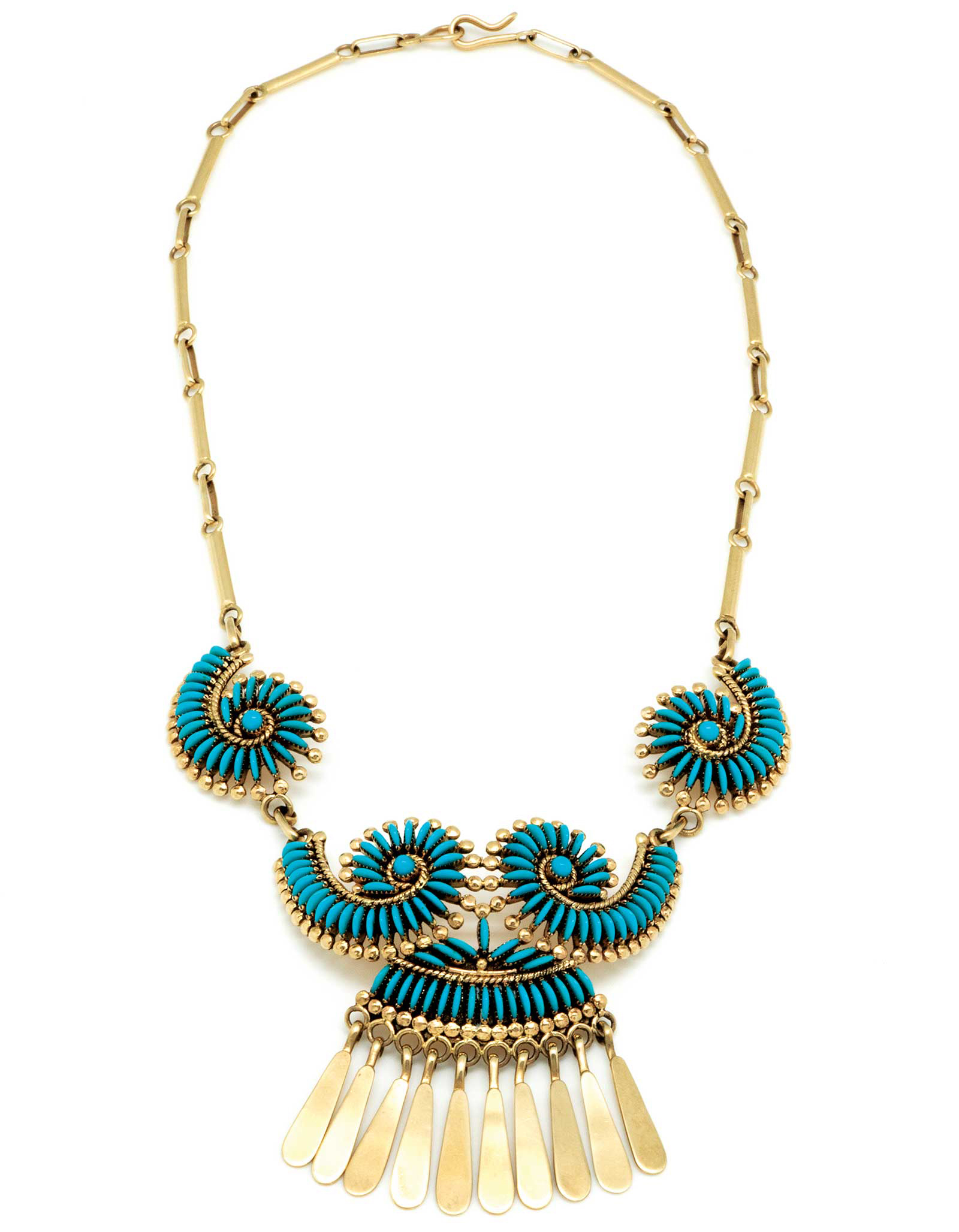 Edith Tsabetsaye (Zuni), 14k gold necklace with very fine needlepoint inlay of clear Lone Mountain turquoise. Image courtesy Waddell Gallery.
Dina Huntinghorse, raised by the Witchita tribe in Oklahoma married Navajo jeweler Herbert Taylor. She helped him with inlay but never soldered…until he died in 1996. “I was always afraid of the torch,” she says. “Then after he passed, I wasn’t afraid of anything!” She started with a sheet of gold she found in her husband’s materials, and just kept going. She says, “The things that sell the most are the ones that are gold over silver…’cause a lot of people will say ‘Oh, I wish I could afford it in solid gold’”
Sonwai, a niece of Loloma, learned her craft working next to her famous uncle as he created with gold. “I was kind of hesitant to use it, because it’s harder to weld. It’s softer, and just have to be very careful with the soldering and heating it up,” she says. “…I remember when Charles and I were working together, doing inlay work. We would put gold lintel, slip it in with the inlay as little accents…on a silver piece, because he’d say that gold, in inlay, warms up all the colors.”
Mixing gold with silver was something Loloma did early on, according to Faust. “All he said was, ‘The use of the two metals together is a design element.’ So he would mix them and use them together.”
“Turquoise looks killer in gold,” adds Faust. “My favorite color combination is actually turquoise, coral with lapis and a little bit of sugalite in there…all those colors and that gold it just pops!”
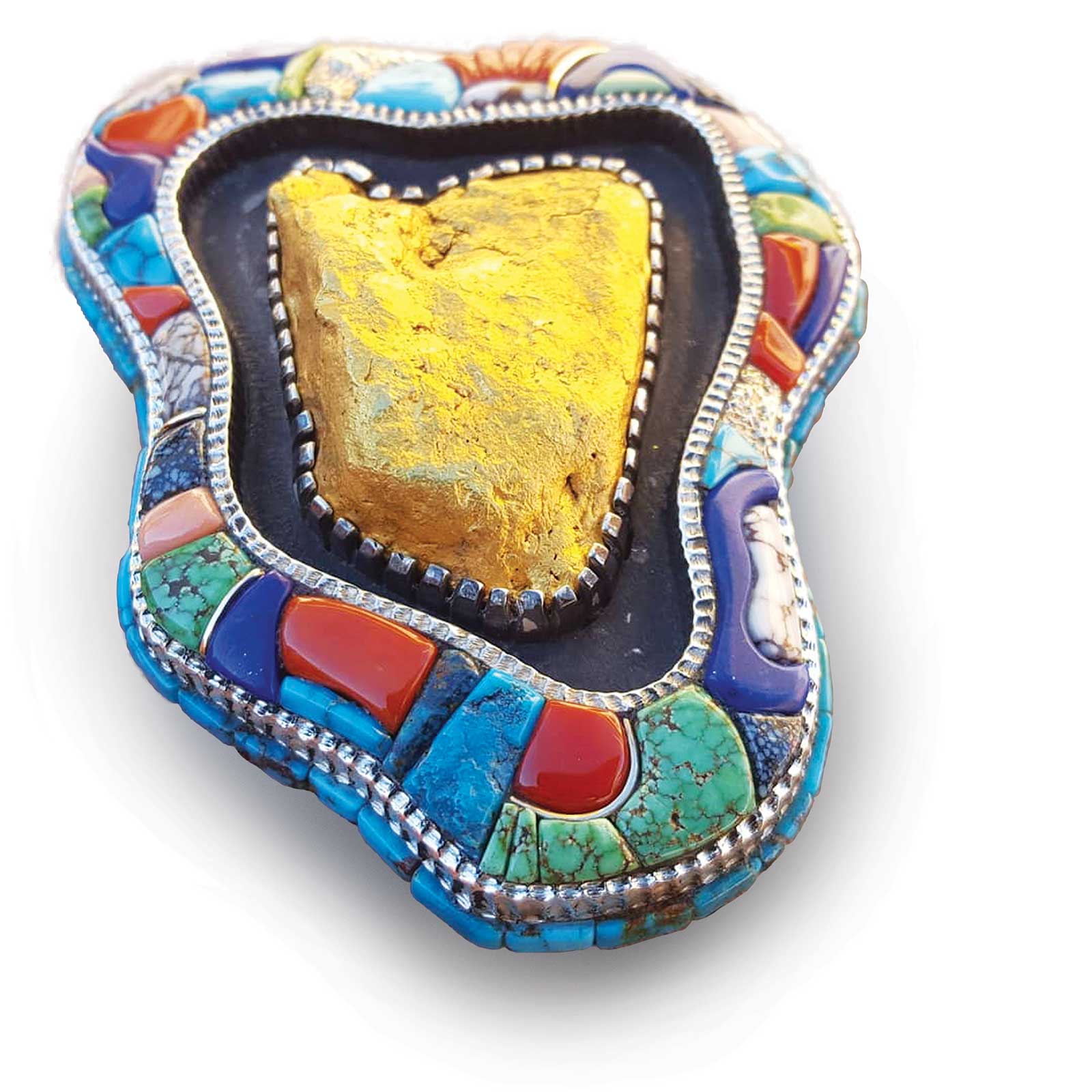 Alvin Yellowhorse (Navajo), buckle with gold nugget
Don Supplee agrees that gold has a power with some of the classic jewelry colors, including turquoise. “Gold shows off stones a lot better,” he says. “Like my brother [Charles] was teaching me, ‘All you need is a splash, just a tiny, tiny bit.’ If you like turquoise, and then put a really cool piece of sugalite, real bright purple, the gold and the blue make the purple purpler. Purple makes the blue bluer. Either way it still looks good, but just put them together, the way it tricks your eye.”
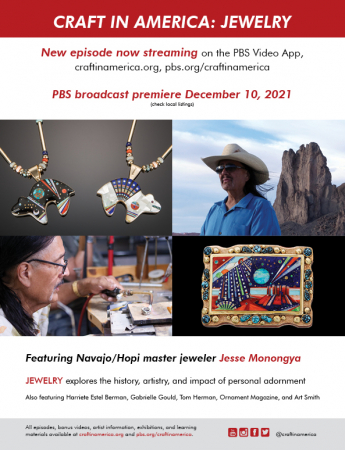
And then there’s gold jewelry pieces created by Jesse Monongya, which are simply magnificent. “Jesse’s in a whole different category of his own,” says Faust. “Everything he does is absolutely exquisite. Realistically for him, to even put the amount of time and labor and market it in silver makes no sense. There’s no way to get the value of his labor out of there.”
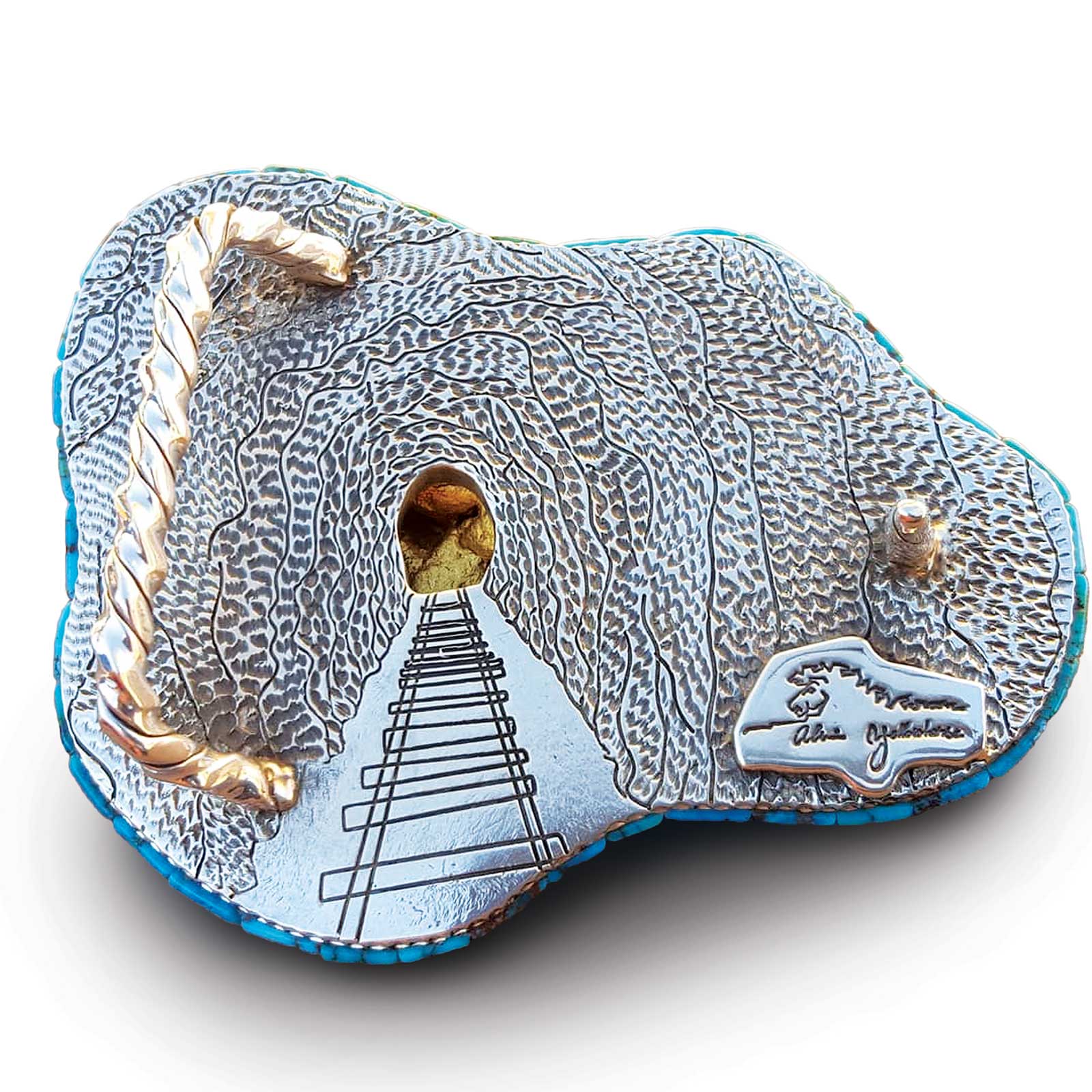 Alvin Yellowhorse (Navajo), reverse side of buckle with gold nugget showing mineshaft and railroad tracks leading to gold nugget
Artists and gallery owners agree Monongya literally has a golden touch with the pieces he makes, but the artist himself puts someone else above him: Yazzie, whom he referred to as a “great master.” “He’s the leading jeweler,” Monongya says.
Yazzie is quietly humble about what he’s done…but his words are just as golden as his creations. “A lot of talents are obvious,” he says. “If you have talent, you’ll see it. And then a lot of it is not. You have to pry them out. You have to uncover it.”
It’s a treasure these artists have discovered in themselves, and struck gold.
Powered by Froala Editor