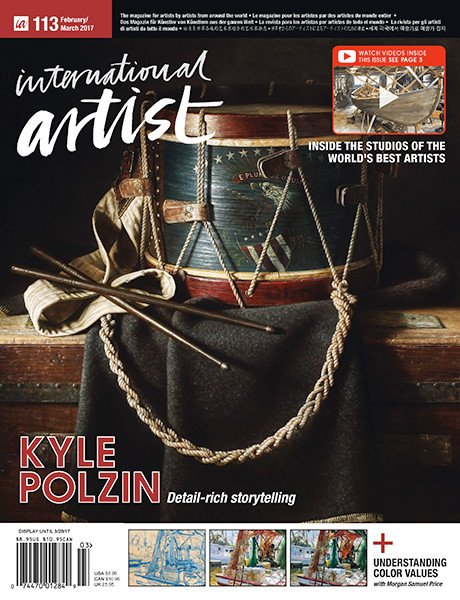
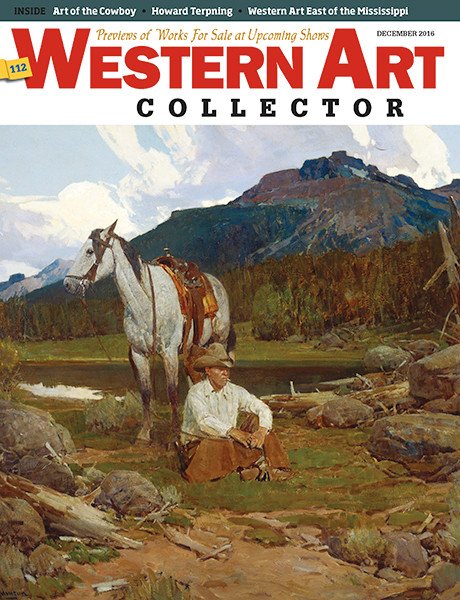
Robert R. Compton (1922-2015) was a Guggenheim Fellow in Earth Science in 1963. He took early retirement from his professorship at Stanford University at the age of 60 and happily painted in his studio every day until he died at the age of 92. Richard Diebenkorn was at Stanford when Compton was there and Compton admired his figurative work, incorporating some of Diebenkorn’s idea into his own early work, and purchasing a figurative gouache.
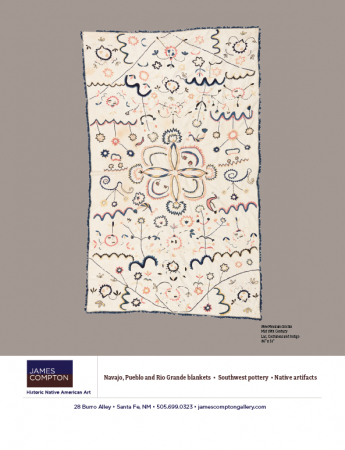
Many of Compton’s paintings and the Diebenkorn gouache are now in the collection of James Compton, the artist’s son. Compton is a collector and dealer in historic Native American art. The elder Compton’s passion for painting is reflected in his son’s passion for the objects he collects and those he puts into appreciative hands.
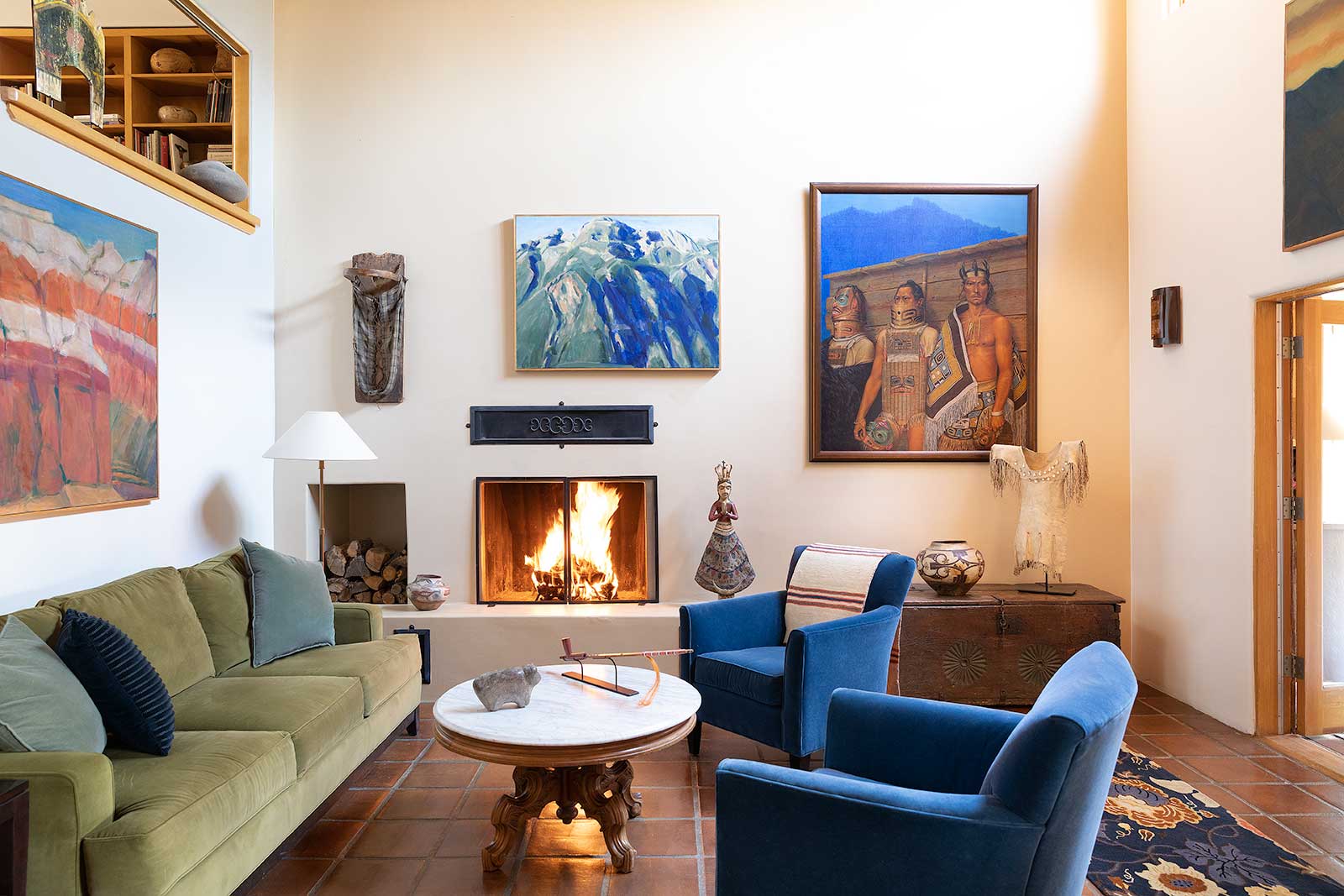 Above the fireplace are, left to right, an Ojibwe cradleboard, circa 1860; Mt. Hamilton, CA, 1988, oil on canvas, by Robert R. Compton (1922-2015); and Juste avant la Bataille, Tlingit, 1989, oil on canvas, by Antoine Tzapoff. On the left, above the sofa is Compton’s Zion Canyon at Park Creek, UT, 1991, oil on canvas. On the hearth is a bulto of a praying saint, circa 1860, attributed to José Aragón (circa 1795-1862).
He purchased his first Navajo rug in 1995. “It was a beautiful, amazing thing,” he recalls. “It was a 1920s reservation era rug made for tourists. I found books on what the weavers made for themselves and became attracted to them. I began to find them in Seattle, where I was living. My first Navajo blanket was a manta I found at an auction for about $300. Later I learned of its real value and spent $2,500 to have it restored. I often end up buying the oddball piece and it turns out to be the best.”
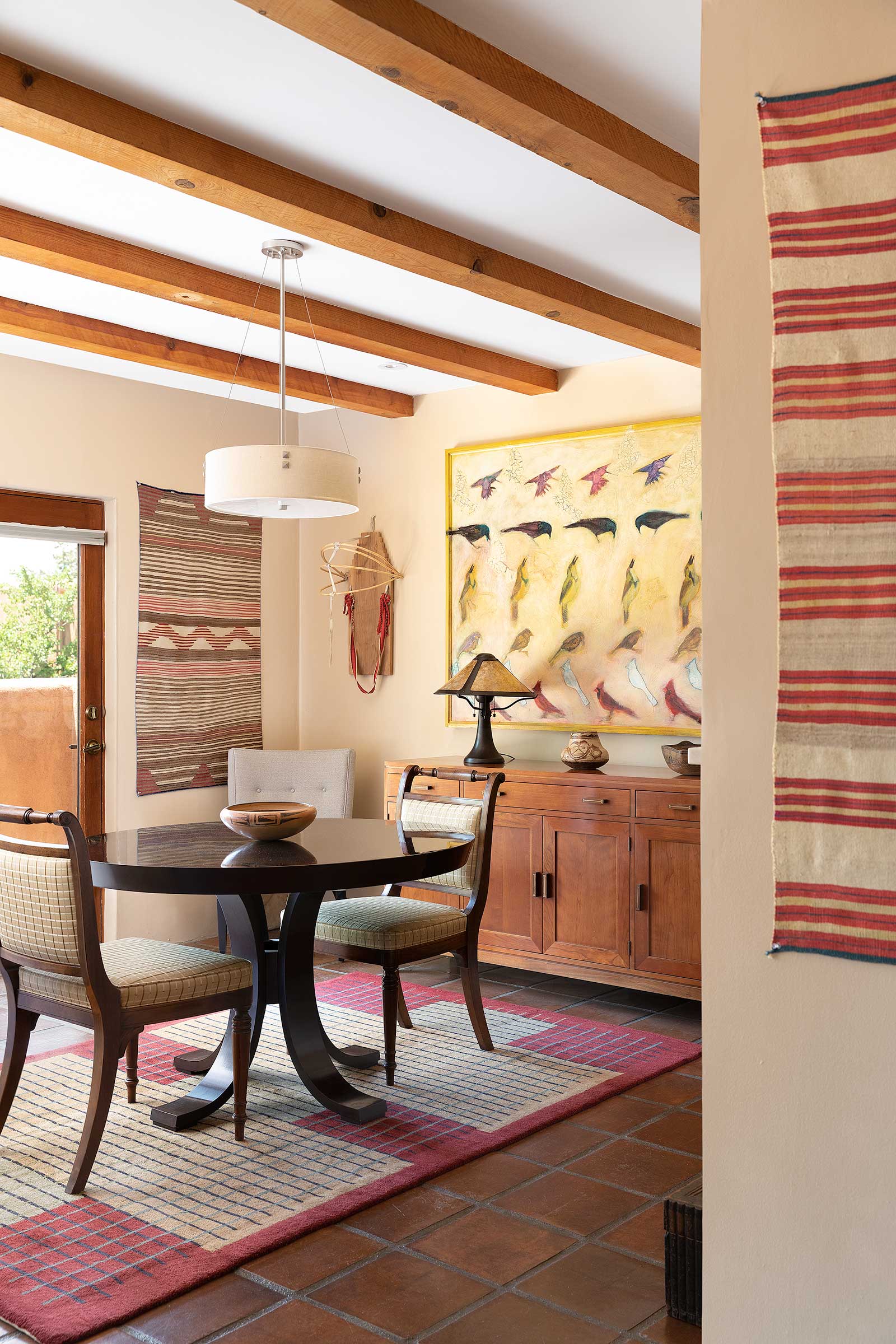 To the right of the door is a Classic Period Navajo child's blanket, circa 1860. On the adjacent wall is a Pueblo cradleboard with red sash, circa 1920. The large painting of birds, acrylic on board, is by Candace Compton Pappas. On the near wall is a Classic Period child's blanket from around 1860. On the dining table is a Hopi bowl, circa 1940. On the sideboard is an early Hopi jar, around 1840.
Compton waxes infectiously rhapsodic about a Navajo blanket from about 1850 that now hangs in his living room. He first saw it in the shop of Robert Mann Rugs in Denver. Mann had just washed it and spread it out on a table. “I told him if it ever became available I’d like to have a chance at it,” Compton says. “Over the next two years the patterns evolved in my mind since I didn’t have a photo of it. Then Bob called to tell me it was available. It was the most money I’d ever spent on anything. When it came to me I had to adjust my thoughts on what it really is.”
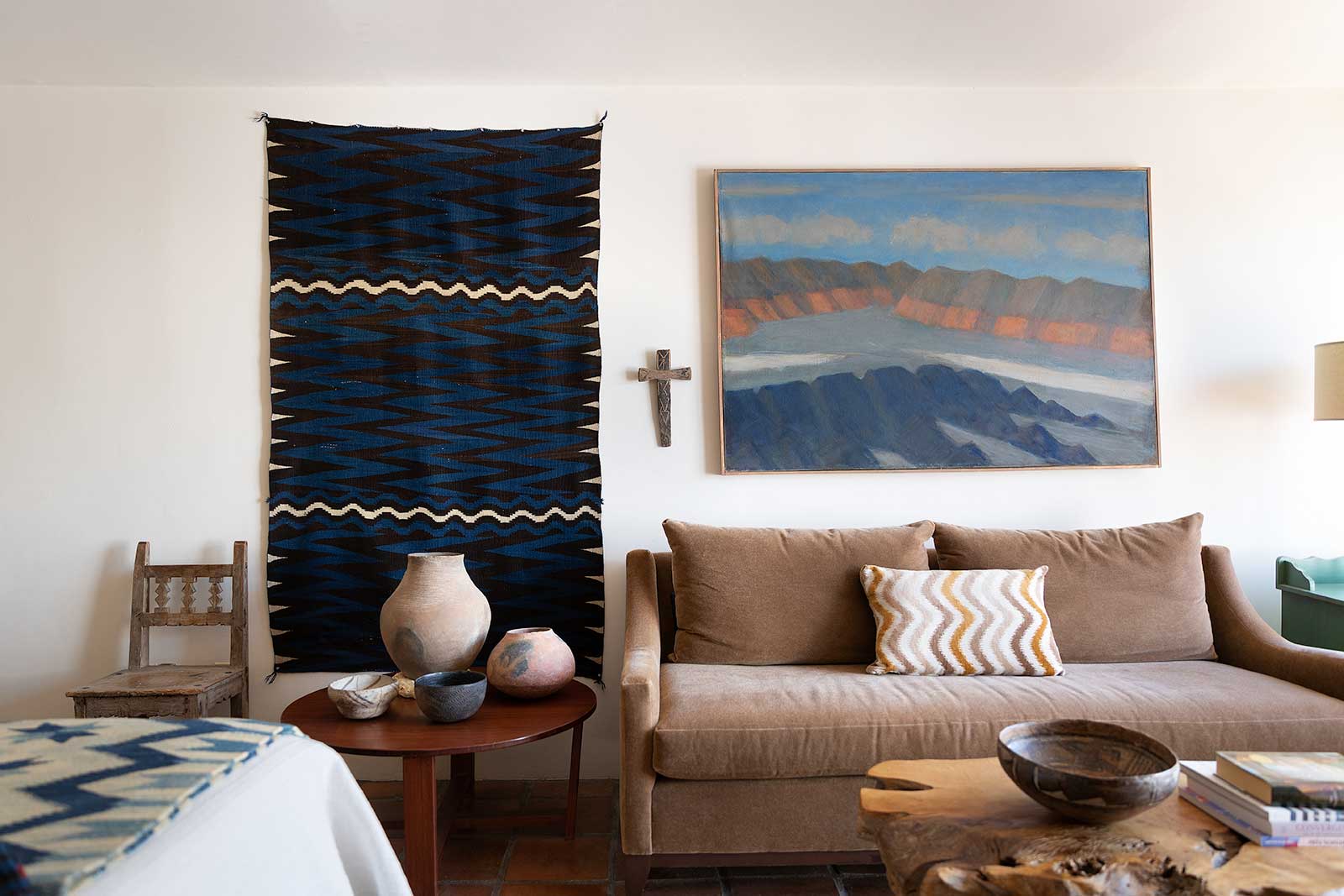 On the left is an early Navajo slave blanket with deep indigo, circa 1850. Next to it is a small Pueblo cross with hay designs, early-19th century. The painting above the sofa is Mountain Ranges, Mojave Desert, California, 2013, by Robert R. Compton (1922-2015). On the tables are various prehistoric Southwest pottery pieces.
He has written extensively about the blanket in his blog. I’ll share a few highlights here. “I discovered an object so beautiful, so intriguing, that it changed my life…I saw the blue first. It’s an Yves Klein sort of blue, so pure and saturated I can’t easily turn away from it. The design, an arrangement of intersecting forces, triggers in me a cascade of out-of-reach memories like some vestigial remnant of past life…
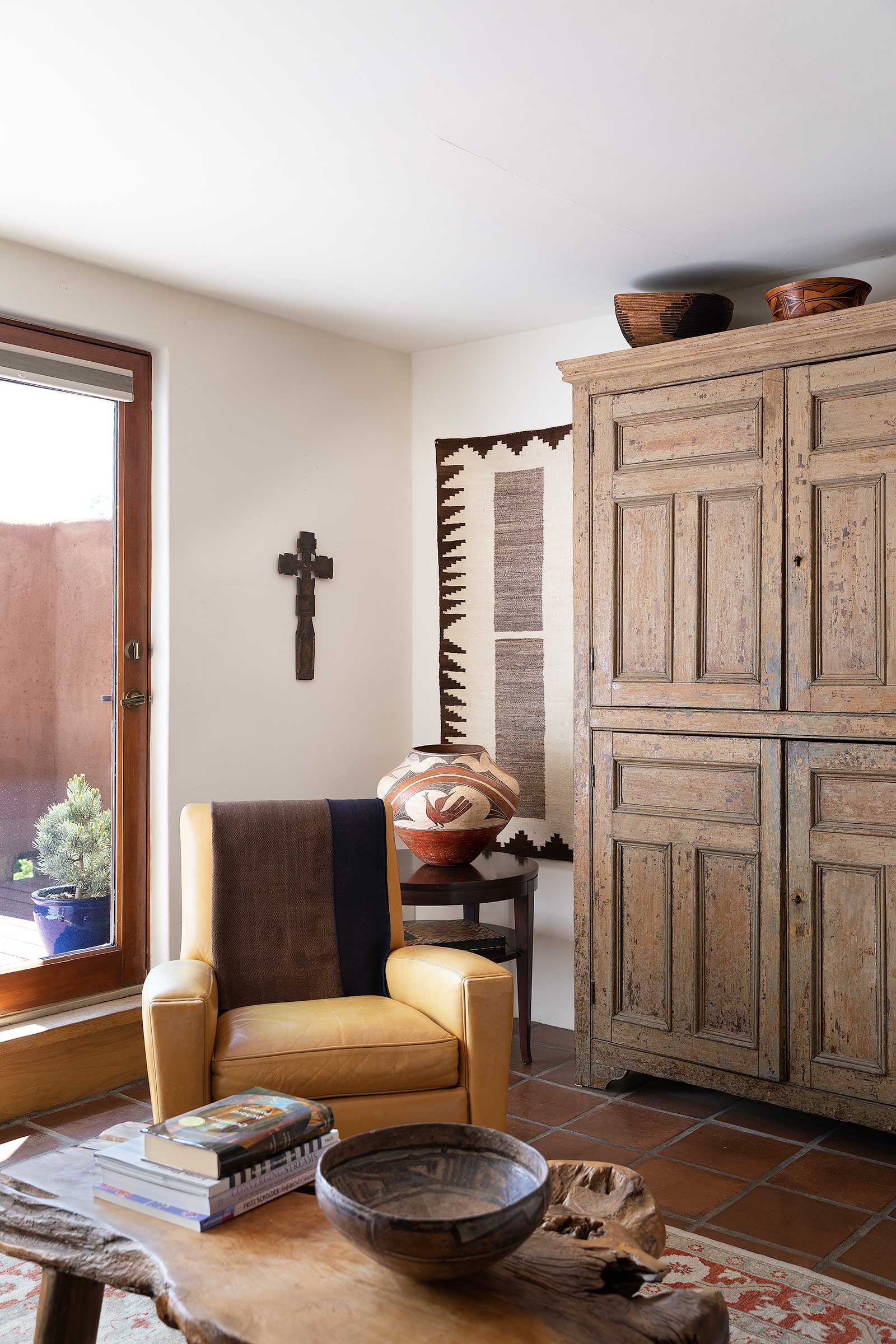 An 18th-century New Mexican Spanish Colonial Cross hangs on the back wall. Adjacent to it is a Navajo double saddle blanket, circa 1900. On the back of the chair is a Classic Hopi manta with indigo borders, circa 1860. In front of the saddle blanket is a Zia storage jar, circa 1910. In the foreground is a Rio Grande glaze ware bowl. The armoire is Scottish, circa 1850.
“I have learned enough in my life to know that answers to big questions don’t come by thinking. If they come at all, they come through my gut, like a visceral vision that remains in situ, present but unable to link with my thinking self. Still, I feel some sort of answer here, and this blanket gives me the same sort of visceral reaction…
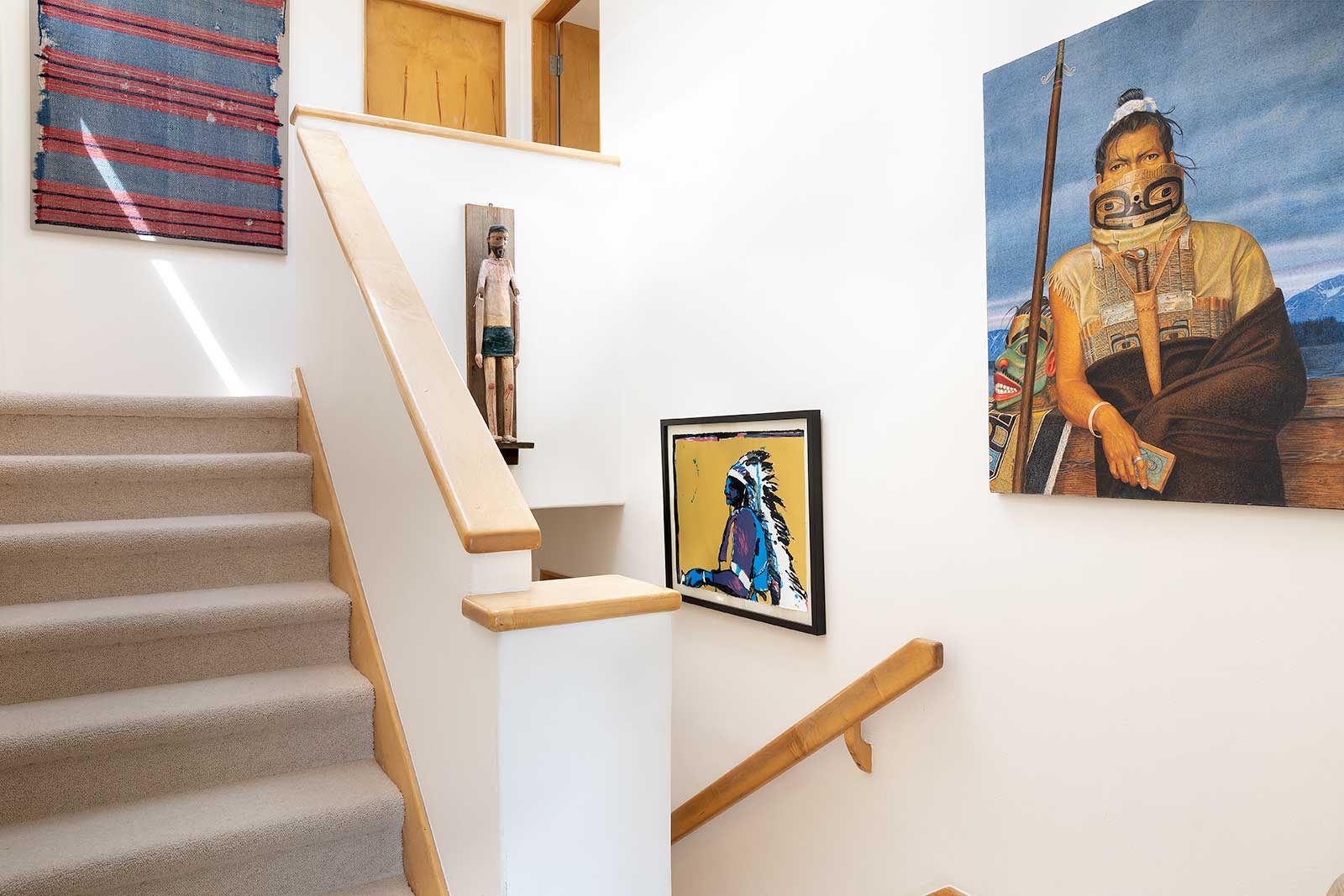 On the stair landing is an early Navajo child’s blanket, ca. 1800. The bulto of Jesus, circa 1890, is by José Benito Ortega (1858-1941). Indian with Pistol, 1978, lithograph, by Fritz Scholder (1937-2005) is above the stair rail. On the right is L’Icone (The Icon), 1990, acrylic on canvas, by Antoine Tzapoff.
“The blanket’s enigmatic quality can, in part, be understood by the contrast between the maker and the owner. Made by a Navajo woman of the early 19th century and owned by a Euro-American man of the modern era, the schism is obvious. This woman, whose life was intimately connected to the earth and its rhythms, is in great contrast to me, this man that lives practically hovering over his earth and increasingly further away from it with all the conveniences he’s given…
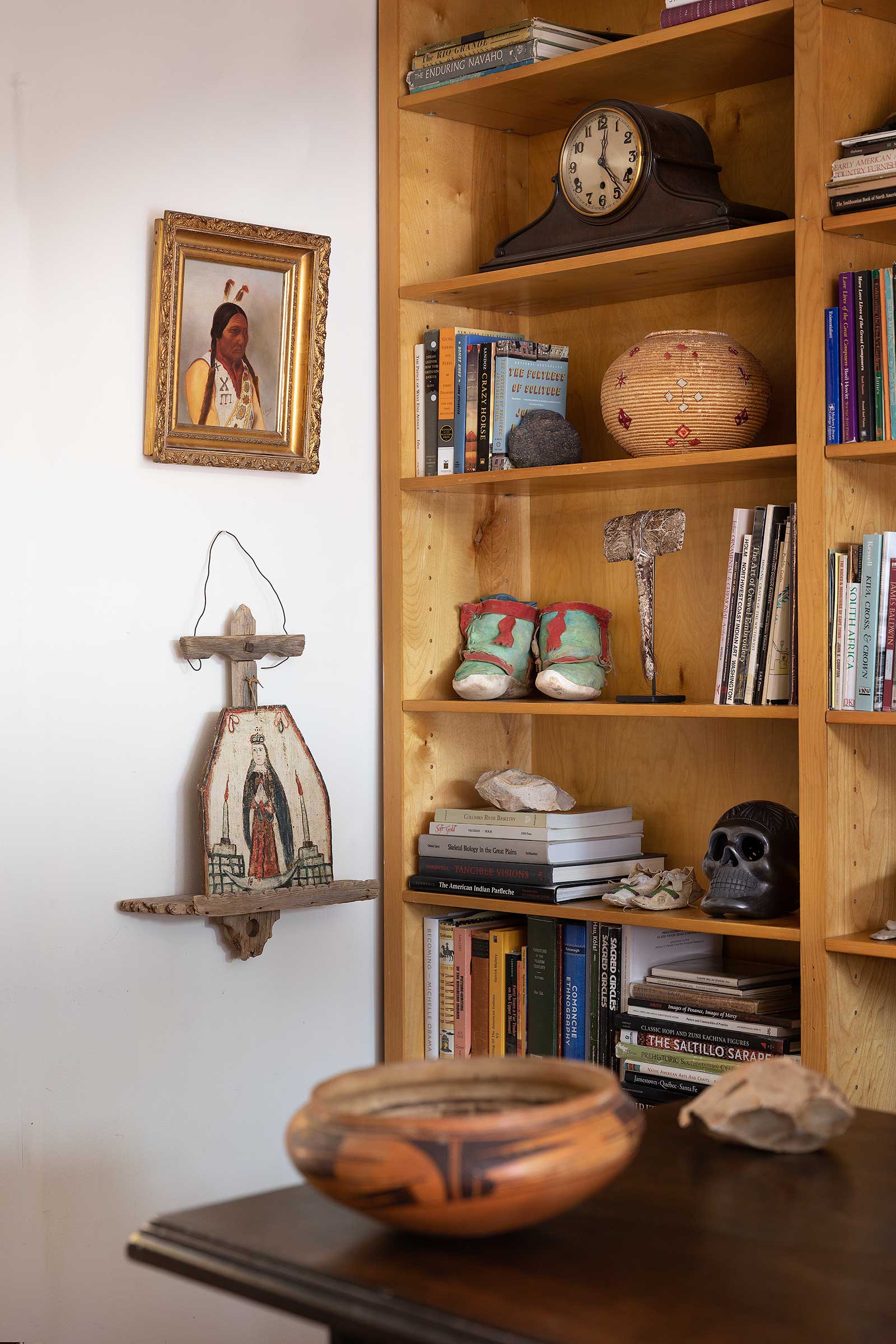
The painting is Chief Joseph, 1906, by Charles Craig (1846-1931). Below it is a New Mexican Spanish Colonial wood retablo of a saint, circa 1820s. The Hopi moccasins on the shelf are circa 1920. Next to them is an early Pueblo hand axe. In the foreground is a Hopi bowl, first quarter 20th century, likely by Nampeyo (1859-1942).
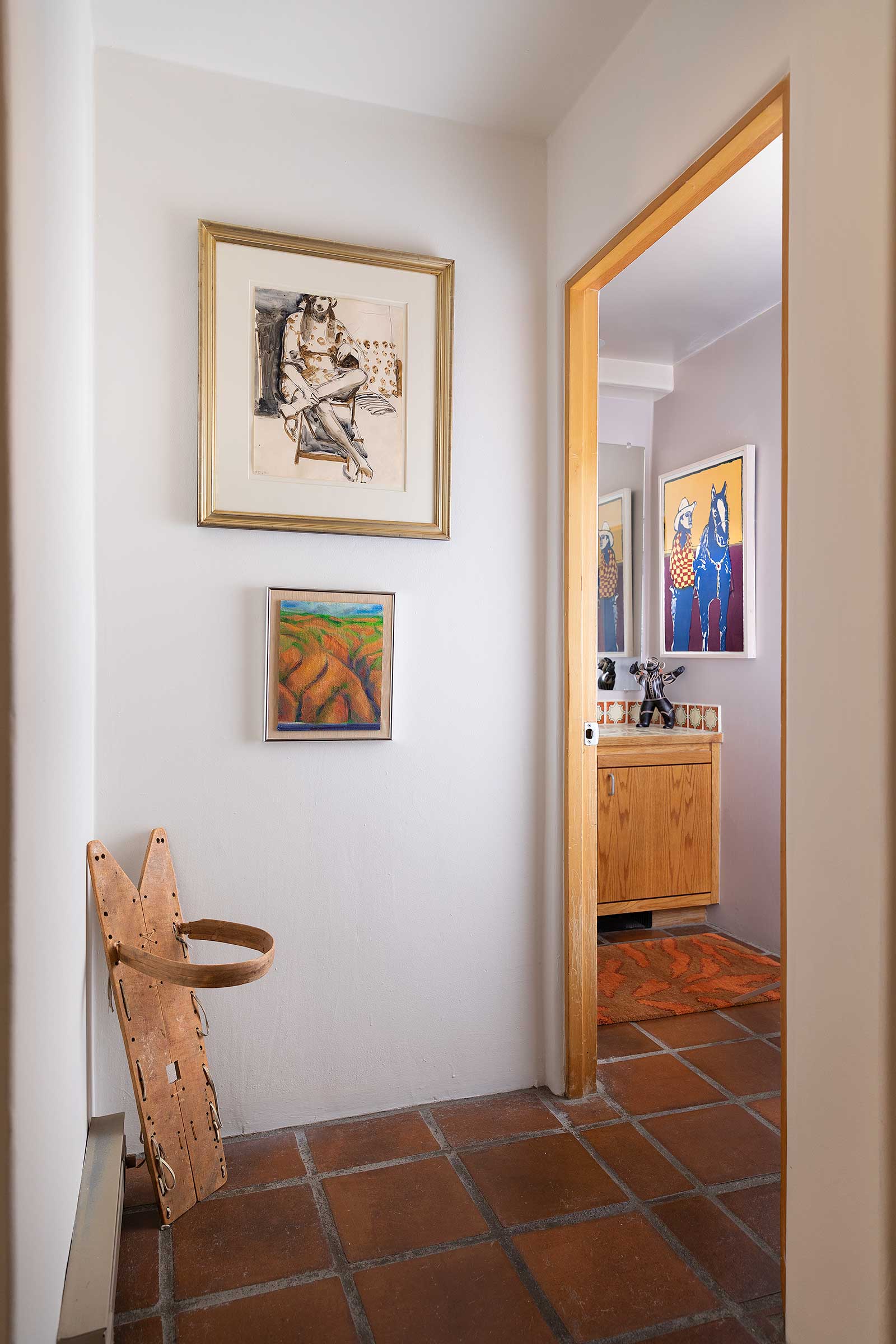 The large gouache and pencil on paper, 1967, is by Richard Diebenkorn (1922-1993). Below it is Coastal Canyons, 1996, by Robert R. Compton (1922-2015). In the corner is a Navajo cradleboard, circa 1900. Through the door is a lithograph, Matinee Cowboy, 1976, by Fritz Scholder (1937-2005). Below it is a pottery figure by Virgil Ortiz (Cochiti).
“I can only guess at the notions behind her design. I know that she lived in a world of true solar darkness a third of her life and that the coming of the dawn, or the setting of the sun, were powerful places of reference for living a life. I know that water was a precious commodity, as was the soil around her, and that the two, mixed together, fed her and her tribe in way that was not just food but sustenance beyond caloric intake. The water and the earth in the blanket mix as if they depend on each other, their ethereal dance producing the serpentine brightness of life.”
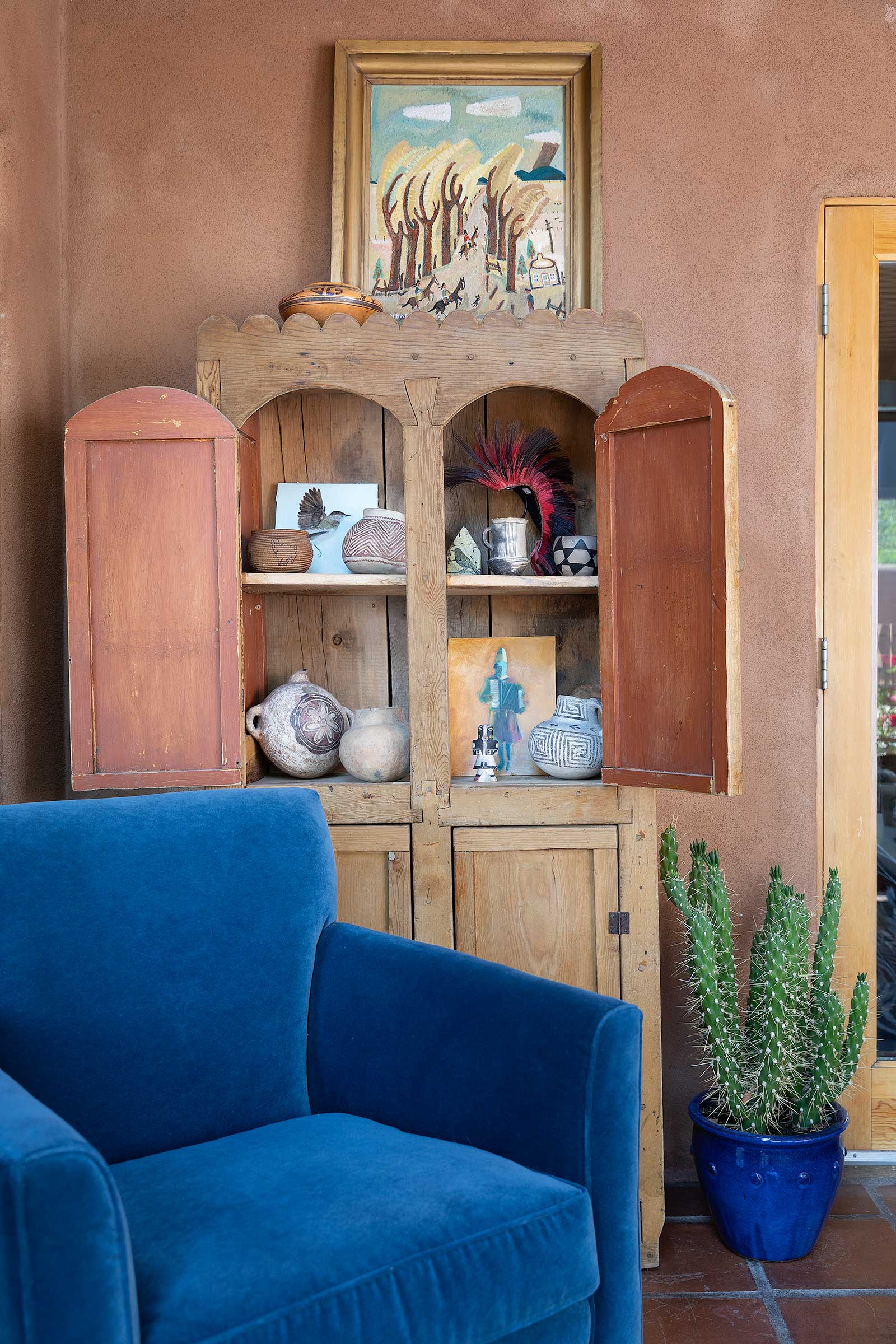
Sometimes, when he has learned the lessons an item has for him, he can let it go and take it to his gallery. A while back he became tired of “buying average things” and sold a number of them to save up the money to purchase something significant. It is an Acomita, or possibly Laguna, pot, from around the 1830s to 1850s. “The design is complicated but comprehensible,” he explains. “The design reminds me of a creation story. It is precise but at the ends of the lines are gesturally painted flower blossoms.” The pot may have served its purpose for the collector and may find its way into the gallery.
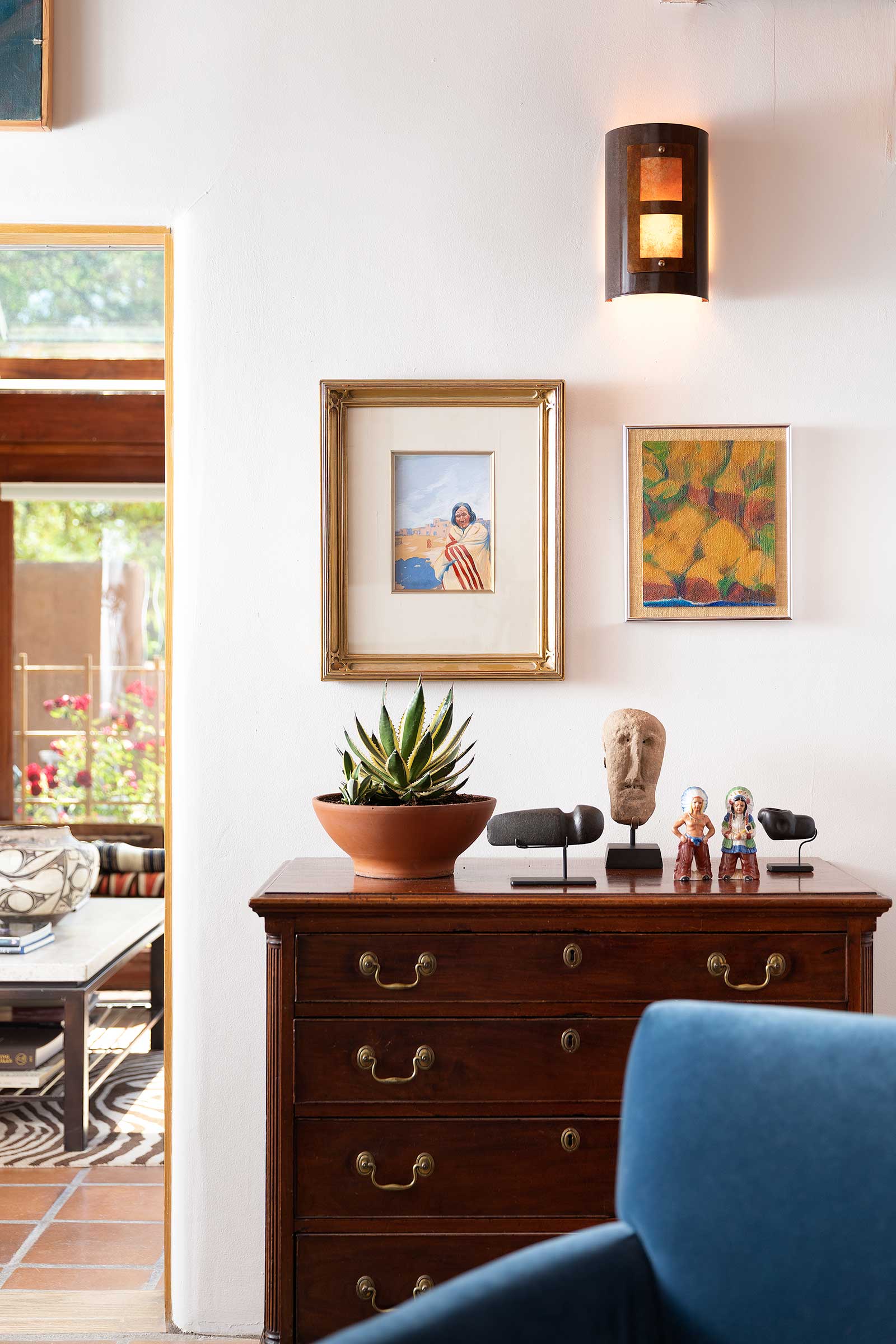 Above the dresser is Taos Pueblo Man with Blanket, gouache on paper, by Oscar E. Berninghaus (1874-1952). Next to it is Coastal Canyons, 1996, oil on canvas, by Robert R. Compton (1922-2015). On the dresser are, left to right, a stone war axe found in Northern Arizona in 1937; a sandstone head of a man found in Mora, New Mexico; two Native figurines from Japan; and a Woodlands slate pipe with bird imagery.
When he decides to take a piece to the shop his spouse will sometimes let him know he’s become attached to it. Scott Cocker is the executive director at Modrall Sperling, an Albuquerque-based law firm and as Compton relates, “he’s more pragmatic than I and sees things in a different way.” The couple will discuss their interest in the piece to decide if it will stay or go off to be treasured by other people.
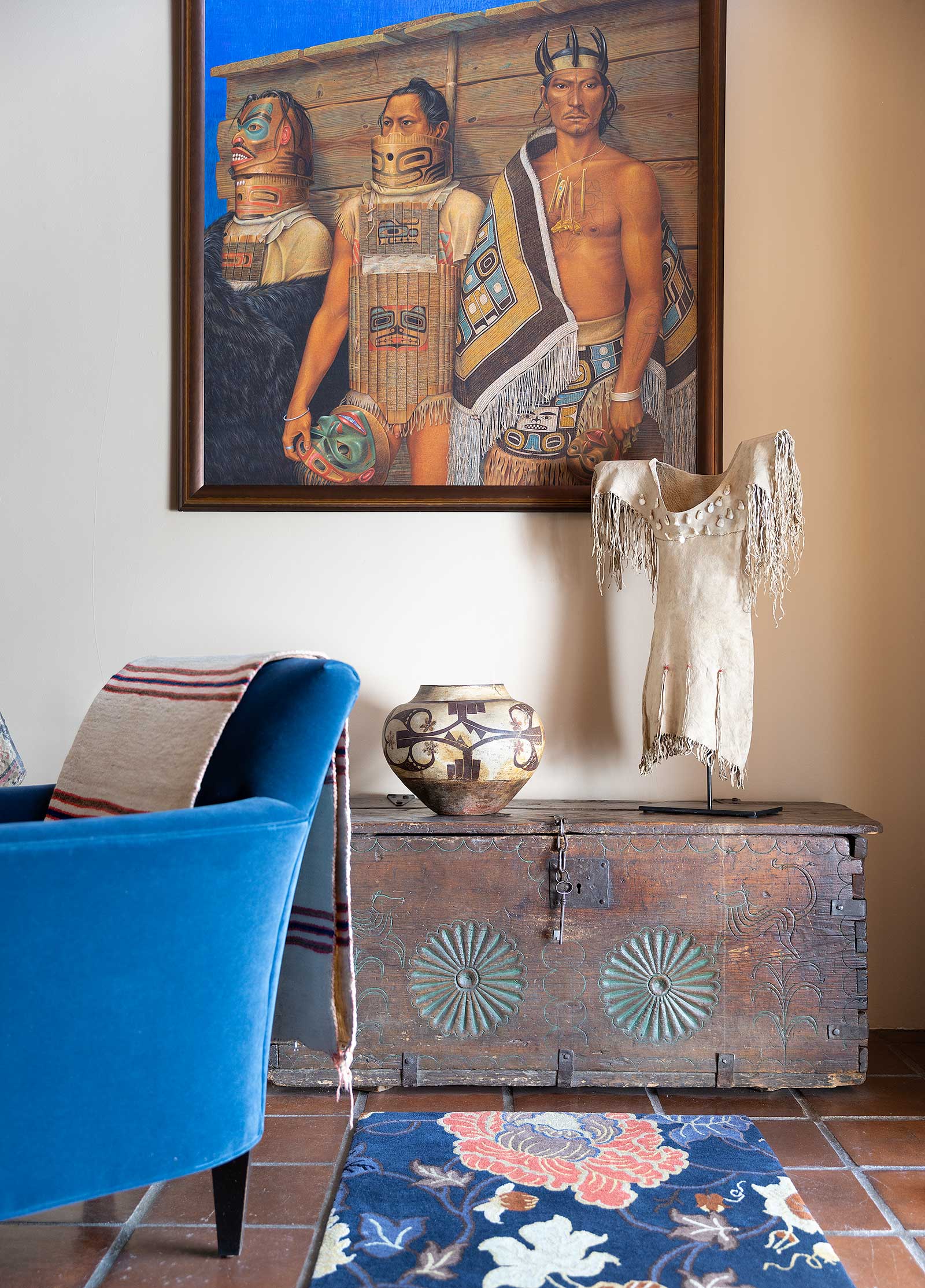 Antoine Tzapoff’s Juste avant la Bataille, Tlingit, 1989, oil on canvas, hangs above a New Mexican Spanish Colonial chest with rosettes, corn stocks and lions, circa 1700. An Acomita or Laguna water jar, circa 1850, sits on the chest next to a Taos or Comanche girl’s dress with elk teeth. A late classic Navajo small blanket, circa 1870, is draped over the back of the chair.
Compton tells his potential clients, “I am particularly interested in connecting with others that find these Native objects to be tools for self-discovery. My collecting has greatly enriched my life with a sense of wonder well beyond the status quo. Collecting has allowed me to look at life in a different way, to examine the relationship between the objects and how I see the world. I look forward to sharing this with you.”
Powered by Froala Editor