A garment, especially one of quality and complexity, has many parts. When considered for more than practical purposes, the creation of clothing can grow into a beautiful and ornate form of art in and of itself. This is what fashion designers do every day. They take fabrics—cotton, silk, suede, velvet, linen, cashmere—and they turn those textiles alchemy-like into pieces of wearable art, imbuing their own passions and self-expression into the very stitches of each piece. Many designers, though immensely talented, may focus primarily on the designs and perhaps one or two other elements, like sewing, ultimately working with other creatives to produce their overall vision.
But Jamie Okuma does it all.
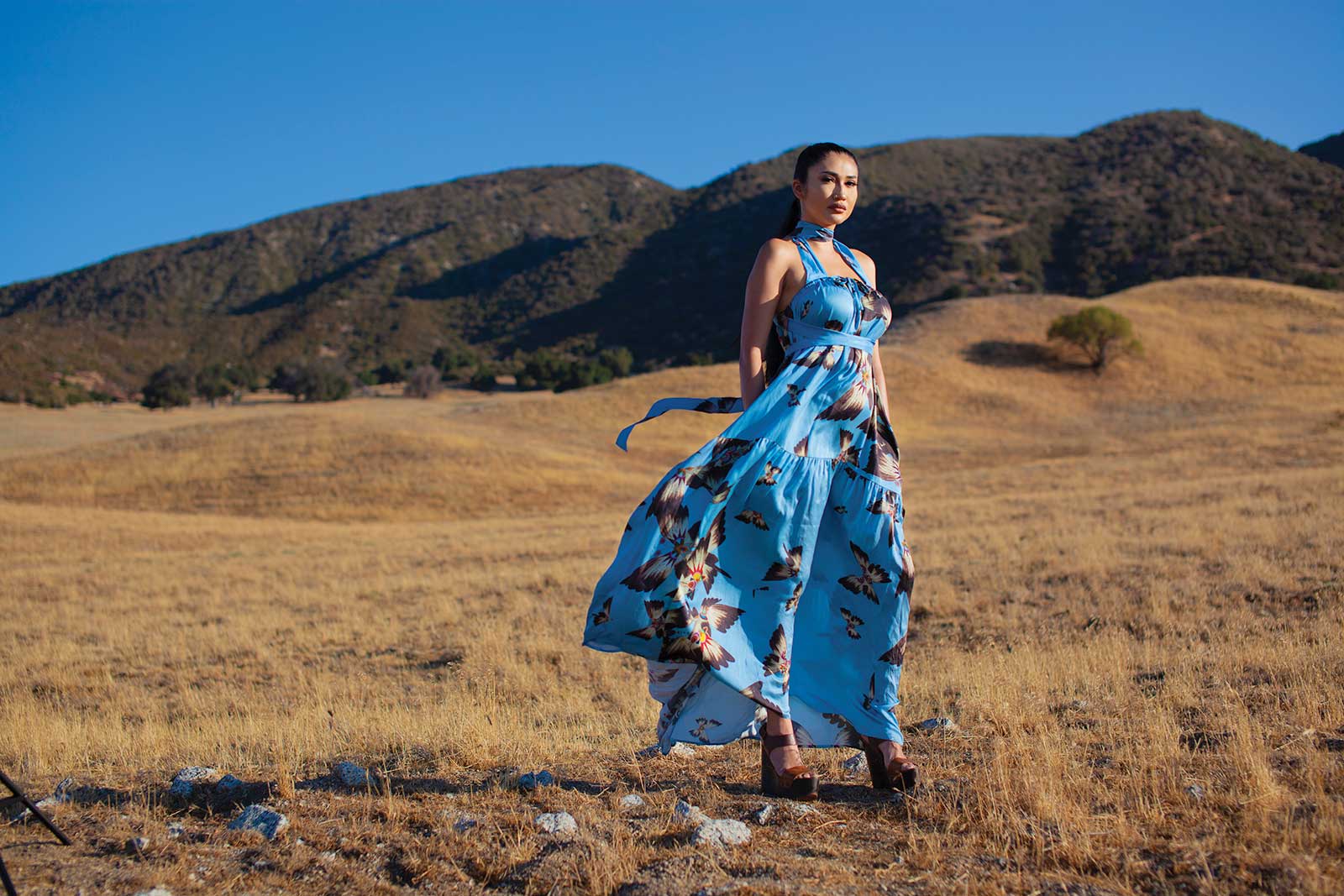 Couture garment | Photographer: Cameron Linton | Model: Nizhoni Wolfe
The artist—of Luiseño, Shoshone-Bannock, Wailaki and Okinawan heritage—labels herself “a fashion artist, because it goes beyond designing.” For all of her couture pieces, Okuma’s hands are part of every last step of the process—the designing, draping, pattern making, sewing, beadwork and more. The only items that don’t carry her direct involvement at every stage, she says, are her ready-to-wear garments, which of course, still implement her original designs and visions.
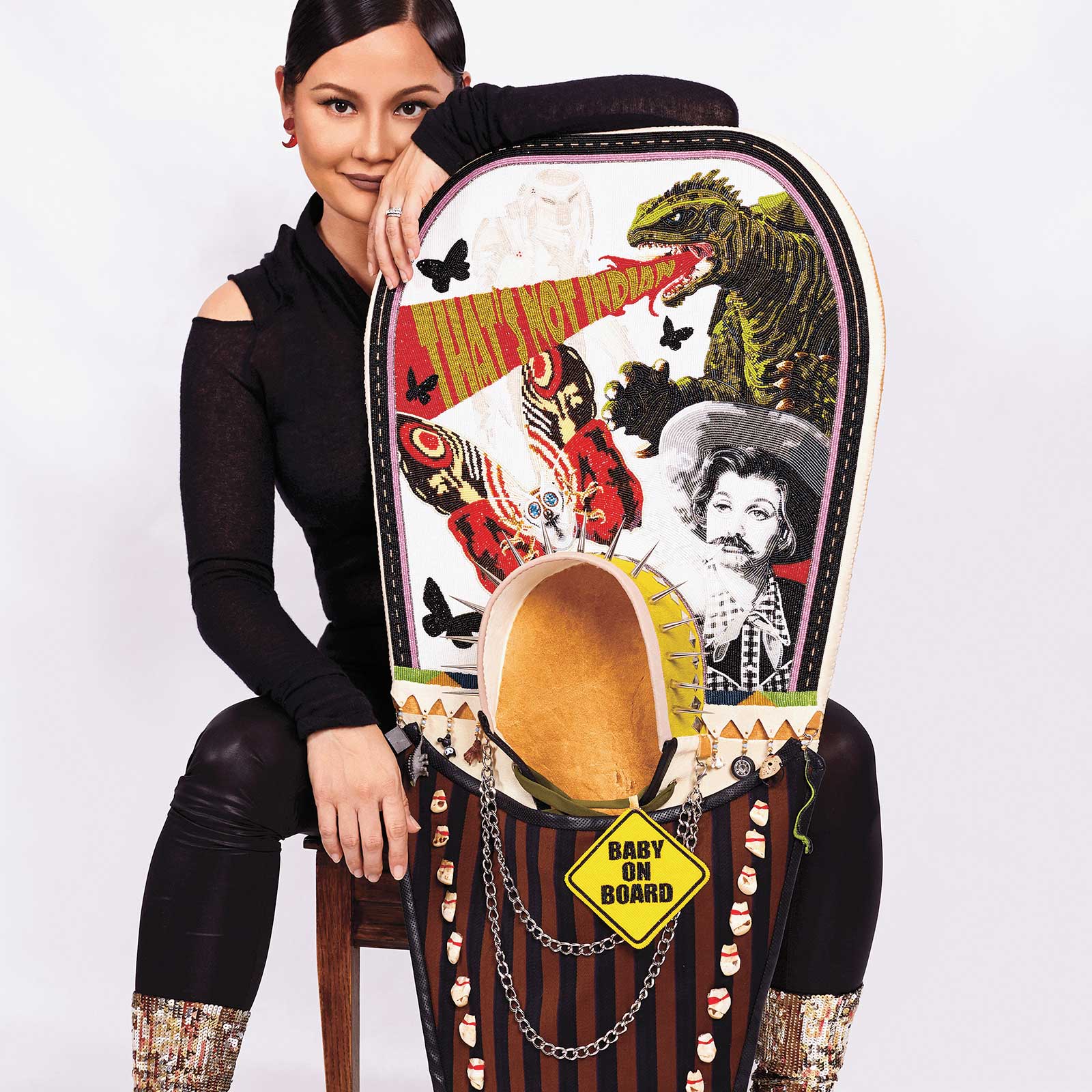 Jamie Okuma with Common Ground: Culture Isn't Black and White, which won Best of Show at the 2020 Heard Museum Guild Indian Fair & Market.
“It’s just something I’ve always done,” Okuma says of her foray into art. “It’s part of my life.” That unabating pull toward the need to create, she explains, is something that is intertwined within her very being. “As a small child, my mom doing what she was doing, and with me wanting to dance, I needed outfits. And that’s how it started.” (Her mother was a graphic artist for the American record label MCA Records.) Okuma was 5 years old when she began learning to bead and sew, observing her mother, but learning entirely on her own through trial and error. “I don’t know any different; it comes very naturally to me,” she adds. The self-taught artist explains that the only formal training she ever received was in jewelry art when she attended the well-known Institute of American Indian Arts (IAIA) in Santa Fe, New Mexico, after studying graphic design at Palomar College in San Marcos, California.
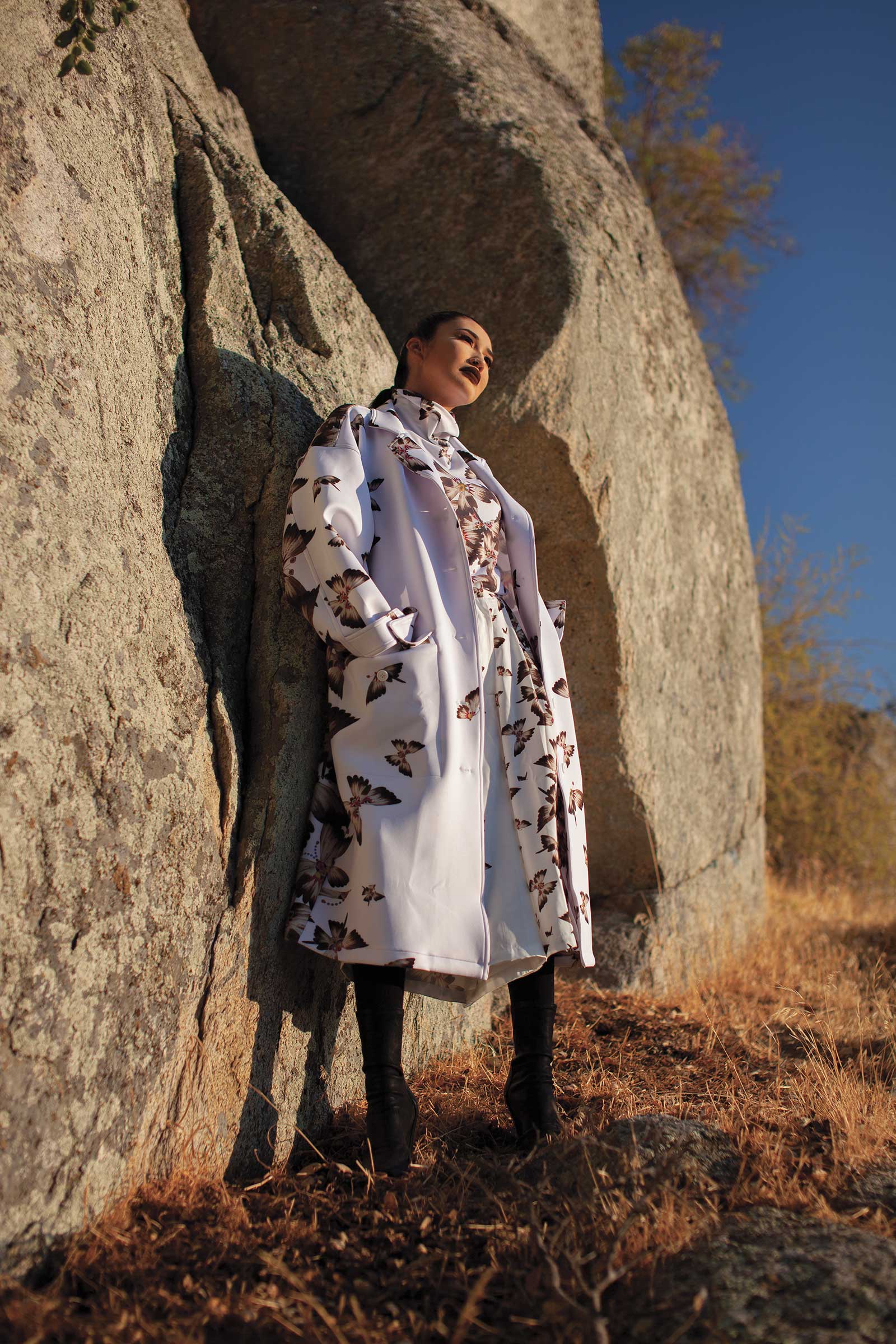 Fall ready-to-wear garment | Photographer: Cameron Linton | Model: Nizhoni Wolfe
“Everything as far as working with my hands with fabric and beads, I need to learn it on my own,” she says. “I don’t like to be told how things should be done, because there’s always more than one way. So I like to figure things out for myself.”
It goes without saying Okuma’s work, especially her chic and sophisticated dresses, are simply stunning. Several of her designs were featured in the SWAIA Indian Market Indigenous Fashion Show this past August. The first six pieces in the show, Okuma explains, were magazine looks that had been featured in major fashion publications from the past year, while the rest were new couture pieces and previews from her ready-to-wear fall collection. Okuma’s work, varied and diverse, has been recognized over and over throughout the years—she’s won Best of Show at Santa Fe Indian Market three times, and a whopping four times at the Heard Museum Guild Indian Fair & Market in Phoenix. She also has work in the permanent collections of the Minneapolis Institute of Art, Nelson-Atkins Museum of Art and Denver Art Museum, as well as the Smithsonian’s National Museum of the American Indian.
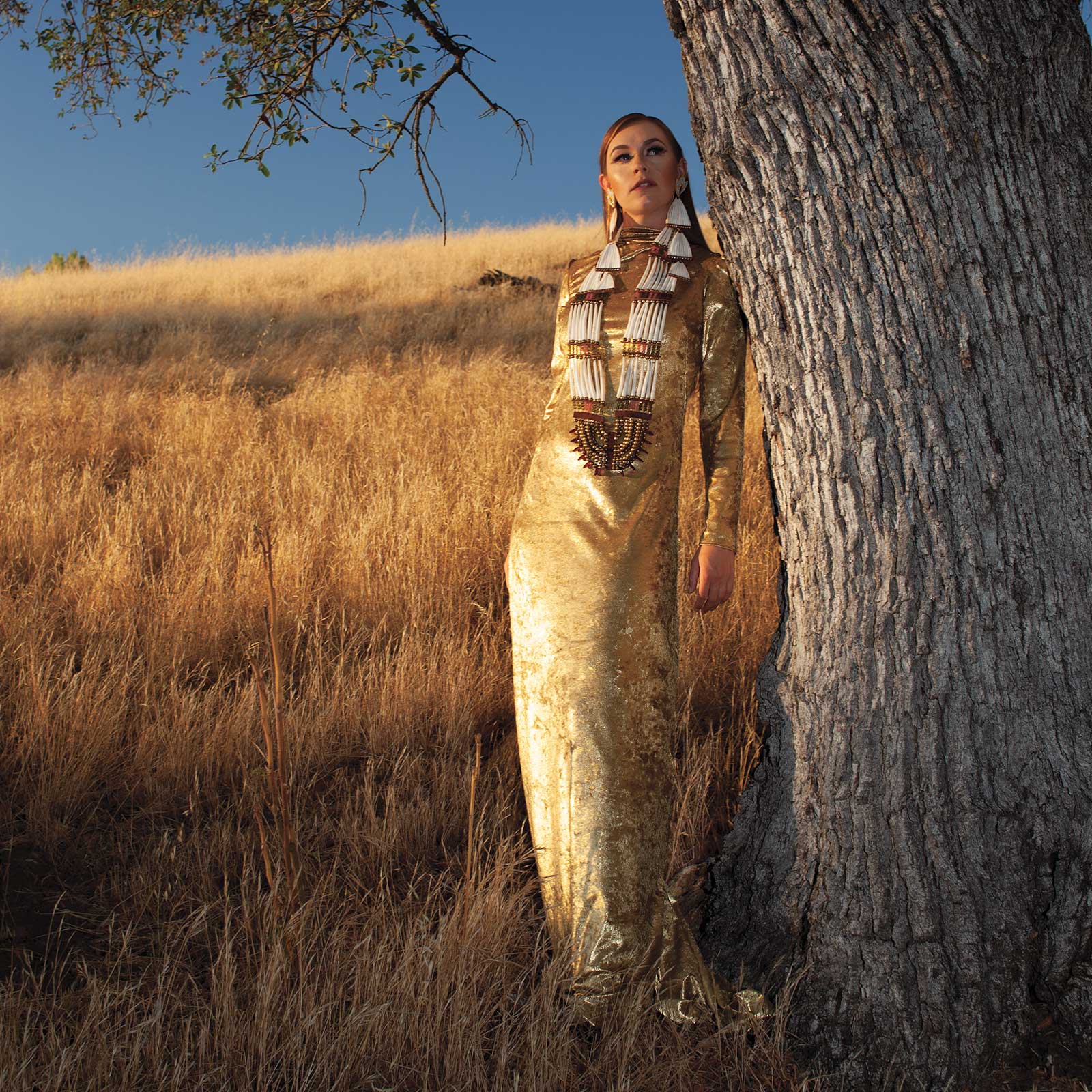 Couture garment | Photographer: Cameron Linton | Model: Corel Taylor
“Nothing and everything” inspire her. “It’s always there. There’s always something I want to be making,” she says. “The designs are always there...Sometimes I feel like I won’t live long enough to do everything
I want to do. It’s more like I’m editing down what I’m doing at any single moment.”
Patterns of shimmering, pearlescent florals are a highlight in several of her more recent couture pieces. A striking black and gold floral dress by the artist feels grandiose and almost larger-than-life as it billows in the wind, illuminated by the warm glow of sunlight during an outdoor photoshoot. On other recent garments, butterflies scatter both organically and with intention across the fabric. One of these looks is a flowy dress of vivid blue with black-and-white butterflies, modeled by Nizhoni Wolfe. The piece, Okuma says, is a one-off that she’s considering expanding into a collection. Another new piece, also modeled by Wolfe, is a white coat of butterflies and part of the artist’s autumn ready-to-wear collection.
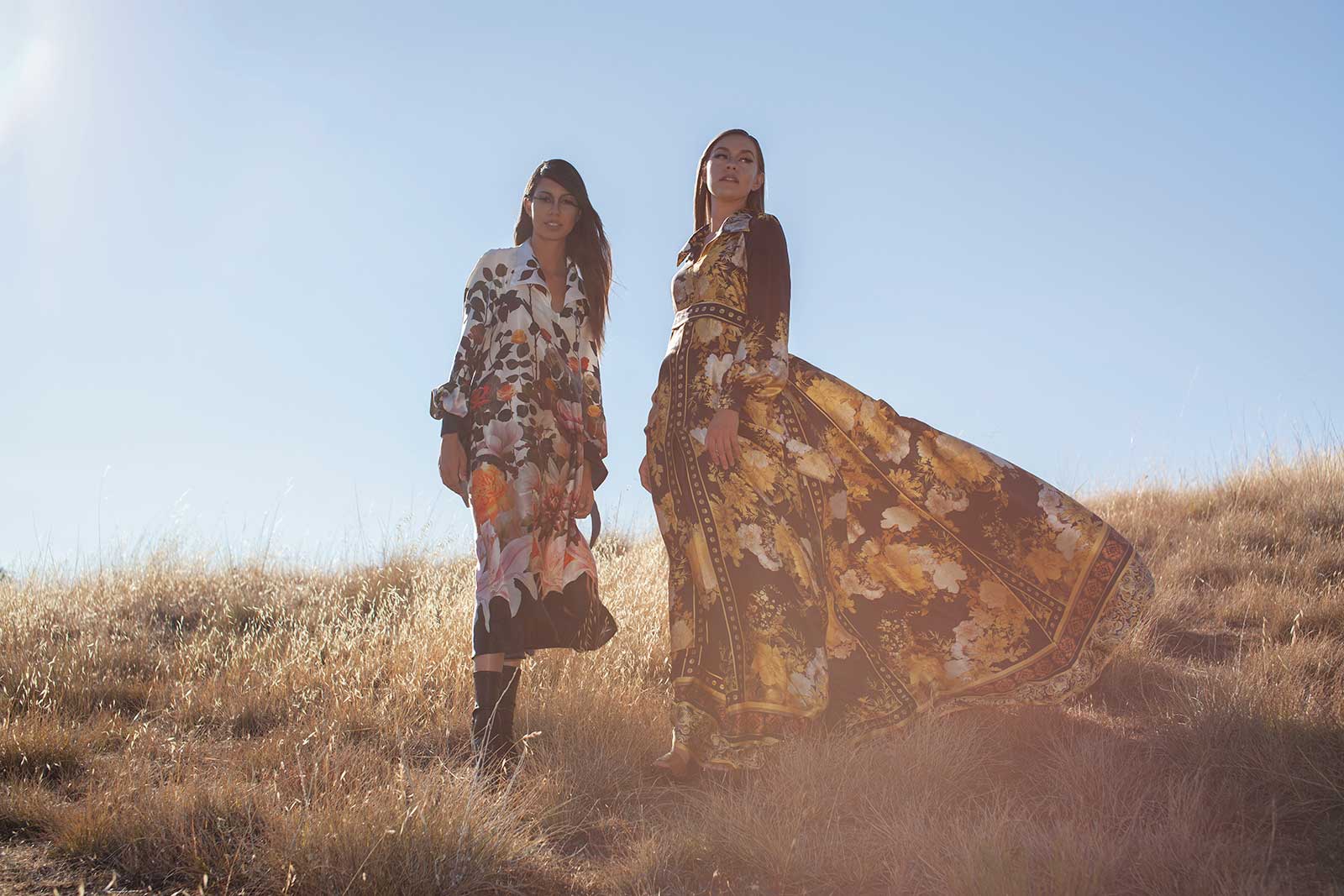 Couture garments | Photographer: Cameron Linton | Models: Neshay Linton (left) and Corel Taylor
“It’s an aesthetic of my tribal regions,” Okuma says of the flower and butterfly patterns. “Traditionally speaking, beadwork has a lot of those elements, so I just carry that over.” She knows that her heritage informs her designs, but not intentionally, she says. Rather, there’s a river of creativity flowing in and out of her all the time, continuous and never ceasing. It simply happens.
“I don’t need to give it a second thought, because it’s just always there.”
Powered by Froala Editor