The year’s offerings in exhibitions of Native American culture contain early observations by curious Europeans in the 19th century as well as expressions of concern for the state of the land by 21st-century artists.
George Catlin (1796-1872) and Karl Bodmer (1809-1893) traveled west to create a pictorial history of the region’s Indigenous peoples. Two exhibitions celebrate their accomplishments.
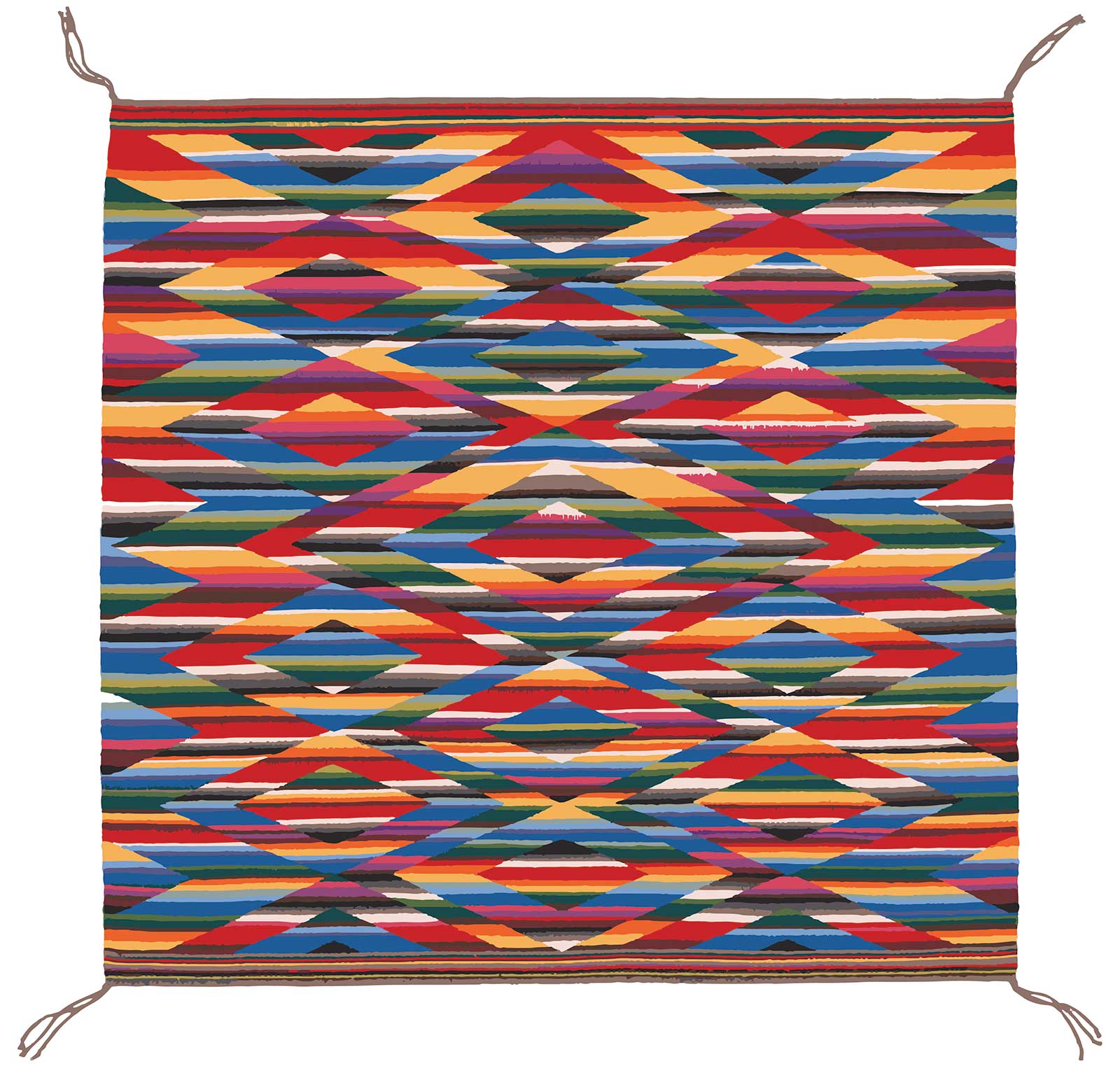 Venancio Francis Aragon (Navajo), Prism of Emotions, 2019, merino/mohair yarns, aniline and natural dyes. Heard Museum Collection. Image: Craig Smith, Courtesy of the Heard Museum. From Color Riot! How Color Changed Navajo Textiles at Montclair Art Museum (See Page 86).
Faces from the Interior: The North American Portraits of Karl Bodmer will be shown at the Joslyn Art Museum in Omaha, Nebraska, October 2 through April 17, 2022. Bodmer’s recently conserved watercolors were produced on an expedition to the northwestern reaches of the Missouri river in 1833-34. The expedition was headed by the German explorer and naturalist Maximilian, Prince of Wied-Neuwied.
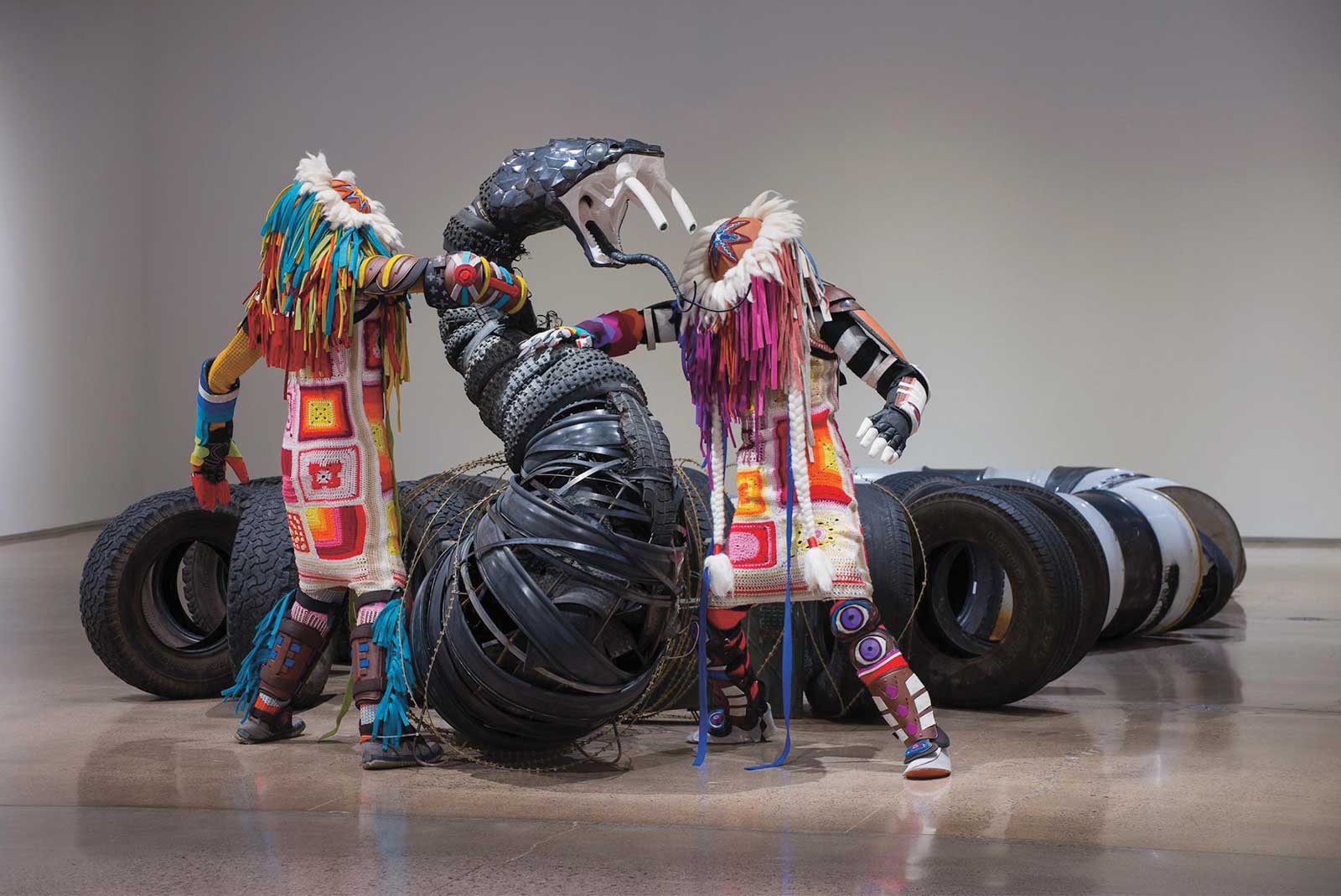 Cannupa Hanska Luger (Mandan/Hidatsa/Arikara/Lokata), This is Not a Snake, 2017-2020, ceramic, fiber, steel, oil drums, concertina wire, ammunition cans, trash and found objects, 78 x 36 x 600”. Image: Craig Smith, Courtesy of the Heard Museum. From Each/Other: Marie Watt and Cannupa Hanska Luger at Peabody Essex Museum.
Catlin produced a portfolio of hand-colored lithographs of his painted portraits in 1844. They are featured in the exhibition George Catlin on Indigenous Land at the Heard Museum in Phoenix.
Contemporary Indigenous art continues in the tradition of historical media and expands into mixed media, photography, printmaking and assemblage.
The tradition of weaving has evolved and is celebrated in the exhibition Color Riot! How Color Changed Navajo Textiles at the Montclair Art Museum in New Jersey, through January 22, 2022. The museum notes, “Change has always been a hallmark of Navajo (Diné) textile design, with weavers’ individualism a running thread. With Diné perspectives and the technical mastery of weavers at the heart of Color Riot!, this exhibition—featuring 70 bold artworks from 1860 to 1930 and the present —celebrates the courage and vision to experiment.”
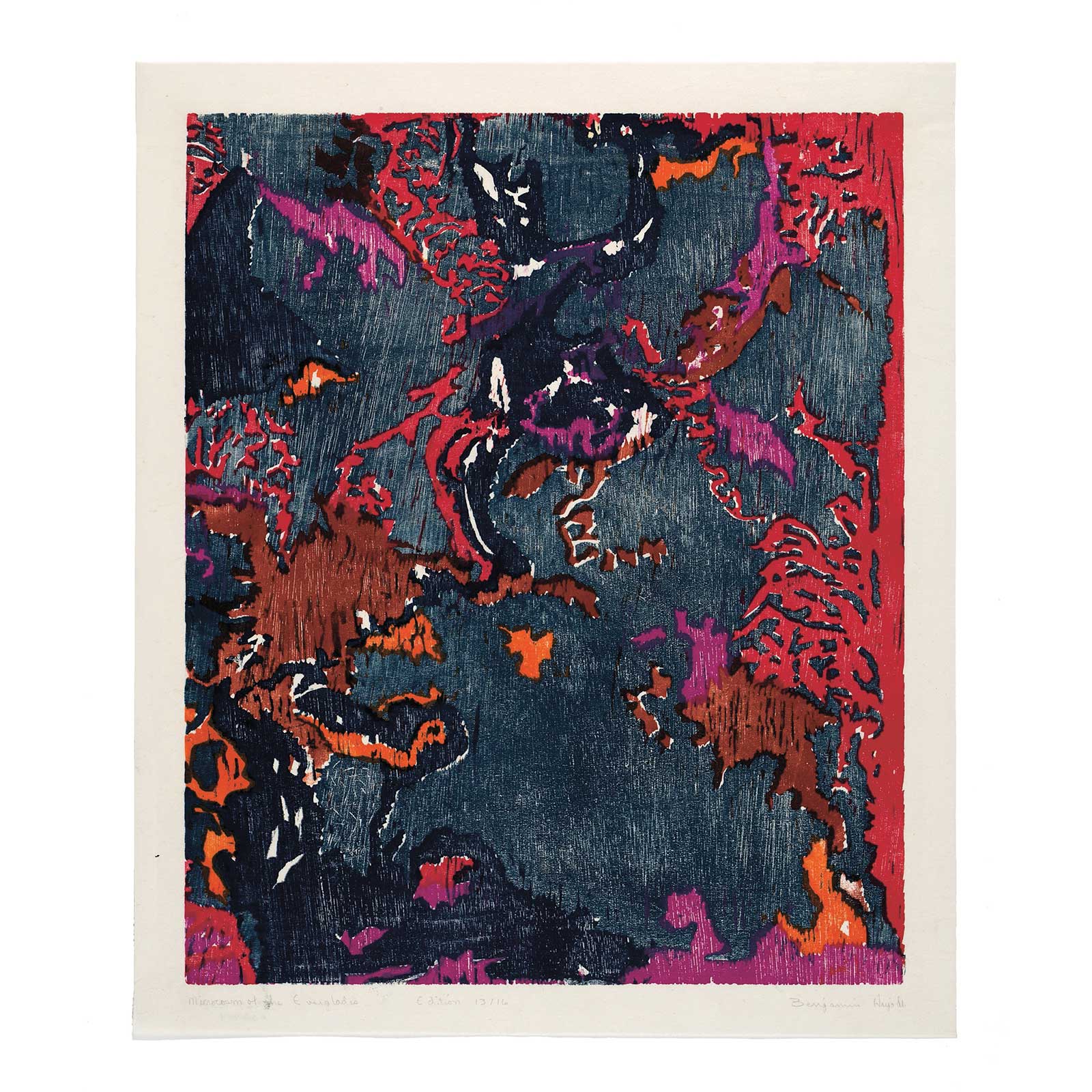 Benjamin Harjo (Seminole/Shawnee), Microcosm of the Everglades, ca. 1965, woodblocks, 16 x 19". From Experimental exPRESSion: Printmaking at IAIA, 1963-1980 at the Museum of Contemporary Native Arts (IAIA).
The Museum of Contemporary Native Art of the IAIA in Santa Fe, New Mexico, explores a different medium in Experimental exPRESSion: Printmaking at IAIA, 1963-1980 on display through February 20, 2022. Drawn from the Tubis Print Collection, “This exhibition celebrates the experimentation of IAIA students during the first two decades of the Contemporary Native Art Movement. The variety of works on paper on exhibit is a testament to the progressive arts education program in graphic arts,” IAIA archivist and exhibit co-curator Ryan S. Flahive, explains.
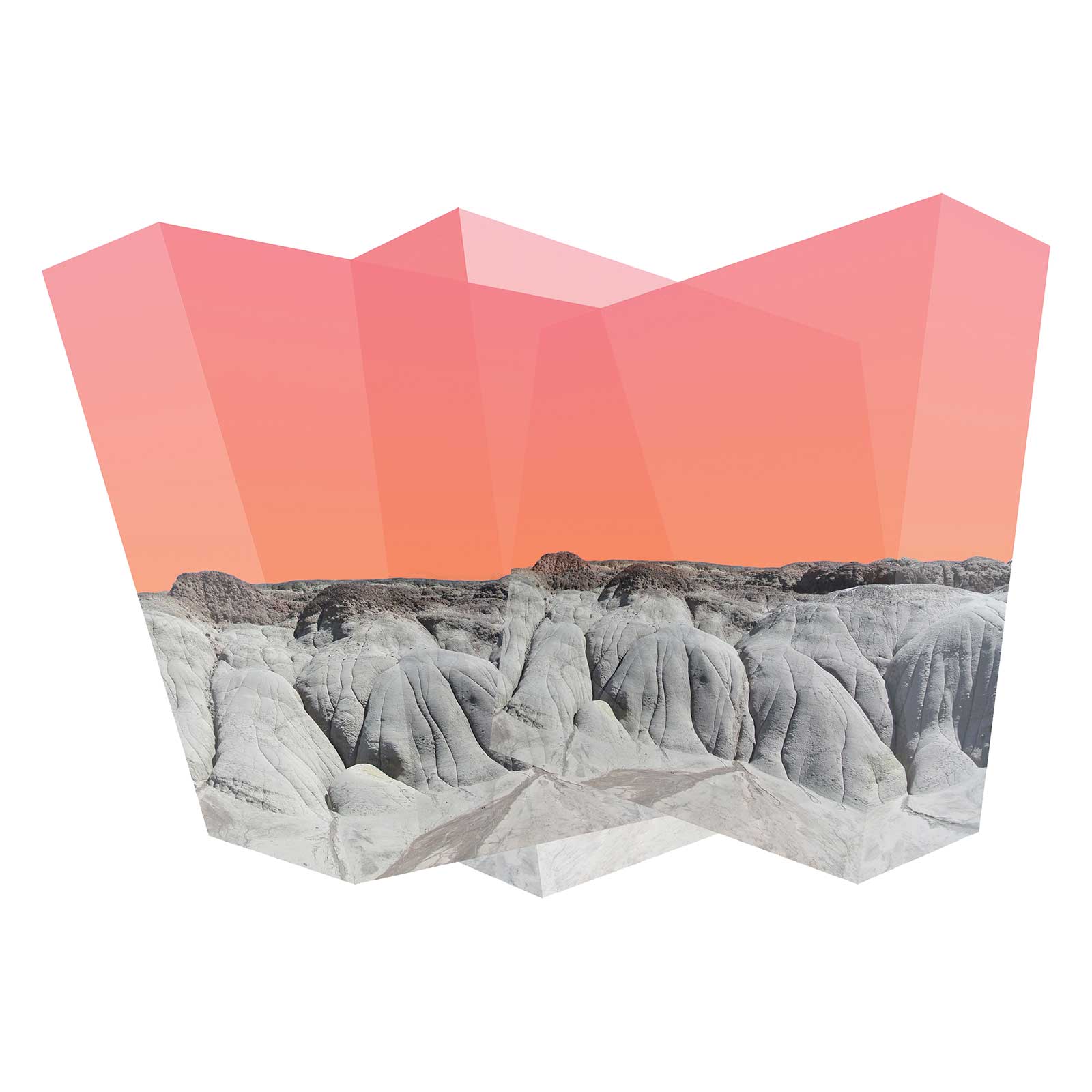 Michael Namingha (Tewa/Hopi), Altered Landscape #11, 2020, digital C-print face mounted to shaped acrylic, 40 x 26 x 1". From Michael Namingha: Altered Landscapes continues at El Paso Art Museum.
At the Peabody Essex Museum in Salem, Massachusetts, Each/Other: Marie Watt and Cannupa Hanska Luger features the work of Watt and Luger, “two leading Indigenous contemporary artists whose processes focus on collaborative artmaking, community engagement, materials and the land. Each/Other features 26 mixed media sculptures, wall hangings and large-scale installation works by Watt (Seneca/Scottish/German) and Luger (Mandan/Hidatsa/Arikara/Lakota/European.”
Michael Namingha: Altered Landscapes continues at the El Paso Art Museum in Texas, through January 2, 2022. Namingha (Tewa/Hopi) explains that his altered photographs are “composed to provide the viewer with an abstracted composition. The pieces are digital chromogenic prints face-mounted to shaped Plexiglas. The shaped aspect of my compositions creates a three-dimensional effect out of a two-dimensional object, removing photography from the confines of a rectangle or a square.” The photographs “address the environmental impact of the oil industry around New Mexico’s Chaco Canyon, a national historic park sacred to the ancestral Puebloans; and the Black Place, Navajo Nation’s Bisti/De-Na-Zin Wilderness,” according to the museum. “While other artists deal with these themes head-on, Namingha’s work is in contrast non-confrontational, even quiet, inviting viewers to contemplate the devastating effects of the oil and gas industries on ancestral lands.”
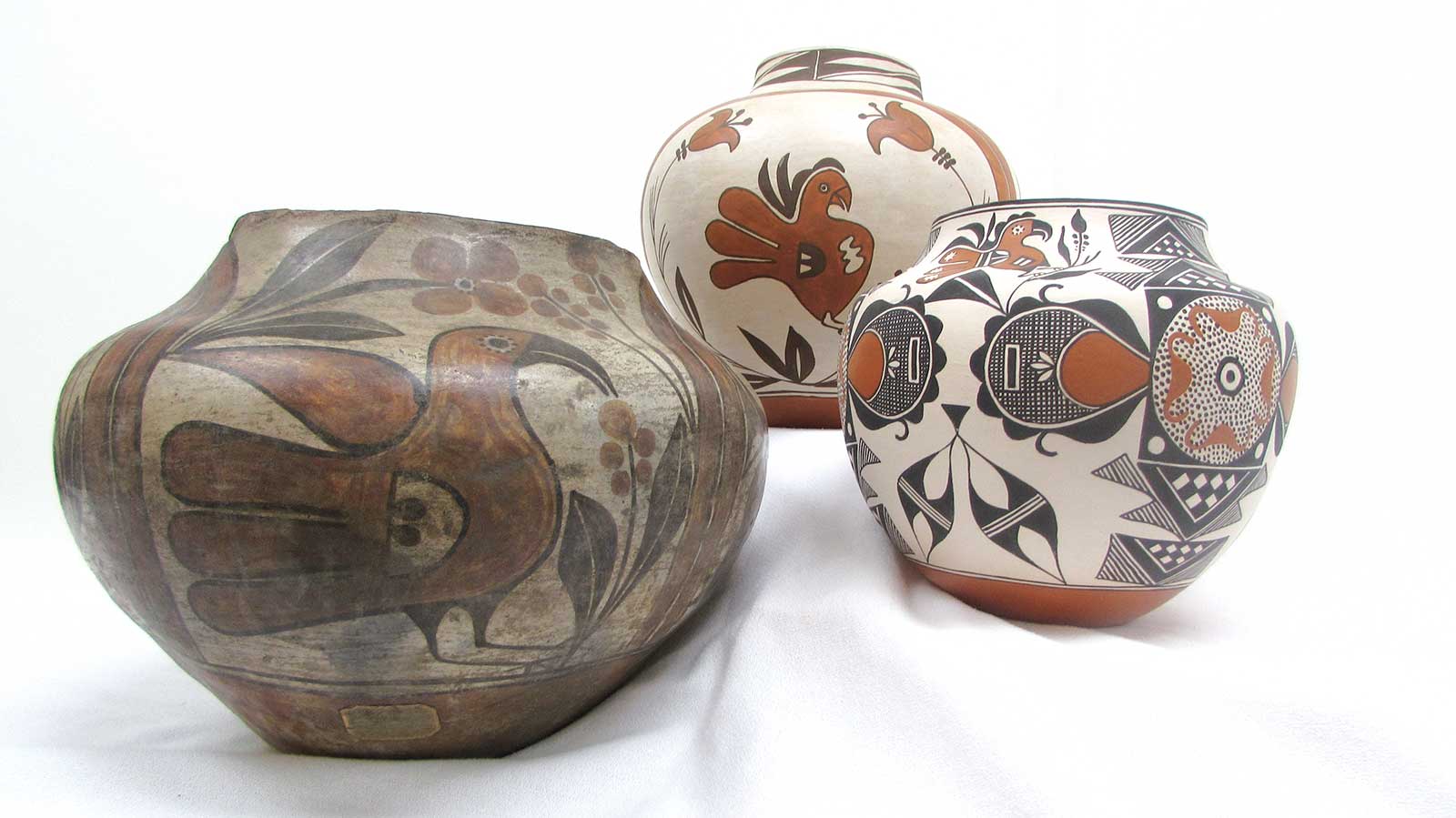 Examples of parrot depictions on Pueblo pottery. From Exotic Parrots in the Desert Southwest at Millicent Rogers Museum.
Private collections continue to feature in museum exhibitions.
Art of Native America: The Charles and Valerie Diker Collection continues at the Metropolitan Museum of Art in New York. The museum notes, “This long-term installation consists primarily of promised gifts, donations, and loans from the major collectors Charles and Valerie Diker as well as other patrons. Their belief in the power of these works to broaden historical, cultural, and aesthetic understandings inspired their generosity. The presentation marks the commitment of the American Wing, established in 1924, to foregrounding Native cultural expressions and perspectives in meaningful, inclusive contexts.”
Canvas of Clay: Hopi Pottery Masterworks from The Allan and Judith Cooke Collection continues at Western Spirit: Scottsdale’s Museum of the West in Arizona. The museum notes, “On exhibit for the first time, more than 65 of the finest examples of Hopi pottery are from The Allan and Judith Cooke Collection. A gift to the museum, this exhibition celebrates six centuries of the Hopi people and culture, whose tribal land lies in northern Arizona.”
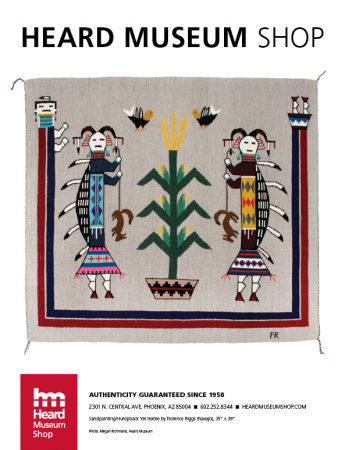
The Heard Museum in Phenix opens the exhibition Toward the Morning Sun: Navajo Pictorial Textiles from the Jean-Paul and Rebecca Valette Collection on November 5. The museum notes, “The 2018 gift to the museum from Jean-Paul and Rebecca M. Valette of their acclaimed collection includes textiles primarily woven during the first three decades of the 20th century. The Valettes spent nearly 40 years collecting and researching the origins and history of these textiles. In many instances, the Valettes’ in-depth research developed valuable biographical information about the weavers.”
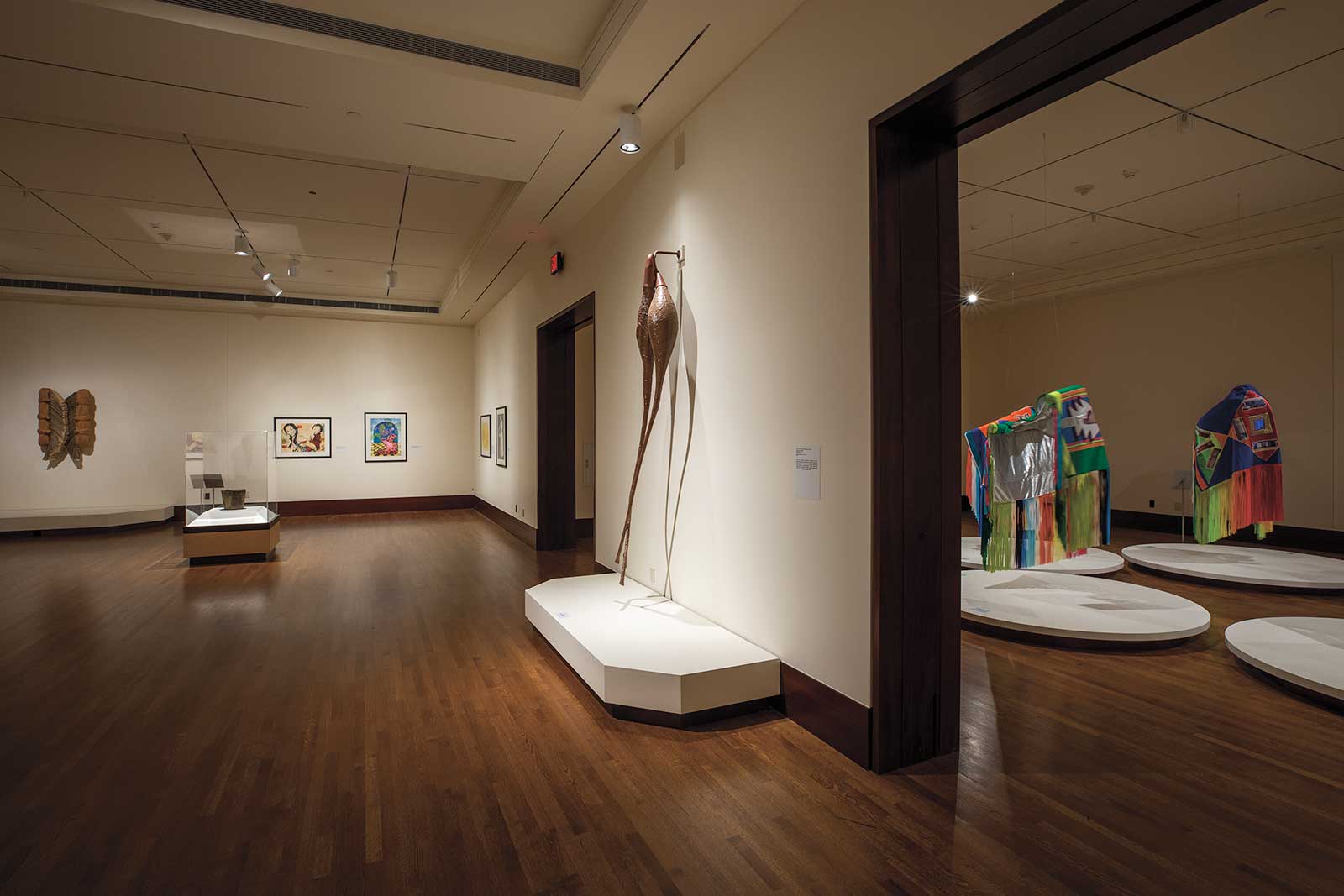 Gallery view of Powerful Women II: Contemporary Art from the Eiteljorg Collection at the Eiteljorg Museum (See Page 102).
Joseph Henry Sharp (1859-1944) traveled west from Ohio in 1889. From 1902 to 1910 he lived on the Crow Agency in Montana. He took reference photographs of the local people, a practice he continued after moving to Taos, New Mexico. The Joseph Henry Sharp Photograph Collection includes approximately 2,972 photographs, negatives, glass sides and ephemera. The C.M. Russell Museum in Great Falls, Montana, will show Through the Lens of Joseph Henry Sharp beginning in the summer of 2022.
Powered by Froala Editor