For the past 50 years, I have been privileged to work with Navajo weavers and witness dramatic changes in the art form.
One major reason has been the disappearance of the trading post as the primary source for goods and services on the reservation. Another has been the manner in which weavers responded to the new market.
This is the story of one family, but it has been repeated many times across the Navajo Nation.
In the early days, the weavers, because of geography and the difficulty of travel, were most likely to sell their weavings at the closest trading posts. These trading posts began to disappear in the late 1960s and early ’70s. This, combined with the arrival of auto financing and pickup trucks capable of traveling reservation roads to get to the highways, made it possible for weavers to travel longer distances to sell their work.
They began to drive to Durango and other off-reservation towns including Gallup, Sedona, Phoenix, Albuquerque and Farmington to sell their rugs. The Navajo weaver was no longer tied to the designs preferred by the local trader.
This is not a negative statement about the trading posts. Traders had to sell these weavings and they knew what sold for them. It was logical that they would pay more to the weavers whose designs they could sell.
Back in the late 1970s, I was working in my father’s Navajo rug showroom in the front of the Pepsi Cola building in Durango, Colorado, about an hour north of the Navajo Reservation. Initially, he obtained most of the rugs we sold through the trading posts.
We then sold them to national park stores, Indian arts and craft stores and museum shops.
In the late ’60s, Anna Mae Barber, from Burnham, New Mexico, began bringing her weavings to my father in Durango. He always included a case of Pepsi in the purchase price. To most of the weavers on the Northern Navajo Reservation, he was known as “The Pepsi Man.”
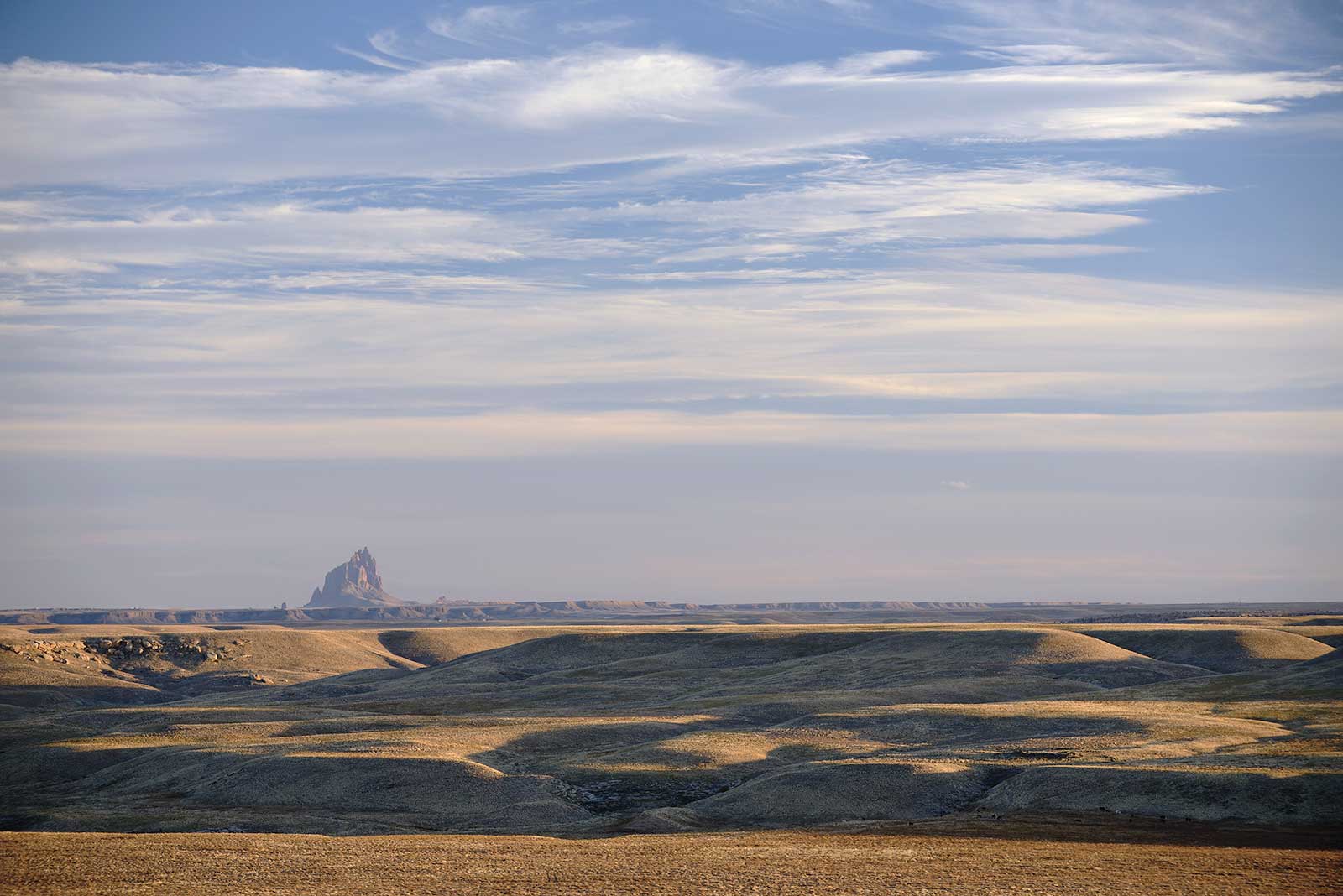
The Burnham Chapter Area is directly to the east of the Two Grey Hills/Toadlena area which is famous for Two Grey Hills rugs. To the north of the area is Shiprock, the traditional home of the Yei and Yeibichai style of weaving. Most weavings made in the Burnham area reflected those two styles.
Anna Mae was the oldest of the five Begay sisters. The others were Marie, Alice, Helen and Sandy. When their mother died, Anna Mae and Marie, the second eldest, took on the raising of the others. Both of these women were weavers. The younger three were not “taught” to weave.
The process of learning to weave for most Navajo families is different than the usual process of learning a skill in the Anglo culture. A child is not made to sit down and follow specific instructions on how to weave a rug, as many of us learned (or our mothers wished we had learned) to play the piano. Rather, if a child showed an interest in weaving, the mother or grandmother would set up a small loom for them and let them try, providing help as asked. Teaching is showing and learning is watching, but as you can imagine, particularly with competition from television and cell phones, most young people today do not have that interest or patience.
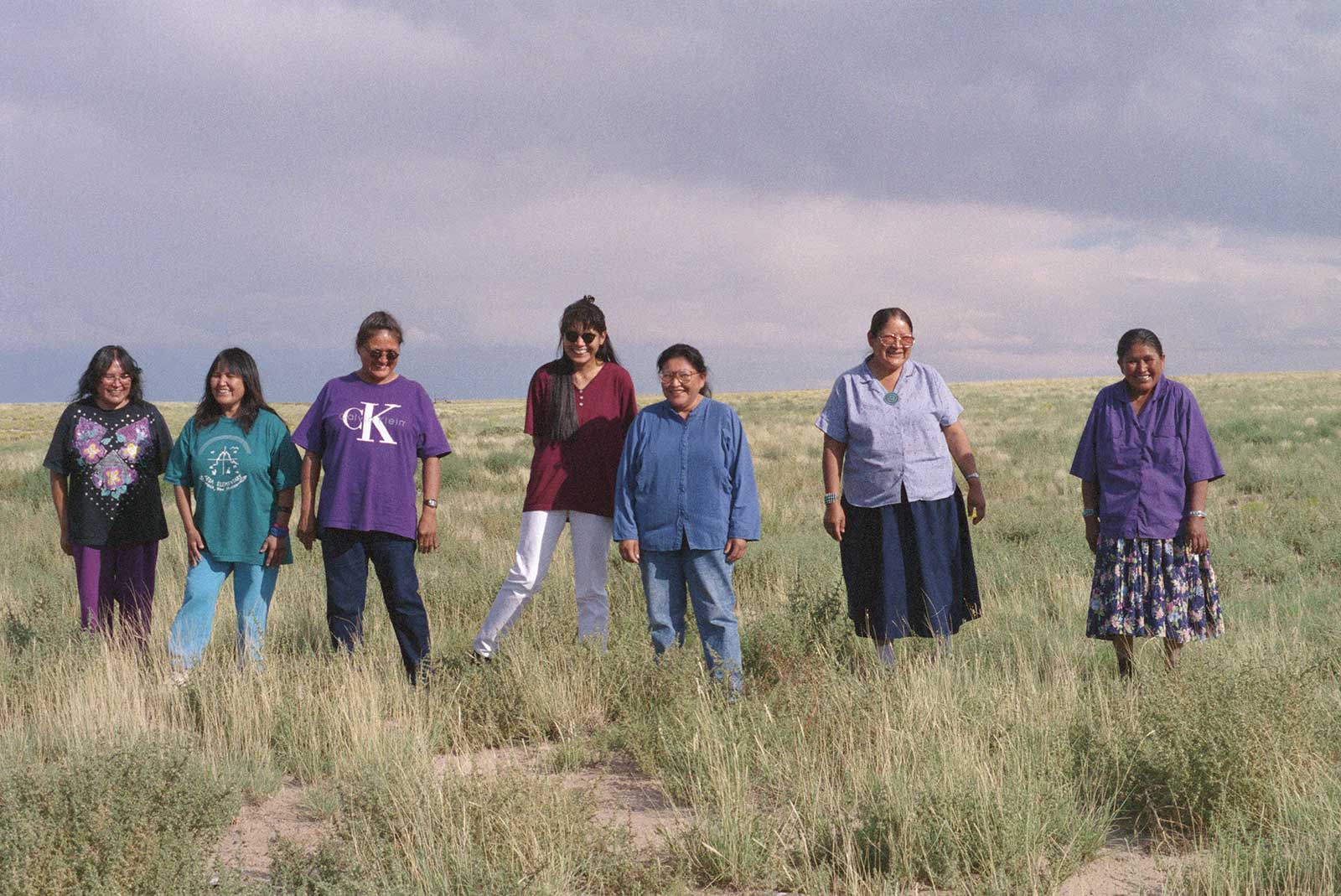 The Begay family: Alice, left, Sandy, Helen, Teresa, Lorene, Marie and Anna Mae in 1998.
The three younger sisters were sent to boarding school. At home during the summers they always saw their older sisters weaving. I have never been, in over 40 years, to Marie’s home when she did not have a loom set up. It was the same with Anna Mae. Until she passed, she wove daily. She had her loom set up at the foot of her bed where she could get to it easily. Alice says, “I wish I had learned to weave earlier, but I never started until I got out of boarding school. I just wasn’t interested.”
When Alice did start, with help from Anna Mae and Marie in setting up the loom and with wool they provided, she discovered a desire to create art, to make something special. “Anna Mae and Marie always wove Two Grey Hills and Yeibichai,” said Alice. “I wanted to do something different.” What Alice did was to take patterns and designs from different weaving areas and add pictorial elements. Her weavings were precise and very finely woven.
Helen went to business school in Albuquerque after attending boarding school, and when she rode the bus back to Burnham at Thanksgiving, she made the decision not to return but to become a weaver. Influenced by Alice, she also adopted the use of multiple patterns and added some of her own unique twists, such as the shadow. “I was at a Yeibichai ceremony,” Helen says, “and when the dancers walked between the fire and the hogan, I saw their shadows on the wall and thought, I can weave that.”
Alice, at the Navajo Nation Fair, saw women carrying their rugs, draped over their forearms to be judged. She decided they could weave that picture into a rug. Sandy, the youngest sister, saw a young couple, walking together arm in arm and decided that could be part of her weaving.
It wasn’t long before Marie and Anna Mae started weaving rugs that included new designs and patterns, although neither of them ever took it to the level of their younger sisters. Marie’s daughter, Teresa, when she was 18, was creating geometric patterns that were unique and different from her mom. Teresa’s sister, Julia, wove similar rugs and mailed them to me from her dorm room at the University of New Mexico.
Anna Mae’s daughters, Laverne, Betsy and Lorene, followed their aunts’ examples.
For several years, we tried to enter weavings by this Burnham family at the Gallup Intertribal Indian Ceremonial. But the rugs were not allowed in the judging as they did not fit into a specific category such as Storm Patterns or Two Grey Hills. Eventually, a category for natural hand-spun wool was established and, since most of these weavings by the family were made with hand-spun Churro wool, they qualified.
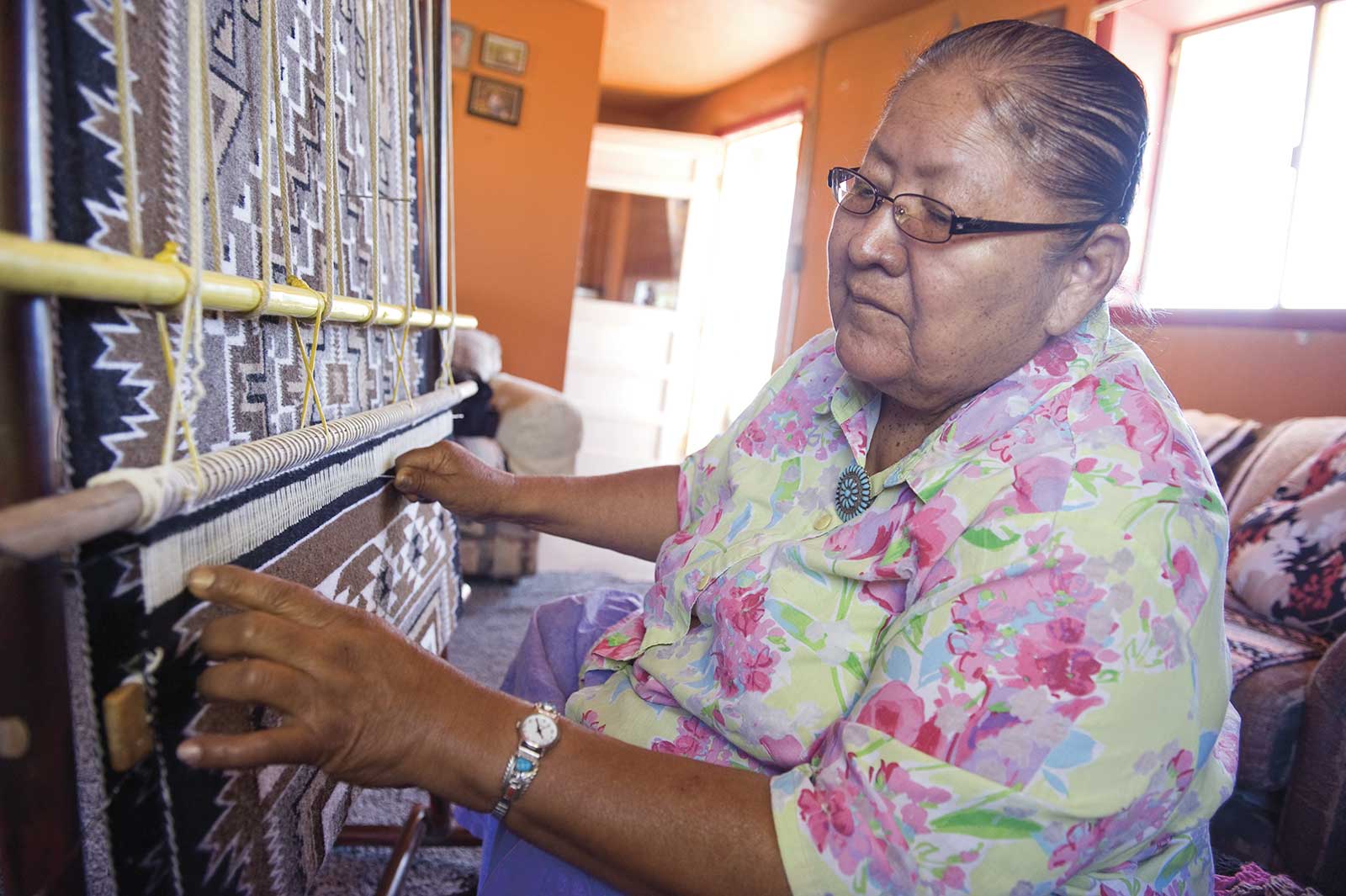 Marie Begay at her loom in Burnham, New Mexico.
That year, in the mid ’80s, Alice’s weaving won a blue ribbon and it was displayed prominently in the exhibit hall. For the four days of the Ceremonial, Navajo weavers stopped and looked at the weaving, basically forming an ever-changing half circle around it. Alice’s weaving was beautiful and it was different. I believe this rug led to a trend in Navajo weaving, which encouraged Navajo weavers to move to more individual patterns.
The first Burnham weaver I worked with was Helen Begay. She brought her weaving to Durango.
I remember my initial reaction when she unrolled it.
I asked, “What kind of rug is it?”
She replied, “It’s a Helen Begay rug and it’s not going to cost you a lot, but later, they are going to cost you a lot.” She was right.
It was a beautifully woven rug, with design elements from Two Grey Hills, Chinle, Storm patterns and Yeis. It had a border on three sides. I loved it.
“Have you made a rug like this before?’ I asked.
“I made one,” she answered, “but I took it to the Crown Point Auction and it only sold for $200, so
I decided to bring it up here.”
That day changed a couple of things for our business. Until then, we had sold Two Grey Hills, Ganado, Yei’s and other regional rugs. When my dad came back from lunch, I said, “We are doing this wrong. We should be selling Helen Begay and Mae Jim and Esther Harvey rugs instead of the style.” He got it immediately.
We had always attributed the weavings to the weaver, but we didn’t market them that way. About this time, many other dealers in Navajo weaving began to do the same thing. When you see pieces made prior to the 1970s, the owners seldom kept the weaver’s name. That has changed.
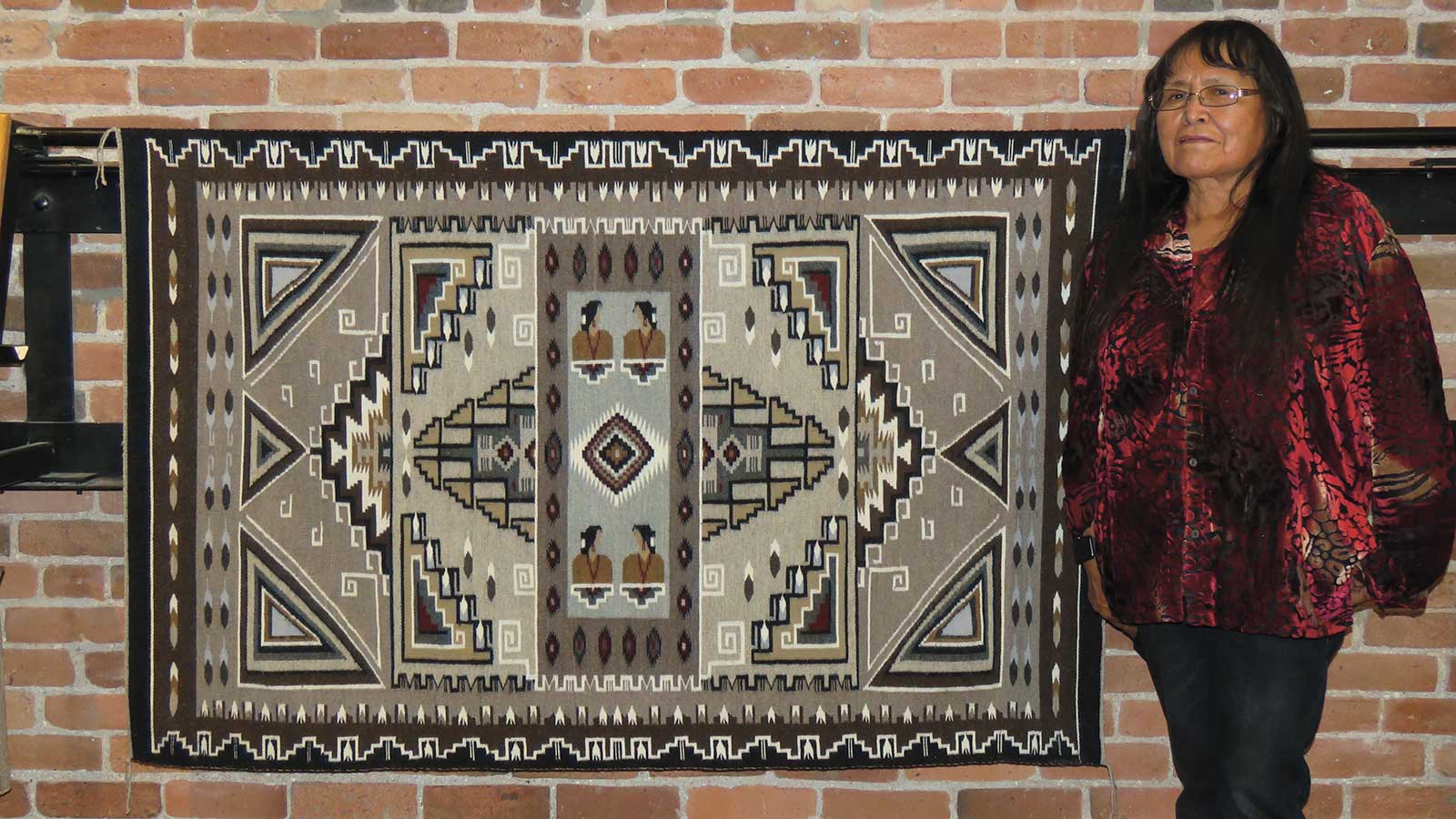 Sandy Begay with one of her new weavings.
Secondly, it made me start to think about the importance of individual artistry. I thought how exciting it must be for a weaver to be so creative. Something I have learned from these weavers is that the act of creating is more important than owning those creations.
Their weaving continues to change. Some of the family are still working at their looms while others have moved on to different lives.
This coming spring 2022, Marie and her family are being featured in a digital exhibition of Navajo weaving that is based on the textile collections of the American Museum of Natural History in New York.
Marie’s oldest daughter, Teresa, graduated from San Juan College in Farmington, New Mexico. She has been an accountant with the Navajo Agricultural Product Industries for two decades. She no longer weaves. Her sister Julia graduated from the University of New Mexico and works in a medical lab in Farmington. She no longer weaves. The youngest sister, Shawda, lives with and cares for her parents. She never took up weaving.
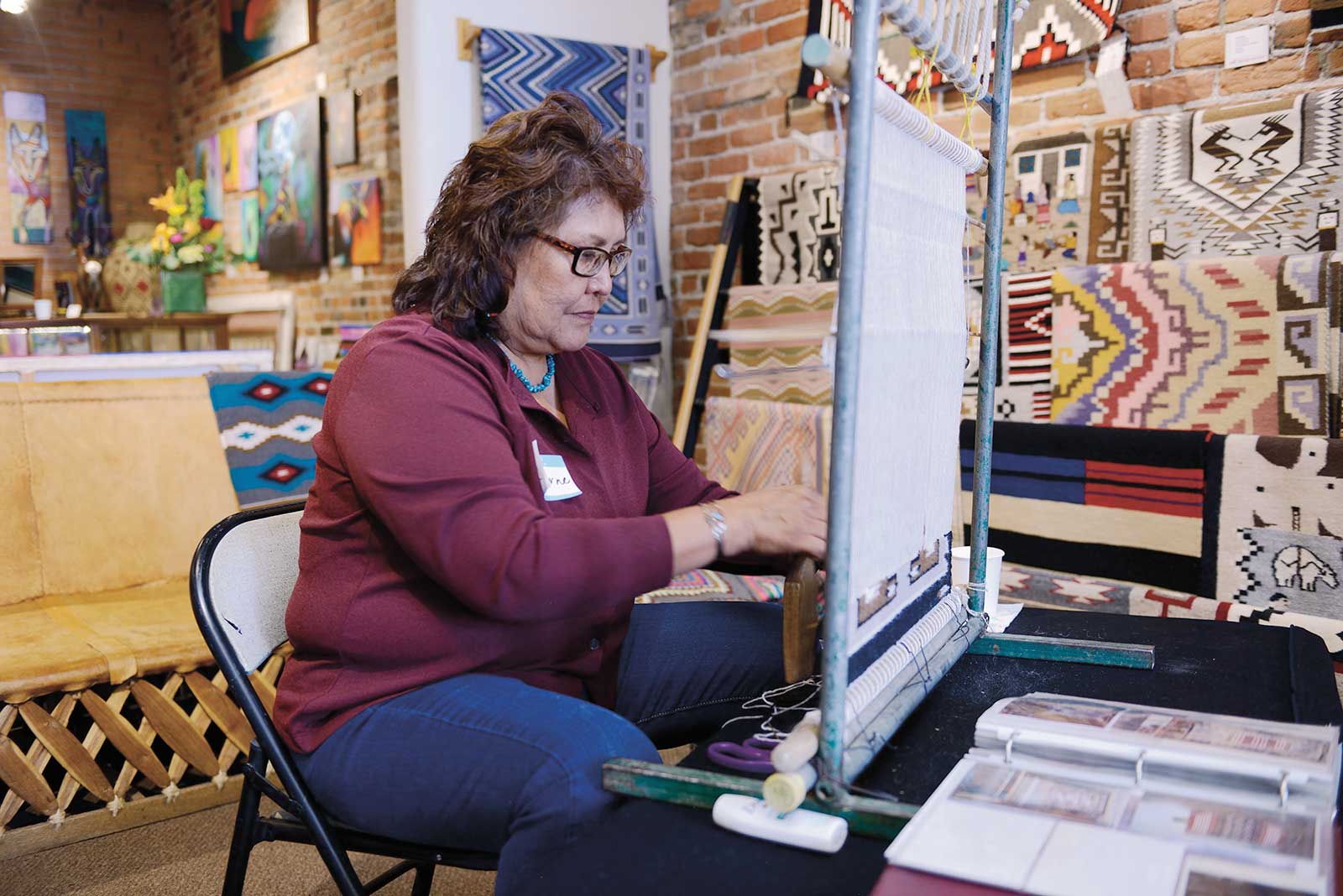 Laverne Barber, Anna Mae Barber’s daughter, weaves at her loom.
Alice and Sandy continue to weave as do their daughters Bernal and Ursula. Alice’s son, Kyle, is also a weaver. Anna Mae’s three daughters, Lori, Laverne and Betsy, are all weavers. Many cousins have adopted the “style” as well.
These women occasionally weave a smaller piece which they take to the Crownpoint Rug Auction. It’s a fun time and they get to visit with other weavers. Unlike the first time Helen took one of her pieces to Crownpoint, they always sell for good prices.
In the old days, the weavers would simply show up at our gallery with rugs. Later, with the advent of cell phones, they called before they came. A couple of weeks ago, I got a text from Laverne with the picture of a weaving. It was beautiful, and looked like half of a traditional pattern.
I texted her back, asking, “Where is the other half?”
She immediately responded, “It’s art, Jackson!”
One summer, Helen was working part time in our gallery demonstrating weaving. She came up from her home in the Navajo Nation when it was convenient for her. The weaving she was working on was beautiful.
One day, Helen’s boyfriend called and told me that their trailer had been destroyed in a fire. Her daughter was fine, but everything else was lost. I went down to the gallery and told Helen. She listened and turned back to the loom, continuing her weaving. I told her, “Helen, I think you need to go. Wayne said Chastity was upset and needs you.” She packed up her things and said that she would see me in a few days.
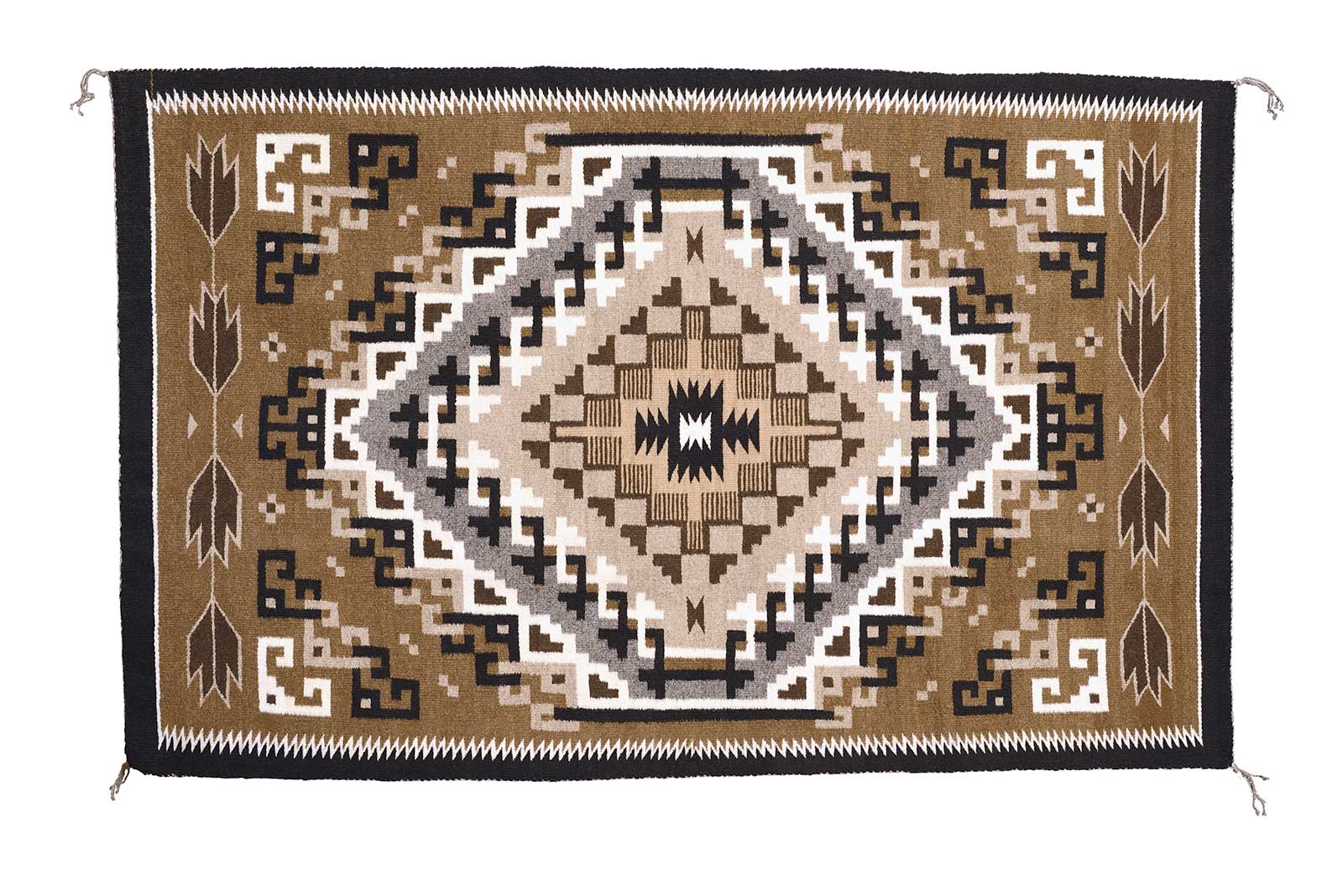 Marie Begay (Navajo), Navajo weaving, handspun wool. All images courtesy Jackson Clark / Toh-Atin Gallery. Photos by Howard Rowe.
She didn’t come back for about a week. We put together a collection of clothes and things she would need. When she arrived, she was obviously upset.
I asked her what the difference was between the time I told her about the fire and the way she felt then.
She said, “I lost the two most important things in my life in the fire. The first was the only photograph we had of our mother. The other thing I lost was the book with the photographs of all of the weavings I have made over the years…When I was having a hard time or things weren’t going well, I could look at that book and know it would be OK, that I was a talented person.”
For thousands of years, the Navajo have been survivors, able to adapt to their environment and thrive during difficult times. And so it is with the Navajo weaver, constantly changing and transforming. While there are fewer weavers today than ever before, there have never been better.
Jackson Clark is the owner of Toh-Atin Gallery. To learn more about the Burnham weavers, and to see videos showing their work, visit www.toh-atin.com.
Powered by Froala Editor