Every year, the Smithsonian National Museum of the American Indian convenes a committee to decide what artwork they will purchase for the permanent collection. And a few years ago, Chickasaw weaver Tyra Shackleford, threw her hat in the ring for consideration.
“I took some photos with some work at home, and they decided to purchase one piece I had finished,” she says. That piece—a multicolored shawl with a striking lightning-bolt pattern—was acquired by the museum in 2019. But the NMAI had even more in mind for Shackleford.
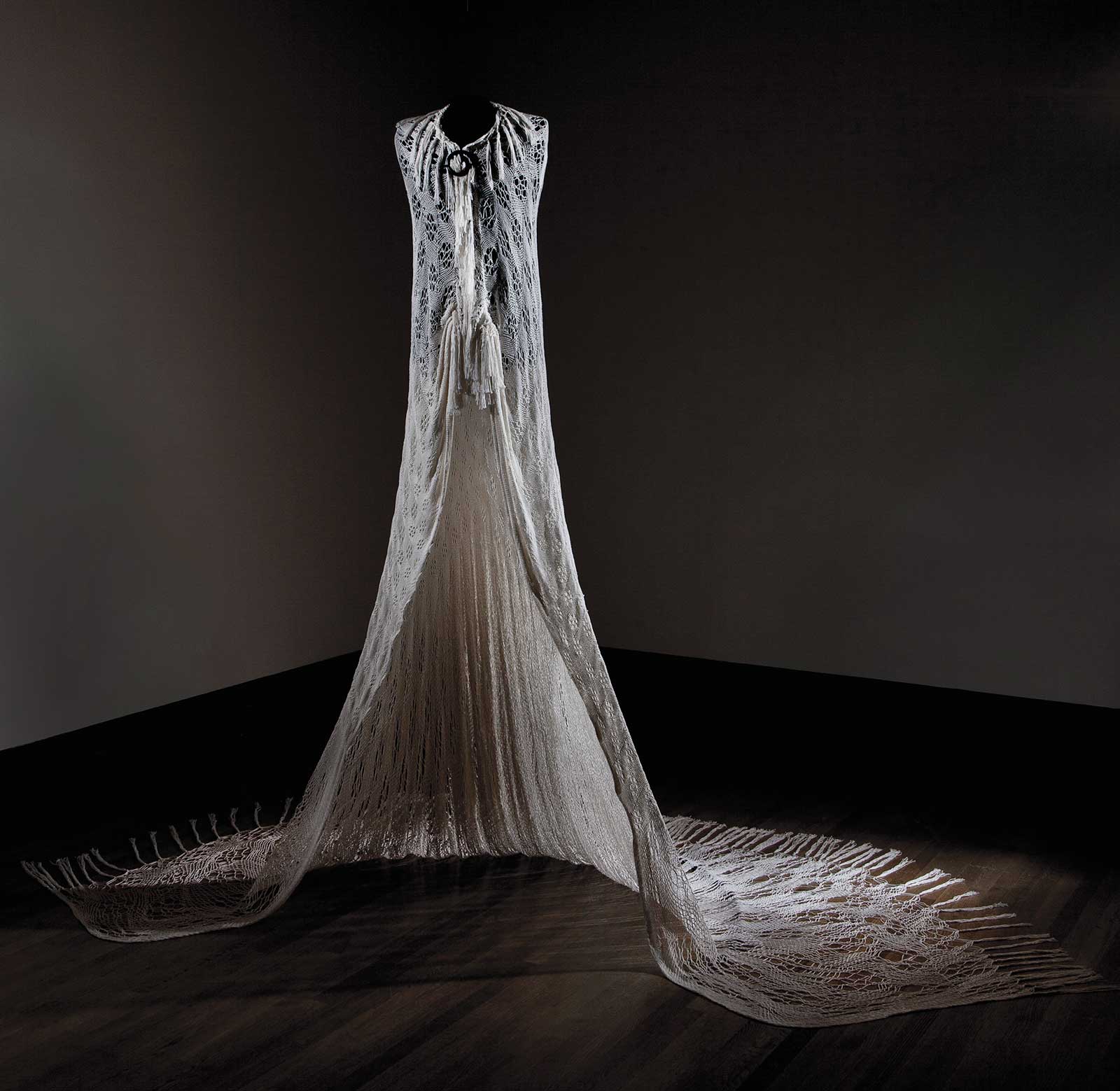 The Lady, interlinking sprang with soy silk yarn and handmade wooden shawl pin, 108 x 48”. The Eiteljorg Museum of the American Indians and Western Art.
They were also interested in a large, lace-like white shawl called The Lady. “I don’t know who in the committee knew my work, but they asked about that piece specifically even though I hadn’t submitted it,” Shackleford says. There was only one problem: The Lady was already in the permanent collection of the Eiteljorg Museum in Indianapolis. Undeterred, the museum committee decided to commission The Lady #2.
For Shackleford, the prospect of replicating her previous work was a unique and intimidating challenge. “The first one came out beautiful and way better than I ever imagined it would be,” she says, “but there are still things that I thought, ‘If I’m going to do this again, I’m going to take the opportunity to make it better.’”
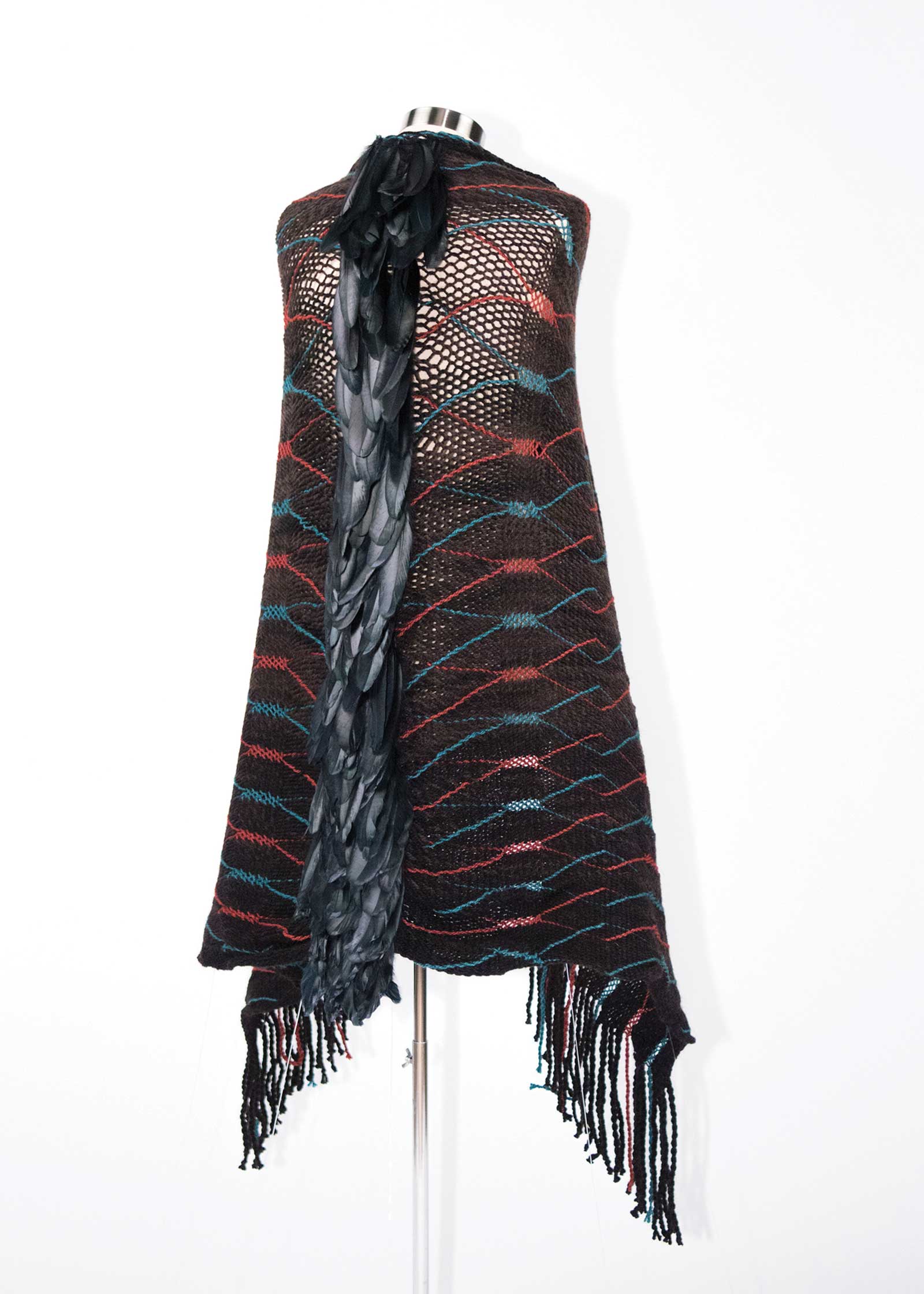 The Raven, bison/merino and bison/muga silk yarn blends with shawl pin made with aromatic cedar and makore wood, acrylic resin and brass, dyed goose feathers
Though the presentation of The Lady #2 and how it will be displayed will be virtually the same as the first. Small changes in the piece will reflect how Shackleford has improved her craft in the intervening years.
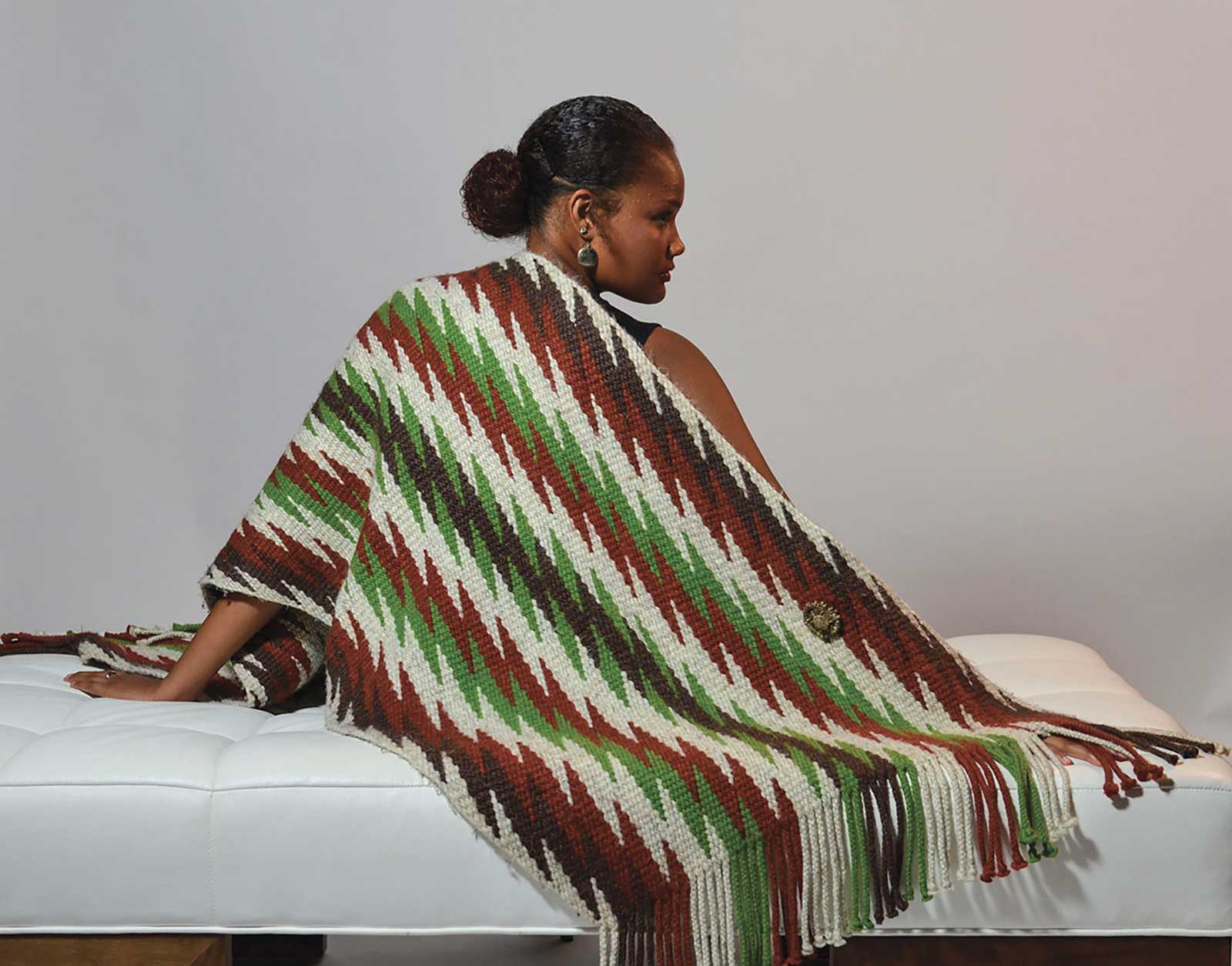 Fingerwoven Shawl, wool/acrylic blended yarn with deer antler button
She was inspired to create the original piece after reading firsthand accounts of Hernando de Soto’s expedition through the Southeastern part of the United States in the early 1500s. “It was our first contact with Europeans, and in one of these journals, one of the men writes about coming across a village that had a female leader who was really powerful,” Shackleford says. “When you think about these Spanish men in this time period, they don’t think highly of the Indigenous people they’re encountering and they don’t think highly of women, but you can tell how they described this woman that they knew she was very respected.”
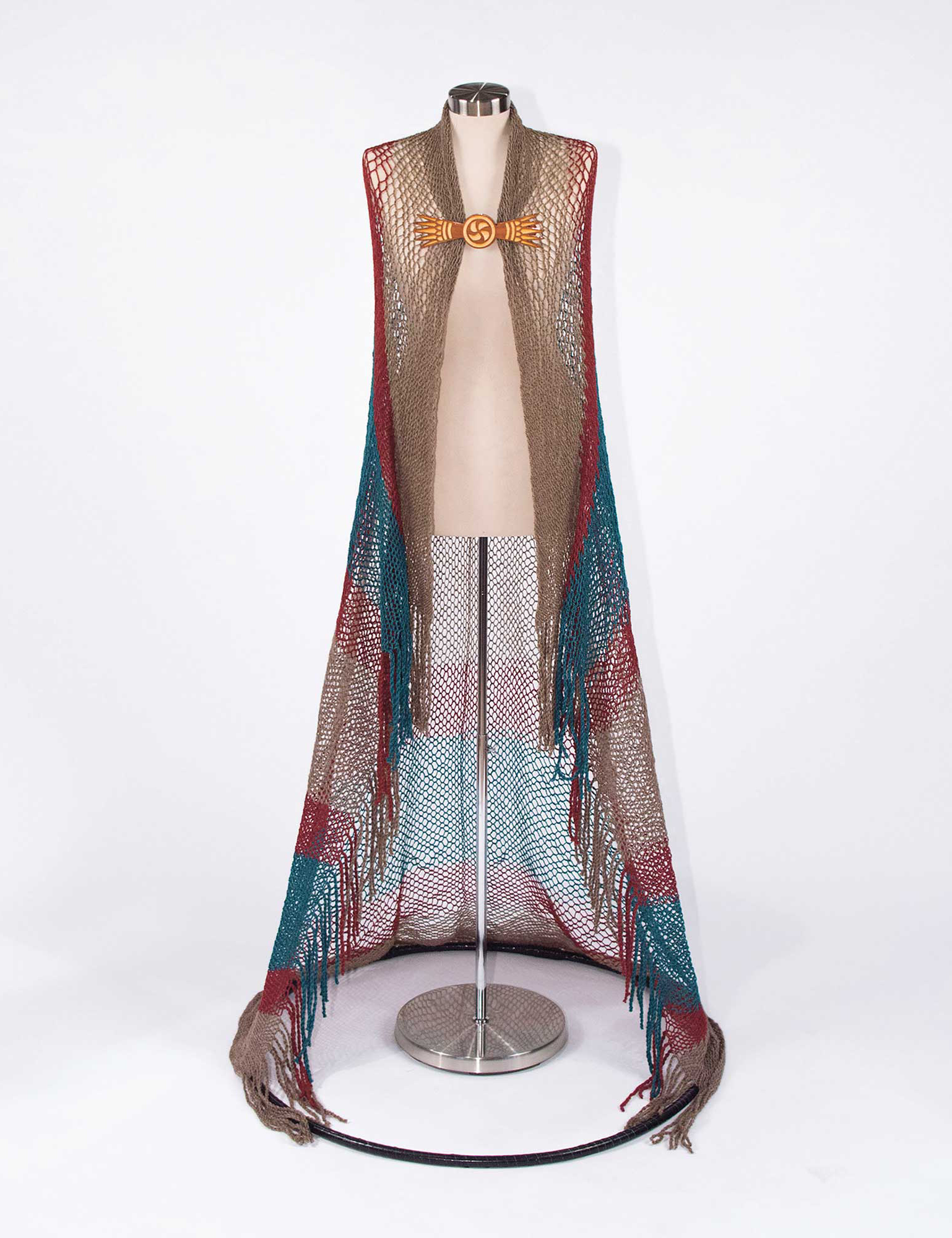 Crayfish, bison/muga silk yarn blend, wood, brass and acrylic resin
While creating The Lady, Shackleford wanted to capture the feelings she had while reading that story of a woman so powerful and revered by her people that even the colonizers had to acknowledge it.
The Lady #2 is woven using an uncommon technique known as sprang. “It’s been found all over the world for thousands of years. The Vikings used it, the Egyptians used it. You see evidence of it in North and South America way before any European contact,” Shackleford explains.
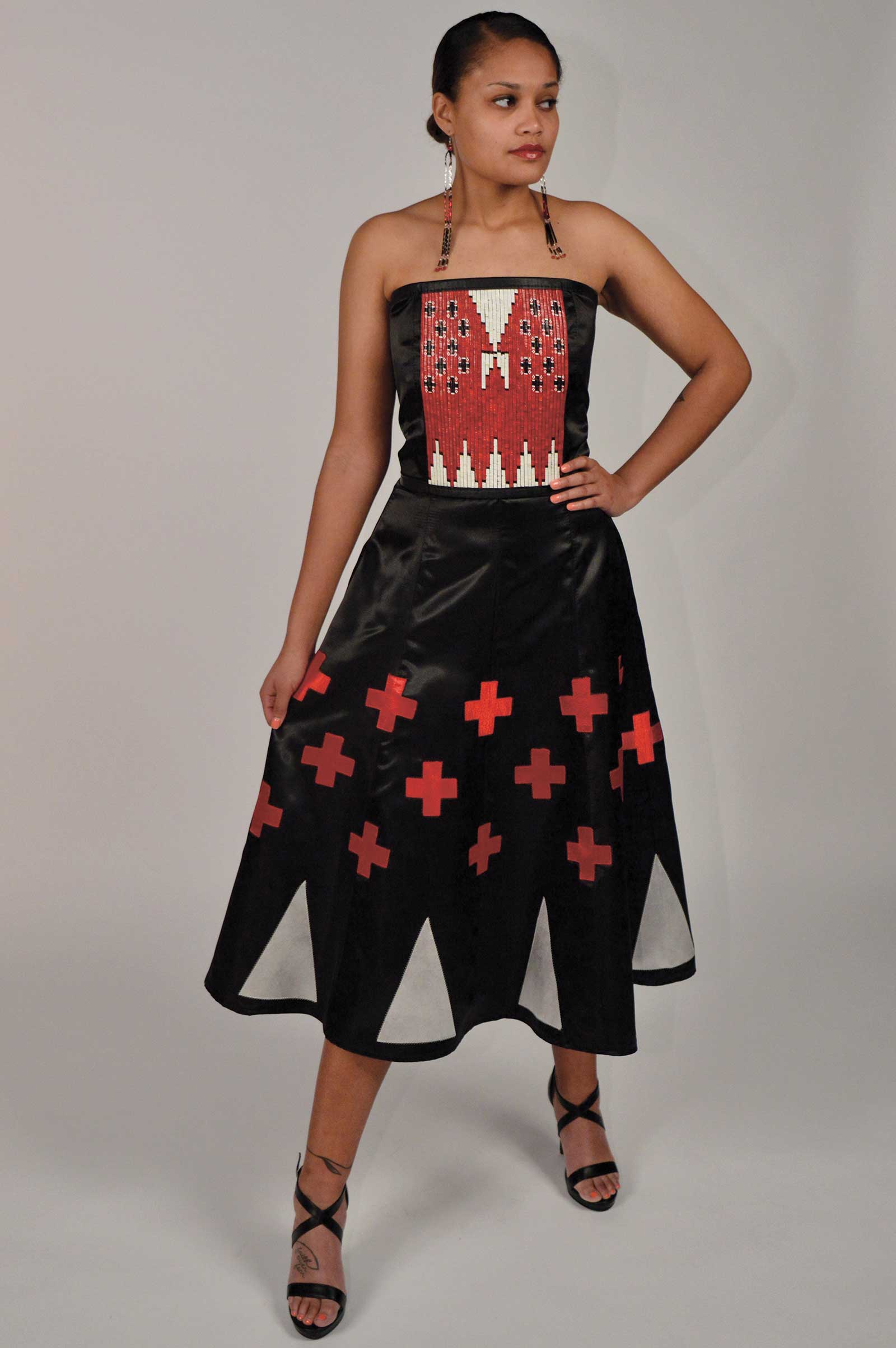 Not Forgotten, porcupine quills, warbla therma plastic, leather, satin, cotton, grommets, sewing thread, hook and eye, invisible zipper with fusible interfacing, size 6
In traditional weaving, weft thread runs back and forth, over and under the warp thread. But in sprang weaving, there is no weft thread. “What you end up doing is twisting the warp threads around each other. If you think about a chain-link fence, that’s the sort of structure that sprang makes,” Shackleford says. “It’s very elastic, and you can do lots of different patterns and designs by creating ‘holes’ in your weaving.”
Shackleford first learned about the technique from fellow Chickasaw weaver Margaret Wheeler. “We both have a passion for historical research, and she came across the technique and shared it with me,” she says. Together, they sat at Shackleford’s kitchen table and weaved a bag using the sprang technique.
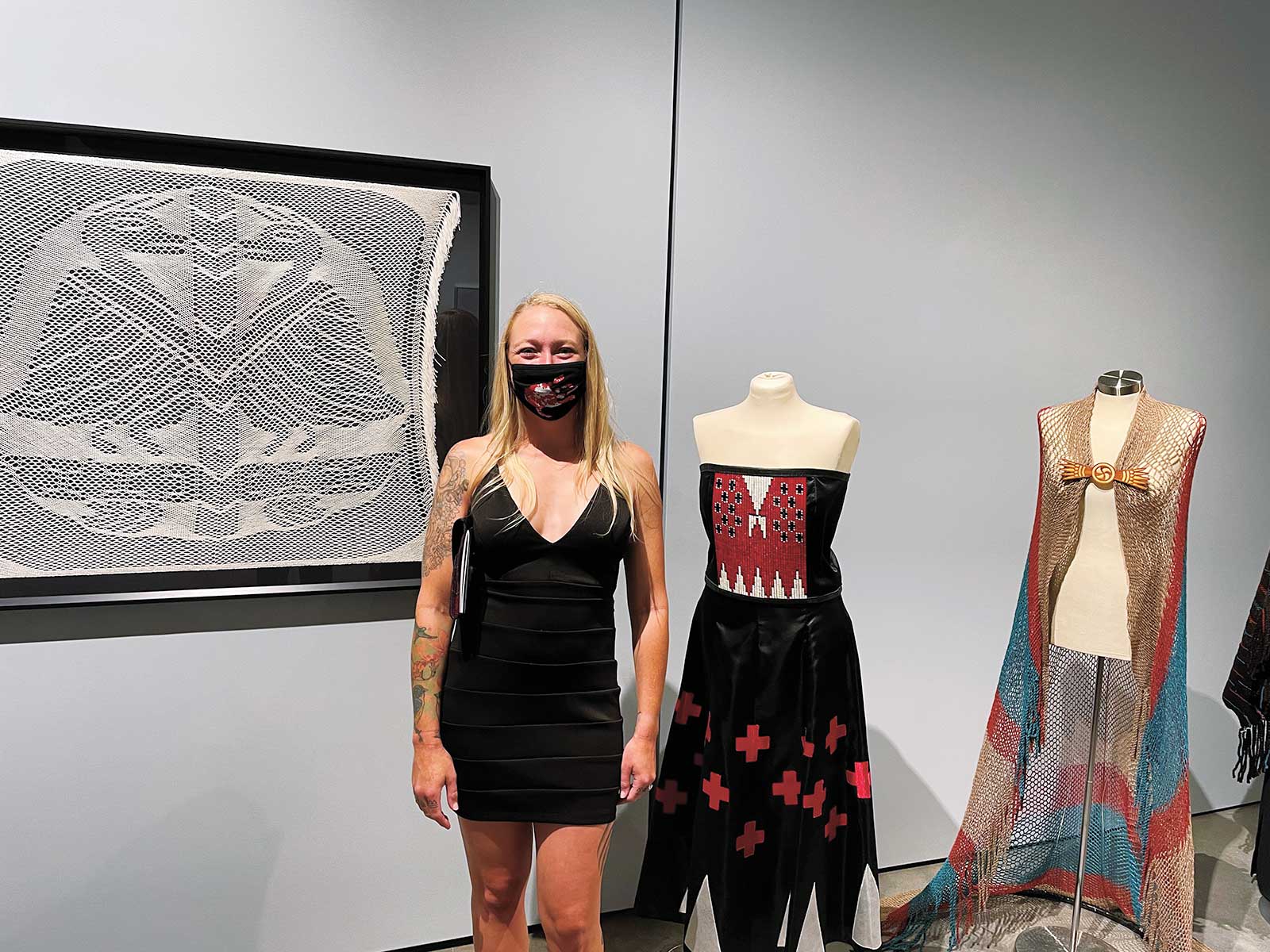 Tyra Shackleford (Chickasaw) at ArtNow 2021 in Oklahoma City, Oklahoma.
“I fell in love,” she remembers. “From there I had to go do a lot more research. I reached out to the Canadian weaver Carol James who practices it to learn from her, too, and I’ve run with it ever since. It’s my favorite technique.”
When The Lady #2 is displayed in the NMAI, Shackleford hopes that it will capture the imagination of a young Chickasaw person and inspire them to learn more about the methods behind the art.
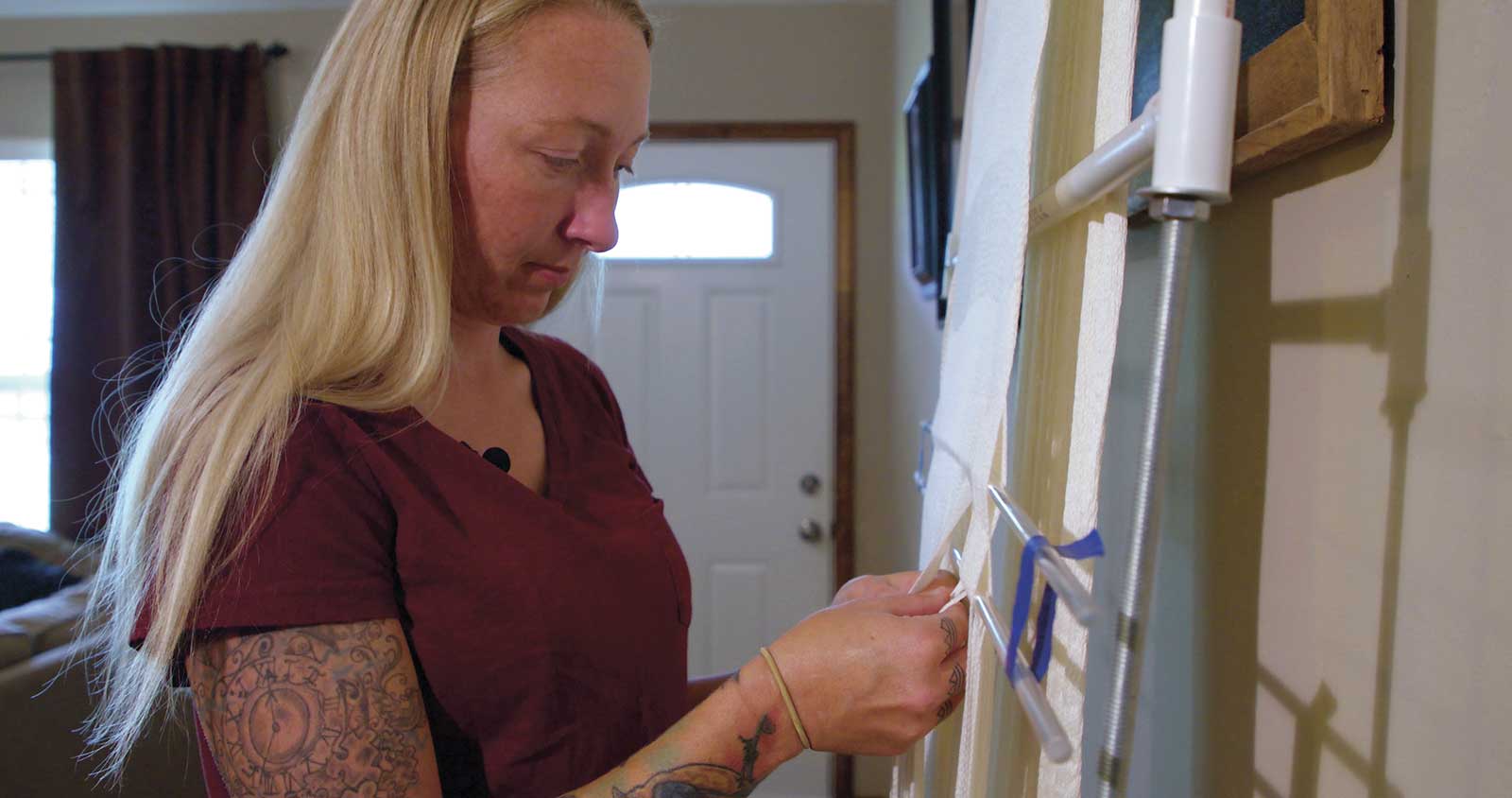 Tyra Shackleford (Chickasaw) works from her home studio.
“The reason I do my art is to preserve and carry forward to the future,” she says. “At one point, these ancient techniques were almost lost, and I don’t want them to be lost. Instead of creating replicas of historical pieces, I want to create new things with those techniques.”
Powered by Froala Editor