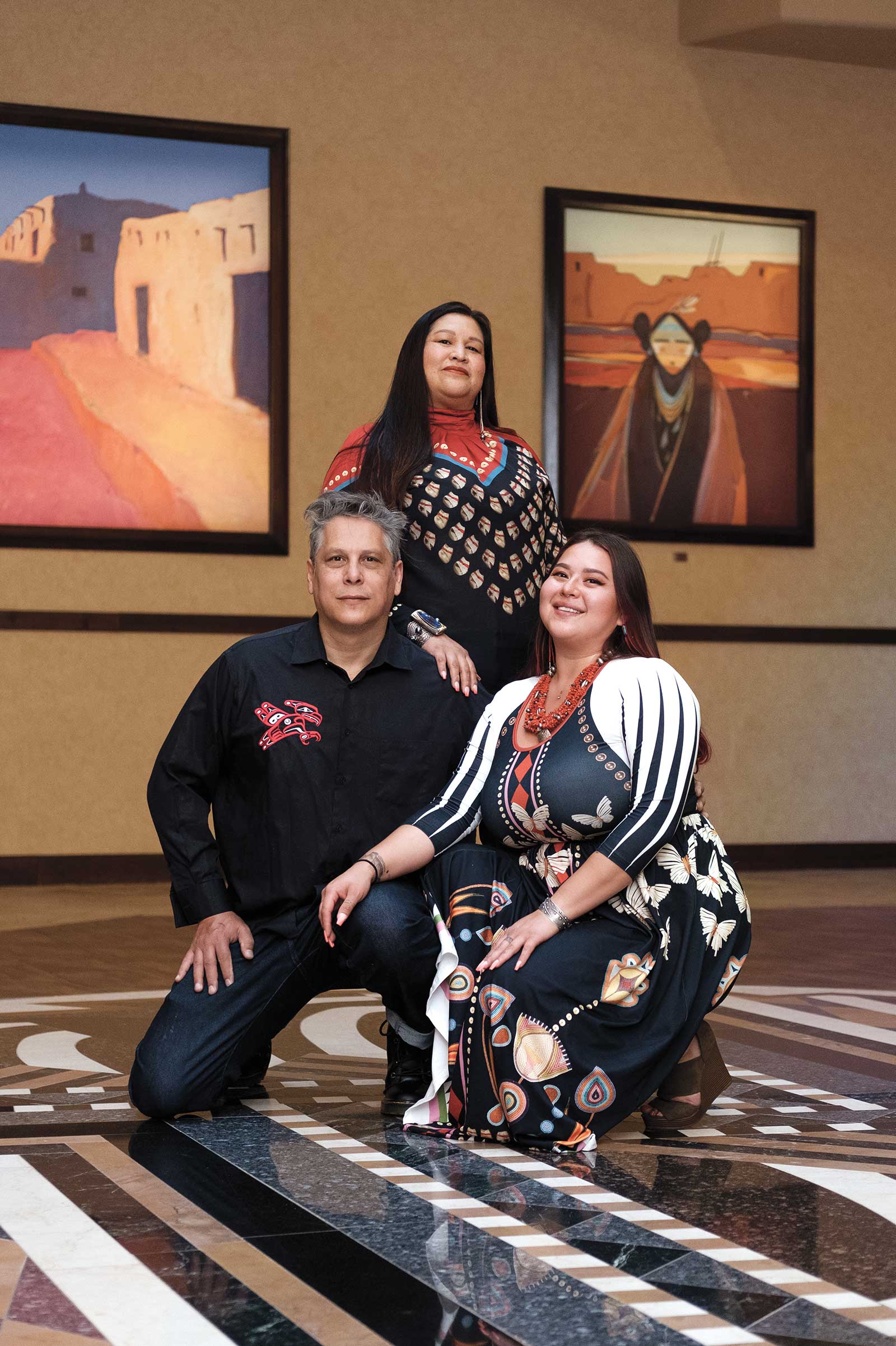
 A family of artists: Melissa Talachy Romero stands by her husband, Mateo Romero, and daughter Jo Povi Romero. Photograph by Jacob Shije (Kha’p’o Owingeh (Santa Clara/ Tewa)).
“The Pueblo people, we are the mud people, we crawled through the earth to emerge into this world, we are made of clay, our homes are made of clay, our pottery and homes are made of clay, the earth is incredible.”
—Povi Romero
My mother’s family lives 45 miles south of Santa Fe, in Santa Ana Pueblo.
My family and I have attended Santa Fe Indian Market regularly, it is truly a generational event for us. We spend entire days taking in the art, visiting friends and family, indulging in roasted corn, all matter of chili, tamales, fried bread and, of course, the notorious Indian Taco. For many of us, Indian Market is an incredibly significant event, and it is a place for us to come together and celebrate our artists and the work they create, as it is part of our collective story. It should be noted that hundreds of brilliant artists who participate in Indian Market come from the many Pueblo communities that populate both New Mexico and Arizona. Pueblo people have been the beloved foundation of market for close to a century.
One incredibly talented and beloved family of artists that have made their presence known at market are the Talachy-Romeros: Melissa Talachy Romero, her husband Mateo Romero, and their daughter, the luminescent prodigy Jo Povi Romero, also known known as Povi Monster. They are a gifted family of artists working in their own forms, spaces and philosophies. Unified by their love for one another, their culture and a family narrative that spans generations, they each share a deep connection to the land, which is in keeping with our Pueblo belief systems.
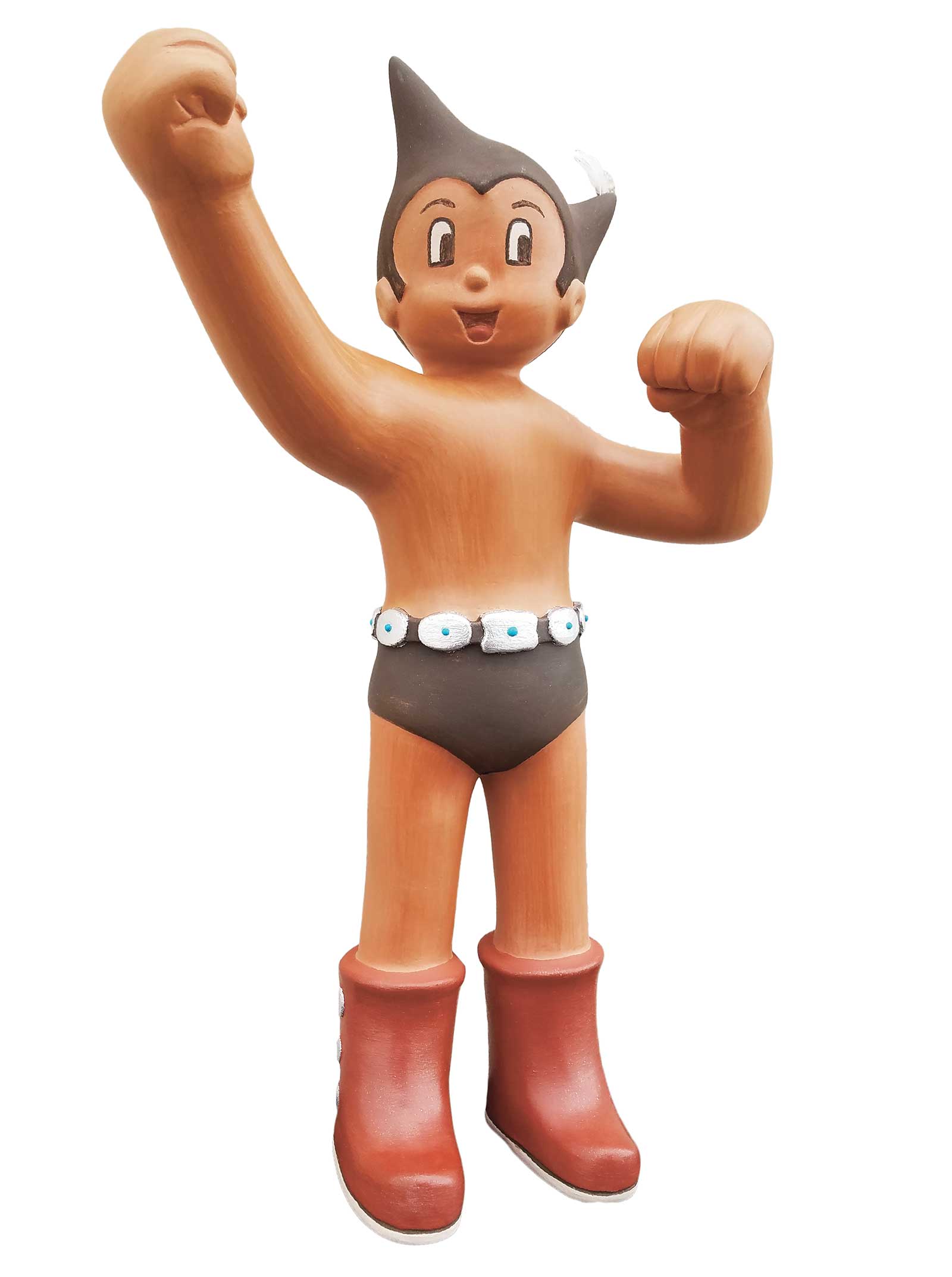 Melissa Talachy Romero (Pojoaque), Astro Boy, Indigenous clay and slip, aluminum leaf, turquoise stone, hand-coiled, painted and kiln fired, 16 x 10"
Melissa, a Pojoaque Pueblo potter, carries on her family’s tradition of Pueblo pottery making following in the steps of her parents, grandparents and great-grandparents—essentially, she has been around clay her whole life. One of her earliest and dearest memories is from a time when she was 2 years old sitting at the kitchen table with her parents and great grandmother. They allowed Melissa to play with the natural clay harvested by her family. Her great grandmother would get pieces of clay, put her hands over Melissa’s and roll out little coils, guiding Melissa through the coil-building process. Her great grandmother was nearly blind at the time. This beautiful memory continues to influence Melissa’s pottery making in that she uses her hands to gauge her work rather than her eyes. Melissa has passed down her traditional knowledge of pottery making to Povi.
Melissa is deeply connected to the Tewa lands where she lives. Those lands are where she continues to harvest clay in the traditional manner she was taught. Echoing this point, Mateo states, “Melissa is an extension of the clay.” During our chat, Melissa’s face lit up with excitement when I asked about her favorite part of the pottery-making process. She responded by expressing an interconnectedness to the lands where she harvests her clay and to the earthy scent of the clay. Pottery making comes second nature for Melissa, and her sophisticated work embodies the spirit of those who taught her to become a lifelong potter. She creates traditional Pojoaque pottery and pottery with a contemporary flair. Her noted contemporary pieces are precise, vibrant and exciting. The most important aspect of Melissa’s work is the amount of love that goes into her pottery. She also makes pottery for ceremonial use within her community.
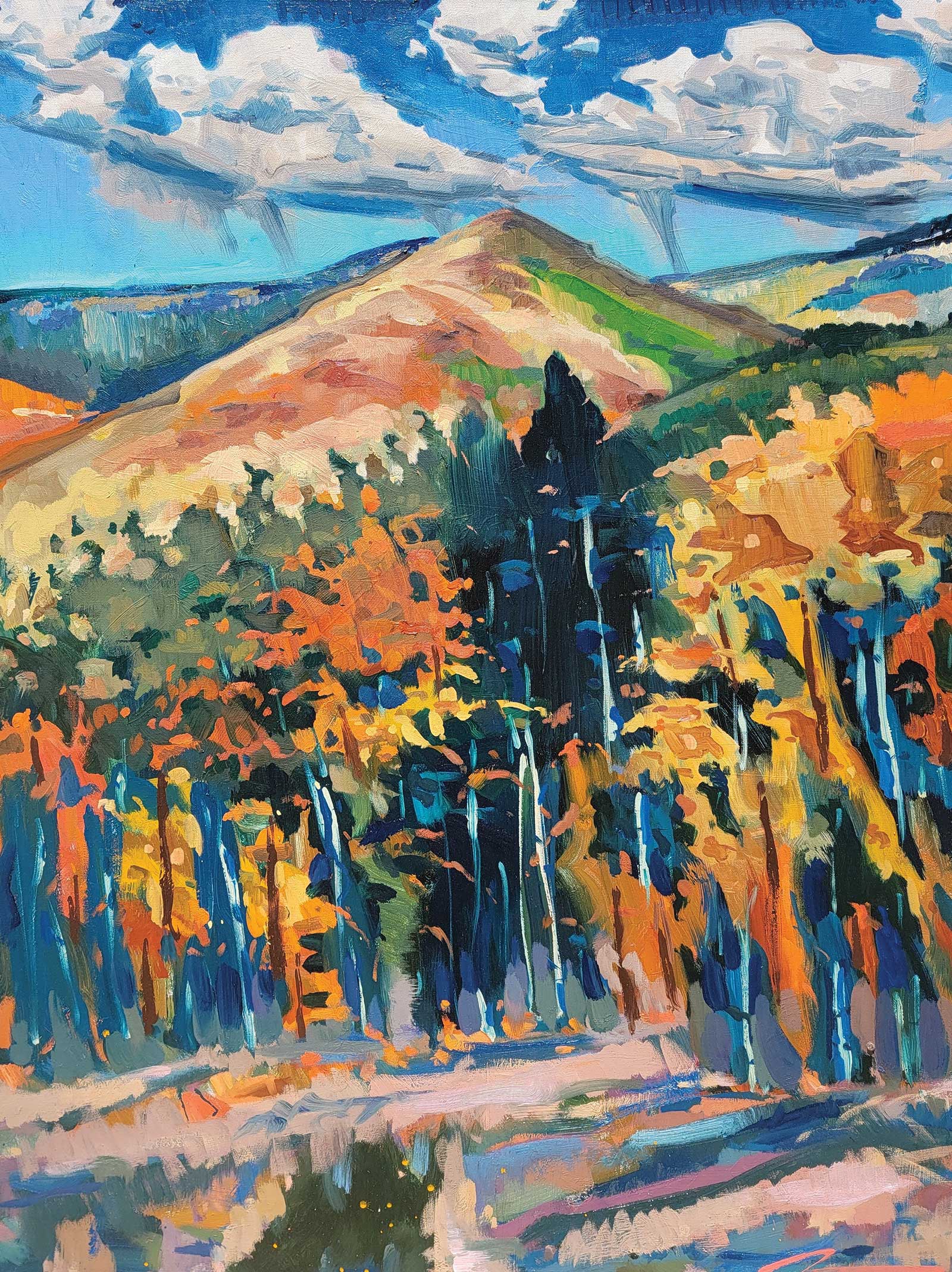 Mateo Romero (Cochiti), Nanaping (Aspen Mountain), oil on canvas, 36 x 48"
Her husband, Mateo, is a Cochiti Pueblo painter who was also born into a family of artists. His grandmother, Teresita Chavez Romero, became a noted Cochiti polychrome revival potter. His father, Santiago Romero, was a painting student of Dorothy Dunn at the Santa Fe Indian School. Diego Romero, Mateo’s older brother, is also an acclaimed artist with a focus on pottery. Mateo grew up emersed in the world of Native art and artists, and in his adolescence Mateo took great delight in drawing exaggerated images of comic book superheroes…without fully realizing that someday he himself would become one of the most recognized artists in contemporary Native art. “Earlier on it’s really self-conscious,” Mateo says, “You grow up around people doing this, they’re practicing artists and you become a practicing artist. It’s not really a conscience thing—it’s an unconscious idea and you emulate your role models, your father and older brother.”
After high school, Mateo attended Dartmouth College wanting to become an architect. After a semester of taking classic studio art classes, however, he knew where his true passion lay. “I did not want to draw buildings, or with draw a T-square,” he says. “The things that resonated with me were charcoal, paper, oil paint, brushwork and palette knife, it was much more loose and expressionistic.” After earning BA degrees in painting and art history from Dartmouth, he received an MFA in printmaking from the University of New Mexico. He subsequently taught various art classes at the Institute for American Indian Art, where he influenced many budding Indigenous artists.
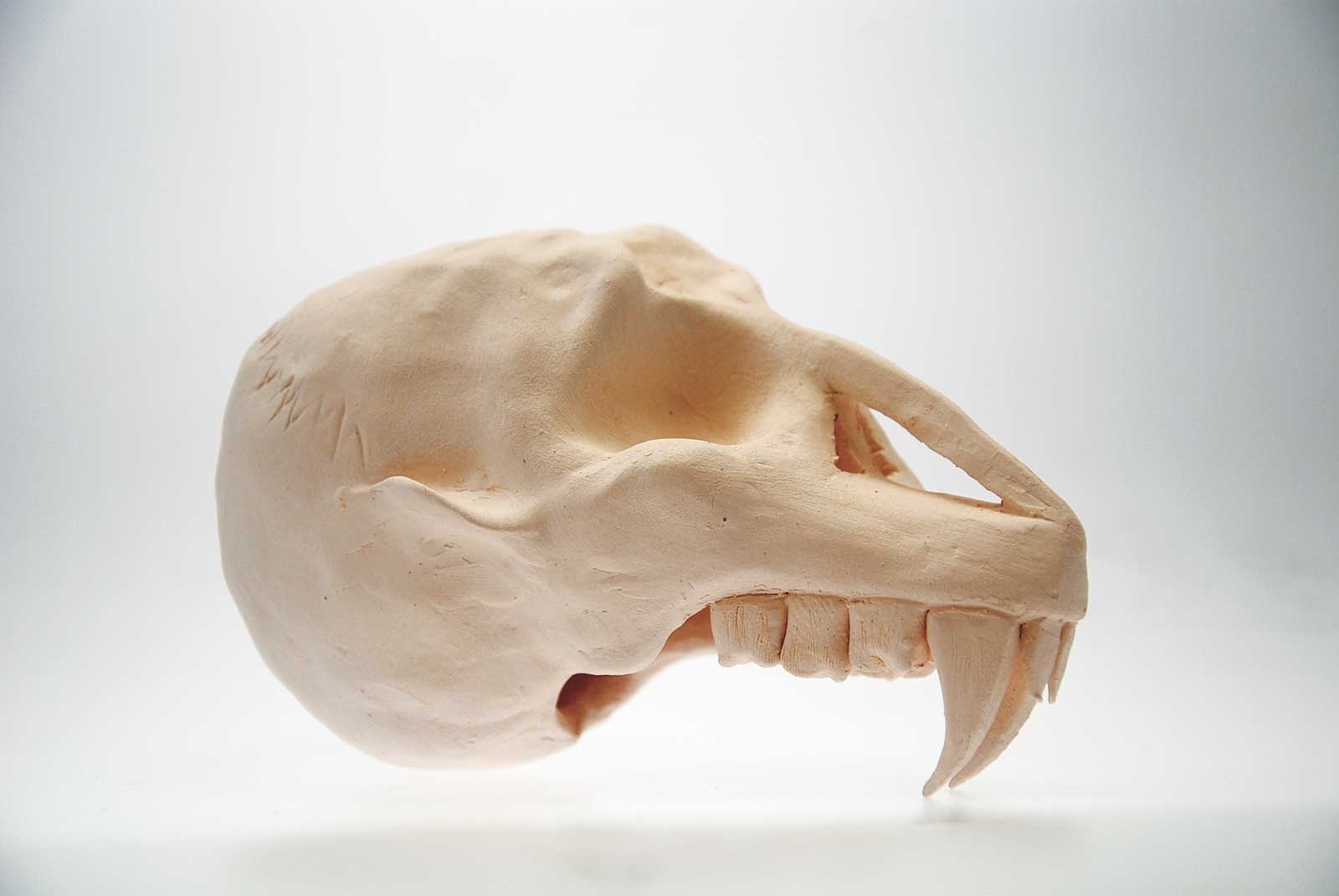 Jo Povi Romero (Pojoaque/Cochiti/Santa Clara/Ohkay Owingeh), Fangy Boy, B-Mix ceramic clay, hand-built, fired with no glaze, 6 x 4 x 4"
Mateo’s well-known earlier works consist of mixed media and photo-transferring in which he utilized historic photographs of Pueblo dancers and Native people found in the public domain. Gradually, however, Mateo tired of working with photographs. Reflecting a desire to pursue more creative endeavors, he says, “Photographic collage stuff had gotten to the point where I could see what was going to happen to the work before I even started it and had an idea of where it was going to go, but this new stuff I’m doing is the opposite. It is much less predictable. There is no photography. It is just me, a brush, a canvas and some color.”
For the past three years Mateo has almost exclusively painted Northern New Mexico and Arizona landscapes including the Grand Canyon. Painting landscapes was not new to him. During our interview, he reminisced fondly about the first time (eight or nine years ago) he set up an easel outside of his home in Pojoaque Pueblo and began painting the beautiful Northern New Mexico setting beyond his doorstep. His inspiration is drawn from the idea that we are part of the land.
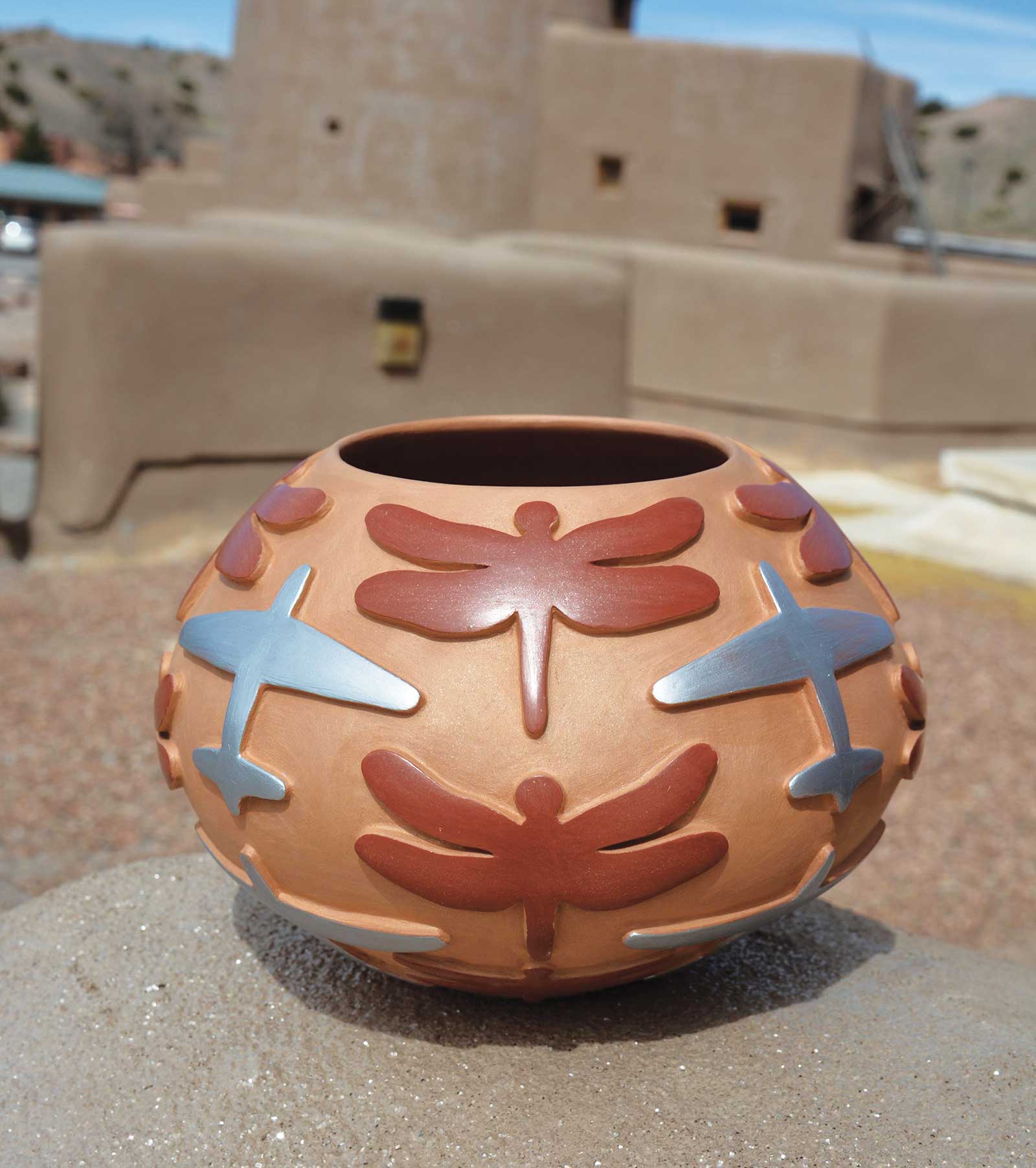 Melissa Talachy Romero (Pojoaque), Dragonflies vs Aeroplanes, Indigenous clay and slip, metallic paint, 6 x 7½"
In his more recent works, Mateo incorporates original Indigenous etymology of Northern New Mexico landscapes by using Tewa and Keres names to title his paintings. He prefers traditional names of the landscapes because “the history, culture, language and values are embedded in those original names.” Mateo captures the beauty of Northern New Mexico landscapes, which often remains untouched by the hands of the outside world. His choice of colors enables him to capture the overarching beauty of the sky and nearby sacred mountains.
He elaborates: “The idea that we are actually part of the landscape—we are not distinct, we’re not viewing the landscape, the landscape is alive and you are alive in the landscape as an extension of the landscape—it’s not sublime. You are not distinct, you are not subject to object it is Pueblo being.”
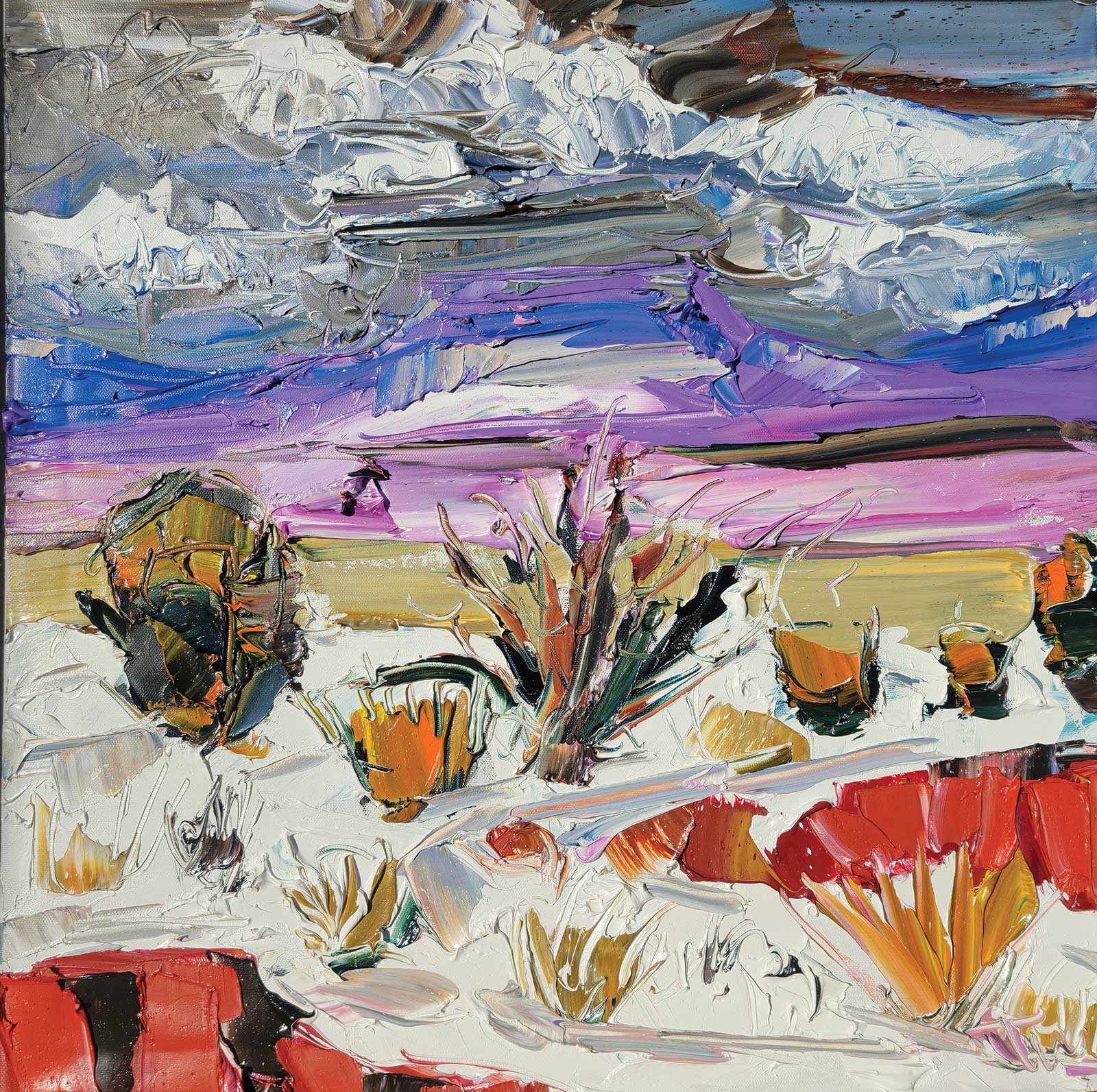 Mateo Romero (Cochiti), Te Nudi Series (Winter), oil on canvas, 24 x 24"
Melissa and Mateo’s daughter, Jo Povi has a bloodline that comes from Pojoaque, Cochiti, Santa Clara and Ohkay Owingeh Pueblos. A multi-talented artist, she is deeply embedded in her culture, traditions and identity as a Pueblo woman. “Povi” means cactus flower in Tewa and she is the namesake of her maternal great-great-great-grandmother. She grew up in Pojoaque Pueblo with her parents and brothers. Consequently, pottery and painting have always been an inseparable part of her life. Recalling her father’s enduring influence on her artistic development, Jo Povi declares, “My father raised me in the studio, while my mother was at work. I remember hanging out in the studio with my father painting all day.”
In keeping with Pueblo tradition, Povi learned to harvest and make pottery from her mother and her maternal grandparents, Thelma and Joe Talachy. During her adolescence, when her mother made pottery to sell at the Indian Market, Jo Povi and her brother worked alongside her creating small pinch pots and small pottery turtles to sell at their parent’s booth. She continued to work with clay until high school when she began exploring sculpture.
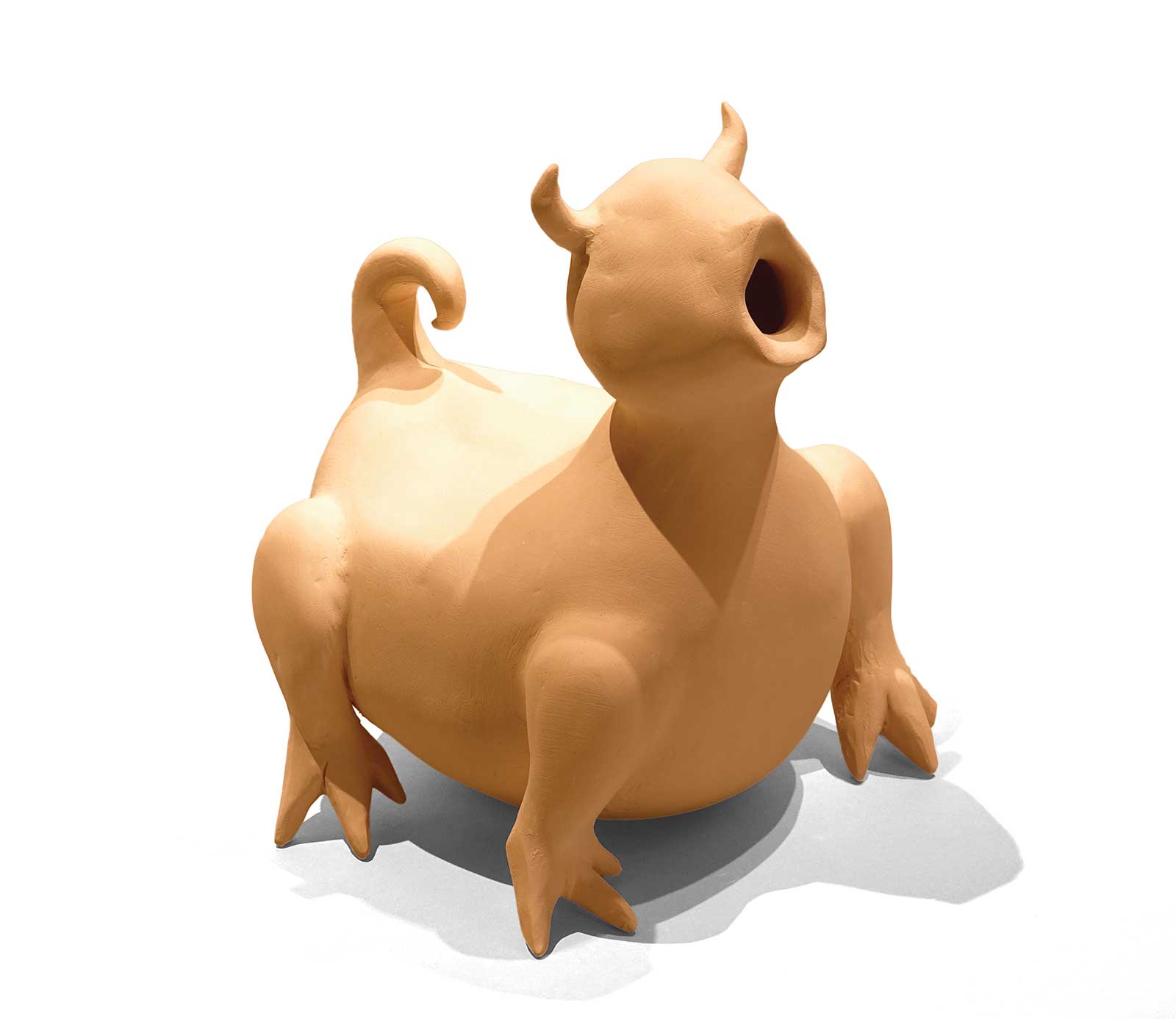 Jo Povi Romero (Pojoaque/Cochiti/Santa Clara/Ohkay Owingeh), Modern Vessel: Oral Fixation, B-Mix ceramic clay, fired without glaze, hand built, 12 x 12 x 10"
While her father and mother taught her the basics of art, drawing, painting, sketching and pottery, she sought to master other methods of art in college. Following in her father’s footsteps, Povi graduated from Dartmouth College, majoring in sculpture and photography. Taking photography classes, she instantly fell in love with the medium. Expressing her passion for photography, she says, “With film development it has the direct hand of the artist and it is also a collaborative process, because film can be so volatile and uncontrollable, and you never know the outcome you are going to get.”
In addition to photography, her main mediums are traditional clay, ceramics, plaster and metal. Much of her work pays homage to power and strength of her women subjects. Reflecting her intent, she states, “A lot of my work is based on my personal experiences as a bisexual Pueblo woman and it feels easier to express my own story than that of someone else.”
In the words of Jo Povi, “The Pueblo people, we are the mud people, we crawled through the earth to emerge into this world, we are made of clay, our homes are made of clay, our pottery and homes are made of clay, the earth is incredible.” Artistic traditions run deep for this family and it is the land which connects them to who they are as Pueblo people and artists. As Mateo says, “We are actually part of this landscape.”
Jo Povi, Melissa and Mateo are truly a family of treasured Pueblo artists. The collective body of their striking work is having an enduring impact on the Indian art world for us to enjoy and appreciate on a deep personal level. Along with many others, I’m looking forward to seeing their art at the upcoming Santa Fe Indian Market.
Powered by Froala Editor