Contemporary art is a porous term—it can hold and contain many meanings that are imbued within it. For some, contemporary art can mean a slick installation in a museum or gallery—artists or collectives working in new media and materials creating conceptual pieces and/or experiences. For others contemporary art can be the work of an artist creating based on a long history of culture, style and practice—forging a continuum of their culture and heritage. For me, contemporary art is all of that, however, it refuses to stop there. I have always believed in art’s porosity and liminality—not confined definitions installed through European-driven colonialism, which has historically placed painting and sculpture at the top of an imaginary hierarchy of aesthetic accomplishment and cultural contribution simultaneously pushing out and ghettoizing non-Western material and visual culture to an “othered” status. Fashion may perhaps be an even more porous term than contemporary art, with a nuance and nebulous aura surrounding it; however, fashion is linked intrinsically to and is part of the ecosystem of contemporary art and a broader understanding of material cultural production globally.
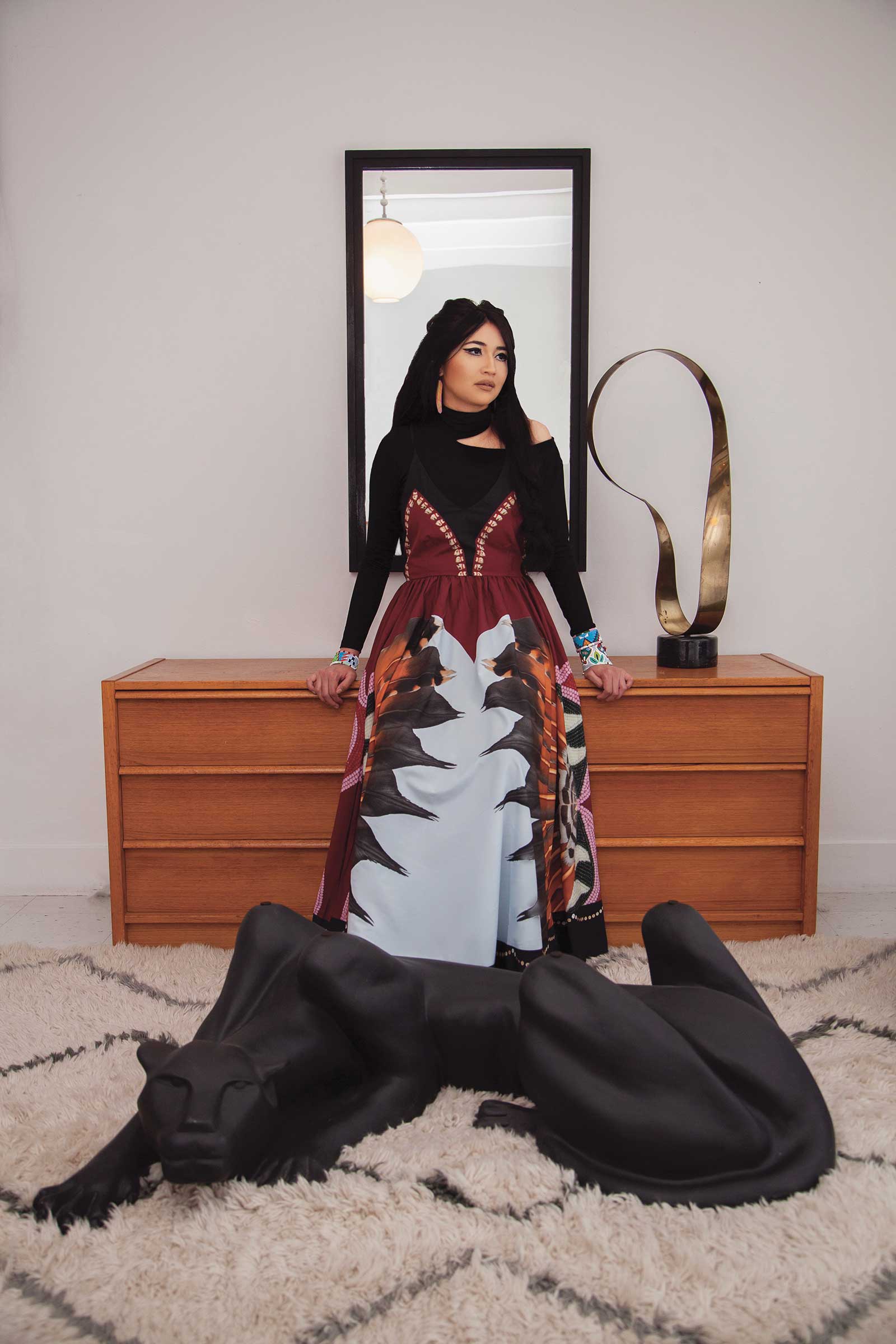 Designer: Jamie Okuma (Luiseño/Shoshone-Bannock). Image courtesy the artist.
Fashion has a commodified nature perpetuated by dominant culture; as such it is not often viewed through the lens of “high art” or “fine art.” This may in part be due to its overall basic function as a utility that is consumed as a fundamental necessity. Stringent binaries or siloed categorical definitions serve no purpose and only do harm—such as relegating fashion, clothing and design more to “craft” than fine art. Representation of fashion as something other than utility or exiled to design/craft and not fine art, has its exceptions. Many major museums, which we often view as purveyors of culture, have recognized the blockbuster quality a fashion exhibition can have. After all, fashion is relatable and accessible, and it can challenge the viewer, but there is a very clear way for the viewer to enter the world of the works on view—and that is its relationship to the body. Major fashion exhibitions in recent years have included famed designers such as Balenciaga at the Kimbell Art Museum, McQueen at the Metropolitan, Dior at Dallas Museum of Art, or Gaultier at the de Young. However, there have been less opportunity for the exhibition and celebration of contemporary fashion from Indigenous designers. Most often, when garments and adornments from Indigenous cultures are shown in a museum context, it is done so in a historiographic frame, and not a contemporary one, and as such, is interpreted and displayed in an anthropological way and not in a fine art model. The legacy of design, aesthetics and materiality of non-Western fashion being appropriated and taken for use of predominantly white design houses, while itself being pushed off into anthropological space, is not new and in fact is quite prevalent. Many mainstream designers, brands and houses profit from other cultures or co-opt and tokenize designers to check a box. This has occurred all too frequently to material culture and visuality from cultures Indigenous to North America. While fashion has proven itself to hold space in the museum and fine art world, it still dangles in the periphery. Perhaps that is because it exists at odds with some of the basic tenants of an art museum. The sterility of museums—no touching, barriers and stanchions, finely honed objects placed behind glass and on pedestals—are meant to protect and exalt the artworks, but that is antithetical to what fashion—clothing, jewelry, body adornments, shoes—represent. Those items are meant to function, to be worn, to be touched, to exist in situ of our bodies. Curator and writer Candice Hopkins stated in a 2021 virtual presentation that “museums are colonial wounds,” and these colonial wounds are predicated on a history of exclusivity, appropriation and elitism. Fashion, while there most certainly is exclusivity and elitism ensconced within it, at its most basic level is for all. It’s about accessibility and forging a visual identity and personal iconography.
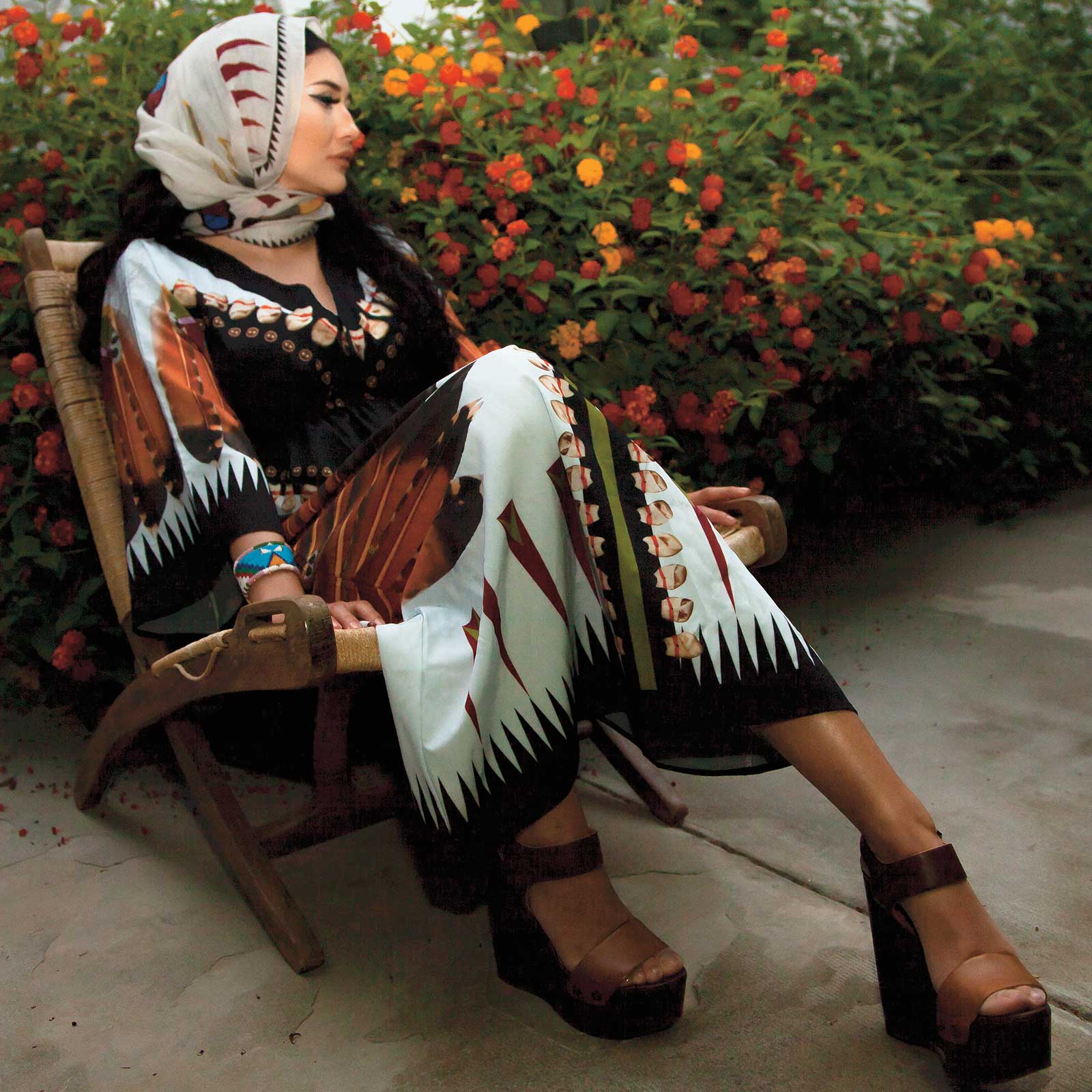 Designer: Jamie Okuma (Luiseño/Shoshone-Bannock). Image courtesy the artist.
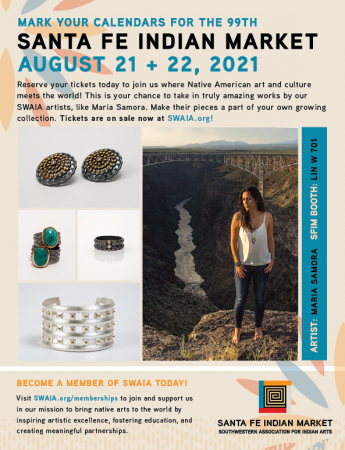
Amber-Dawn Bear Robe from the Siksika Nation in Alberta, Canada, who serves as assistant faculty of art history in the Museum Studies department at the Institute of American Indian Arts (IAIA) and organizes the Southwestern Association of Indian Arts (SWAIA) fashion show, now in its eighth year, stresses the need for representation and financial support for Indigenous designers. “The art and culture of Indigenous people in Canada and the United States are the foundation of everything in North America, including fashion,” shares Bear Robe. “That voice needs to be recognized outside of the Indigenous fashion bubble; it needs to be recognized in the larger discourse and fashion industry.” The SWAIA fashion show is one such voice out there, however—whereas there is a large and more visible presence of Indigenous contemporary artists and designers in Canada, Bear Robe shared that “here [the U.S.] it feels like a whisper.” When you only have one hour, once a year, it can be challenging to keep the conversation going. Indigenous designers working today are pushing forward historically used materials and techniques with contemporary materials, silhouettes, and modalities, creating a hybridity between their respective cultures and the global community we live in.
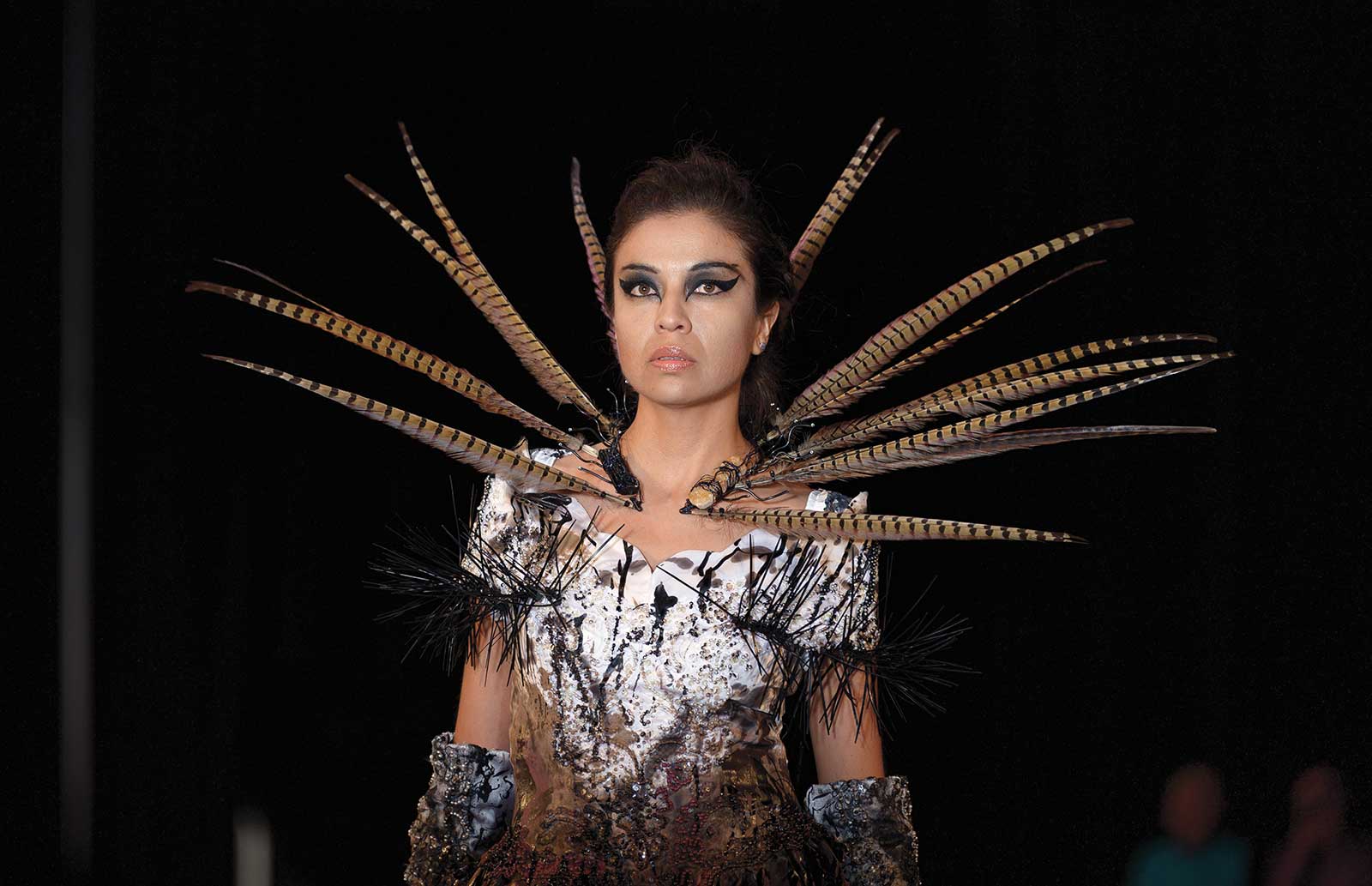 Designer: Decontie & Brown / 2019 Santa Fe Indian Market Haute Couture Fashion Show.
Luiseño and Shoshone-Bannock fashion artist Jamie Okuma is one such designer. From her instrumentalizing tropes of ribbon work and constructing entire haute couture gowns out of the material, or her practice of reclamation and almost a reverse appropriation and adaptation of European designers’ luxury items—she’s indigenizing them, reclaiming them to make something new. Her work is setting a new stage for fashion, for Indigenous fashion, that is not predicated on a stereotypical idea of what Native fashion is supposed to look like. Her play with prefabricated items that are altered and shifted to a new life or meaning is not only an extraordinary use of upcycling, but is also not so dissimilar to fine art practices of the ready-made or found object popularized in the early-20th century by the likes of Marcel Duchamp and Meret Oppenheim, such as Oppenheim’s Le Déjeuner en Fourrure (The Fur Covered Breakfast) in which the artist took a mass-produced tea cup and saucer, adorning it in luxury fur, changing its function and how it is viewed and experienced. While Okuma’s unofficial collaborations with Christian Louboutin are technically still functional as a wearable object, it elevates the works out of just a utilitarian piece of luxury footwear and thrusts it towards a one-of-a-kind original art object.
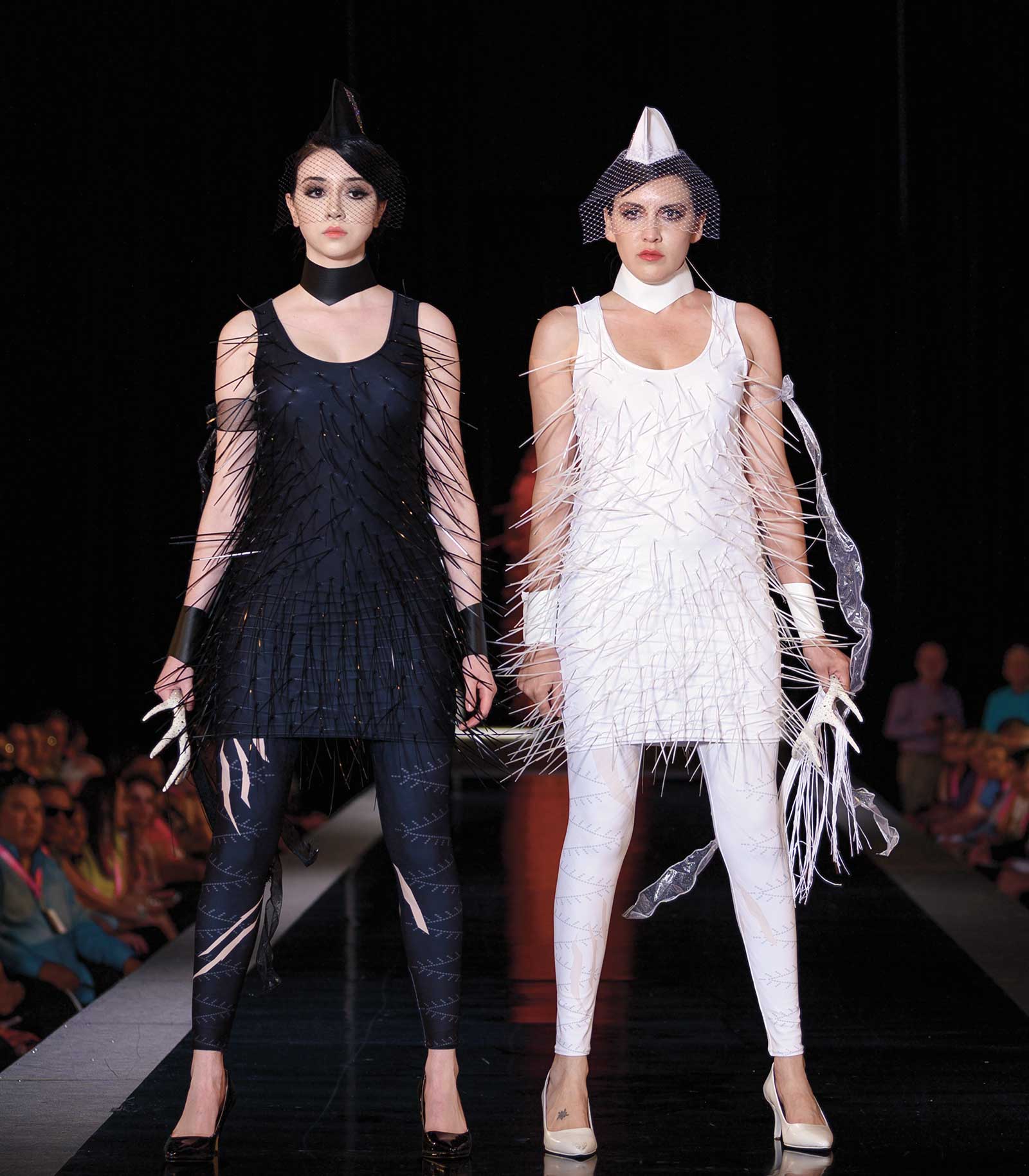 Designer: Decontie & Brown / 2019 Santa Fe Indian Market Haute Couture Fashion Show.
One must ask the question: If the object in question is touched, placed on our bodies, does it no longer function or have the aura and identity as art? Art often references the body—involves the body—relies on or instrumentalizes the body, so it takes no great leap to view fashion as an important and integral part of the contemporary art landscape. In fact, when you look at the history of art over the past 80 years, you see an increasing importance to the relationship between art and the body from its production—i.e., gestural abstraction in the 1940s and 1950s, performance art in the 1960s forward, video and time-based art that involves filming the body, relational aesthetic works, and so on. So, if the inclusion of, reliance and importance of the body in what we could call contemporary art of the last century is so crucial, why then would we not include artists creating works to be worn and exhibited throughout the world as we traverse across it.
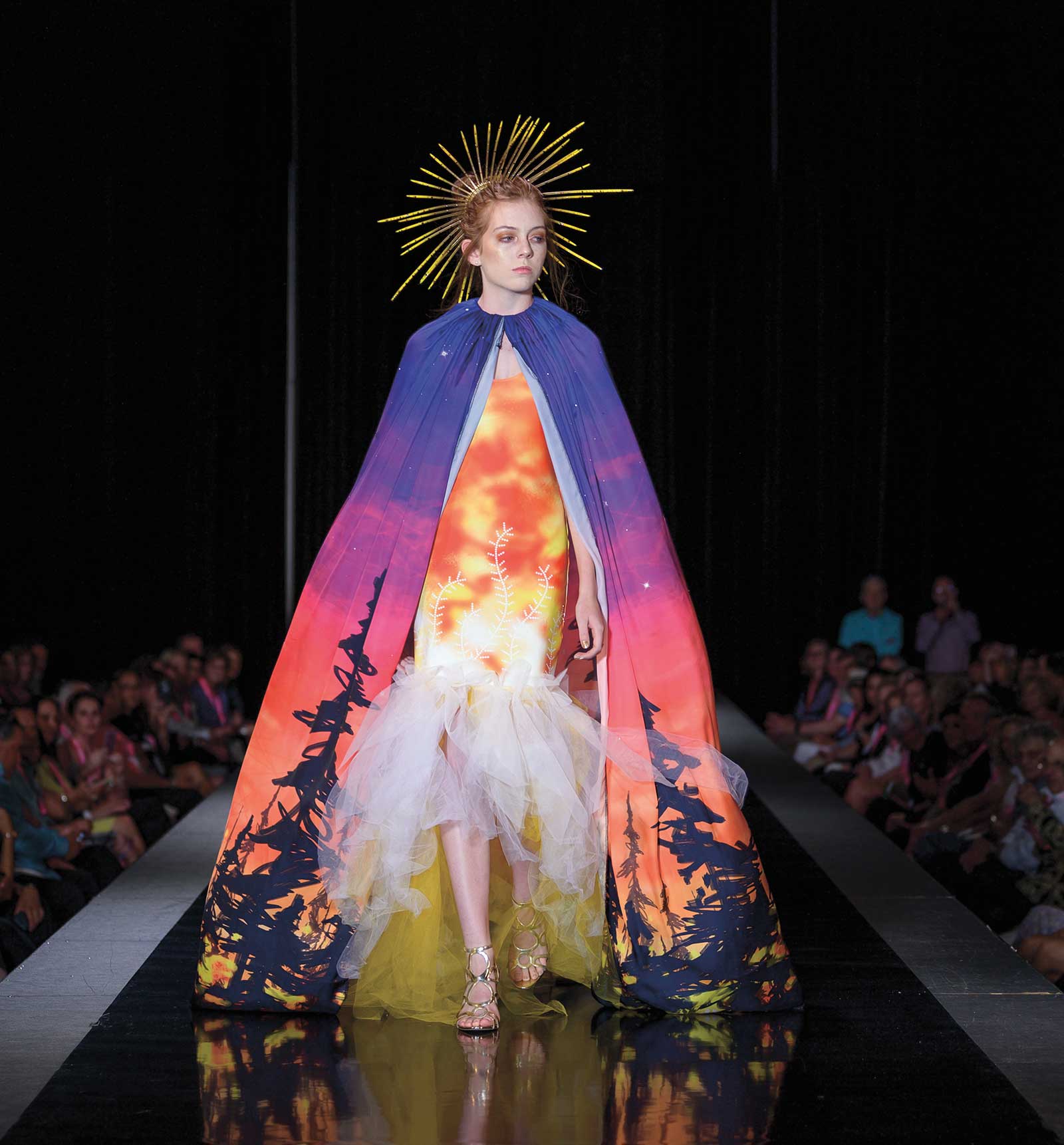 Designer: Decontie & Brown / 2019 Santa Fe Indian Market Haute Couture Fashion Show.
Vogue writer Christian Allaire (Ojibwe) fell in love with fashion early in his life. “I grew up around regalia, my sister in her jingle dresses,” he shares. After all, what could be more opulent than exquisitely lush materiality quillwork and beading, ribbon-work and woven materials? Though Allaire grew up witnessing this visual and material richness firsthand, his original intention starting off in fashion journalism was not to cover cultural fashion, but rather to focus on what we can label as mainstream. Upon entering the fashion scene Allaire realized quickly the massive lapse in coverage of Indigenous designers, while concurrently witnessing the appropriation of their aesthetics and visual vocabularies. “I realized, well, if no one else is covering it, then I will,” he says. “Native fashion is a pillar of American fashion, and it is only growing.” As he pointed out, however, it must be done in a sustainable way. The labor model has to go deeper than a tokenized relationship where the designer/artist gets a small fee for their work, while the company purchasing that use go on to profit heavily from it. He said that’s why events like the SWAIA fashion show, Toronto Indigenous Fashion Week, Vancouver Indigenous Fashion Week and at Australian Fashion Week are so vital—because it gives a focused moment for these artists to showcase their innovation, their point of view. “It’s so important,” says Allaire. “These events allow Indigenous designers to just be designers, that they do not have to prove their [Indigeneity] and can make whatever type of work they want.”
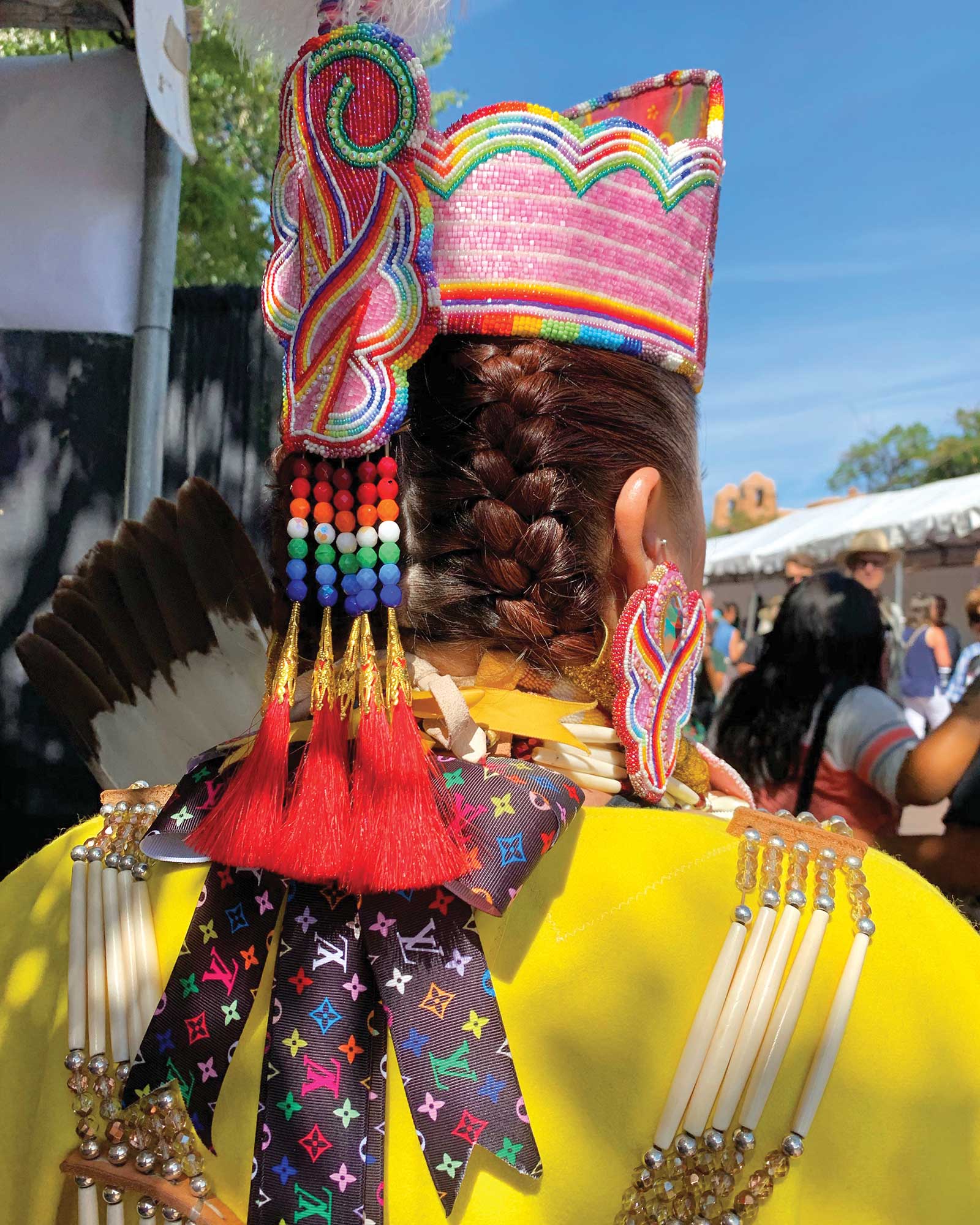 Designer: Natasha Ashley Brokeshoulder / 2019 Santa Fe Indian Market.
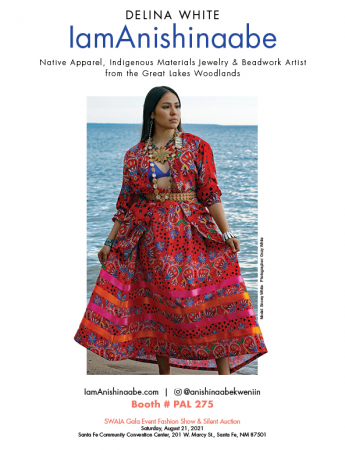
At the 2019 Met Gala, Allaire dawned a sharp black tuxedo with a gorgeous beaded red rose pin in lieu of a corsage by the Dene artist Skye Paul, whose lush and tightly packed beadwork pieces rival any encrusted broach by a major jewelry house. Another creative working in beadwork is Apsáalooke (Crow) artist Elias Not Afraid. Not Afraid’s beadwork is out of this world, blending historical techniques with punk aesthetics like skulls, spikes, all glimmering in glass and gold beads. The self-taught artist blends customary Apsáalooke designs with some newer and edgier materials—making a pastiche of his contemporary life and his cultural heritage.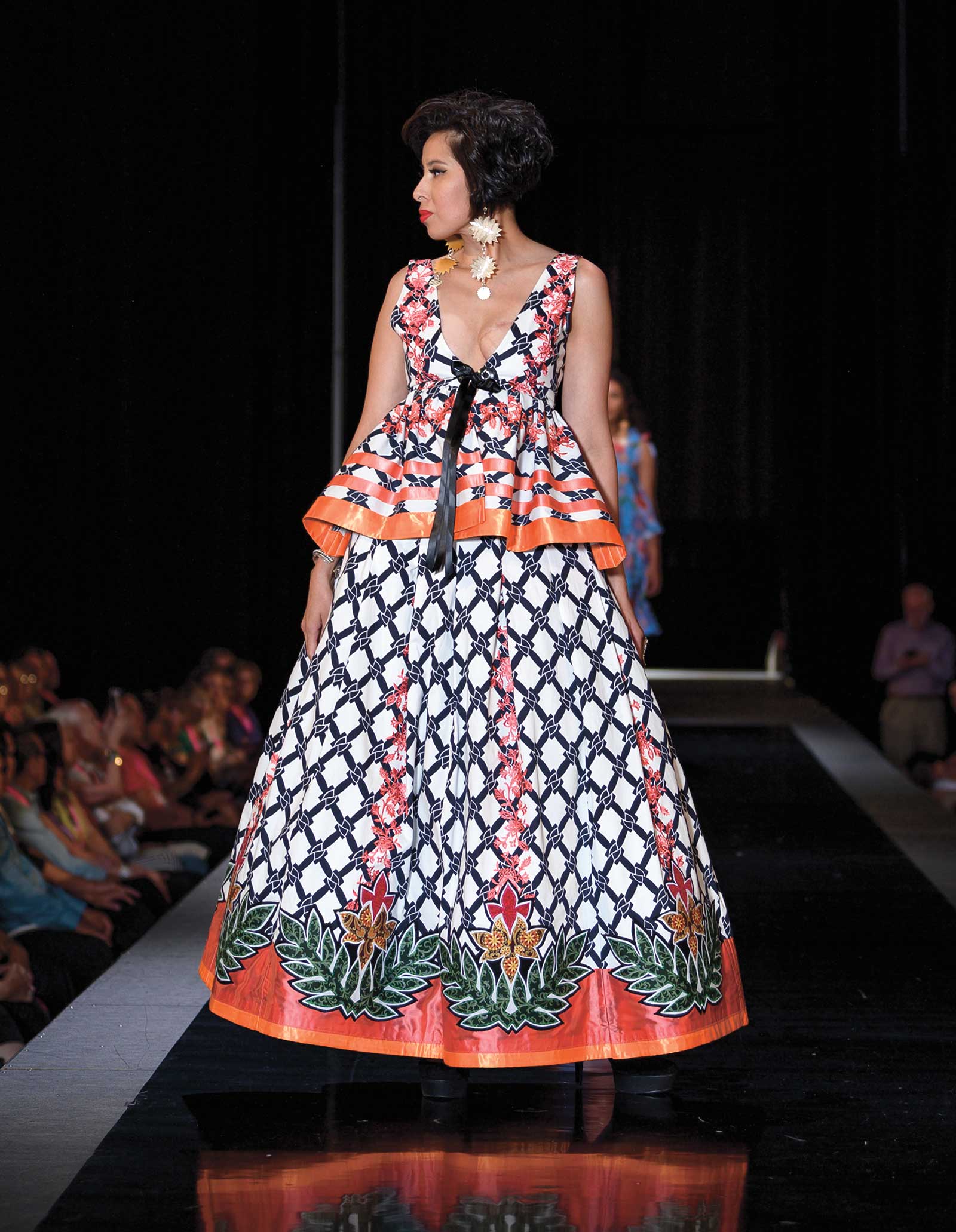 Designer: Delina White (Minnesota Chippewa Tribe) / 2019 Santa Fe Indian Market Haute Couture Fashion Show.
An additional Apsáalooke artist that creates work which shatters the colonial binary of pitting “traditional” versus contemporary is the work of Bethany Yellowtail. Yellowtail’s eponymous label creates incredible ready-to-wear items that feature many notable patterns and motifs from within her culture, as well as contemporary silhouettes a global femme would wear today. Yellowtail, along with Not Afraid, were featured in Apsáalooke Women and Warriors exhibition at the Field Museum in Chicago, organized by curator and writer Nina Sanders (Apsáalooke). What I find particularly revelatory is the connection between fashion as art, art as activism and how all of those converge to move the needle forward toward a better world. These artists are not only making exquisite wearable pieces of art, they are breaking stereotypes, codified through centuries of colonialism and cultural theft. They are reclaiming their space and illustrating the diversity and beauty of their communities, while challenging the reductive readings of what their work is “supposed” to look like.
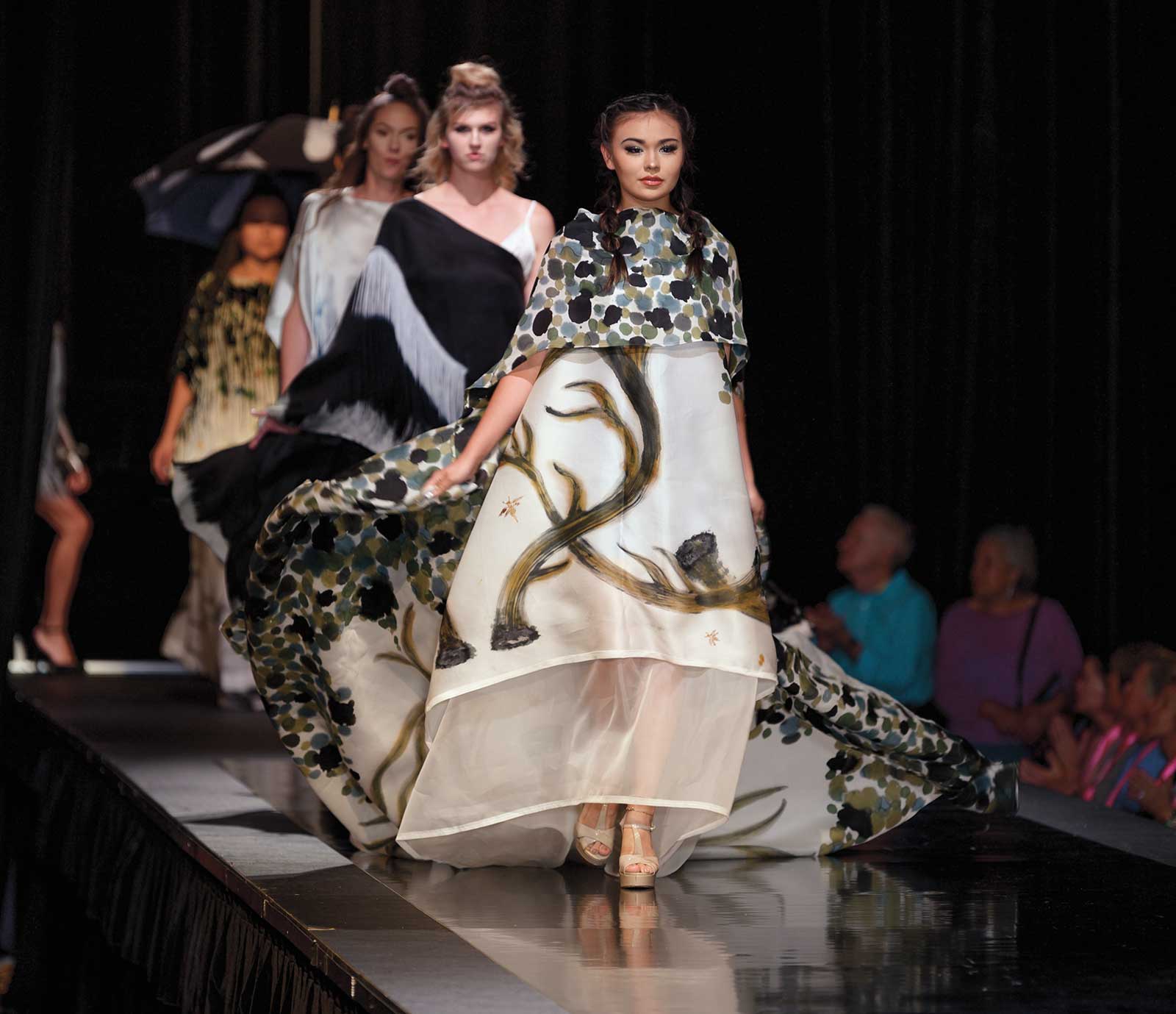 Designer: Patricia Michaels (Taos) / 2019 Santa Fe Indian Market Haute Couture Fashion Show.
The body and the way it is shown is a battleground, one that can march on the frontlines of change. Over this past year our relationships to our bodies, and the bodies of others, was changed, as the way in which we presented our corporeal selves to the rest of the world. Instead of donning our favorite outfits, accessories and jewelry to share a declaration of our own iconography of self, we found ourselves living in sweatpants, T-shirts and slippers, inhabiting comforting clothing in a very discomforting global moment. With Covid cases going down and vaccination rates going up, a return to life as we somewhat knew it is seeming ever increasingly possible. Perhaps with that, the idea of art, fashion and their liminality are even more important to us now. As we emerge from a dark year, we look to light, to inspiration and the role that fashion/art can do to life us toward a more beautiful, diverse and equitable society.
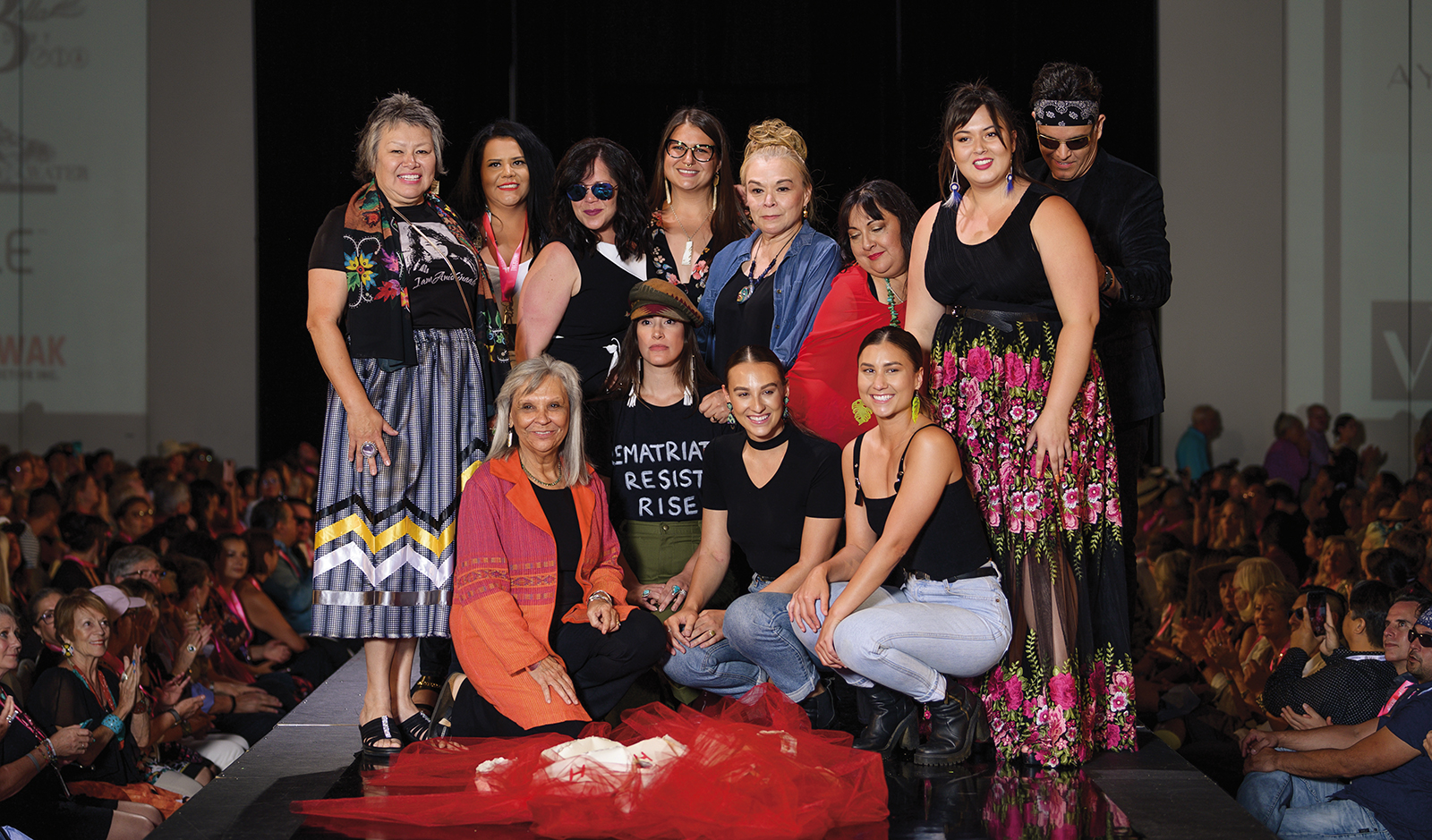 Designers at the finale of the 2019 Santa Fe Indian Market Haute Couture Fashion Show. Top row, left to right: Delina White, Sho Sho Esquiro, Donna Brown, Tania Larsson, Pamela Baker, Patricia Michaels, Leslie Hampton and Jason Brown. Bottom row: Margaret Roach Wheeler, Korina Emmerich, and Jordan & Madison Craig of Shy Natives.
While the fashion shows and articles about and inclusive of Indigenous North American designers is crucial, it does not and should not end there. There needs to be more sustainable partnerships with retailers to disseminate the work to a public that wants to buy it; additionally, there needs to be more space given to artists who work in wearable art to be shown in museum and gallery spaces. There have been some wonderful exhibitions of Indigenous fashion at Peabody Essex Museum or the National Museum of the American Indian, but it is not nearly enough. The Metropolitan Museum of Art’s annual fashion gala will take place this September after a hiatus imposed by Covid-19. It comes back to us with a theme centered on celebrating all things American fashion—including a two-part exhibition, In America: A Lexicon of Fashion and In America: An Anthology of Fashion—so it will be interesting to see how much and how genuinely Indigenous designers are included. As Bear Robe states, “this is the original fashion of North America—the first couturiers were Native Americans.”
Powered by Froala Editor