“I have been coming to Santa Fe and Taos all my life,” Dugan McElroy, says. “This is where we came on vacation. As a child I thought the best place to live in the world would be at Taos Pueblo. All the children were running around barefoot!” She had a natural affinity for the pueblo since her maternal grandparents were Choctaw and she lived in Oklahoma which is home to more than 30 Native American tribes. “I grew up going to powwows,” she says. She also has a natural affinity for collecting since her mother collected antique portraits of women painted on porcelain and her aunt collected antiques in general. “We went to a lot of antique stores on our trips,” she admits.
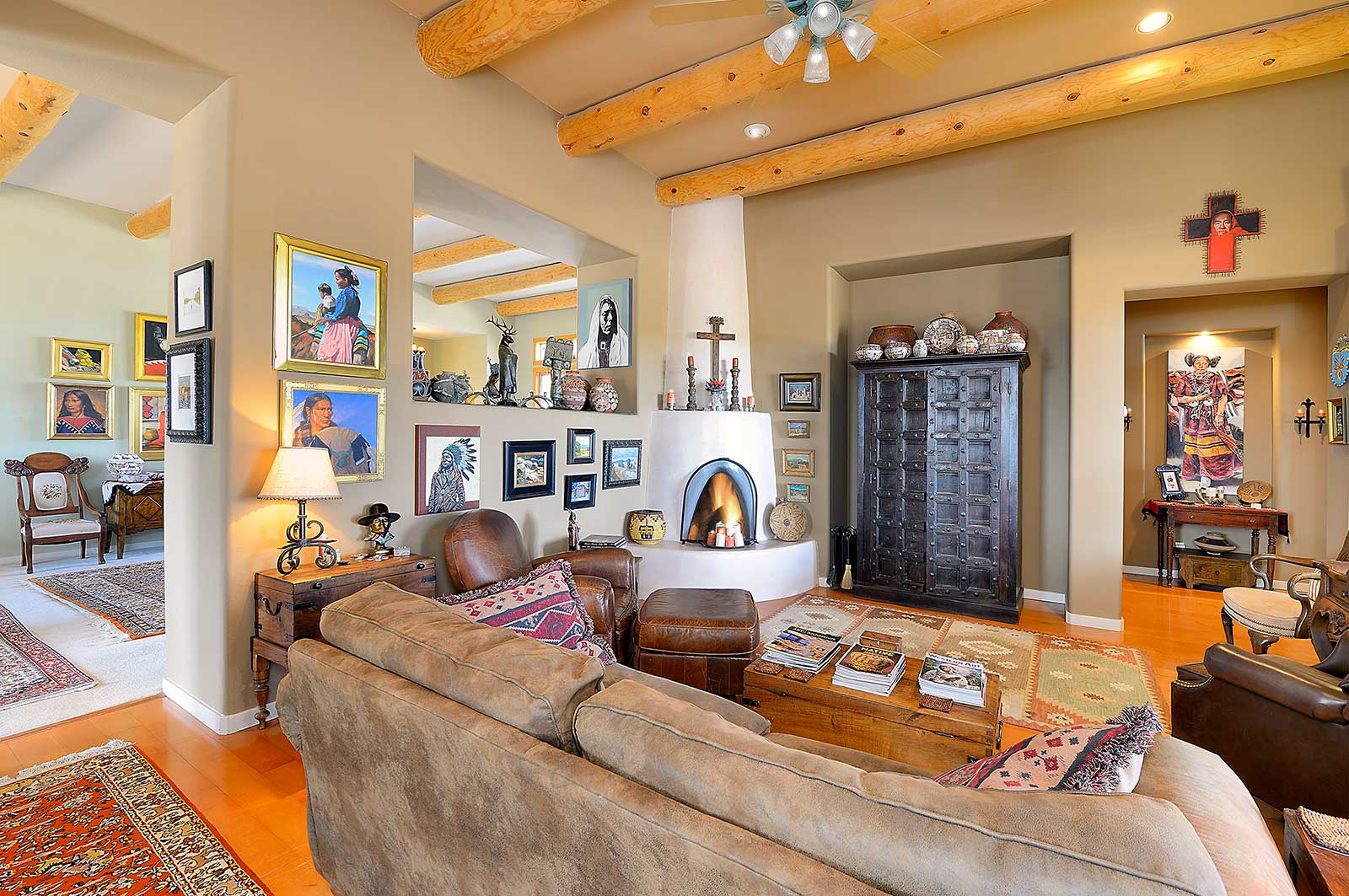 The Santa Fe home of Dugan McElroy features a vast selection of material that includes works by Western and Native American painters, bronzes, weavings and basketry, historic Native American objects, antique furniture and an exceptional collection of Pueblo pottery.
After the death of her husband in 2009, McElroy decided to move to Santa Fe where she now lives and collects. “I just love the feel out here,” she explains. The first piece of Western art she bought was a painting of a Native American by the Oklahoma artist Ron Owens. Since moving to Santa Fe, she has met and become friends with many artists and just buys what she enjoys. Following in her mother’s footsteps, there is an underlying theme of portraits of women.
She has met many artists through Nocona Burgess (Comanche) whose paintings are in her collection. She met Nocona through his father who was at an art show wearing an Oklahoma University sweatshirt which immediately caught McElroy’s attention. They began a conversation and he introduced her to Burgess. The rest, as they say, is history.
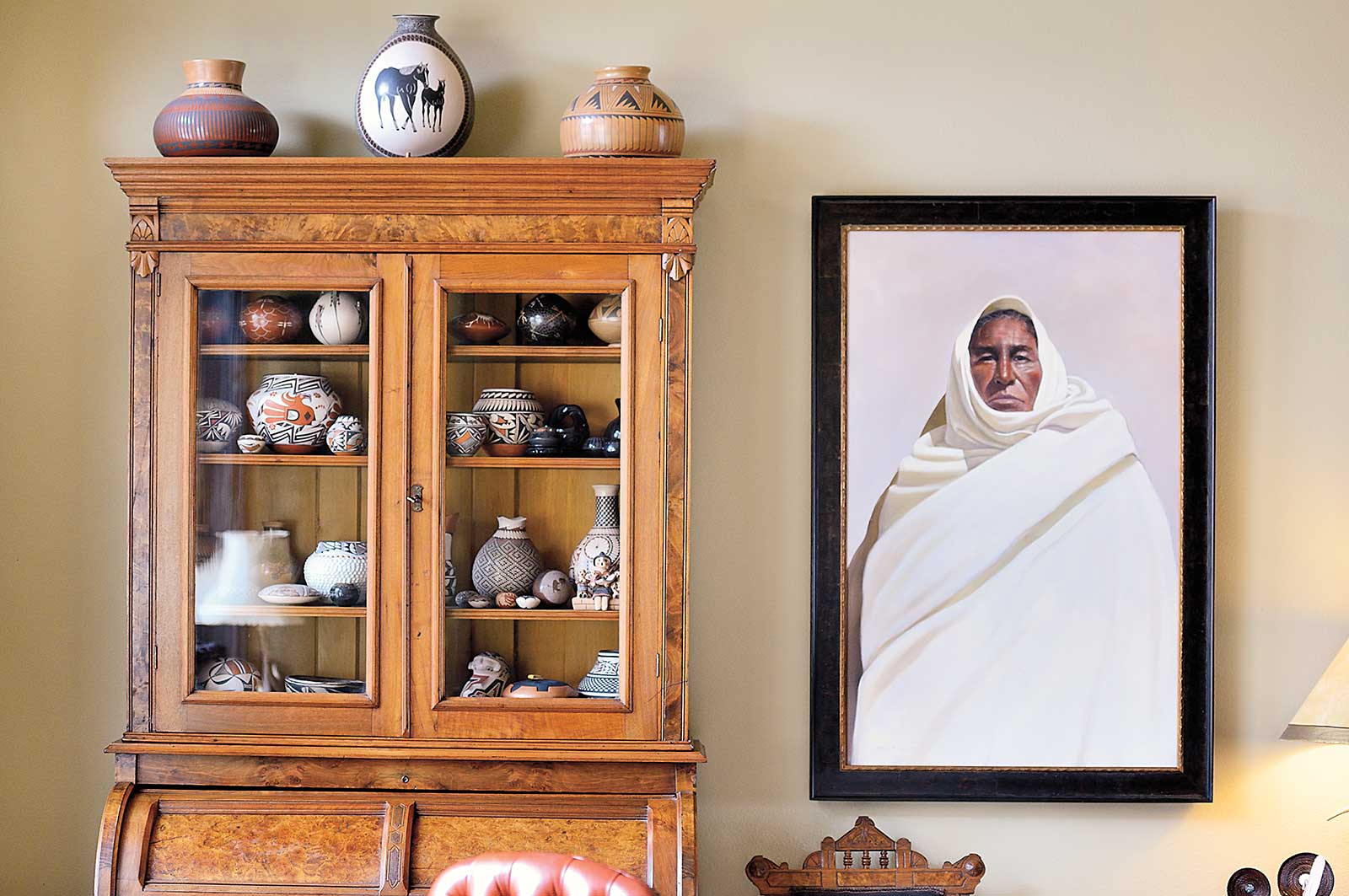 The walnut secretary belonged to one of the first doctor’s in the Oklahoma Territory and has been in the collector’s family for decades. It contains a collection of pottery items including an antique Hopi canteen that belonged to the potter Otellie Loloma, the wife of jeweler Charles Loloma. Also, there are Acoma ollas, San Ildefonso pottery from the family of Maria Martinez, and pottery from the Mata Ortiz tribe. On the right is The Past is Before Us, oil on canvas, by Roseta Santiago.
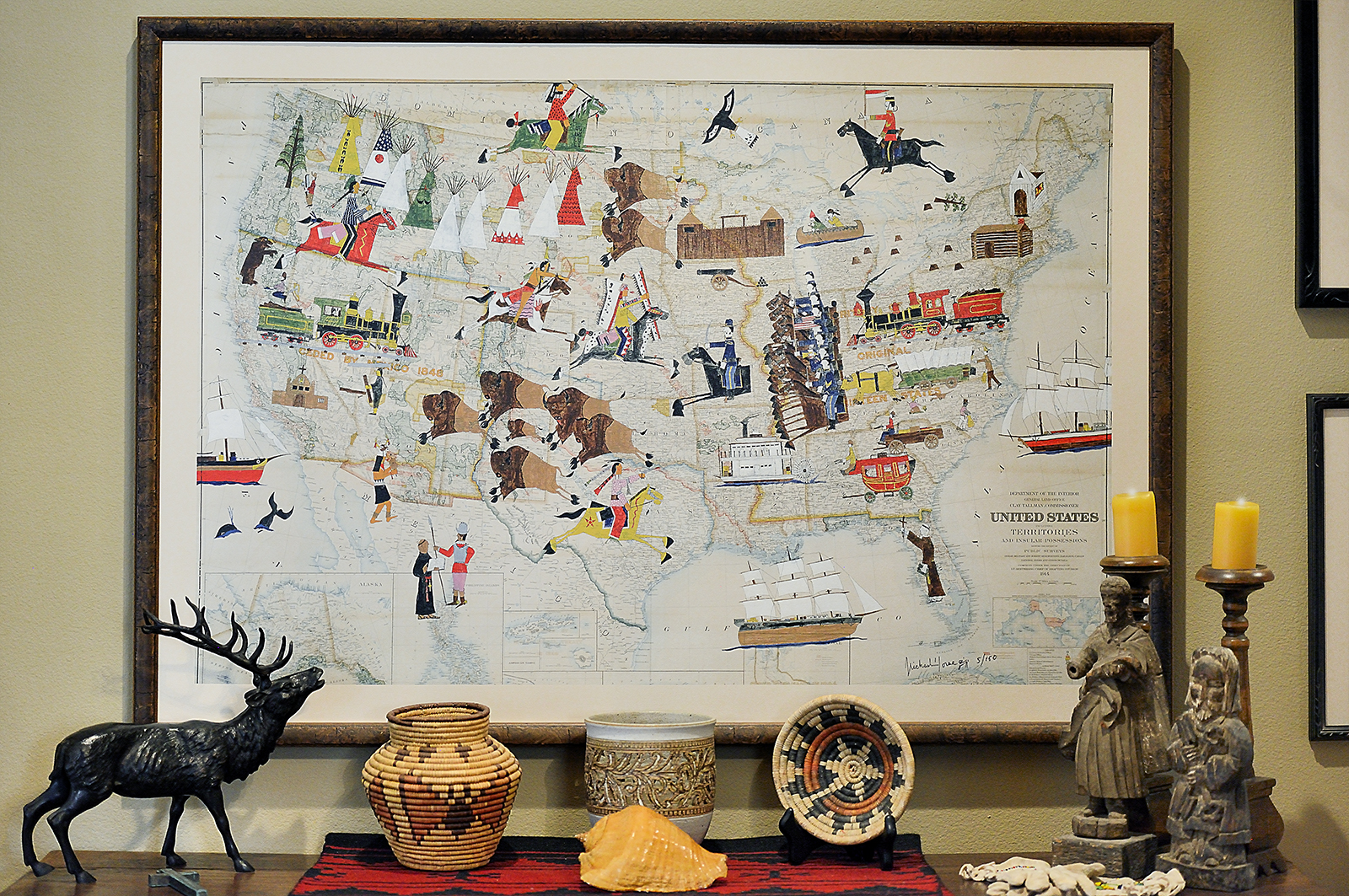 The large ledger painting depicting the history of the United States is by Michael Horse who is of Yaqui, Mescalero Apache and Zuni descent. Horse is also an actor who appeared as Deputy Hawk in Twin Peaks.
Her collecting strategy is relaxed. “I don’t go out looking,” she explains. “I go out and find.” Meeting the artists is an integral part of her collecting. She may meet an artist and then look for their art or she may find a work she likes and later seek out the artist.
“I feel a connection to the Native work,” she says. “I have a deep appreciation for Native cultural beliefs and art.” Among the non-Native artists, she admires the accuracy of the work and the way the artists depict history.
When I drove up to McElroy’s home I wasn’t sure I was at the right house, but I saw a Randy Chitto Koshare figure in the window and knew it had to be the right place. Randy is Mississippi Choctaw, lives in Santa Fe and was introduced to McElroy by Nocona Burgess. Her network of connections is rich and rewarding.
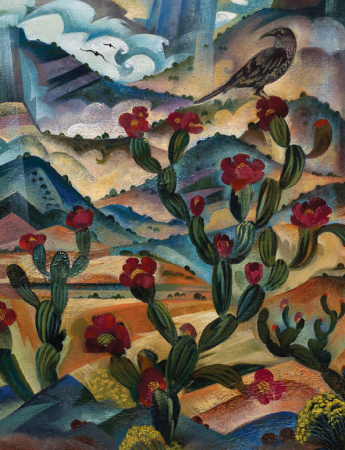
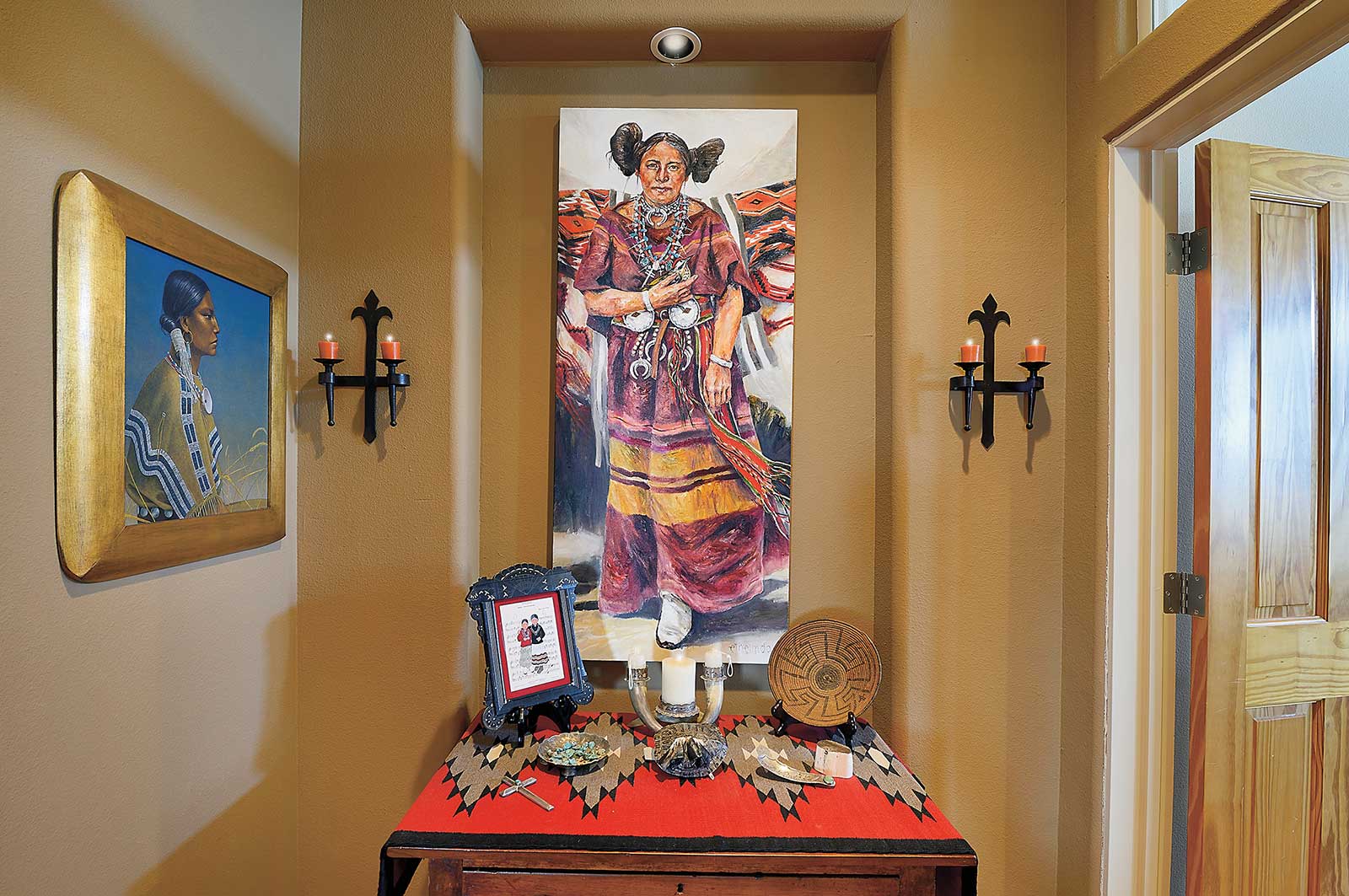 Ethelinda’s The Flicker, oil on canvas, commands the end of a hall. On the left is Portrait of a Plains Woman, oil on canvas, by Antoine Tzapoff. On the table are, left to right, The Jeweler’s Daughters, ledger art in antique frame, by Sheridan MacKnight (Hunkpapa Lakota, White Earth Chippewa and Scottish); a silver dish, silver shoehorn, a horn and silver lidded box and a horn and silver candle holder by Santa Fe artist Tom DeWitt; and Man in the Maze, an antique Pima basket. The table is covered with an antique Navajo weaving.
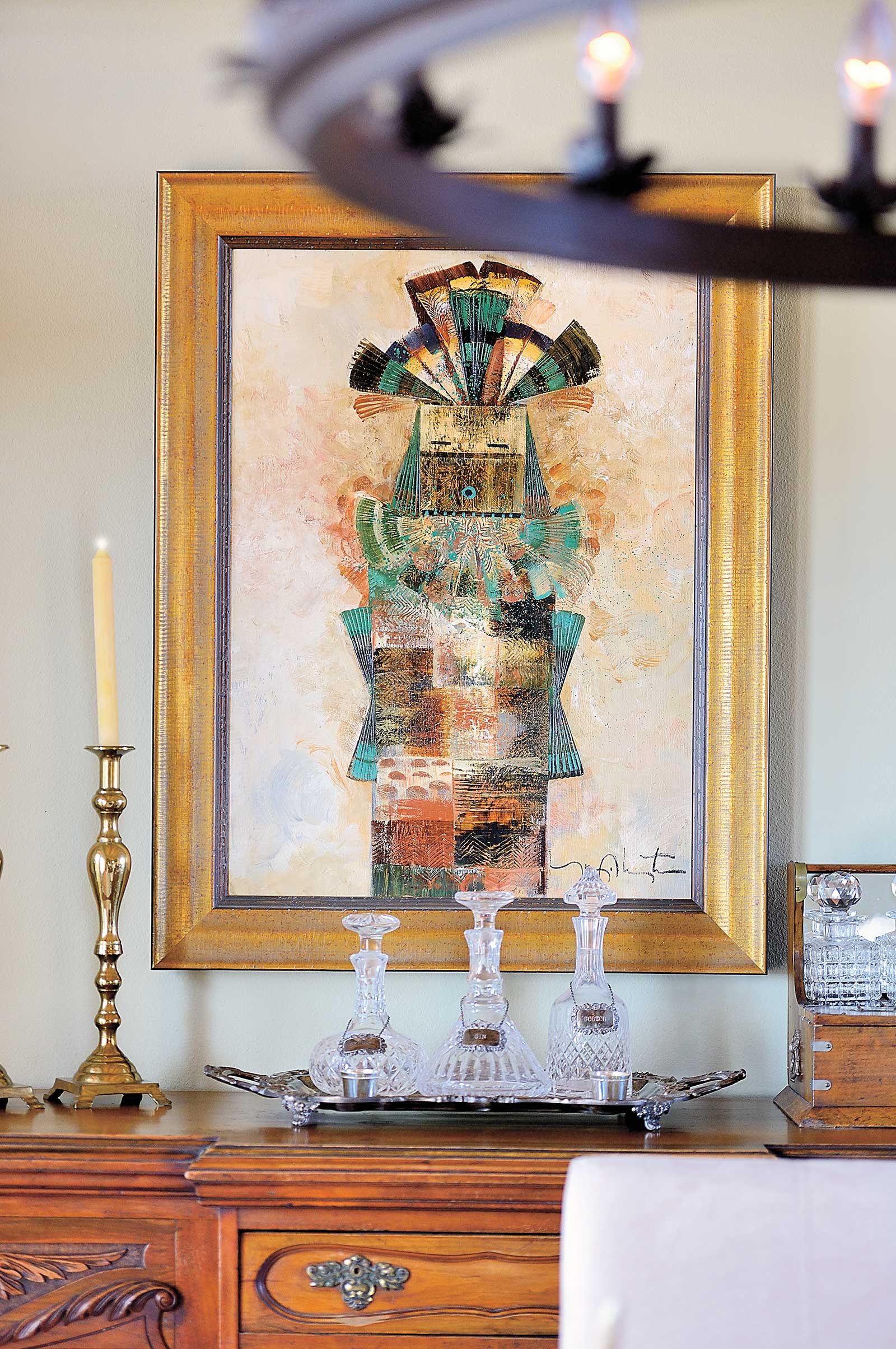 Above the table is an early oil painting of a katsina by Tony Abeyta (Navajo).
She met Roseta Santiago through mutual friends and Roseta invited her to visit her studio. “I fell in love with her pot paintings,” she explains, “and now collect her portraits and figure paintings.” In fact, there are 15 works by Roseta in the collection. “Roseta asked to borrow a photograph of my sons David and Ross when they were young. She surprised me one day with a painting based on the photo.”
Among her pottery collection is a selection of pieces by Robert Tenorio (Santo Domingo/Kewa). He makes traditional Santo Domingo pottery as well as pieces he decorates with train motifs. “Robert tells wonderful stories,” McElroy explains, “and he depicts them on his pots. He won a car as a prize one time but realized he needed a pickup. He traded the car for a pickup and there’s the pickup on his pot. Many of the stories on the pots are of Santo Domingo women selling pottery to tourists who came through on trains. He shows his grandmother trading a pot for a lamp—but she didn’t have electricity. I bought the pieces because of the stories. They make me happy when I look at them.”
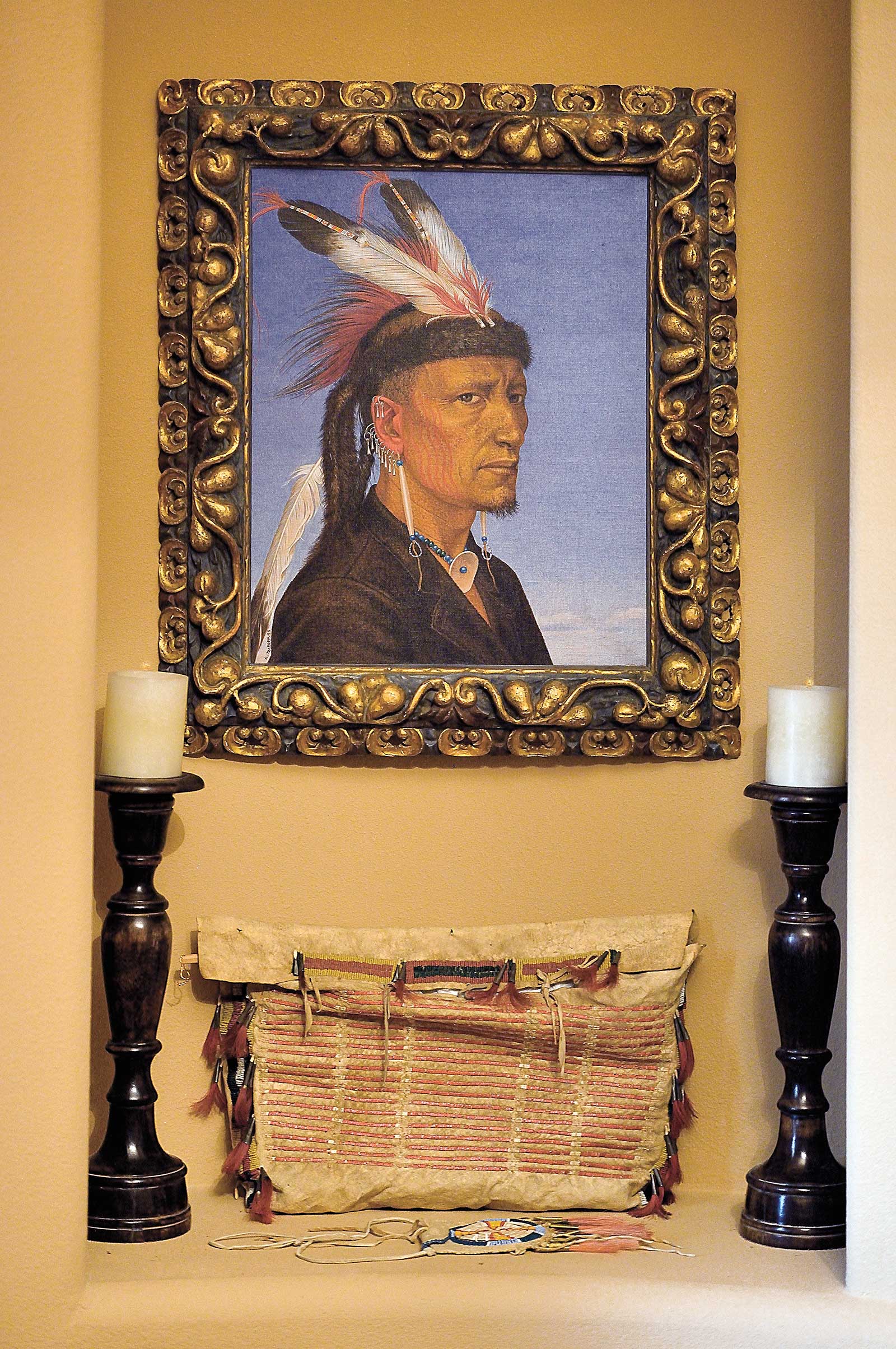 Antoine Tzapoff’s Portrait of a Plains Warrior, oil on canvas, hangs above a 19th-century Plains tipi bag featuring beadwork, quillwork, red-dyed horsehair and tin cones.
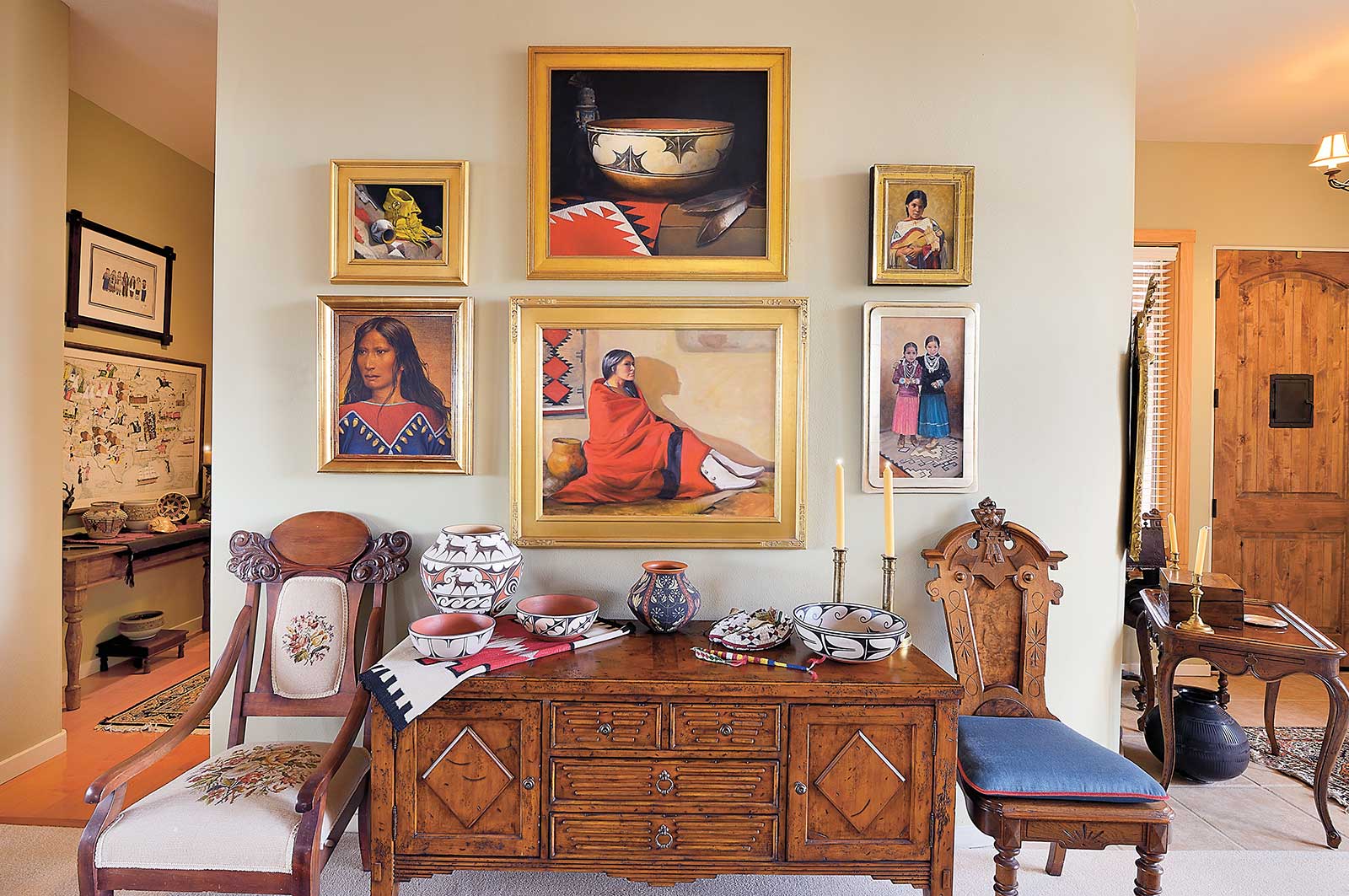 In the living room are—top row, left to right—Apache Moccasins, oil on canvas, by Roseta Santiago; her Santo Domingo Dough Bowl, Eagle Feathers and Kachina on Navajo Textile, oil on canvas; and her oil The Doll. On the bottom row are Plains Woman, oil on canvas, by Antoine Tzapoff; Santiago’s Navajo Girl in Red Trade Banket and The Jeweler’s Daughters, oil on canvas, also by Santiago. On the table are three vintage Santo Domingo dough bowls and a vintage Zia olla. In the center is Wildflowers, a pot by a Richard Zane Smith (Wyandot). Next to the Smith are mid-20th century beaded Sioux moccasins and an awl case. The chair on the left is an antique “watermelon chair” an heirloom from the family of the collector’s late husband.
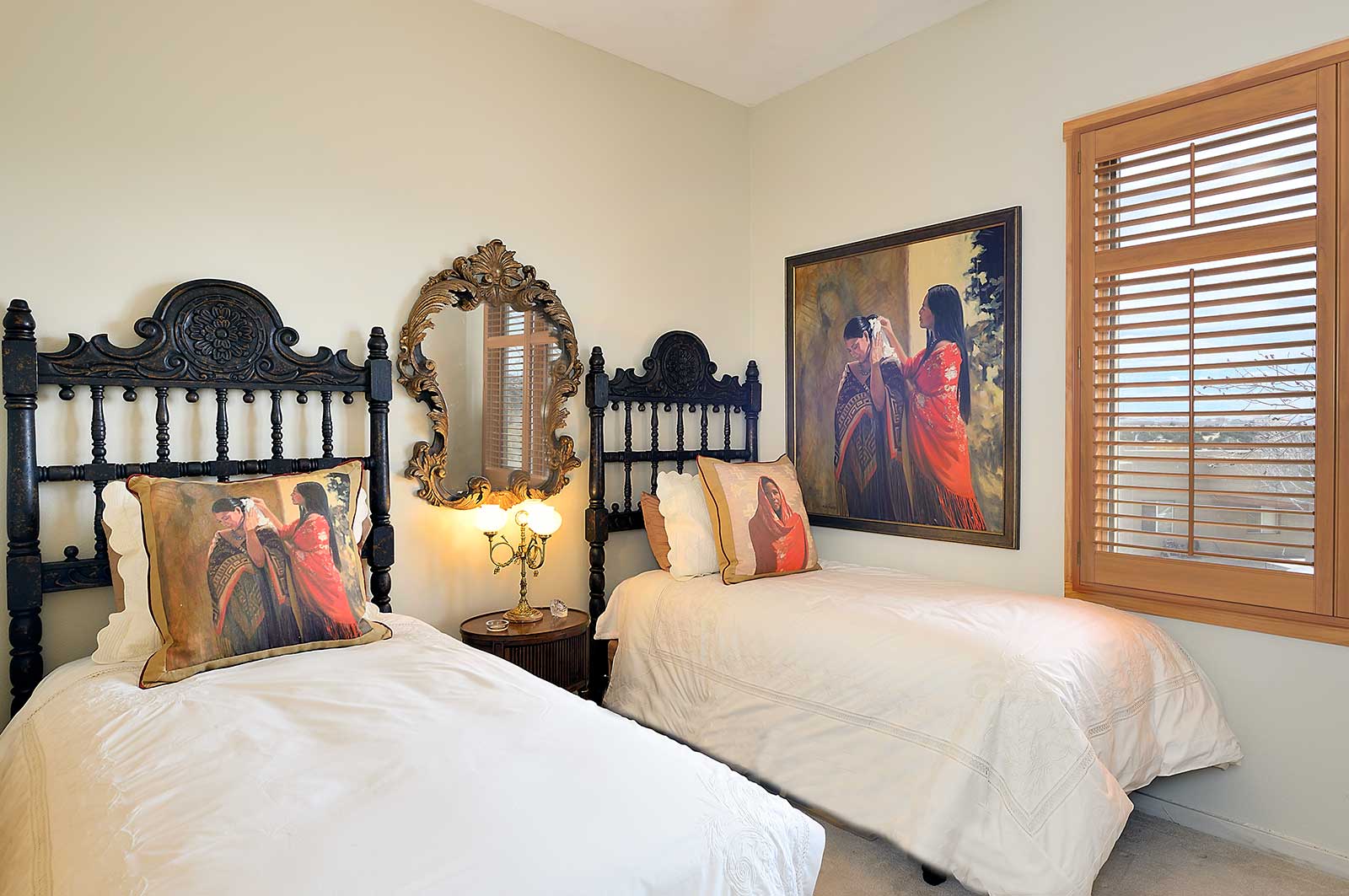 In a bedroom is Roseta Santiago's oil on canvas, Guadalupe Street at Garfield, 2018. The pillows bear reproductions of paintings by Santiago.
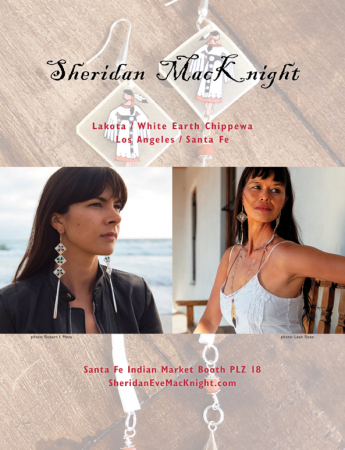
She also has a collection of Sheridan MacKnight’s ledger art. Sheridan is Hunkpapa Lakota, White Earth Chippewa and Scottish. McElroy is attracted to the fact that ledger art is actually painted on pieces of history, often ledger pages, and, in the case of Sheridan MacKnight, popular sheet music and pages from Lakota hymnals. She often depicts children preparing to go off to boarding schools, looking sad and scared. “My Choctaw grandparents went to boarding school,” she explains. The Choctaw General Council established six boarding schools in 1842. Originally run by missionaries, educated Choctaws soon took them over. The schools were an example of a tribe educating its members rather than the federal government imposing a foreign culture.
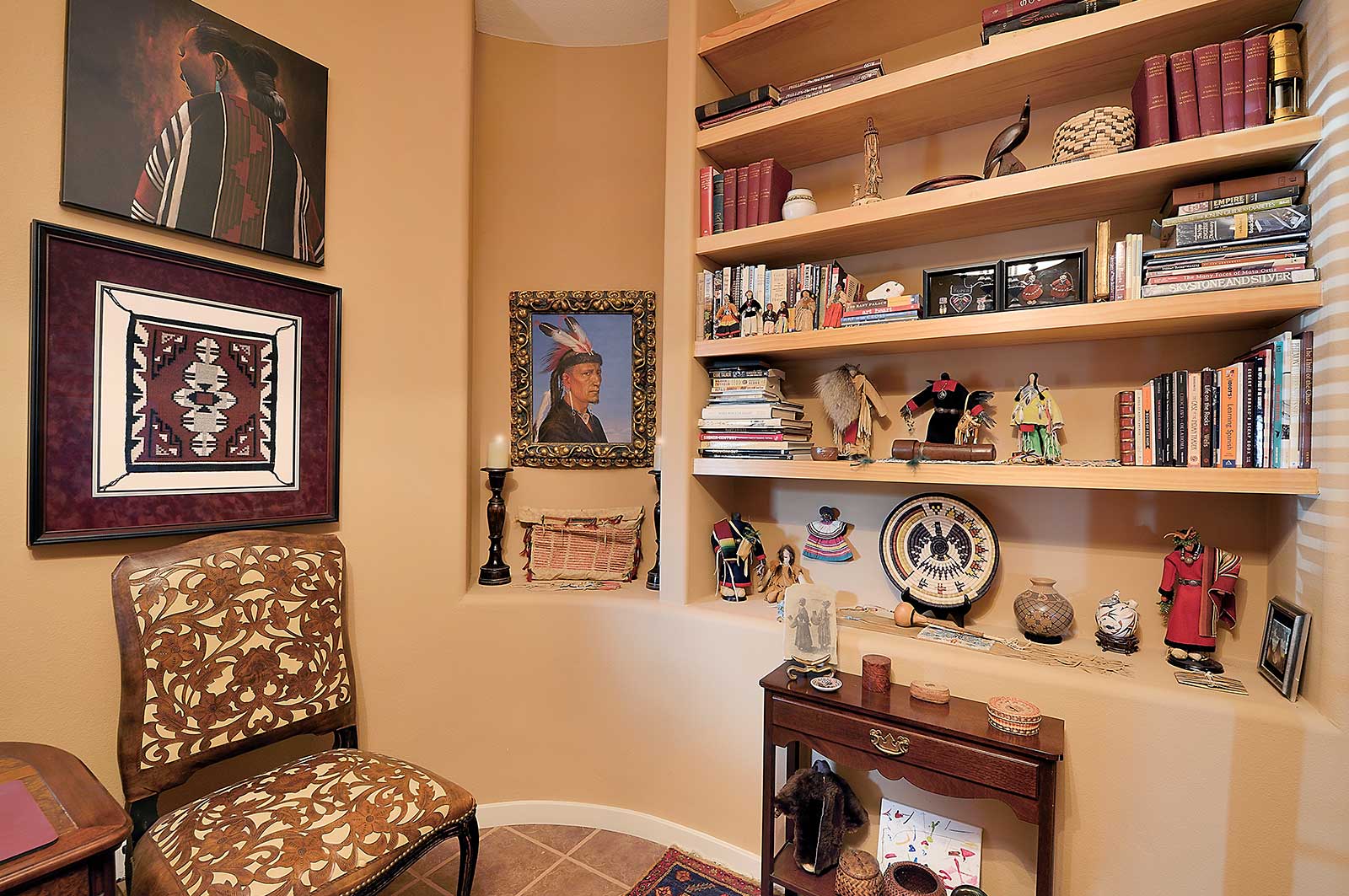 Pottery, baskets, small hand-made dolls, carvings and miniature sculptures line shelves next to Antoine Tzapoff’s oil painting Portrait of a Plains Warrior in the wall niche. Below the painting is a 19th-century Plains tipi bag featuring beadwork, quillwork, red-dyed horsehair and tin cones.
McElroy’s collection had an unexpected influence on her son David, then a lawyer in London, when he visited his mother in Santa Fe. He became intrigued by the silver boxes in her collection and by a visit to the studio of silversmith Tom Dewitt. He began working with silver and later moved to Santa Fe. He has since exhibited in Santa Fe Indian Market as well as the Heard Museum Guild Indian Fair & Market. (David’s own collection was featured in the November 2017 issue of this magazine.)
“I don’t consider myself a serious collector,” McElroy comments. “I buy what touches me and I enjoy it every day.”
Powered by Froala Editor