Over a year later, memories of the global pandemic are still here, raw and fresh. Something else is still here, surviving and in some cases thriving. This is what so many incredibly talented Native American artists want the world to know: Despite how people of color were especially hard hit by Covid-19, they are still creating art. They are still here.
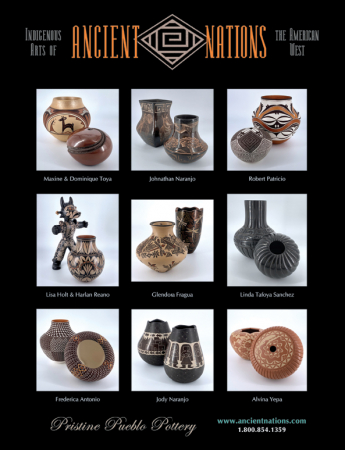
What is normally the first major show of the year, the annual Heard Museum Guild Indian Fair & Market went off as usual in March 2020. Afterwards, Jemez Pueblo potter Glendora Fragua packed up and headed back home to Albuquerque, New Mexico. “As we drove out, there were only one or two cases (of Covid) in the Phoenix area. And when we got back, that’s when the whole thing started.”
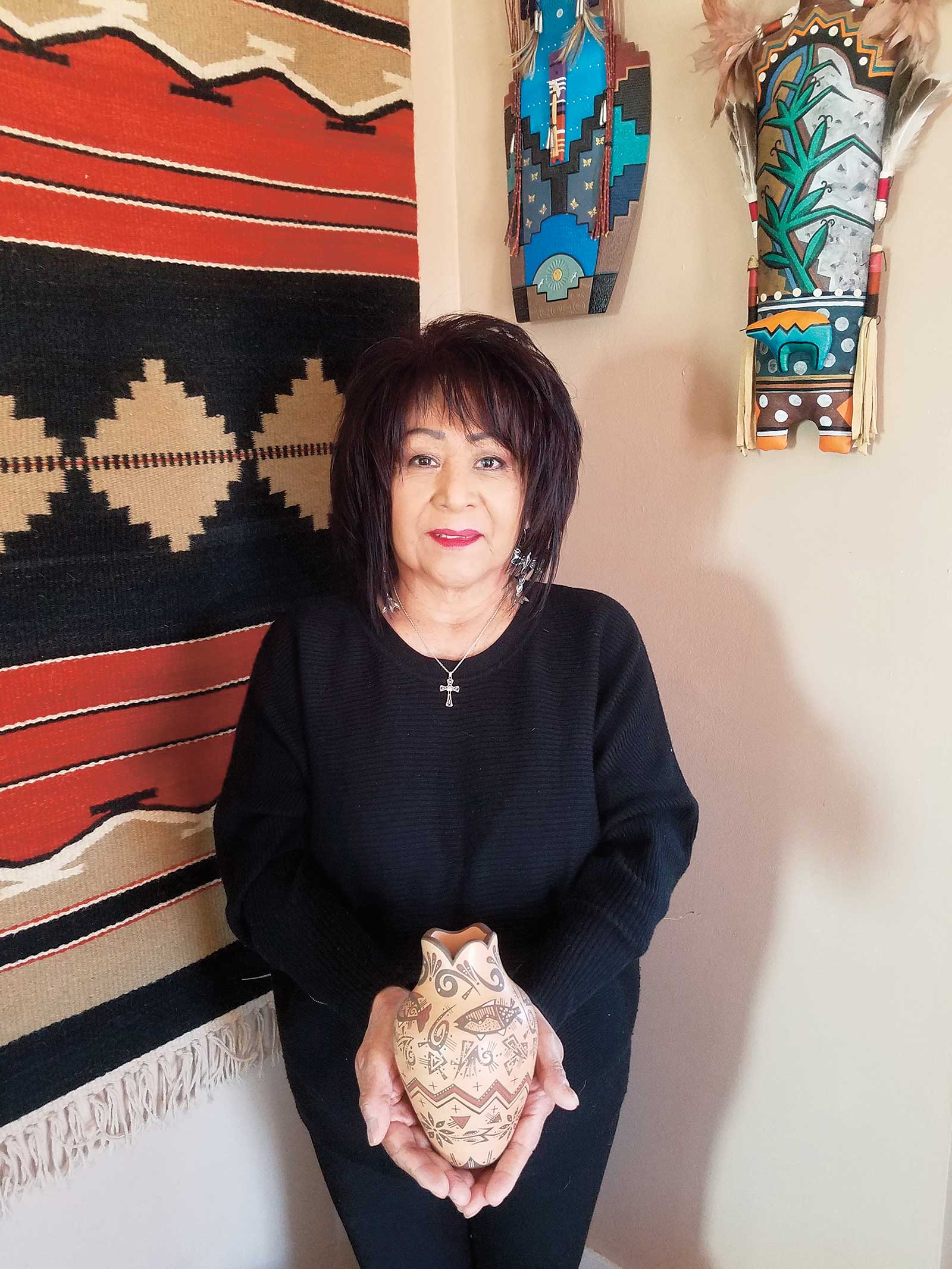 Jemez Pueblo potter Glendora Fragua with one of her pots. During the pandemic, the artist experimented with new mediums.
Eighteen-year-old Navajo painter Penelope Joe says the pandemic came to the Navajo Nation during her high school’s spring break. “I remember that announcement on KTNN (Navajo radio station) that morning. When you’re young, you never think something like this could happen at all.”
Penelope says the first three weeks, they locked their gate and didn’t go anywhere. “I’m not gonna lie. We were scared ‘cause my grandparents are elders. My mom and me had to protect them.”
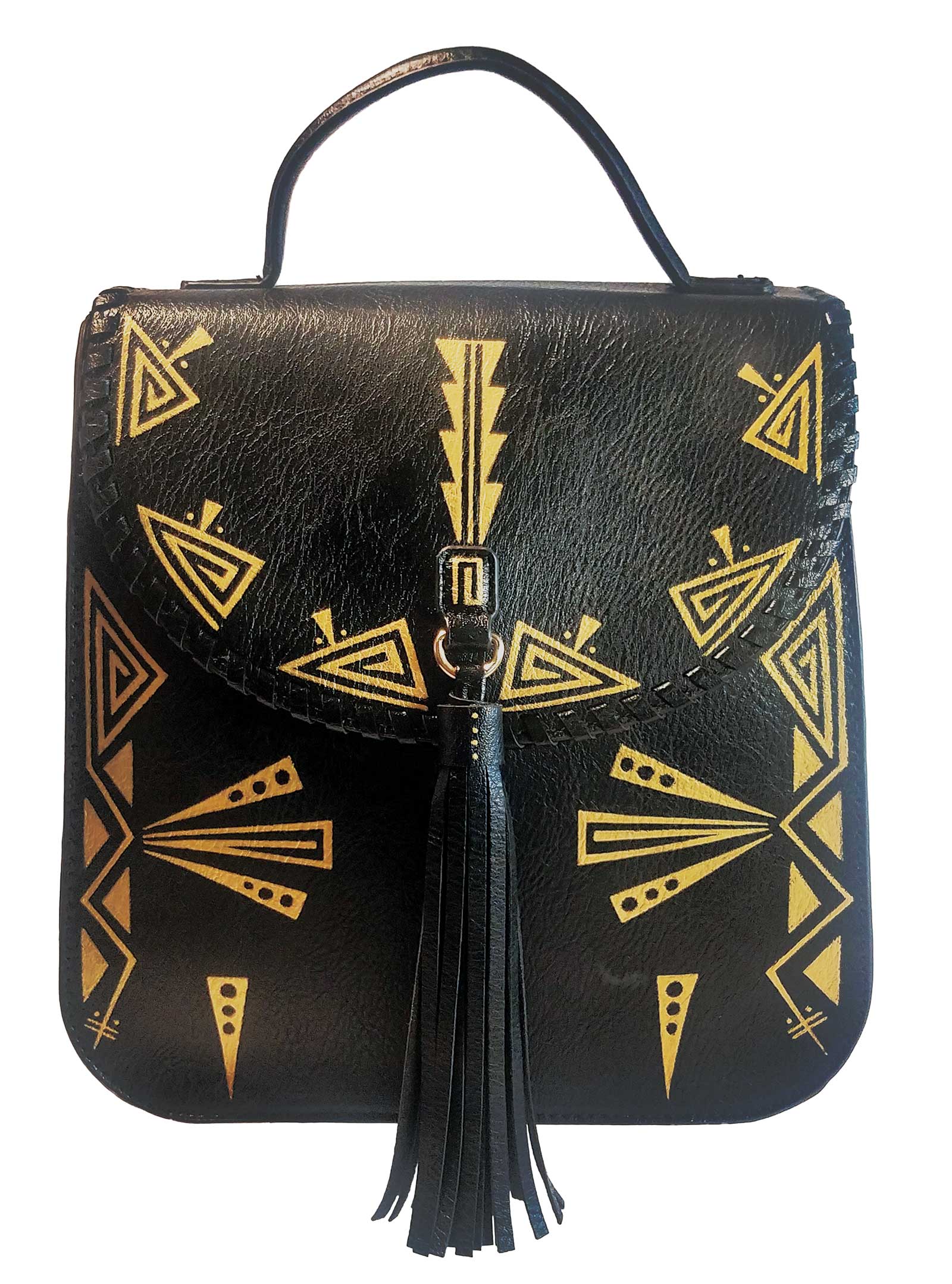 Glendora Fragua (Jemez), painted purse. Courtesy the artist.
Barbara Jean Teller-Ornelas is a Navajo tapestry weaver living in Tucson, Arizona. Her nephew was a home health care worker living with Barbara and her son. He caught Covid at the end of March 2020, unknowingly bringing it home to his cousin and aunt. “Around April 5, we all got sick,” she recalls, “but my nephew was worse than us. So I called an ambulance on [April] 14. They took one look at us and said, ‘You all need to go in. You’ve got the virus.’ We had no idea this was happening.”
All three went into ICU. Barbara had pneumonia as well, and was hospitalized for nearly three weeks. Her nephew, however, was intubated right off. He died nine days later.
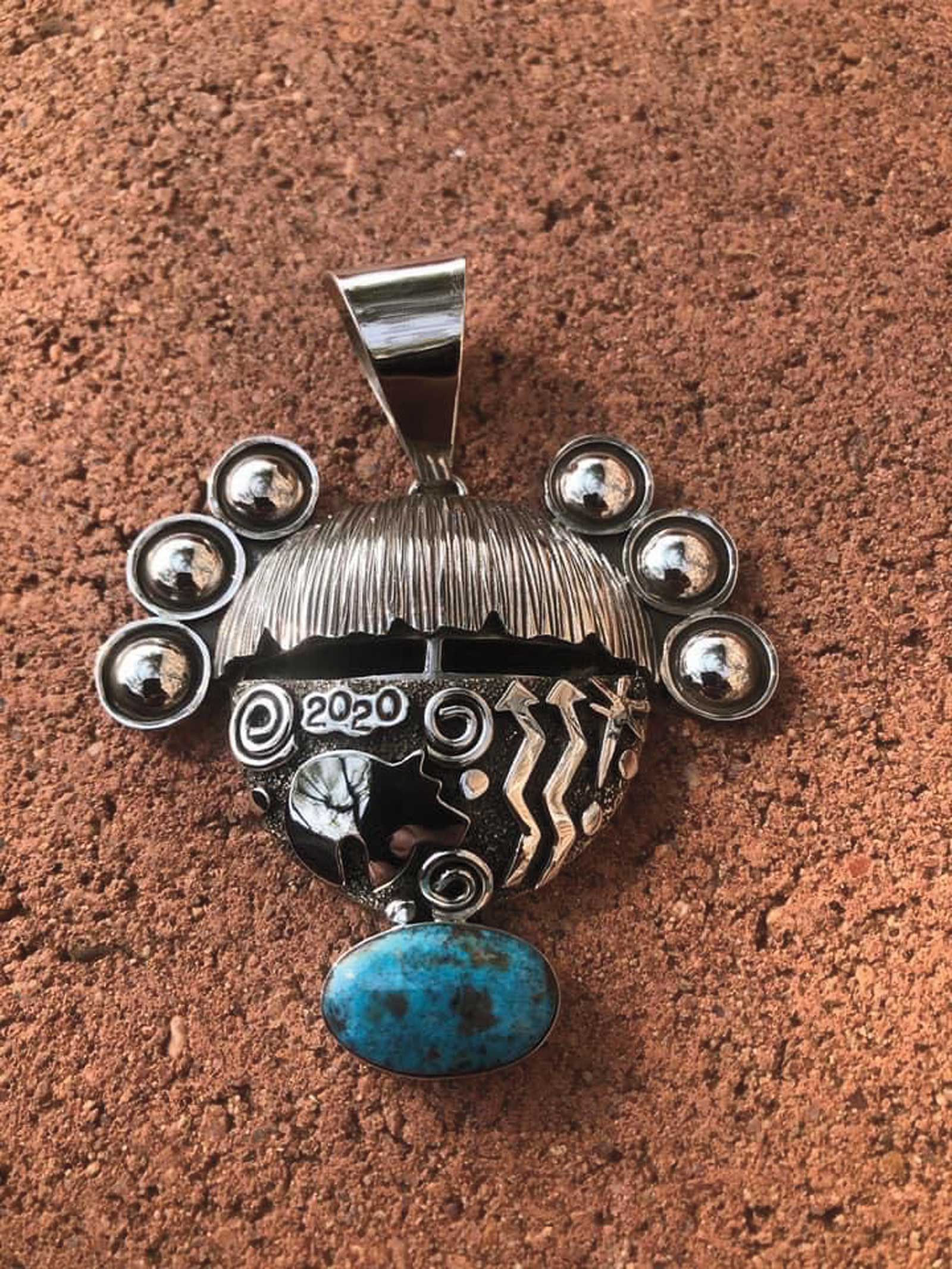 Alex Sanchez (Navajo/Hopi), silver pendant with turquoise. Courtesy the artist.
“My son was OK for the first couple of days,” Barbara recalls, “and then he went downhill real fast. They intubated him, and he was on a ventilator for 50 days. He was in a coma the whole time…and was in the hospital for three months, then three months in rehab. He had to re-learn how to walk and talk.”
Elvie VanWinkle, a master weaver of Navajo textiles, says the sickness spread like wildfire across the Navajo Nation. “I think because we didn’t understand much of what the virus was about,” she says. “In the beginning, people continued to get together, visit each other, shake hands, because shaking hands and saying hello is big among the Navajos…we didn’t know that much about the virus.”
“It hit hard those that live out in the rural areas, those with no running water, no electricity,” Vanwinkle says. “Some of the leaders and some of the community people delivered hand-washing stations to some of the individuals who live out in the rural areas.”
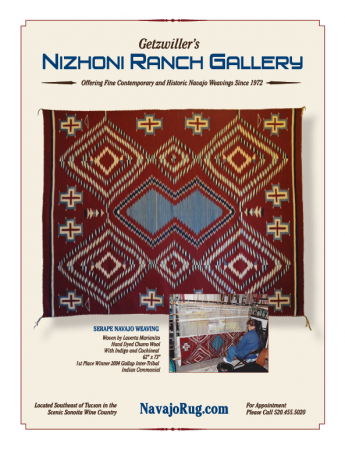
Steve and Gail Getzwiller, owners of Nizhoni Ranch Gallery, work closely with about two dozen Navajo weavers, some being the second and third generation in their family weaving exclusively for the gallery. “We did work with Red Feather (a non-profit), donating to them to help during this time,” says Gail Getzwiller. “They had an organized group and on-the-ground success in providing washing stations, etc., across the Navajo reservation.”
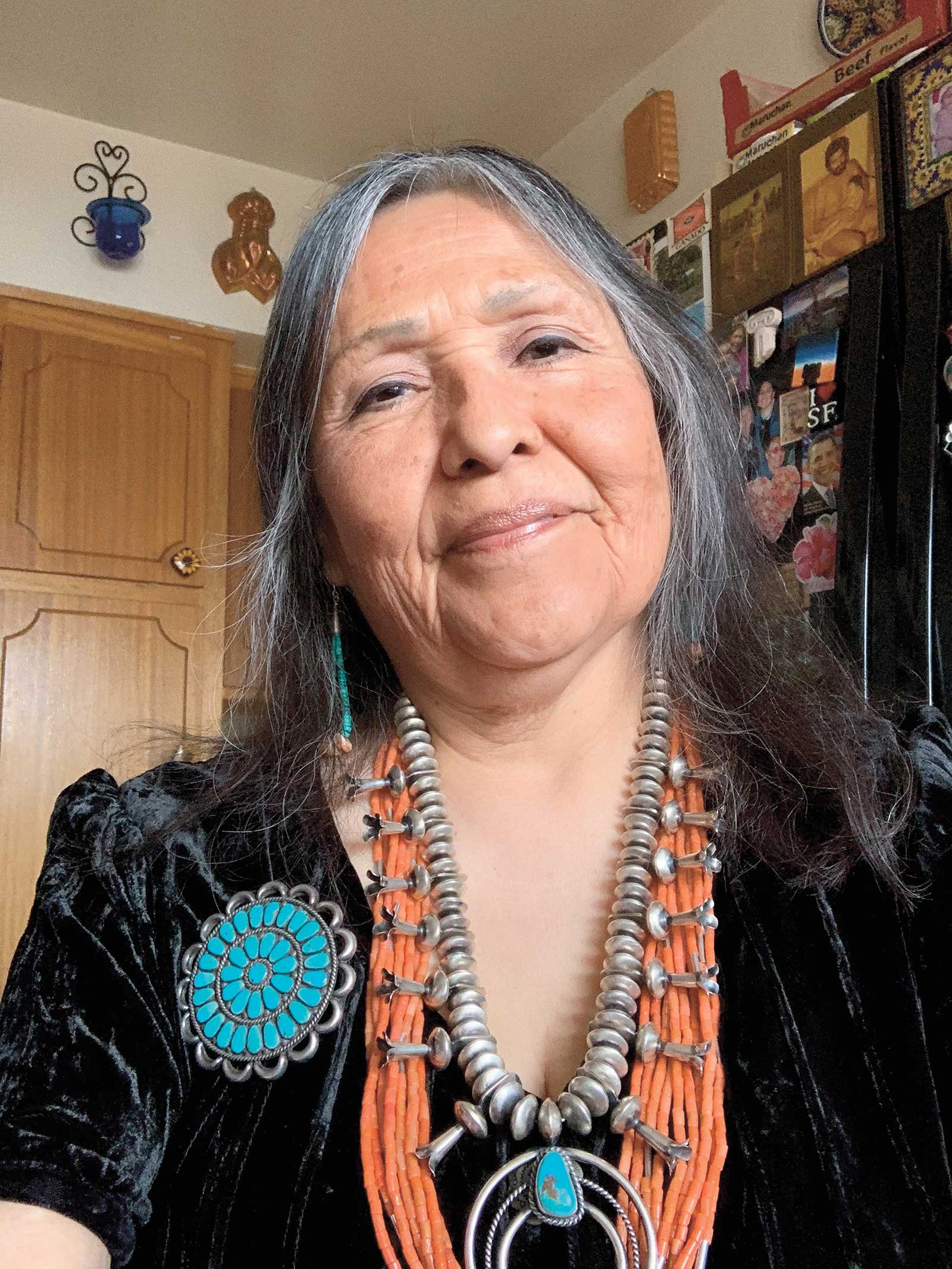 Navajo weaver Barbara Jean Teller-Ornelas had a dangerous case of Covid that kept her from her loom for nearly a year.
The Getzwillers normally send churro wool and other rug-making material to weavers, but they're now tucking in hand sanitizers, toilet paper and other essentials.
Alex Sanchez, a Navajo/Hopi jeweler living in Gallup, New Mexico, saw another need on the reservation: masks and gloves, which he said the elderly especially didn’t understand. “They’d share (masks), husbands and wives would,” he says. “Some of the masks were old and just dirty. I bought (some), and whatever people helped with I matched…5,000 masks, 5,000 gloves. I went out to communities and passed them out. Three times I did that.”
“So many people donated so much; truckloads of water, bottled water, hand sanitizer, masks, you name it,” says VanWinkle. “People helped out…our people…my people.”
The economic blow to artists was immense. Reservations were on lockdown. Galleries closed, and, even more importantly, suppliers artists used for materials were closed.
Penelope Joe started painting when she was 12, winning first-place awards when she was 13. This young woman with big dreams creates big art, on big canvases; kitchen-table sized. Ordering online was a problem, since most will only deliver to physical addresses, which remote areas on the reservation simply don’t have.
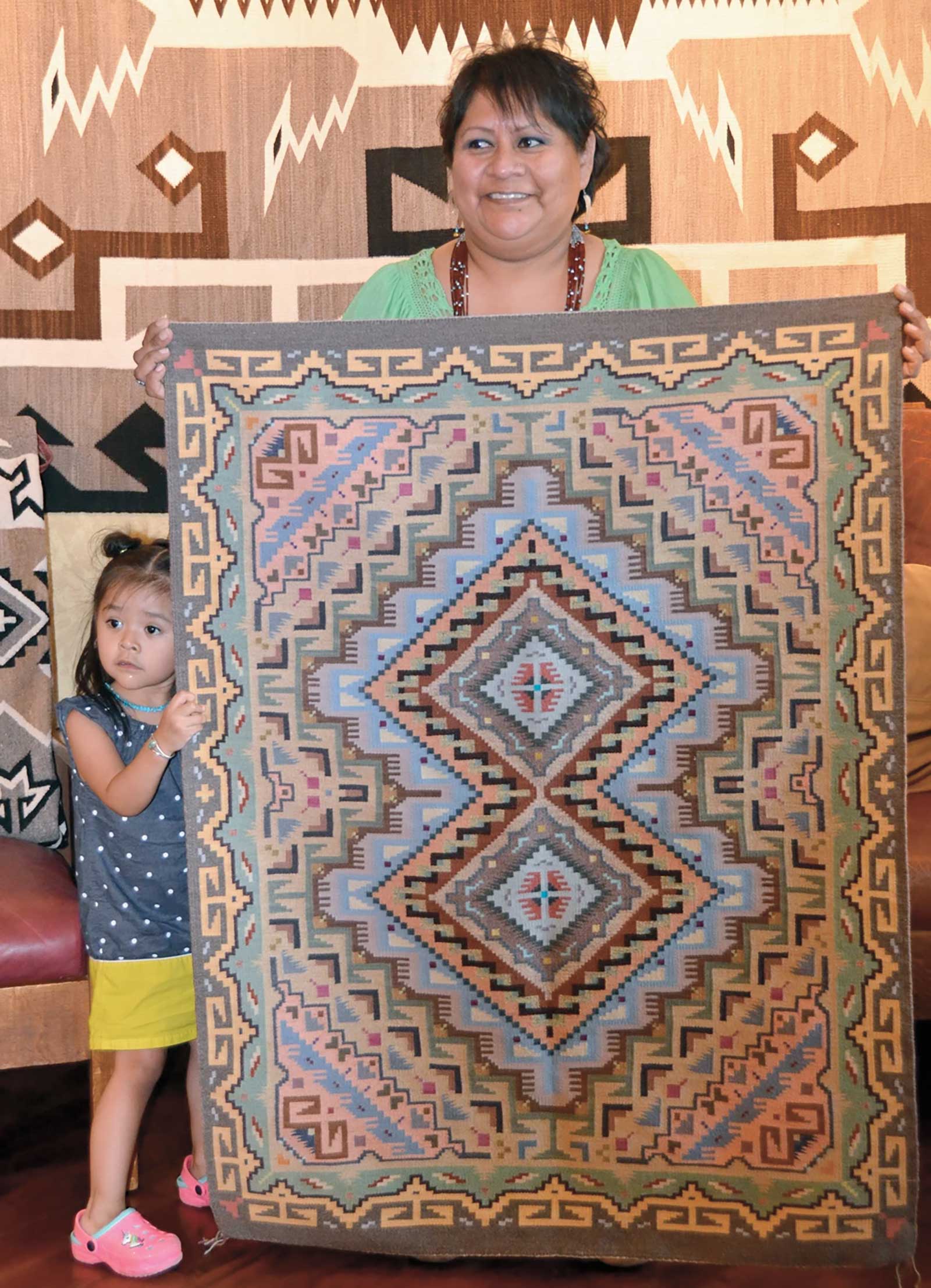 After catching Covid-19 in January 2021, Navajo weaver Elvie VanWinkle was afraid to even touch her work in her studio. She has since fully recovered and is weaving again.
Thema Tsosie, Penelope’s aunt, was trying to find canvases from smaller online art shops. “They have the hardest time with the post office to even deliver to the house. At times, we had to wait by the main road, but then you couldn’t be on the road for anything, so it was a real struggle. It wasn’t easy.”
Tanner’s Indian Arts in Gallup specializes in jewelry crafted by Native American artists. Joe and Cynthia Tanner and their daughter Emerald, learned suppliers of silver, gold and lapidary materials were closed like galleries and other retail. Then Joe Tanner had an idea. “What I remember,” he said, “was reviewing the uncompleted silver and gold work in the safe, waiting to be set.” Joe decided to give these unfinished pieces to certain young jewelers he worked with.
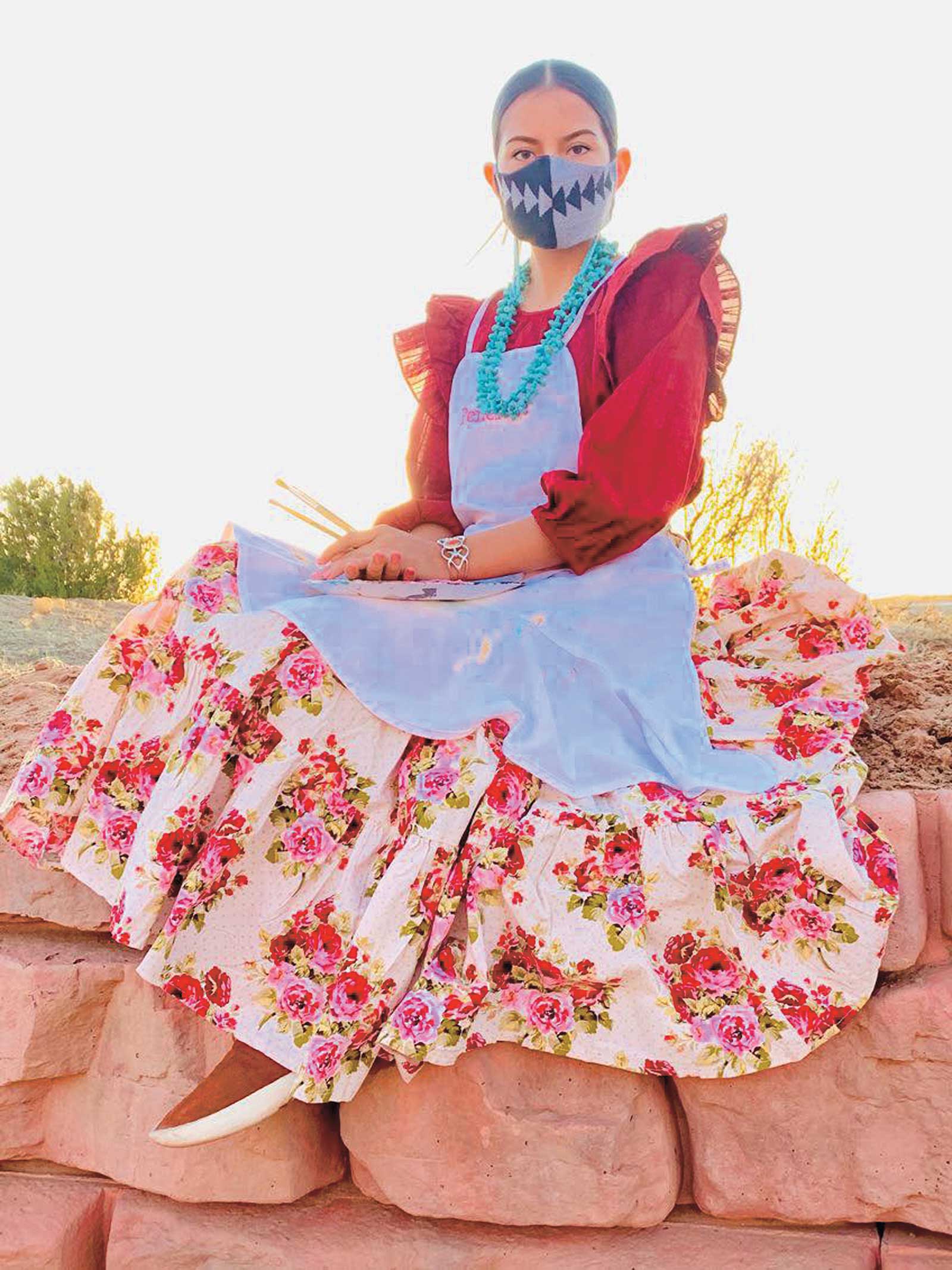 After catching Covid in November 2020, 18-year-old Navajo painter Penelope Joe had to care for her family, who were also sick. She used painting to bring joy back into her life.
“Dad has a long history of being that sort of catalyst putting artists and talents together,” says Emerald Tanner. “I think really why we drew on that and why we did so much of it is, of course, because the silver was limited, but it really gave us an opportunity to couple this new, modern talent with these granddaddies of contemporary Native American jewelry like Preston Monongye, Lee Yazzie and [Charles] Loloma.”
Emerald says their headquarters became the Taco Bell parking lot, where she’d meet up with the cadre of young jewelers who now had the opportunity to take unfinished pieces, some older than they were, and bring these pieces to life.
“That’s what really sparked the concept,” says Emerald. “It’s something we felt could be our contribution to keeping these artists that were so focused and excited to be on board with us.”
As the year and the pandemic continued, show venues and galleries were either closed or operating virtually. The Tanners used Zoom to stay in touch with their clients. Nizhoni Ranch Gallery already had a strong online presence. “Internet sales actually increased during Covid,” says Gail Getzwiller. “We have been blessed that we can continue to help and be a place for weavers to market their works.”
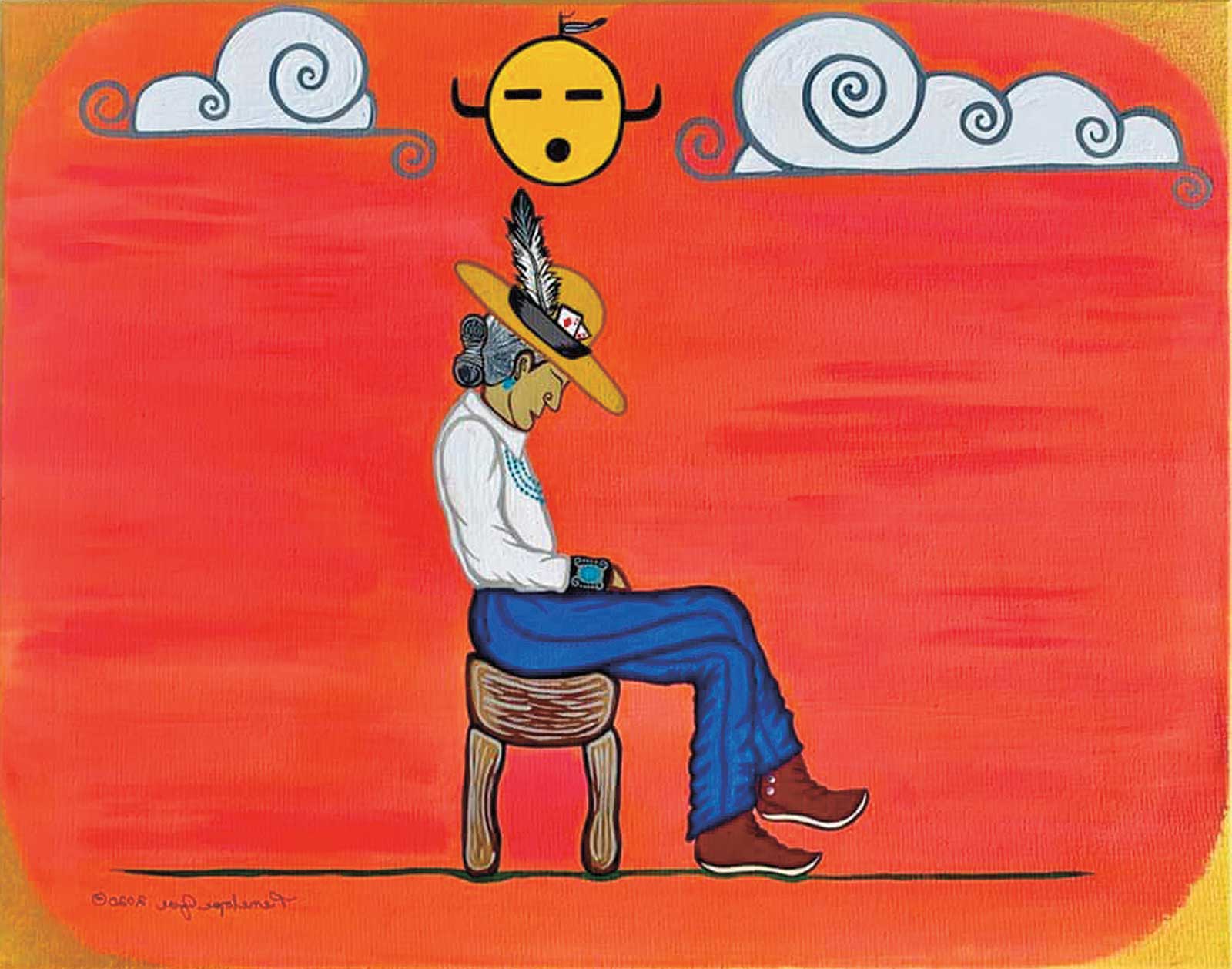 Penelope Joe (Navajo), untitled work. Courtesy the artist.
And for that, VanWinkle and the other weavers in her family are grateful. “We are probably some of the lucky ones to work with Steve, because he’s continued to buy from us in this pandemic.”
Glendora Fragua depended on shows to sell her pottery and, after the Heard, it became pretty apparent there weren’t going to be any more for a while. She had never posted any of her pots for sale on Facebook before. She tried it…and quickly sold out. “I was really surprised!” she says. “So I was thinking ‘What other things can I do?’”
She bought black masks, and painted her designs on them. When those sold, she tried women’s hats and men’s baseball caps, then earrings and purses, even shoes, all with her designs beautifully painted on. Her new business model worked.
For Penelope Joe, she had to put her painting on hold for about two months until canvases finally came in. But the first ones she received were 8 by 10 inches, tiny when compared to the 5-by-7-foot canvases she had been working on. “I was so mad,” she recalls. “But my mother told me, ‘maybe this is just telling you to learn how to do smaller art and teach yourself.’ That’s what I did.”
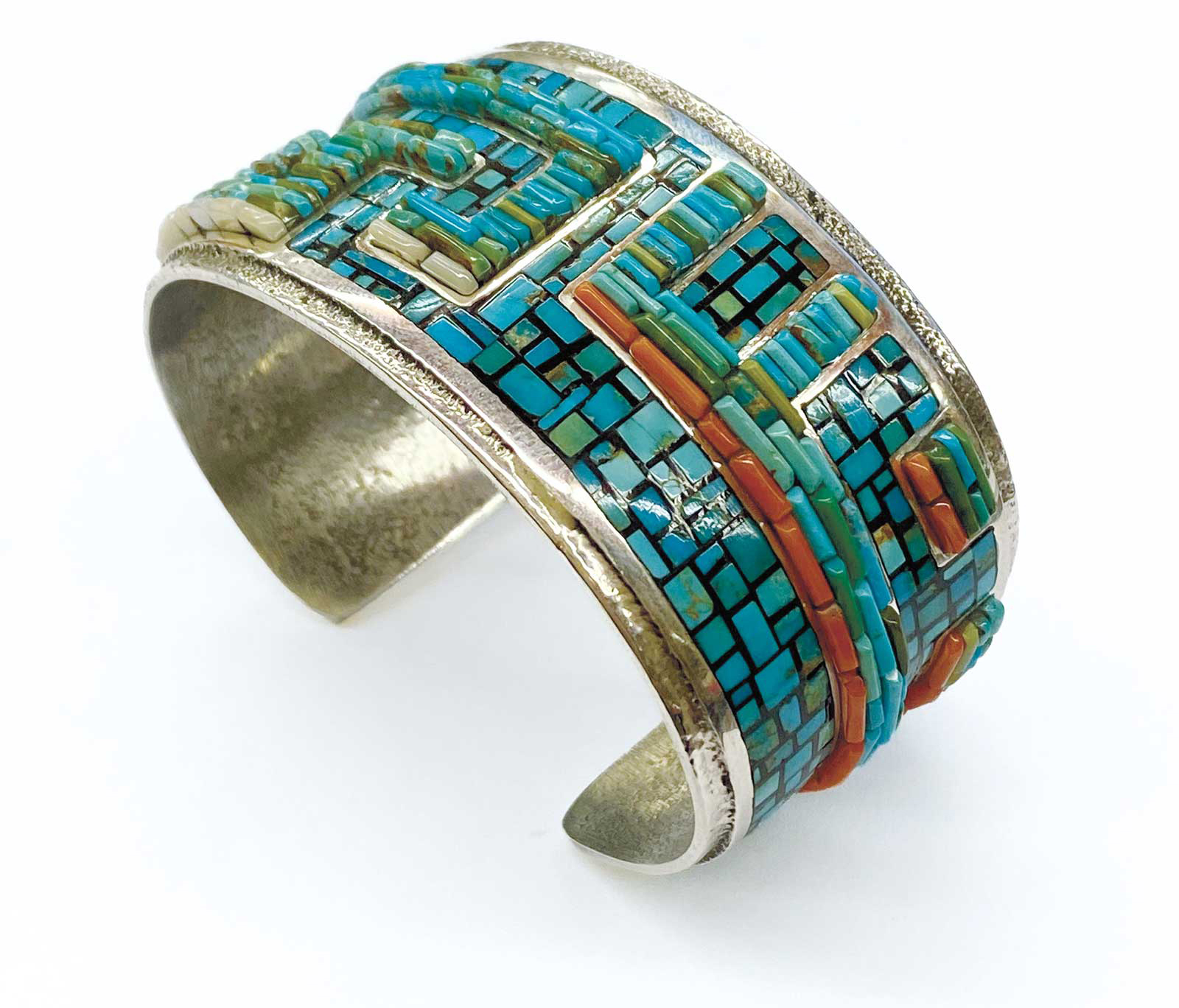 A mid-1960s Preston Monongye (Hopi) turquoise bracelet completed by Bryan Tom (San Felipe Pueblo/Navajo) in 2020. During the pandemic, during periods where materials were hard to find, Joe Tanner from Tanner’s Indian Jewelry asked contemporary artists to complete unfinished pieces from their vault. Courtesy Tanner’s Indian Jewelry.
She was working hard on her art, and with her aunt, to finally have an online presence. That plan derailed in November when her grandparents caught the virus, which spread to Penelope and her aunt. All four were hospitalized, and when they came home, it was Penelope who looked after everyone. Her painting, which brought her such joy, was back on hold.
In January, Alex Sanchez became sick with Covid, as did his wife. Doctors in Gallup said he needed to be on a ventilator and was flown to an Albuquerque hospital. Fortunately, his breathing improved there without a ventilator, but he remained on oxygen for several weeks afterwards. He’s off of it now, thankfully, and is back to creating jewelry.
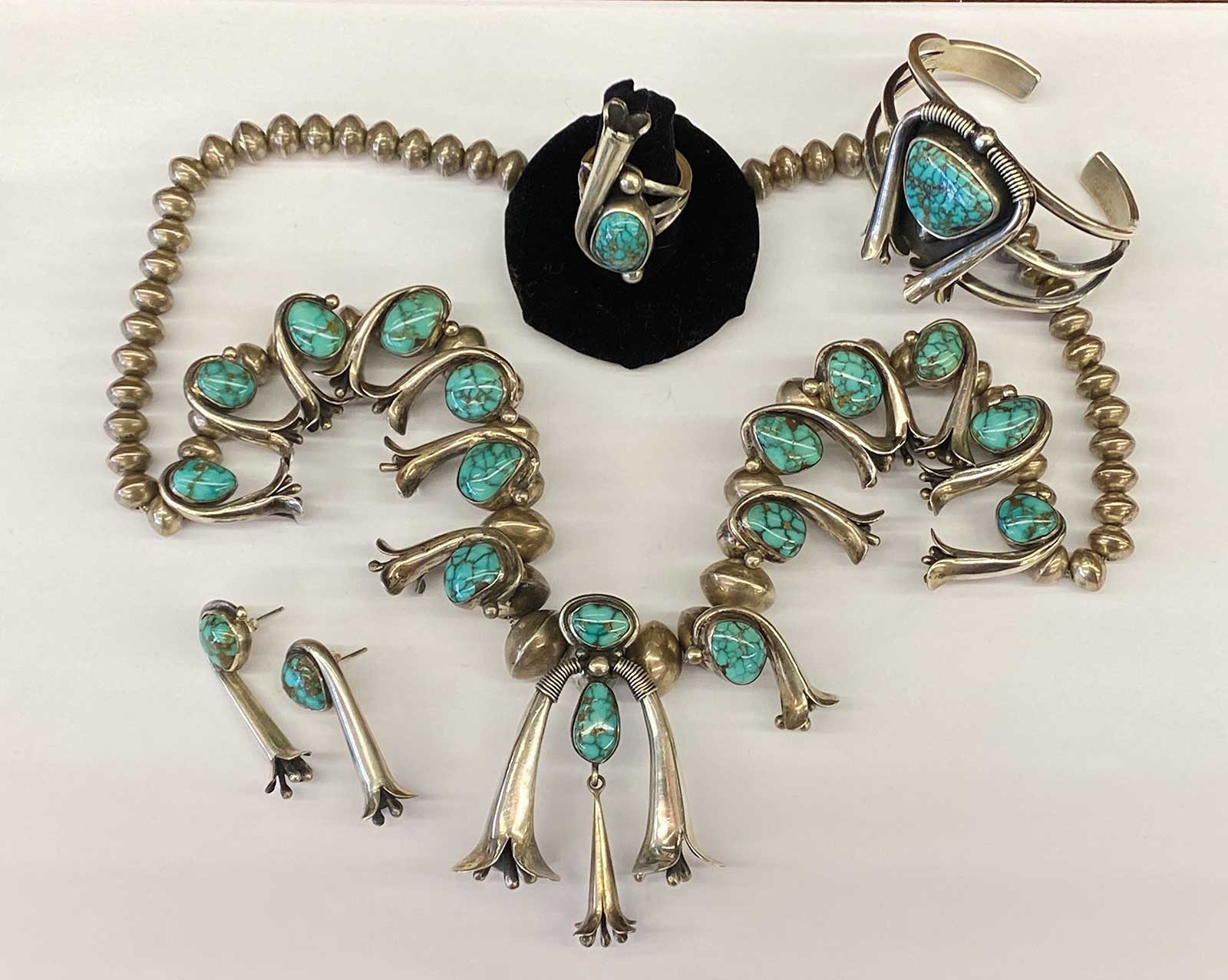 Squash blossom necklace and other jewelry originally done by Charles Chee Long (Navajo) in the 1960s and completed in 2020 by Harrison Jim (Navajo). Courtesy Tanner’s Indian Jewelry.
Elvie VanWinkle also caught it in January. “I didn’t want to touch my rug,” she says. “I didn’t want [the virus] to come in contact with my work. But I’m one of the ones who recovered.”
It was a long time before Teller-Ornelas could even sit beyond two hours at her loom. “I realized it affects my whole body…and your body’s telling you ‘I can’t help you.’ We learn how to stay in tune with what is happening, and we learn how to stop and relax.”
Her family cheered when she finally finished a piece she had put on the loom a year earlier. Her son, also a weaver, isn’t fully recovered, but he’s getting there.
One thing the pandemic has given back to Teller-Ornelas is the joy she used to experience with her art. “I’d sit in front of my loom every day, and I touch it, and I feel it…I’d hear my grandma’s songs coming back, and I could hear her prayers coming back to me, coming, and repeating it…it moved my sense of balance back.”
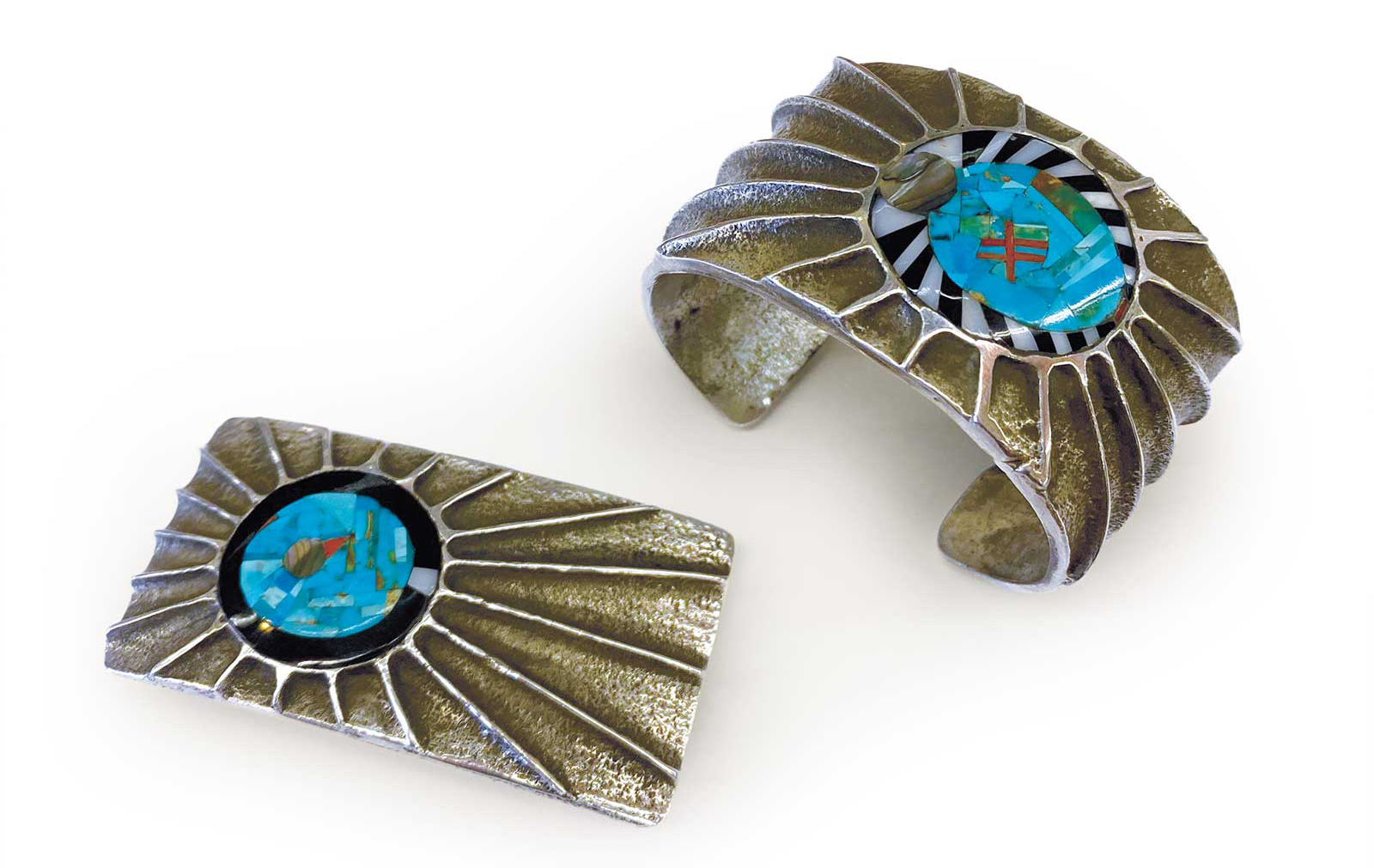 Lee Yazzie (Navajo) buckle and bracelet set started in the 1970s, completed by Bryan Tom (San Felipe Pueblo/Navajo) in 2020. Courtesy Tanner’s Indian Jewelry.
Glendora is excited about the upcoming Bernalillo Indian Arts Festival in July, the first show she’s been to in 16 months. She knows now her art can be improvised with other mediums successfully and sold online. Still, her one take-away from this is knowing where her artistic heart remains: “I’m definitely going back to pottery. That is my passion, pottery.”
Penelope Joe’s grandfather, already weakened by Covid, died after a heart attack this past March. His young, artistic granddaughter is now looking forward, embracing the art that is embracing her in return. “When I finally got back to it,” says Penelope, “it brought me so much peace, joy, comfort, love, because I know they’re my healers…and they’ll always be healing me.”
Powered by Froala Editor