It takes a village to do many things, big things. There’s strength in numbers when it comes to preserving something truly special. We often hear those phrases, but can it apply to saving a vital part of one’s culture? Does it apply to an art form that decades ago was vanishing? Oh yes it does, when you’re talking about Wabanaki basketry, which was nearly lost but saved by some very determined artists.
But as for Wabanaki, it’s not one tribe but rather a confederation of four different tribes in Maine: Penobscot, Passamaquoddy, Maliseet and Micmac. Reservations are small, as are populations, especially when compared with those in the Southwest. (A majority of Maliseet and Micmac members are actually in Canada).
For centuries, basketry has been part of the culture for these Northeastern tribes, the “people of the first dawn,” which is what Wabanaki means, especially when you consider where the first rays of sun glow in America.
Master basketmaker Theresa Secord, from the Penobscot Nation points out the skill is centuries old. Secord says, “Our people have been making baskets for thousands of years. But selling them for 200, and that’s documented in books and writings and photographs in Maine. This is very traditional and historical.”
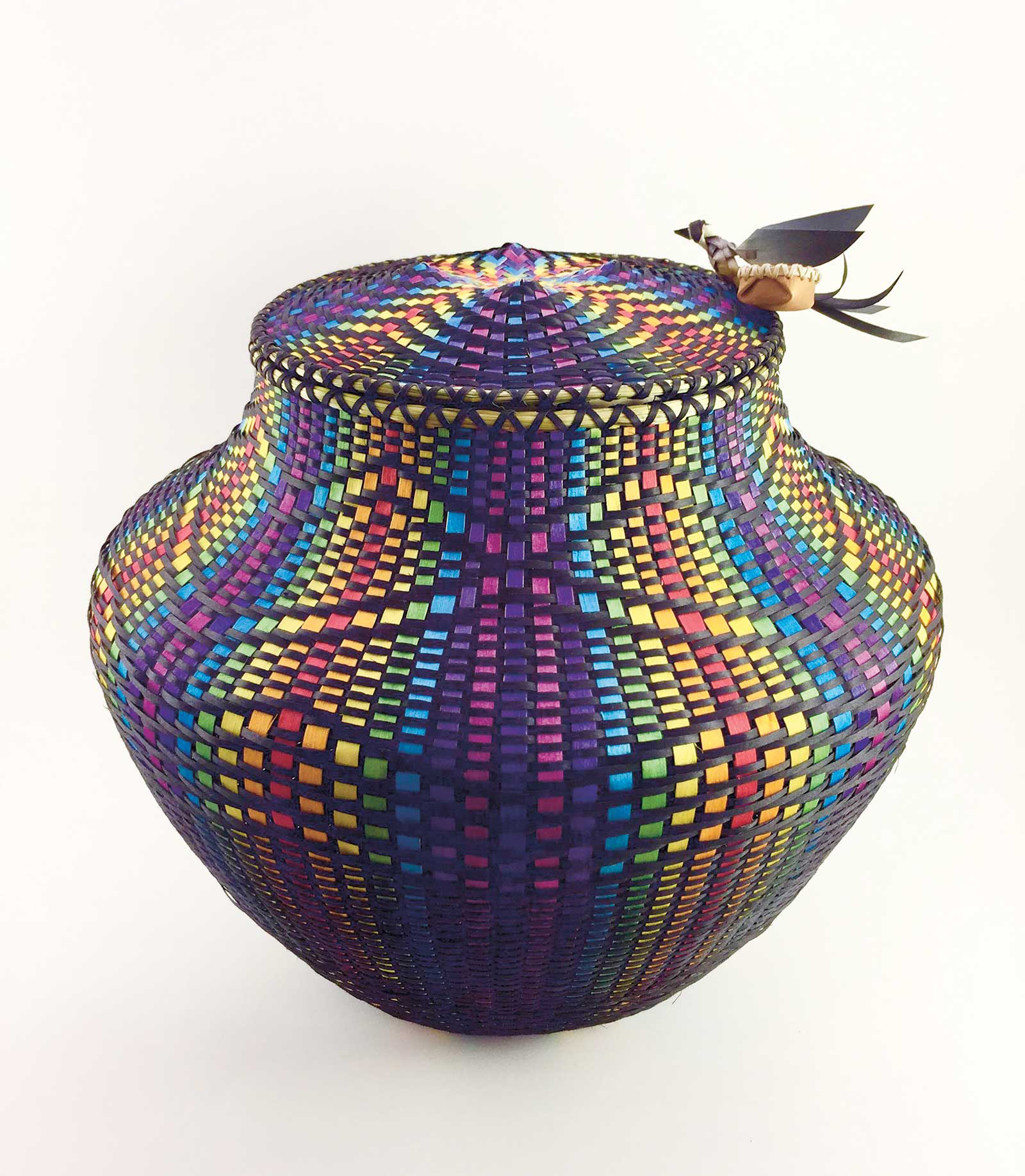 Geo Soctomah Neptune (Passamaquoddy Two-Spirit), rainbow basket with woven ash bird, 2017. Courtesy the artist.
The ash tree holds a sacred place in Wabanaki culture. Legends say a Supreme Being, Koluskap, fired arrows into the ash tree, and the first men and women emerged. Chris Newell is the director for the Abbe Museum in Bar Harbor, Maine, which holds the largest collection of ashland basketry in the world. He is also Passamaquoddy, and says the connection of their creation story to these baskets of black and brown ash is all the more important to the culture. Wabanaki baskets started with a utilitarian purpose, as they were sold to the Euro/American market, including potato farmers in northern Maine.
“The Micmacs, Maliseets and even Passamaquoddy basketmakers were making the potato baskets, which they still use today,” Newell explains. “They’re very lightweight, they are durable, they can hold a ton of weight and they’re gonna last a long time.
“When the farmers were buying them,” Newell continues, “they were paying a quarter or 50 cents a basket.” These particular baskets, with a very wide gauge of ash, were made not for looks but for strength. Baskets of a much finer gauge, more decorative “fancy baskets” were also made. Secord has a photograph from 1953 of her great-grandmother, Philomene Saulis Nelson, another talented basketmaker, who sold her art on Indian Island, which is the Penobscot reservation in Maine.
But the hard work wasn’t appealing, especially with younger members of the Penobscot Nation. “There was a time in my childhood when it was definitely on the way out,” Newell recalls. “In the ’80s the average basketmaker’s age was in their mid-60s.”
Secord learned how to make baskets in 1988, about the time she turned 30. “I learned from a Penobscot basketmaker elder [Madelyn Tomah Shay] on Indian Island when I was working for my tribe after graduate school.”
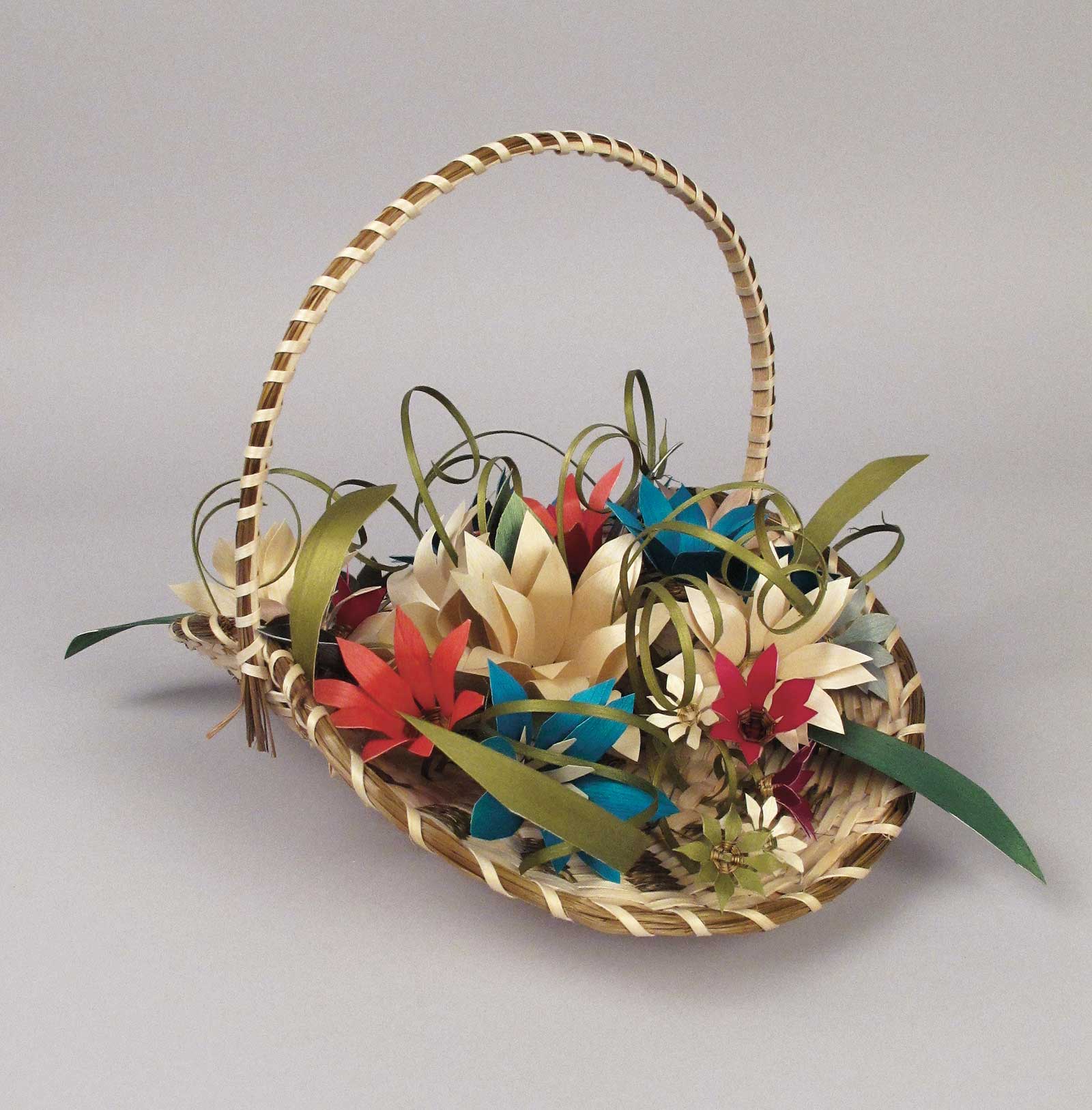 Molly Neptune Parker (Passamaquoddy) and Geo Soctomah Neptune (Passamaquoddy Two-Spirit), ash and sweetgrass basket/flowers, 2012. Abbe Museum, Bar Harbor, Maine.
Secord was learning the Penobscot language and basketry while being involved in a state apprenticeship program designed to pass along inter-generational knowledge associated with ash basketry. This was when basketmakers were having a hard time finding materials as well as finding younger people to learn the craft. Maine folklorist Kathleen Mundell, who had been working with basketmakers and the apprenticeship program, suggested this was the time to look at those issues together.
She asked Secord to organize the first meeting with basketmakers from all four tribes. This was how 55 founding members the Maine Indian Basketmakers Alliance, or MIBA, first came together. “The mission was one thing: To save our endangered ash and sweetgrass basketry,” says Secord. “The goals around it and the work we did to support that mission were to increase the market for our baskets.”
As Secord focused on writing grants and making connections with other funding sources, Mundell matched up elder basketmakers with apprentices, teaching one-on-one with someone in their community. A highlight for the group was the annual July market and festival in Bar Harbor. “That’s a great public event that brings a lot of people together,” says Secord. “Younger basketmakers can see the basketry, and the younger tribal members can meet mentors.”
The Alliance also opened a retail gallery in Old Town, Maine, as their movement really gained steam and membership, with lessons not just on making baskets but how to market and sell them. “So we started these apprenticeships and tribal basketry workshops, where as many as 20 of us, from all four tribes, would teach up to 80 community members,” says Secord.
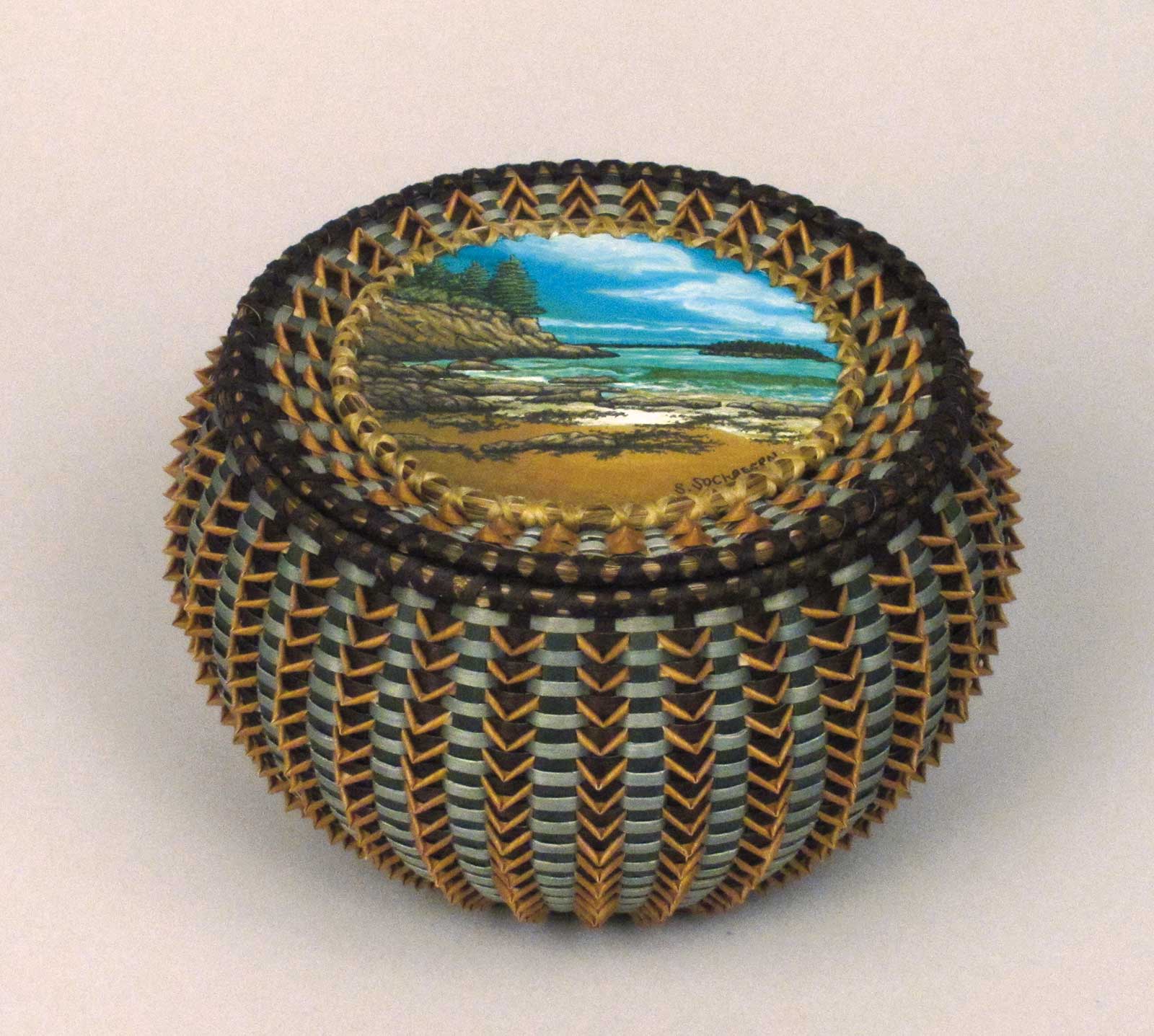 Sarah Sockbeson (Penobscot), ash and sweetgrass, acrylic painted basket, 2012. Abbe Museum, Bar Harbor, Maine.
“Workshops would be like a weekend affair, where we could teach everything,” she continues. “Woven potato baskets, the so-called ‘fancy basket’ styles, how to braid sweetgrass, how to pound the ash log…we’d have men and boys out there doing that.”
One of those young men was Jeremy Frey, who to this day credits art with saving his life when he was working through personal struggles. “He came to us at the right time, and his mother was one of our first apprentices…she was teaching Jeremy and we had a big workshop,” recalls Secord. “She said…‘If he comes down from Indian Township, to help us prepare the ash, pound the ash logs, will you give him $25 or $50 for gas?’ And I said, ‘Sure!’” It turned out to be a very wise investment, especially a few years later.
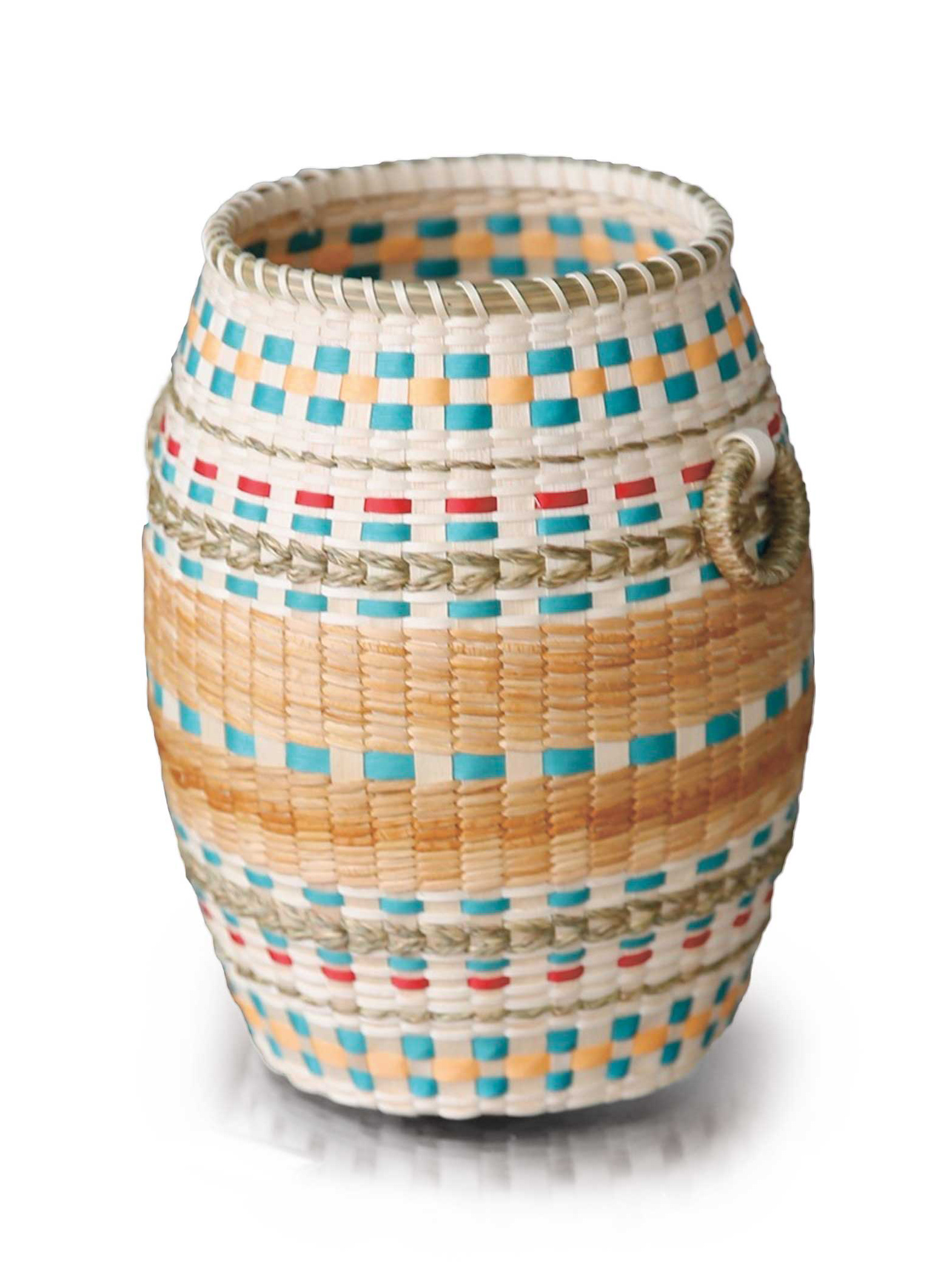 Theresa Secord (Penobscot), woven Penobscot barrel basket of ash wood, sweet grass and cedar bark. Colby College Museum of Fine Art, Waterville, Maine. Courtesy the artist.“We launched artists like Jeremy into the national Indian art market,” Secord says. “Before I went to Indian Market [at Santa Fe],” says Frey, “there wasn’t even a basket category. Basketry competed with Navajo rugs, any textile. And when
I showed up, a few other people showed up, and we all got together and petitioned SWAIA and said, ‘Hey! There’s enough weavers to have a category of baskets.’ A year or two later, I won the whole show.”
To be more precise, his winning Best of Show was in 2011. Earlier that same year Frey also won Best of Show at the Heard Museum Guild Indian Fair and Market. The winning would continue. Wabanaki basketry had arrived.
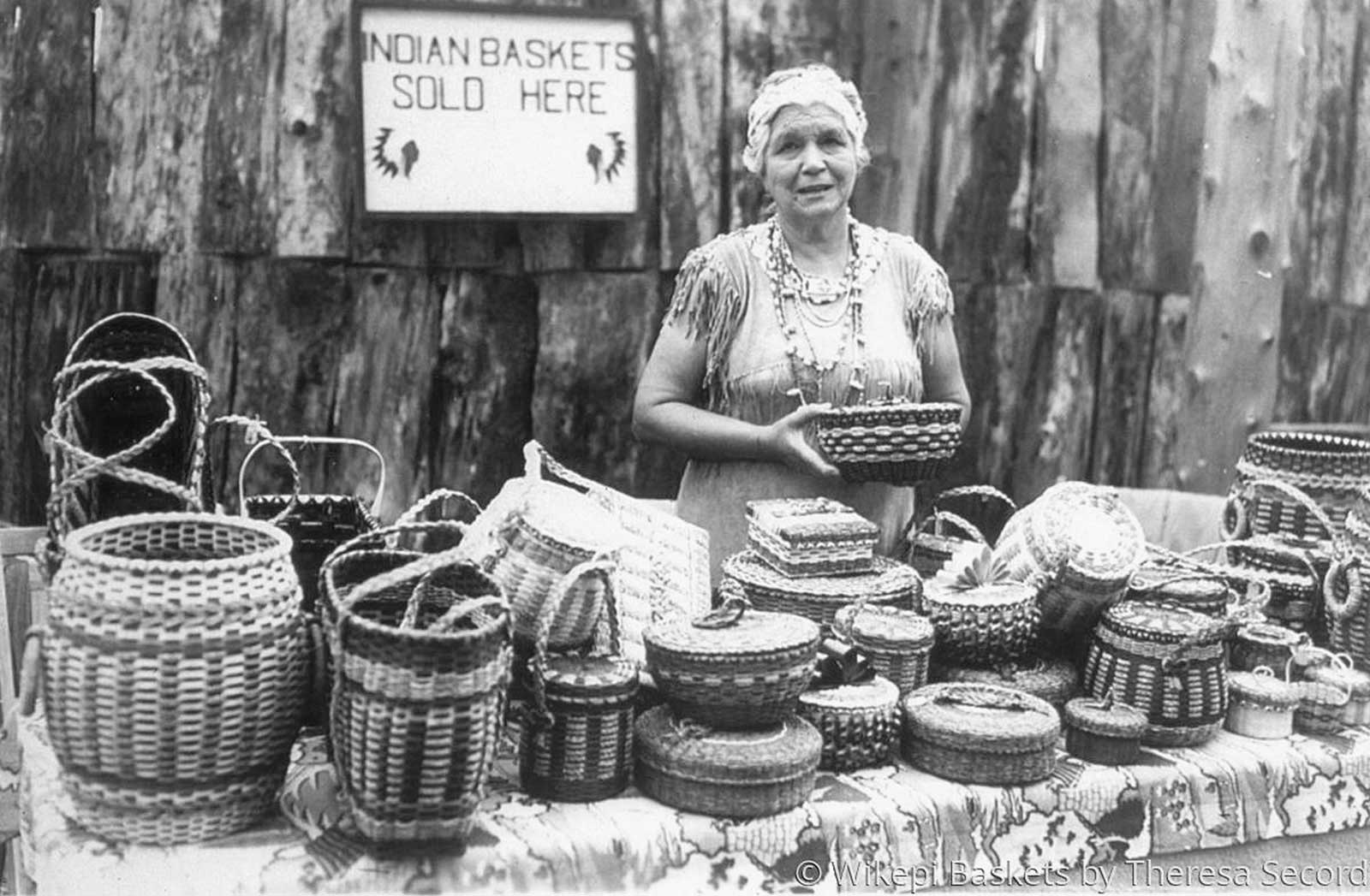 Philomene Saulis Nelson, master basketmaker and great-grandmother of artist Theresa Secord (Penobscot). Photo taken in 1953 on Indian Island. Courtesy Theresa Secord.
“Unbelievable,” says Secord. “No one had even won with a basket before! We had a lot coming from the easternmost point in the continental United States, from a relatively poor, rural Indian reservation, at Indian Township.”
“People had never seen our work out there. No one had. And they didn’t even think it was Native. They didn’t understand,” Frey recalls. “But then as we exposed and taught people how it was done, and the traditions behind it…it’s a different style for sure.”
Working with incredibly thin strips pulled away from ash tree logs, it takes a lot of dexterity to patiently bend, shape and weave them in and out. Sometimes the strips are bent into small points or small curls as they continue their journey around the basket. Sometimes sweetgrass is added. Sometimes one basket grows into what appears to be two or three when it’s still really one piece.
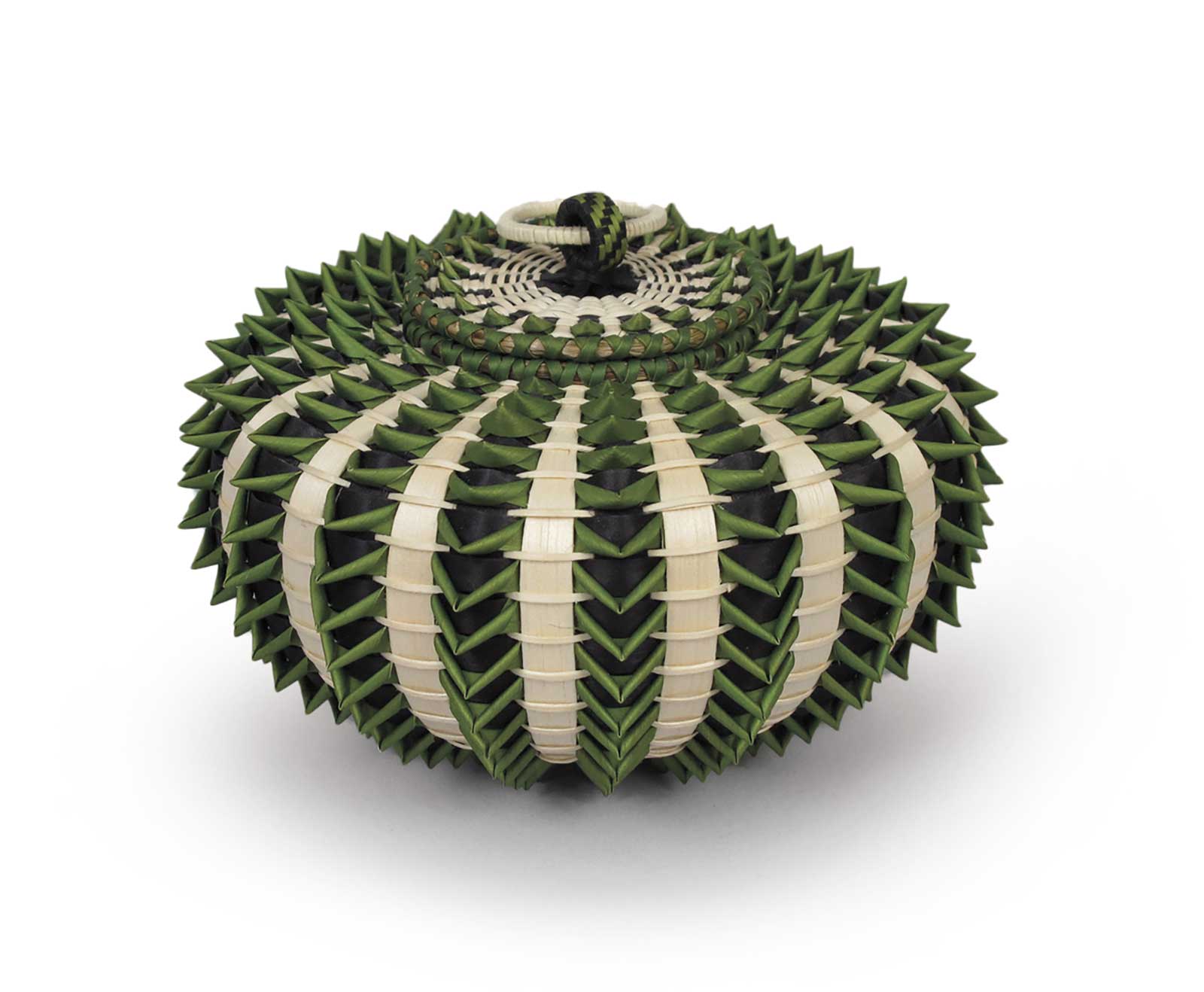 Jeremy Frey (Passamaquoddy), ash and sweetgrass basket, 2015. Abbe Museum, Bar Harbor, Maine.
“I base everything I do on the original learnings I got,” says Frey. “I tweak them through my vision, which is a contemporary vision.”
He adds, “When I started traveling, innovating, I got a little bit of pushback—‘That’s not traditional!’—but after a while, the youth started seeing what I was doing and they all decided, ‘Hey! I can be innovative too!’”
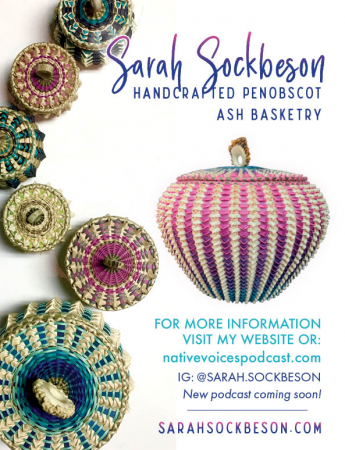
Sarah Sockbeson, a Penobscot master weaver, is also one of the younger basketmakers who came up through the apprenticeship program with the Alliance. She says she honors the past while celebrating the present with her art. “You should have a solid foundation,” she says. “From there you should have the freedom to represent who you are as an artist, in whatever you choose to incorporate into your work.”
She sometimes incorporates a piece of deer antler for a handle, a “sculptural kind of element,” she says. Or maybe it’s just color. “I love color in general,” she says. “I love playing with the different dyes and using different processes to achieve different colors…
I usually use the synthetic just because of the more vibrant colors I can achieve.”
Geo Neptune’s baskets also stand out because of the colors and feature unexpected waves of different hues. “I’ve been experimenting with those brighter color pieces,” Neptune says. “A blending technique from both my grandma and my own experimentation and style with color, and techniques that I learned from a Maliseet elder Brent Tomah.”
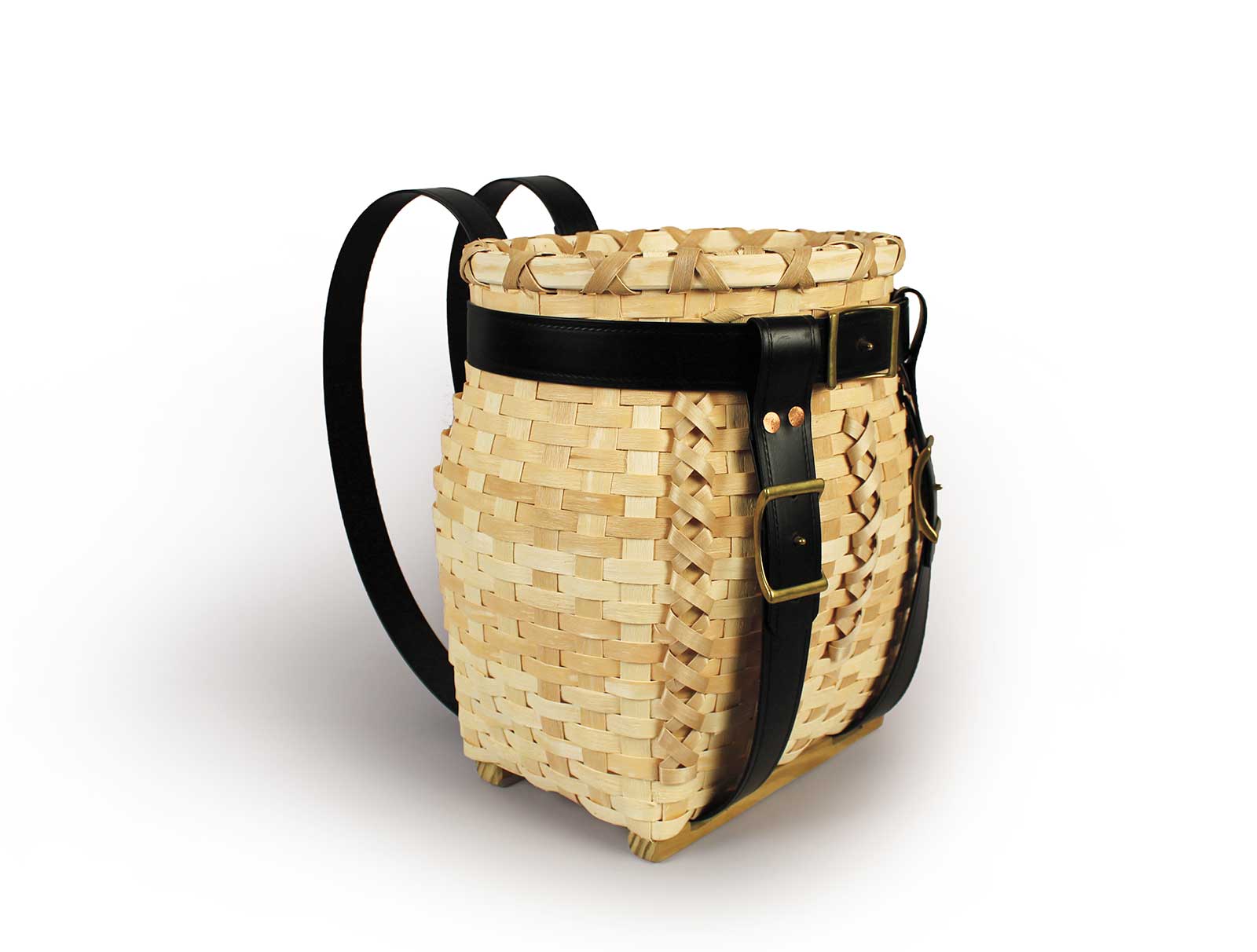 Richard Silliboy (Micmac), ash and leather pack basket, 2016. Abbe Museum, Bar Harbor, Maine.
Neptune sometimes adds a touch of whimsy with a woven ash bird, something their grandmother made when they were children. “As far as I know, I was the first person to put a woven bird on a basket…that was kind of quickly seen as my signature,” the artist says.
Neptune’s grandmother, Molly Neptune Parker (1939-2020), was a true master basketmaker and one of the founding members and president of the Alliance. “[She] worked really hard to not only create a market within Maine for Wabanaki baskets, but also helped Wabanaki artists find markets throughout the rest of the country,” her grandchild says with pride.
The Maine Indian Basketmakers Alliance continues its outreach and apprenticeships, continues to help young Maine basketmakers gain connections beyond state borders to an ever-growing global market. There’s also grave concern about the emerald ash borer, an aggressive insect which has decimated ash forests in other areas. The insect remains a threat to Maine, and a threat to these basketmakers whose culture began with ash trees.
“I think of them as how far can I work this material,” says Frey. “There’s so many reasons the material needs to be saved and used sparingly. So my whole approach to basketry was always make the most elaborate, beautiful thing you can…with a minimum.”
What else has the Alliance accomplished? The average age of Wabanaki basketmakers has lowered from 63 to 40, as younger people continue to be inspired. Membership is up from the original 55 in 1988 to about 150 basketmakers in 2021. So, mission accomplished.
“It was really an amazing effort by the entire group of basketmakers,” says Secord. “I say to people we set up to save our own endangered art form…and we did.”
Powered by Froala Editor