Birds—and their feathers—have always been deeply significant to the Pueblo Indians of the American Southwest. Different types of birds have played roles in Pueblo society that range from clan identity to legends and “how it came to be” stories. Individual birds held meaning and purpose by representing ideas, and their feathers functioned as signs and signals between humans and sacred spirits. An important part of the natural world, birds served as agents charged with various social and spiritual functions.
The first Pueblo metalworkers took up silversmithing near the end of the 19th century. Avian figures were already used as decorative designs on embroidery, pottery and weaving. Pueblo smiths borrowed visual aspects of these bird depictions, both abstract and figural. They chose specific birds out of the more than one hundred varieties native to the region. Images of stylized birds in profile were selected, along with repetitive design borders of a more abstract nature. When non-Native scholars began studying designs, their focus was on expressive features. One example of this research can be found in a work by Harry P. Mera, at the Laboratory of Anthropology in Santa Fe. He published a survey in 1937 titled “The Rain Bird”: A Study in Pueblo Design.
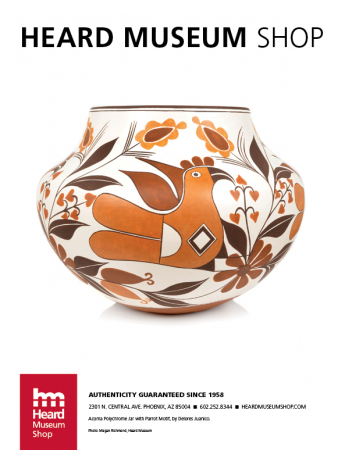
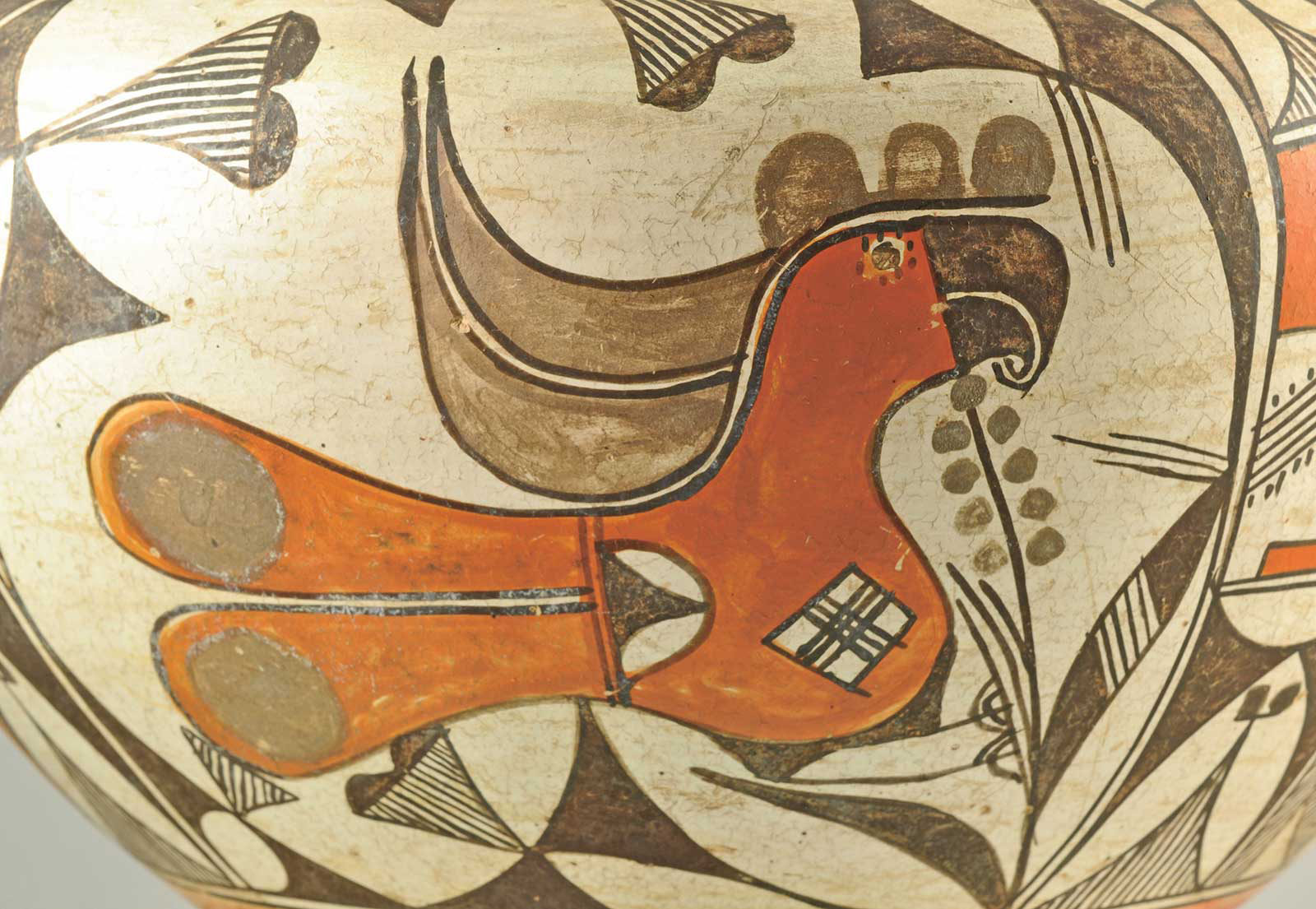 Stylized parrot on pot from Acoma, 1920s. Courtesy of Paul and Valerie Piazza.
Pueblo silversmiths created many designs from nature in the early- to mid-20th century. Their decorative work began as abstract loops and coils and evocative outlines. At the same time, non-Native Indian traders and curio store owners—who were eager to build a commercial market—pushed for more realistic depictions of birds on jewelry, seeing them as convenient cross-cultural design motifs.
One of the most meaningful birds in Pueblo life was actually an import from the South. Archaeological evidence from pre-contact sites confirms that parrots from Mesoamerica were highly valued. Parrots are associated with the sky, sun and salt-gathering. Acoma, Laguna and Hopi have Parrot clans, and the feathers of these elegant birds were attached to certain types of fetishes and katsinas. A representative 1920s pot from Acoma Pueblo reproduces a stylized image of a parrot. Such a design from pottery influenced a tourist jewelry rendition of a parrot brooch, cut from sheet silver in the 1960s-1970s, with its distinctive outline and animated open feathers and beak. In Santo Domingo, artist Anthony Lovato’s pin pendant (circa 2010), depicts a parrot with silver feathers that are more richly delineated, but the piece itself gives the same emphasis to its curved beak.
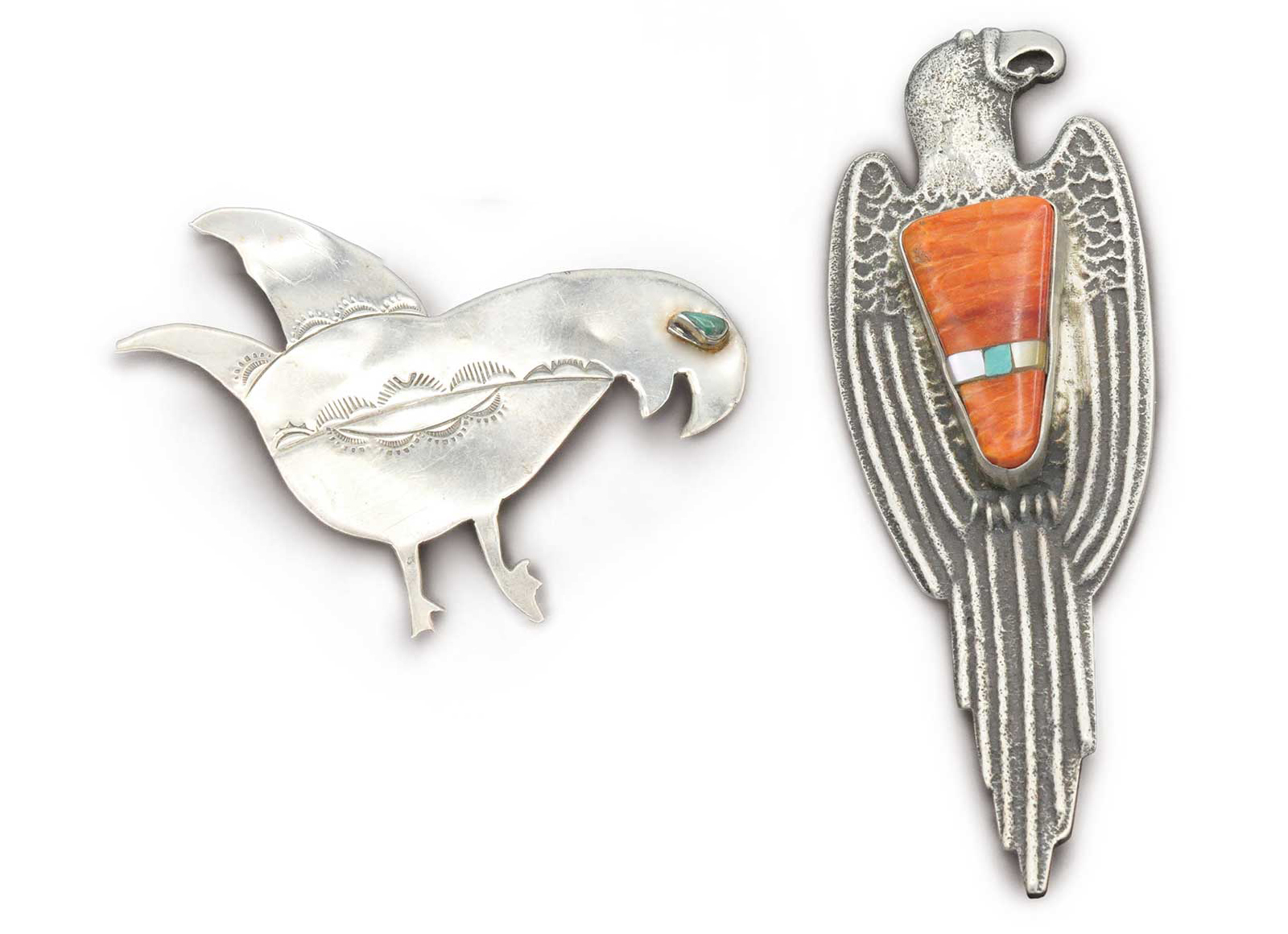 Unsigned Pueblo bird pin, mid-20th century, and pin pendant parrot by Santo Domingo (Kewa) artist Anthony Lovato, ca. 2010.
The portrayal of other birds through abstraction can be noted in an unsigned mid-20th century tourist brooch, with two silver elongated eagles flanking a wholly abstract old-style Pueblo bird outline in agate, with suggestive semicircular silver head and tail feathers. This same traditional shape appears in a silver ring set with fossilized agate by Ohkay Owingeh artist Mike Bird-Romero, made in 2007. Bird-Romero, whose personal hallmark features two outlined Pueblo birds, has studied old-style Pueblo design for years, aided by his historian wife Allison. Such pride in artistic legacy marks the work of many contemporary jewelers.
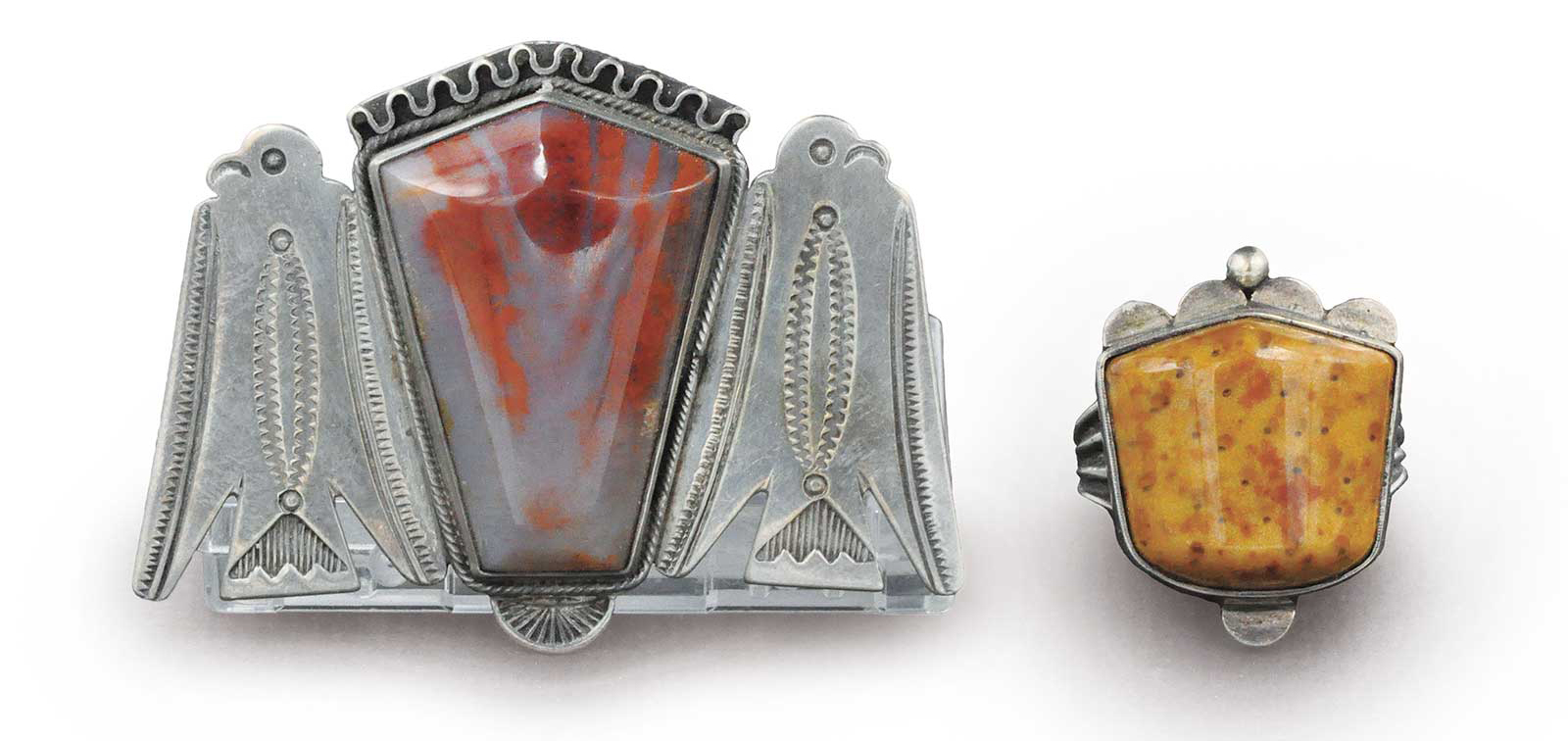 Agate brooch, unsigned 1940s, and fossilized agate ring by Mike Bird Romero, 2007.
The owl is noted for its ambiguous associations. This bird’s nocturnal nature gives it associations with death and inauspicious omens. Some of the central Rio Grande Pueblos once viewed the owl as being linked with witchcraft. The Western Pueblos, however, more often see it as a messenger poised between good and evil. Acoma, Cochiti and Zuni have a tradition of making clay owl figurines that are popular with collectors and tourists. At Zuni, mosaic inlay jewelry is one of the pueblo’s specialties. A hugely popular owl design made by Ann Sheyka proves to be a good example; her large and small pin pendant owls are particularly prized—especially for their watchful, sideways glance.
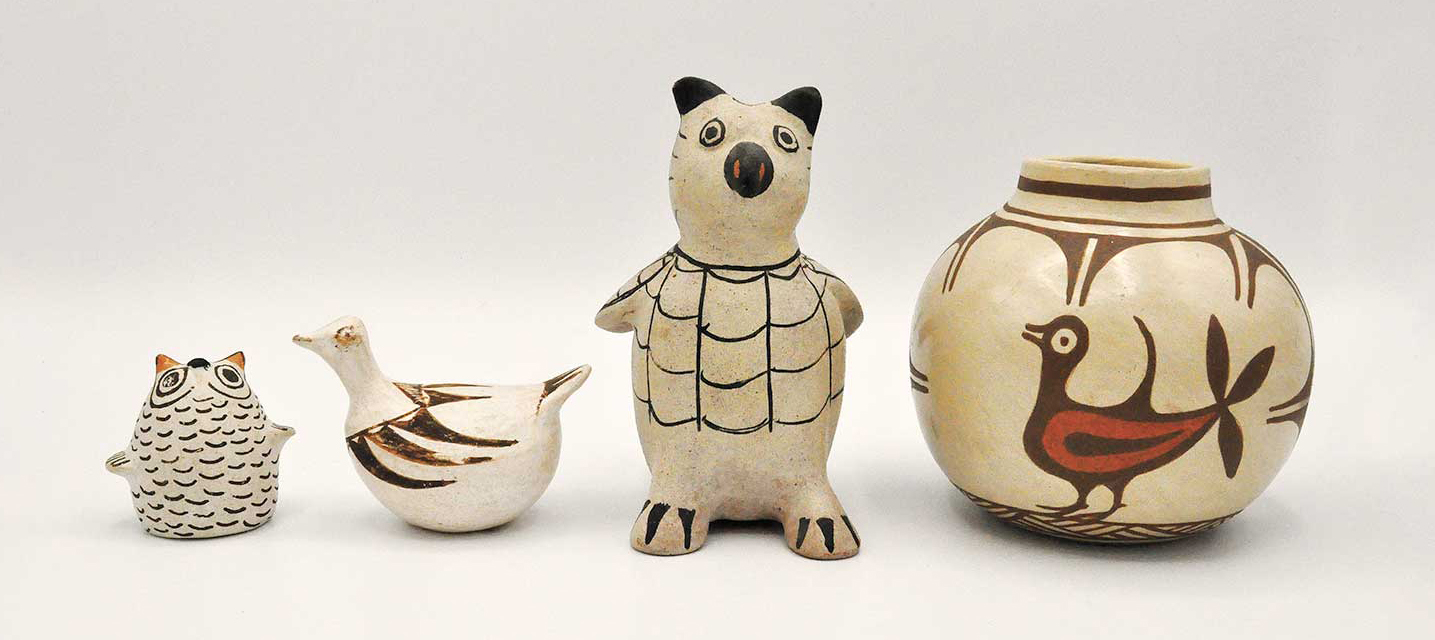 Mid-20th-century pottery: left to right, owl and bird figurines, Acoma; owl figurine, Cochiti; Zia bird design on pot. Courtesy of Paul and Valerie Piazza.
Bird jewelry design motifs taken from pottery prototypes usually show their subjects in profile. Silhouette styles proliferated from the 1950s to the 1970s. One type of bird, the cactus wren, is a desert dweller, and also the state bird of Arizona. The cactus wren is known for having an affinity for prickly pear cactus. Wrens in Pueblo legend were associated with war, and are known to call out if they sense danger approaching. Dennis and Nancy Edaakie created a popular 1970s design motif showing the cactus wren in profile on a silver pin pendant. This wren’s jaunty stance, with upturned head and raised plume tail, derives from older, stylized bird presentations on Pueblo pottery.
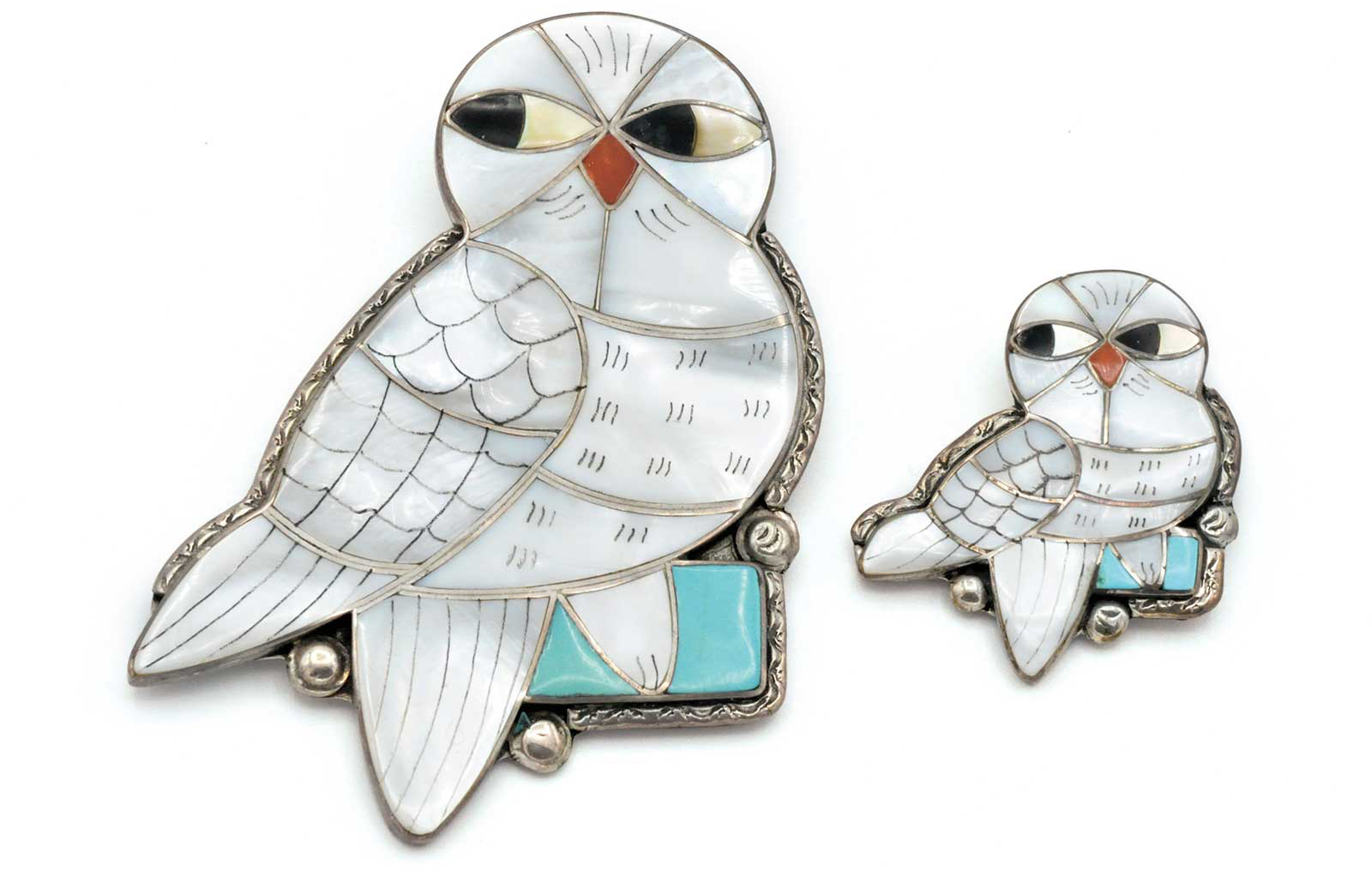 Two owl pin pendants by Ann Sheyka, Zuni, 1970s.
The 1970s were a time when Indigenous jewelry was shedding its craft identity to be replaced with recognition as full-fledged art. The subject for a channel inlay brooch by Elsie Quam, a lively cardinal in mid-flight, reveals a decorative transition to less immobile silhouettes in this decade. Quam’s cardinal, however, has uplifted wings often found in earlier 20th century pottery and painting. The Pueblo people esteem this bird as a directional guardian of the South.
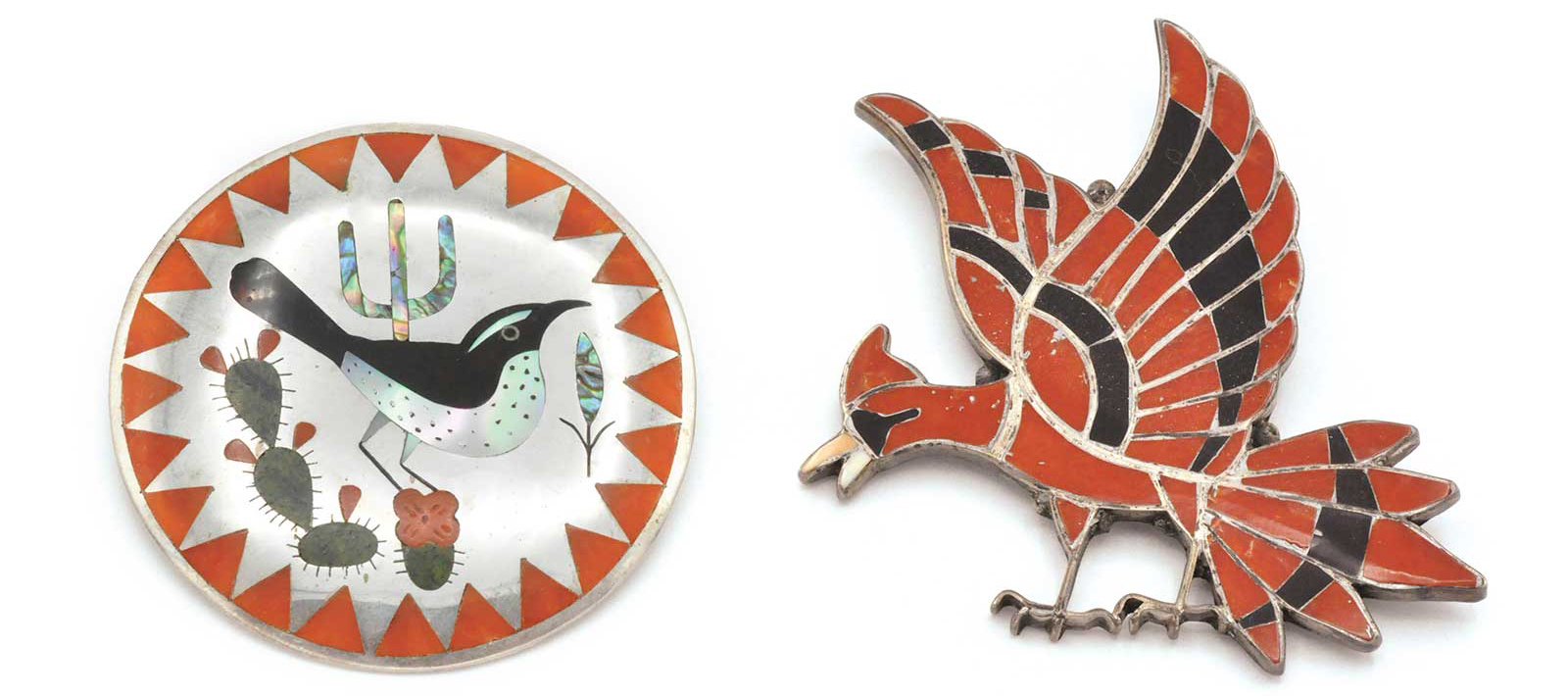 Cactus wren pin pendant by Dennis and Nancy Edaakie and cardinal brooch by Elsie Quam, both Zuni, 1970s.
Animation in jewelry motifs developed during the creation of tourist-era commercial adornment. Silver items like spoons and other flatware often sported sprightly figural subjects. There was a playful element in these compositions which lured traveling consumers shopping at train stops and curio stores. Two unsigned pins of thin sterling silver, made in the mid-20th century, feature birds associated with the Southwestern landscape. A sandhill crane with an exaggeratedly straight neck symbolizes the flocks which gather along the Rio Grande. This migratory bird comes from the North and its appearance is viewed as a good sign; the Hopi and Zuni also have clans named for the crane. The other pin represents a roadrunner, another bird of good omen (and the state bird of New Mexico). In comparison to these classically rendered trinkets, a post-1980 pin pendant, also unsigned, reveals a bird with more skillfully and realistically detailed feathers perched on a three-dimensional branch, a tourist piece altogether more advanced in its design.
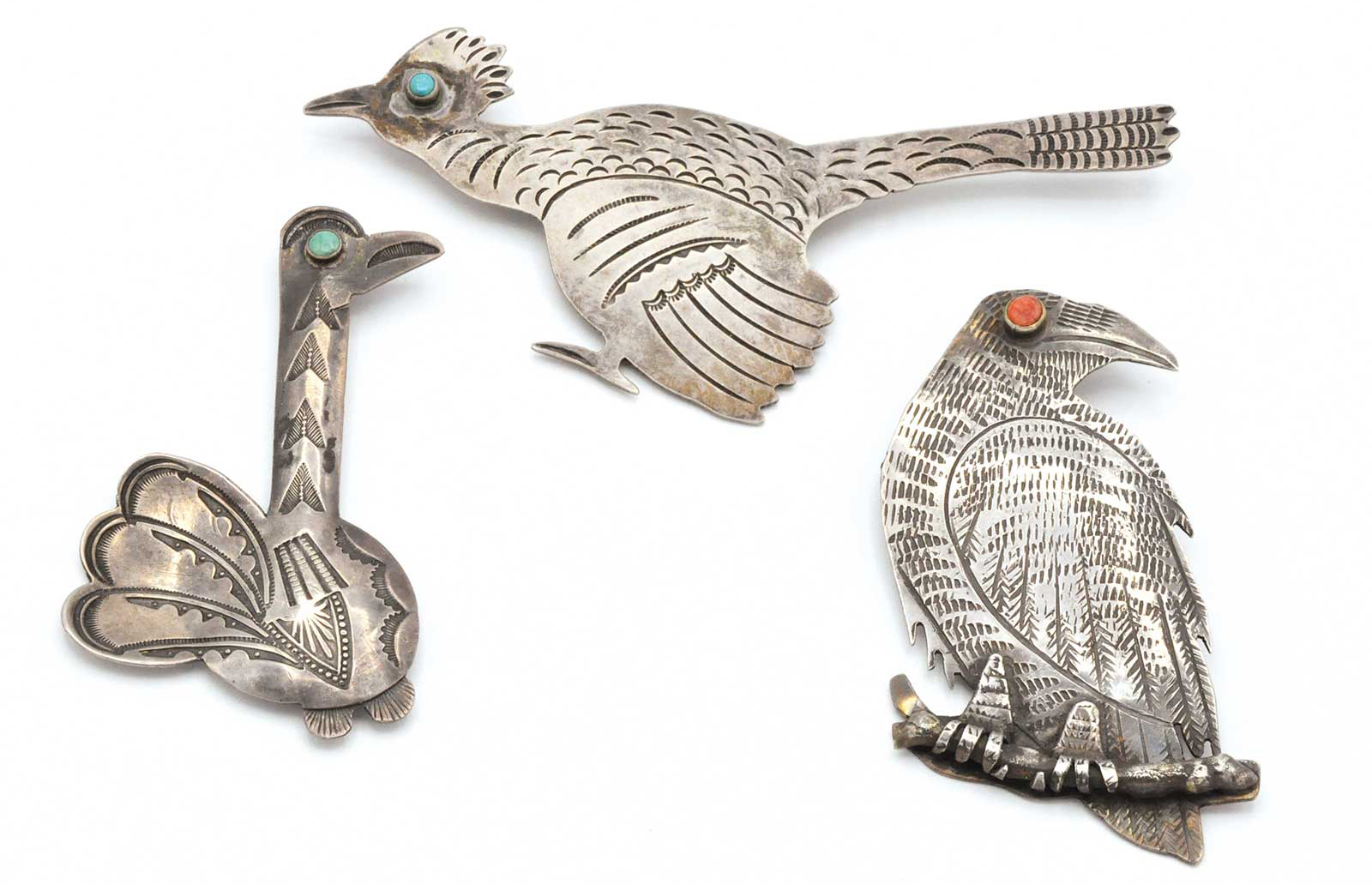 Three silver tourist pins, unsigned, left to right: sandhill crane; roadrunner, mid-20th century; perching bird, post-1980.
These gathered avian depictions tell a story of tradition by a people known for their sensitive portrayals of nature and its winged messengers. Their variations in visual interpretation, from abstract to decoratively figural, demonstrate how jewelry that honors the past can accommodate individual artistic interpretation.
Powered by Froala Editor