The key concepts at the heart of contemporary ledger art are narrating a story, recording history and insubordination, drawing over material records of the invading cultures, on maps, old checks and legal documents from more than 100 years ago. We have commissioned artists to do them on Italian, French and other European correspondence, as well as family heirloom documents and maps, going back 400 years.
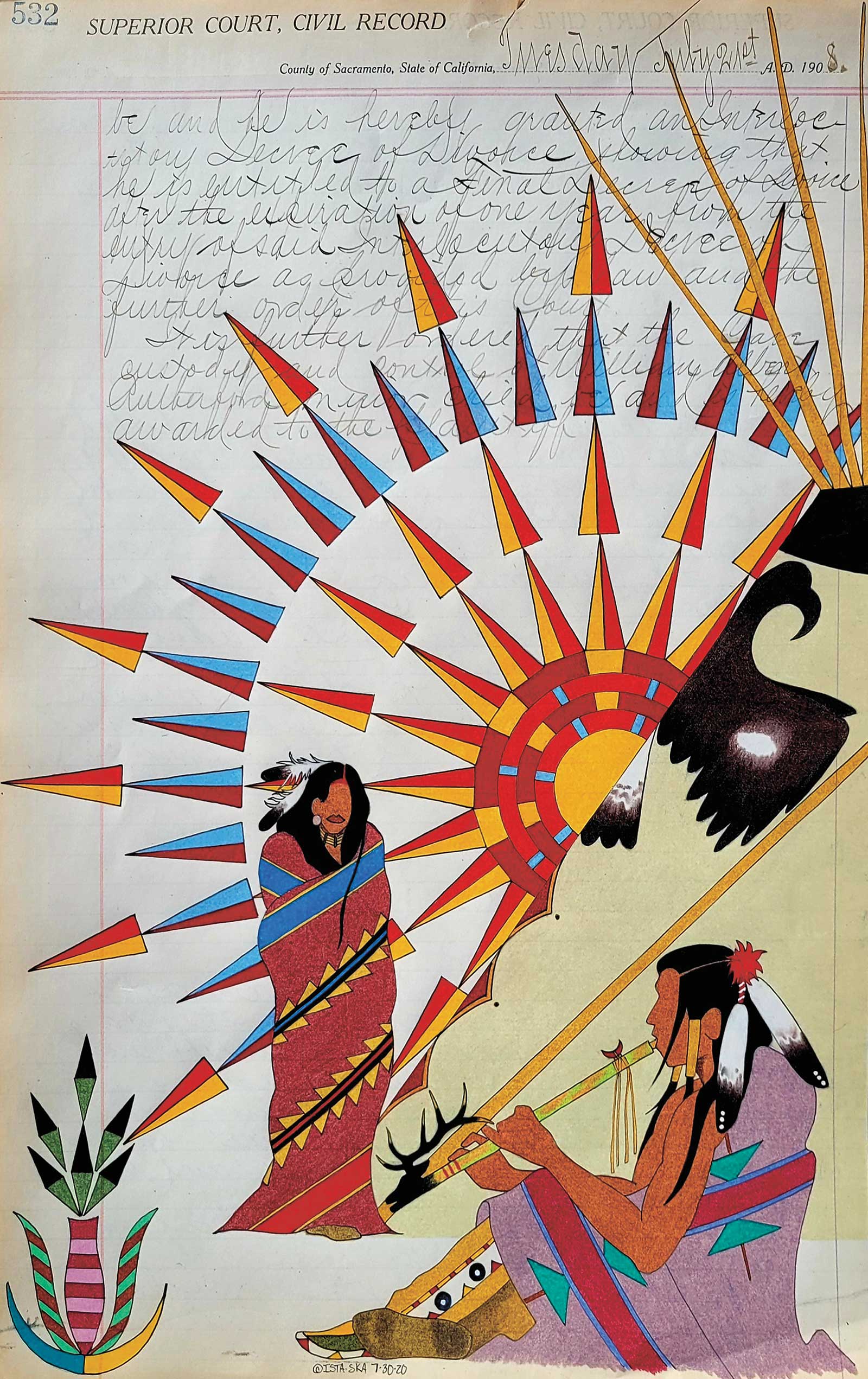 Travis Blackbird (Omaha), Courting at Sunrise, Superior Court Civil Record, 1908, Sacramento, California, 17 x 11"
Instead of relegating Native art ledgers to museums, these artists carry on a great tradition that would otherwise disappear in the onslaught of contemporary American non-culture. Tribal histories derive from migrations that used hides and war shirts to record images, so the advent of paper from the American soldiers’ presence provided a new medium on which to create their art, which from the beginning of interaction, was purchased for a pittance by soldiers. Army officer Richard Henry Pratt coined the expression, “Kill the Indian to save the Man.” Yet he was considered an enlightened humanitarian at that time by members of Congress and the “American Aristocracy” who wanted to eradicate all of the Indigenous peoples of North America in the name of “Manifest Destiny.”
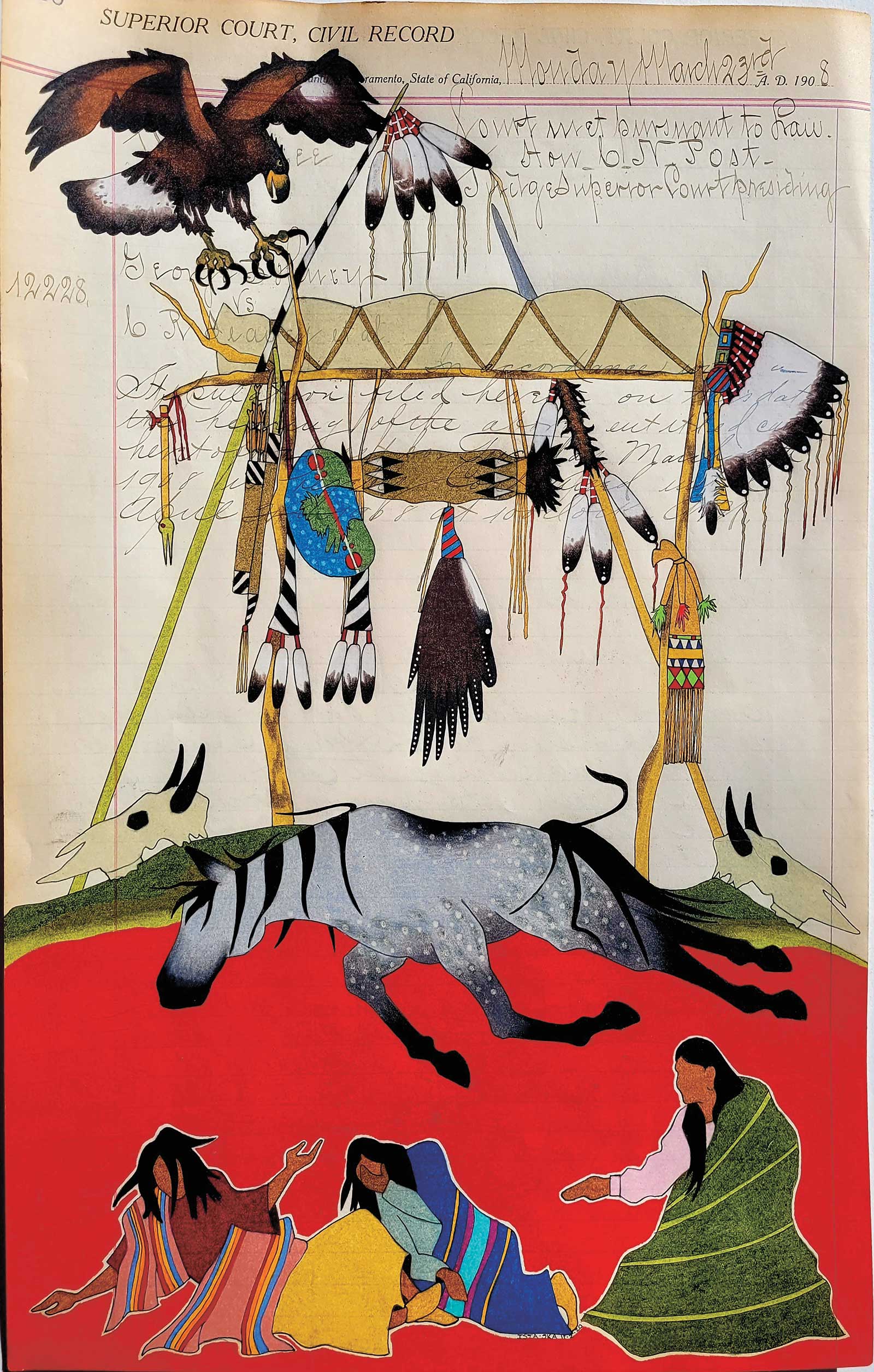 Travis Blackbird (Omaha), Omaha mother explaining the chief’s passing, Superior Court Civil Record, Sacramento California, March 23, 1908, 19 x 11"
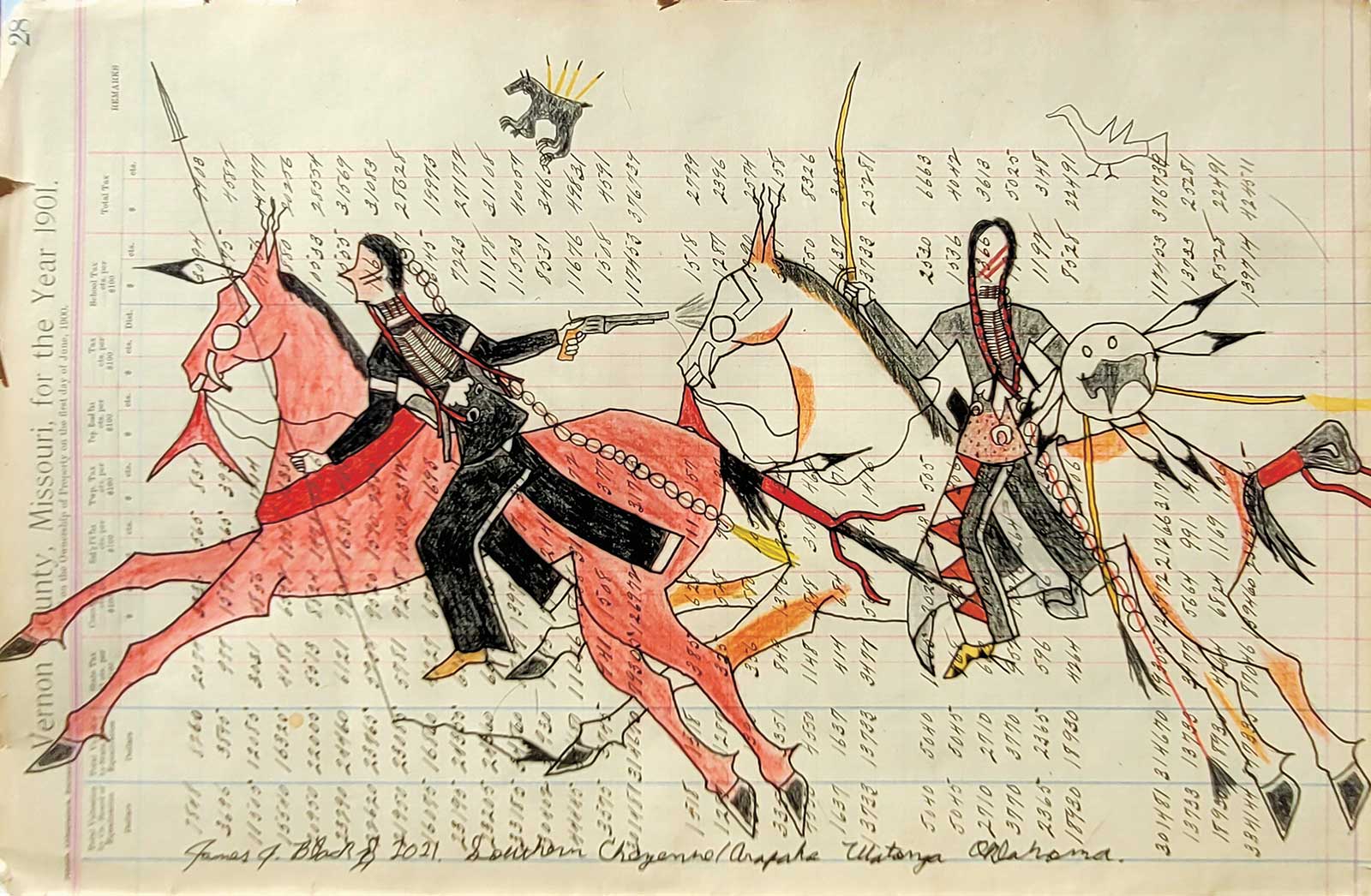 James Black (Southern Cheyenne/Arapaho/Oglala), Feathered Horse and White Dove, Two Legendary Cheyenne Warriors, 14 x 19"
Pratt was not the first, nor would he be the last, to encourage the eradication of Native American people. A century earlier, William Trent, a trader turned militia commander, had come up with a plan that is recorded in a bill he sent to the British Army indicating that he intended to give blankets “to Convey the Smallpox to the Indians.” The invoice’s approval confirms that the British command endorsed Trent’s actions.
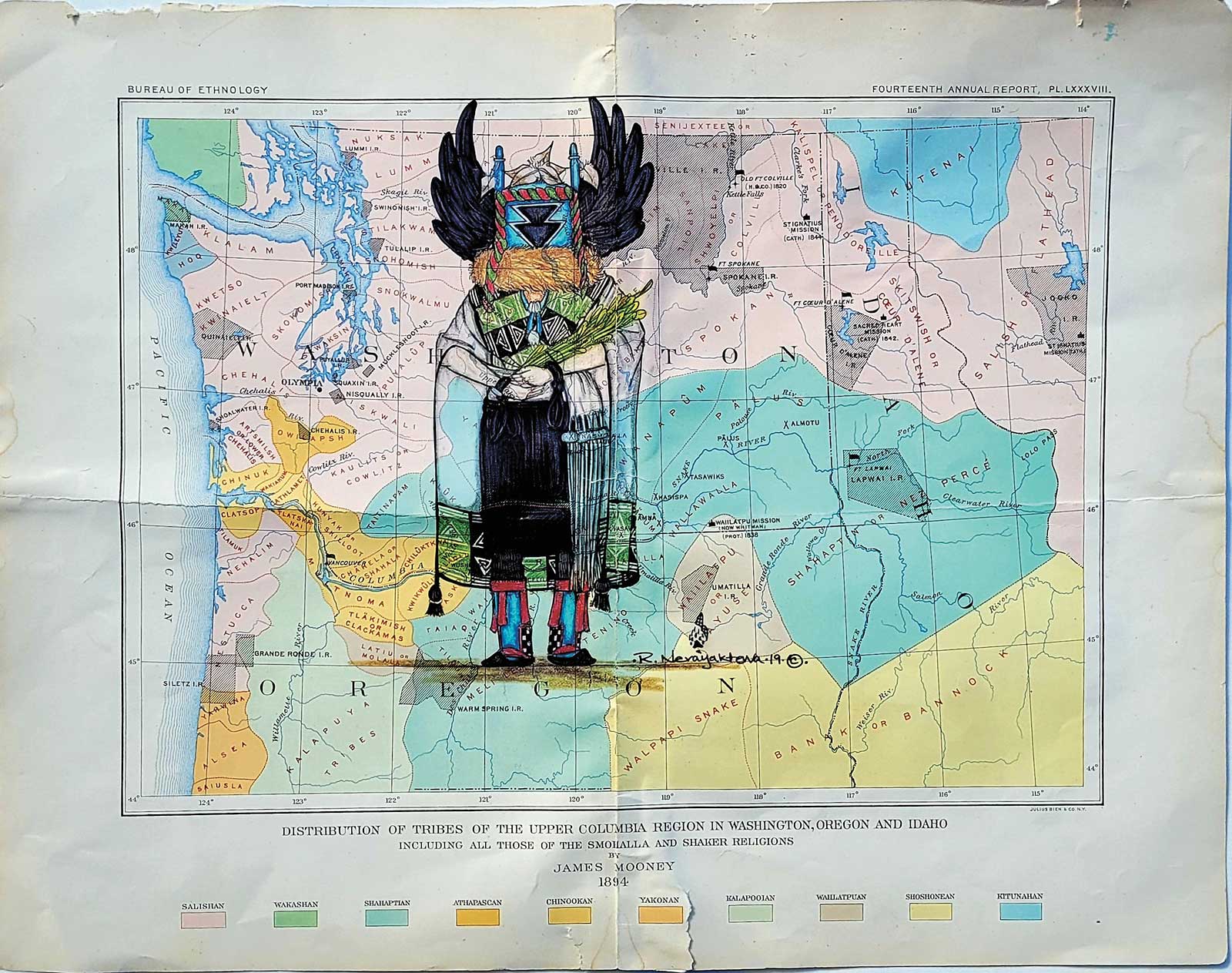 Rael Nevayaktewa (Hopi/Tewa), Crow Mother, Highest Hopi Female Deity, on 1894 Washington State Map of Religions of Native People by James Mooney.
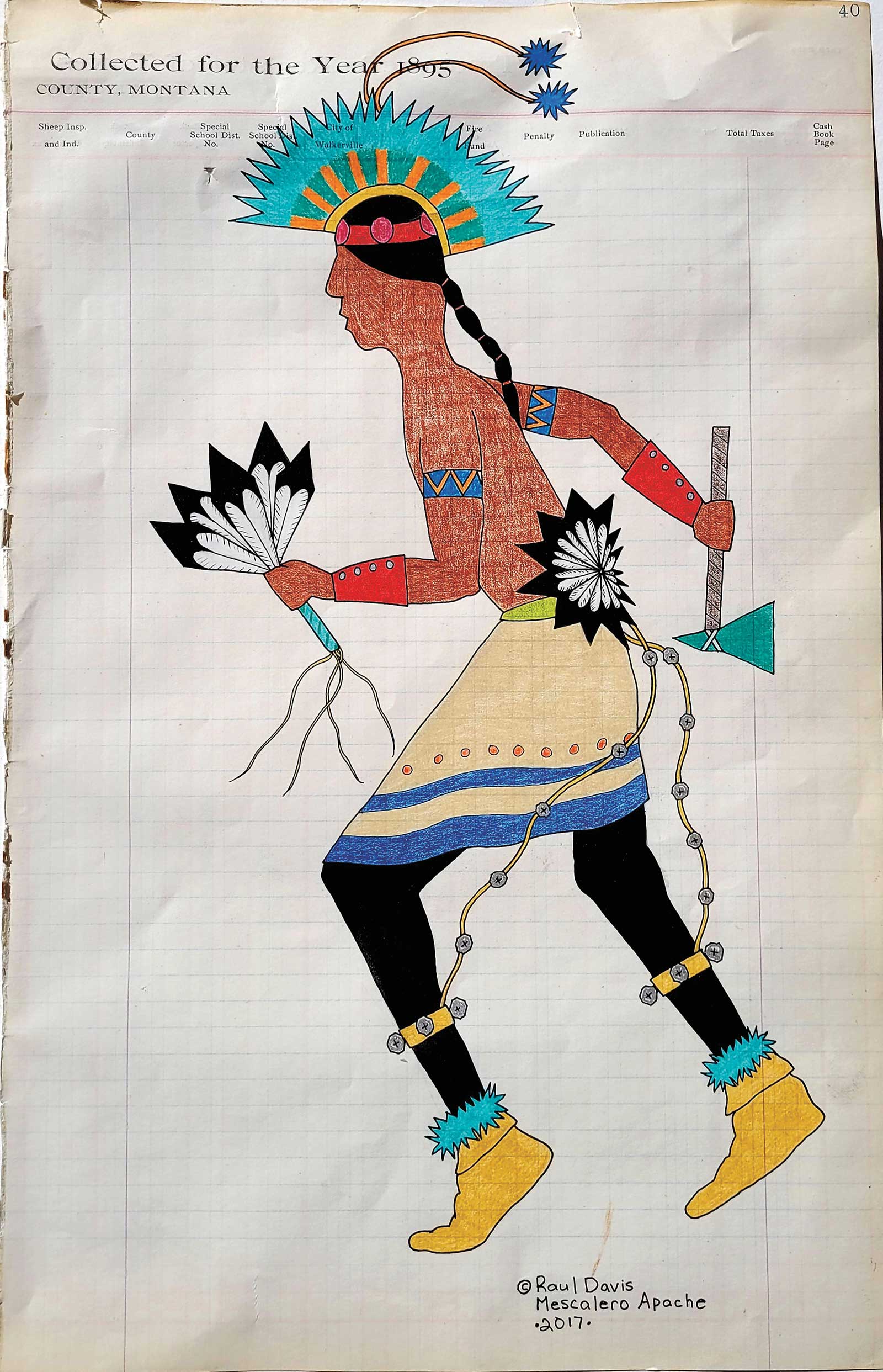
Raul Davis (Mescalero Apache), Apache Dancer
Reporting on parleys with Delaware chiefs on June 24, 1763, Trent wrote: “[We] gave them two Blankets and an Handkerchief out of the Small Pox Hospital. I hope it will have the desired effect.” The military hospital records confirm that two blankets and handkerchiefs were “taken from people in the Hospital to Convey the Smallpox to the Indians.” The fort commander paid for these items, which he certified “were had for the uses above mentioned.” A reported outbreak that began the spring before left as many as 100 Native Americans dead in Ohio Country from 1763 to 1764.
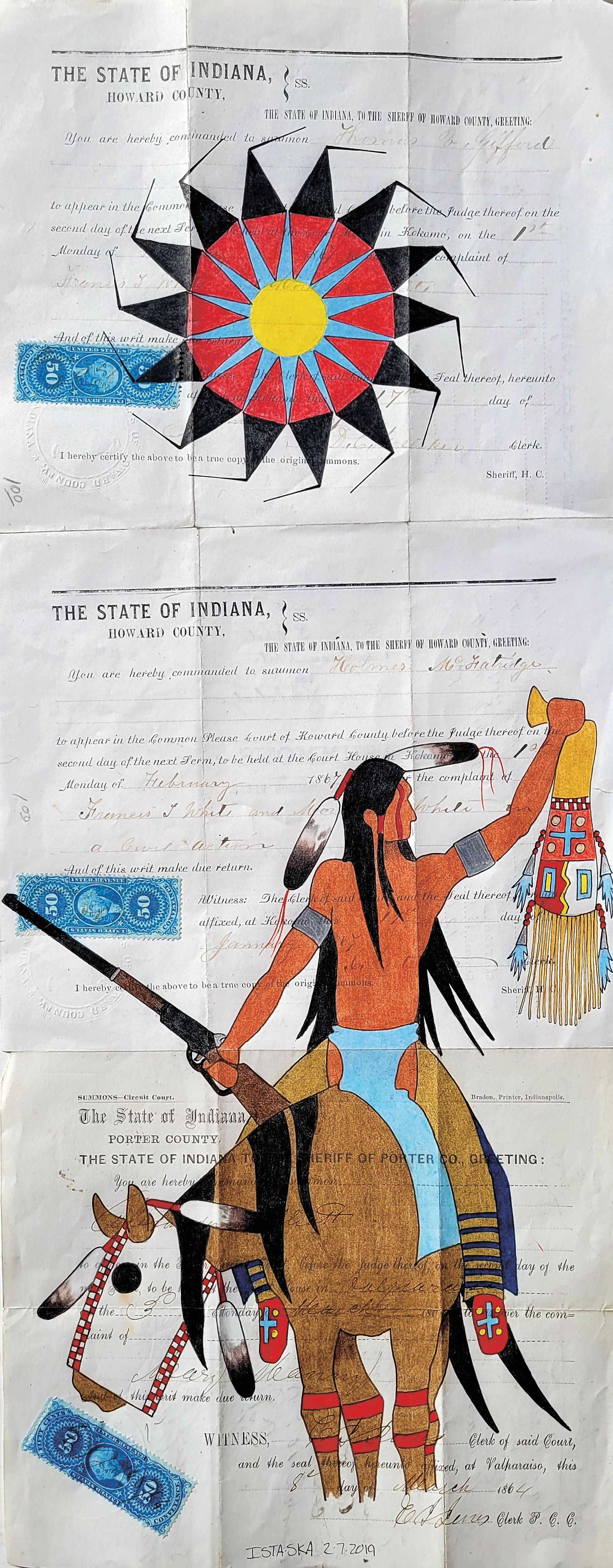 Travis Blackbird (Omaha), Survival Victory Salute, on Indiana summons with George Washington image on stamps, 21 x 9"
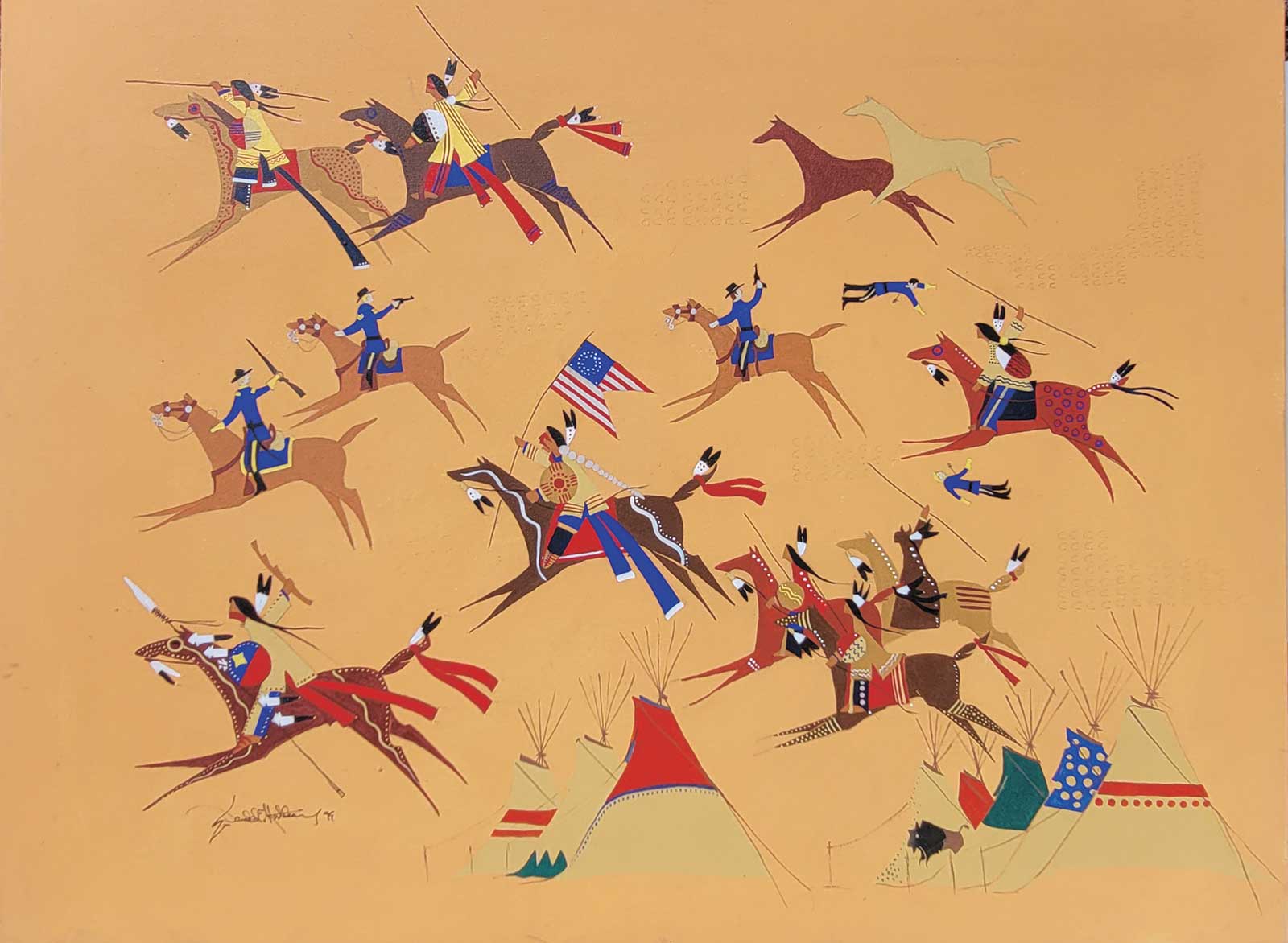 Donald F. Montileaux (Oglala Lakota), Chasing Away the SoldiersA month later the use of smallpox blankets was discussed by British General Jeffrey Amherst in letters to Colonel Henry Bouquet. Amherst, having learned that smallpox had broken out among the garrison at Fort Pitt, and after learning of the loss of his forts Venango, Le Boeuf and Presque Isle—all in present-day Pennsylvania—wrote to Colonel Bouquet:“Could it not be contrived to send the smallpox among the disaffected tribes of Indians? We must on this occasion use every stratagem in our power to reduce them.” Bouquet, who was already marching to relieve Fort Pitt, agreed with this suggestion in a postscript when he responded to Amherst just days later on July 13, 1763: “P.S. I will try to inoculate the Indians by means of Blankets that may fall in their hands, taking care however not to get the disease myself. As it is pity to oppose good men against them, I wish we could make use of the Spaniard’s Method, and hunt them with English Dogs. Supported by Rangers, and some Light Horse, who would I think effectively extirpate or remove that Vermine.”
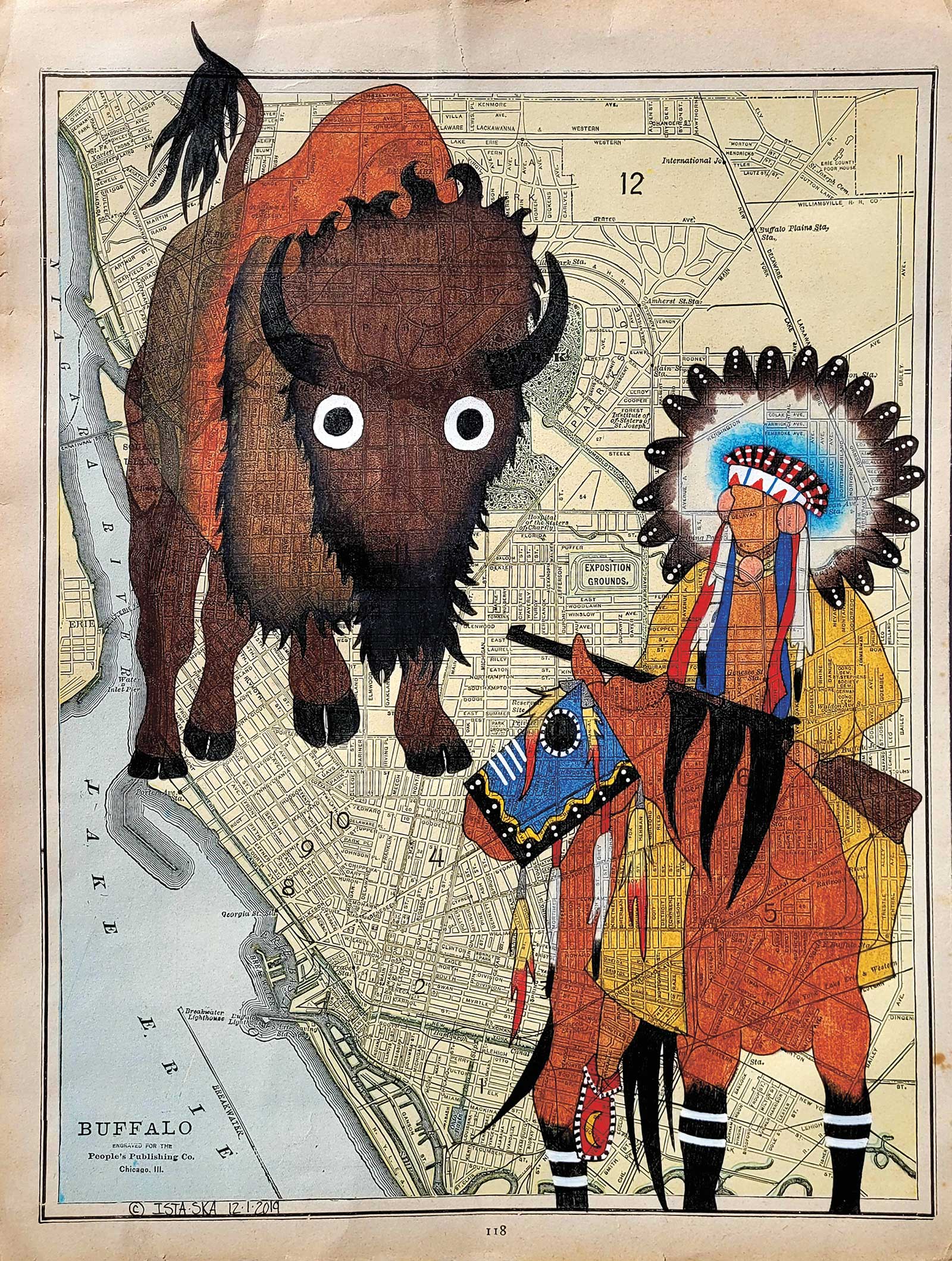 Travis Blackbird (Omaha), Buffalo and Omaha Chief, on 1900 Buffalo New York map, 16 x 11"
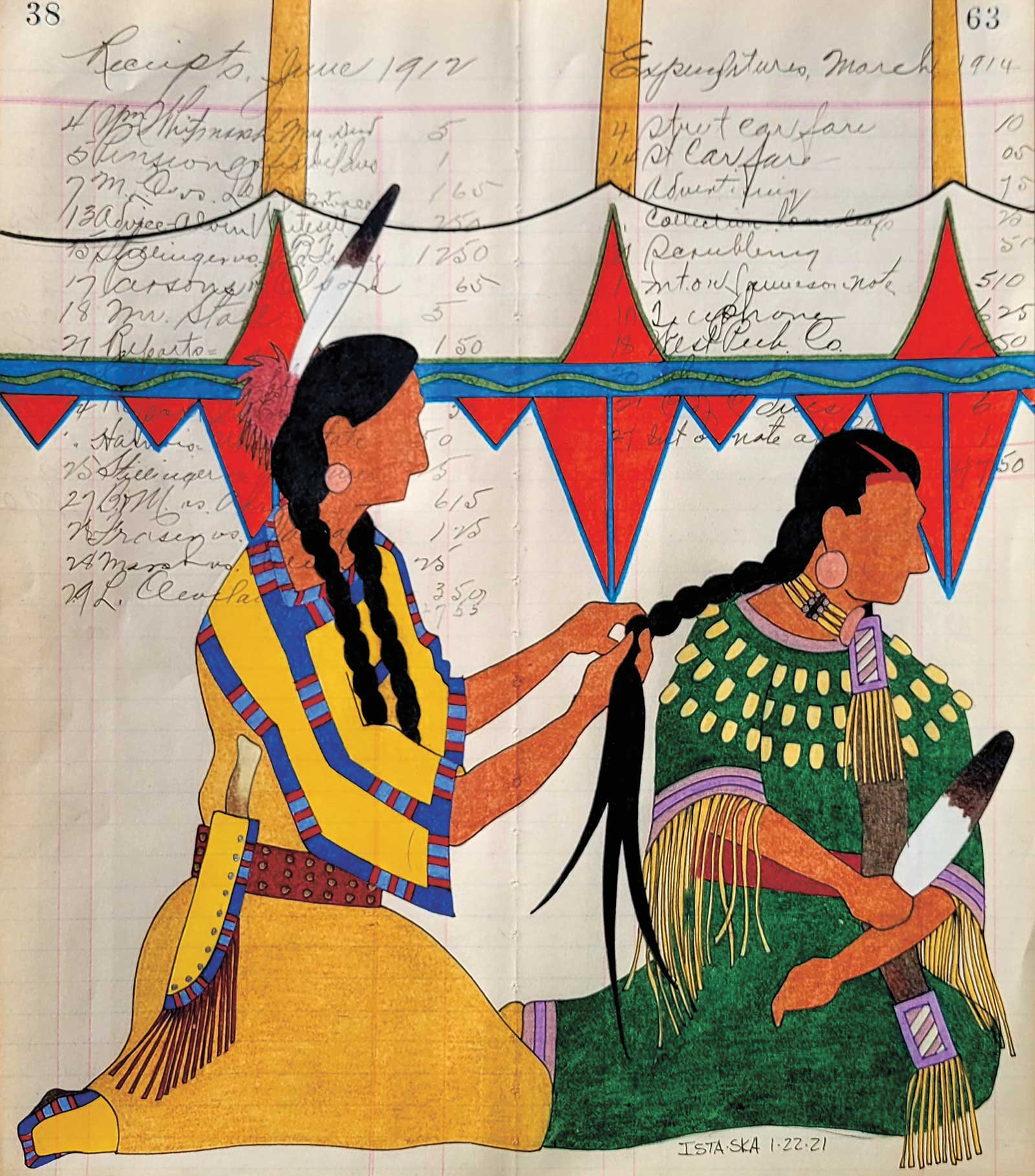 Travis Blackbird (Omaha), Omaha Mother and Daughter, on expenditures receipt, 12 x 14"
Amherst replied, also in a postscript: “P.S. You will Do well to try to Inoculate the Indians by means of Blankets, as well as to try Every other method that can serve to Extirpate this Execrable Race.I should be very glad your Scheme for Hunting them Down by Dogs could take Effect, but England is at too great a Distance to think of that at present.”
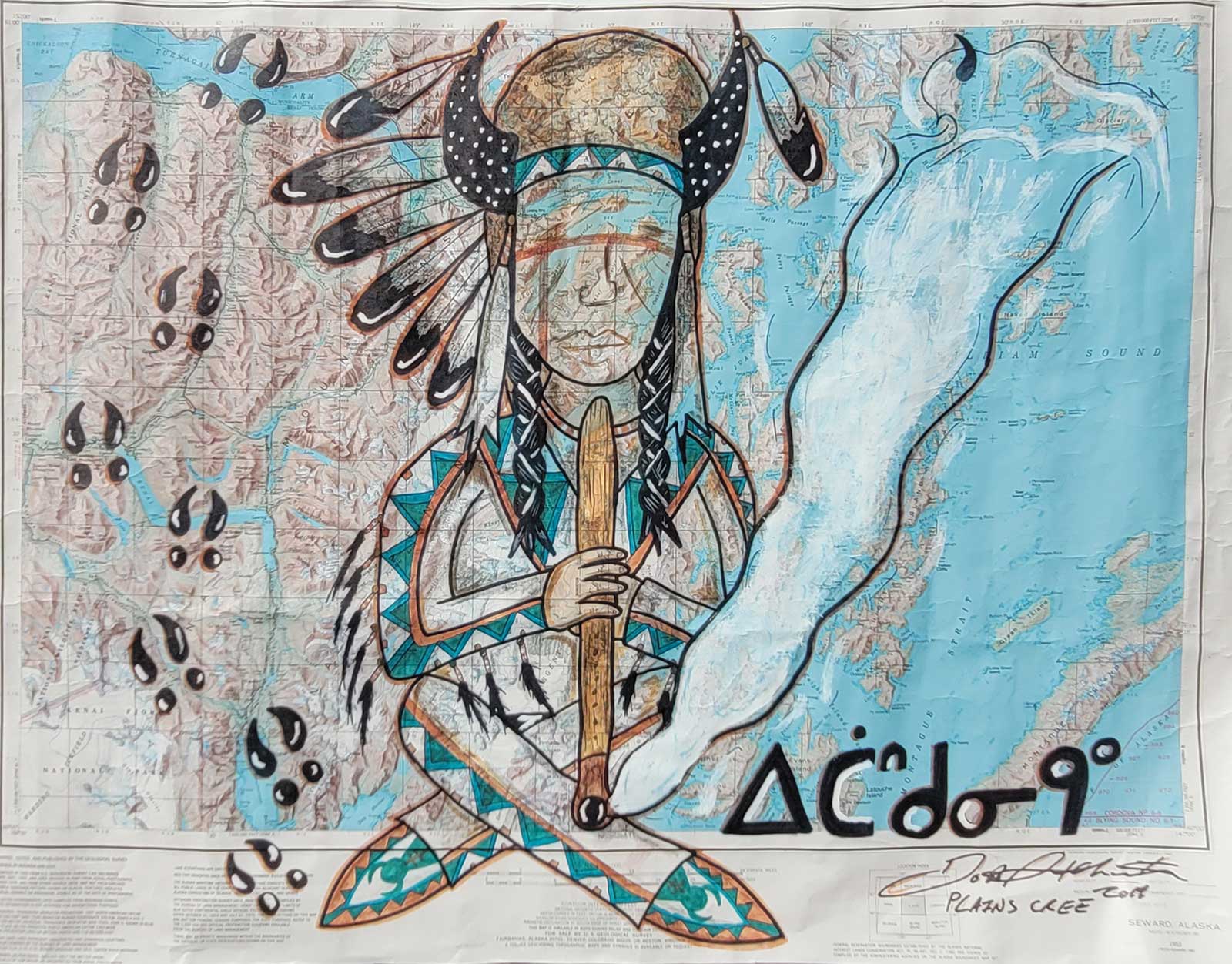 Joshua Atcheynum (Cree Nation), Memories, on 1953 navigation map of
Seward, Alaska, 22 x 30"
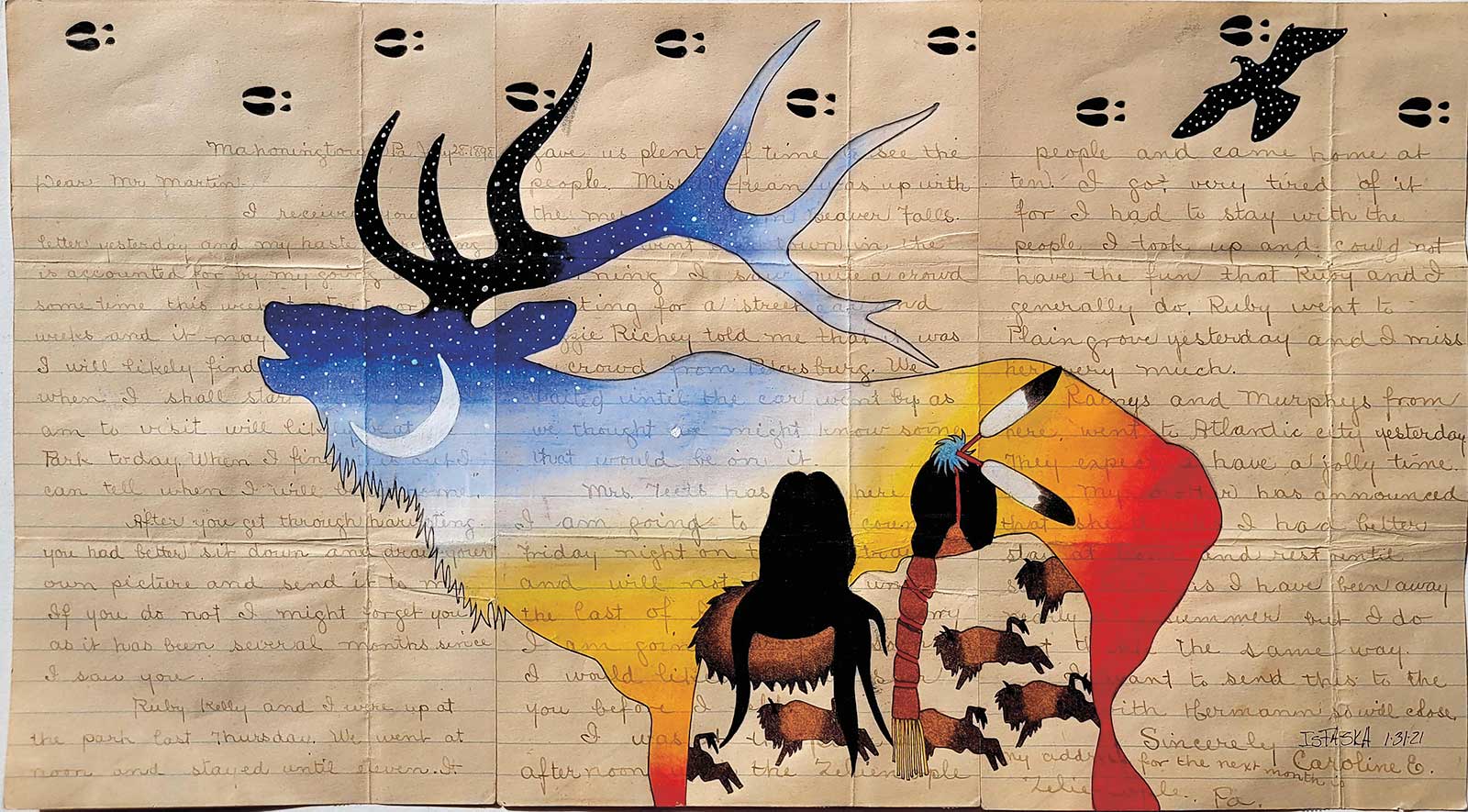 Travis Blackbird (Omaha), Elk Speaks Under the Stars, on a personal letter, ca. 1990, 9 x 18"
The same tactic, used by the U.S. Army to plan and commence the smallpox epidemic of 1837-38, almost destroyed the Mandans and severely reduced the Arikaras and Hidatsas. By 1851, these decimated tribes were of course far more pliable, with the Treaty at Fort Laramie holding council with representatives of the government of the United States.
These dark chapters of American history begin to establish the narrative threads of Pratt’s expression “Kill the Indian to save the Man.” It was Pratt who, in 1875, rounded up leaders of the Red River War—Comanche, Kiowa, Southern Cheyenne and Arapaho warriors—and had them removed to Fort Marion, where their hair was cut and they were issued European-style clothing. It was also during this period that prisoners were given paper with pencils, crayons, ink and watercolor. Ledger came soon thereafter. The fort was built by Spain in 1672, with the original name of Castillo de San Marcos. Upon receiving the fort from Spain, the Americans changed its name to Fort Marion. It was named to honor General Francis Marion, who served in the Revolutionary War.
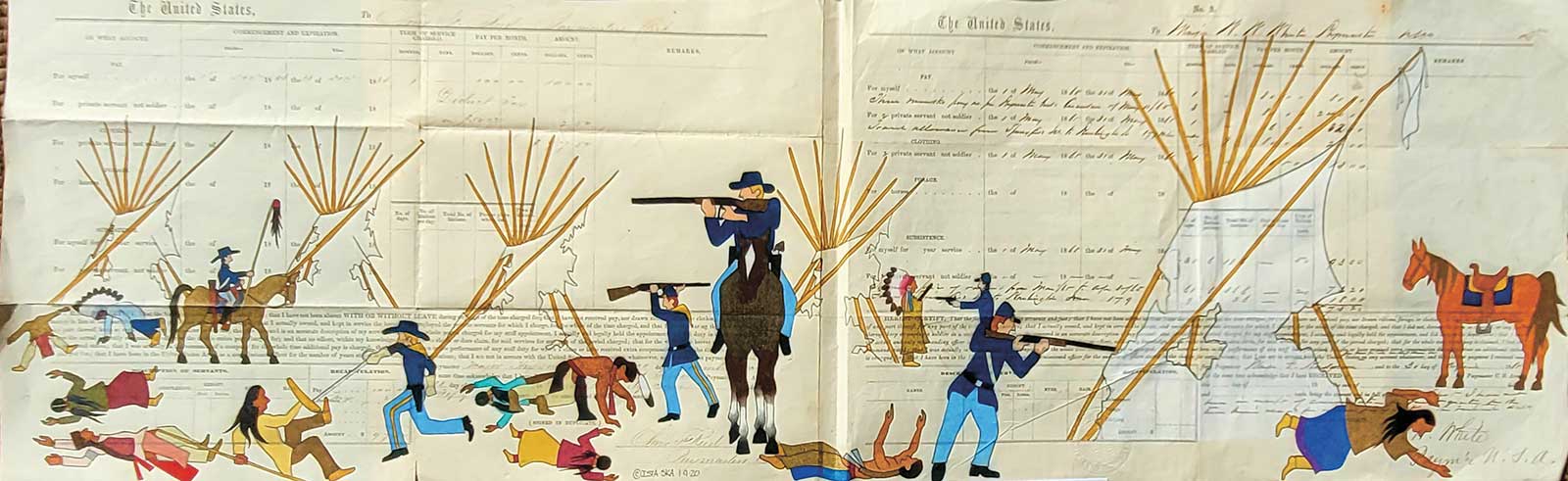
Travis Blackbird (Omaha), Civil War Muster-Out Roll – 1864, on an authentic muster-out roll, 11 x 38"
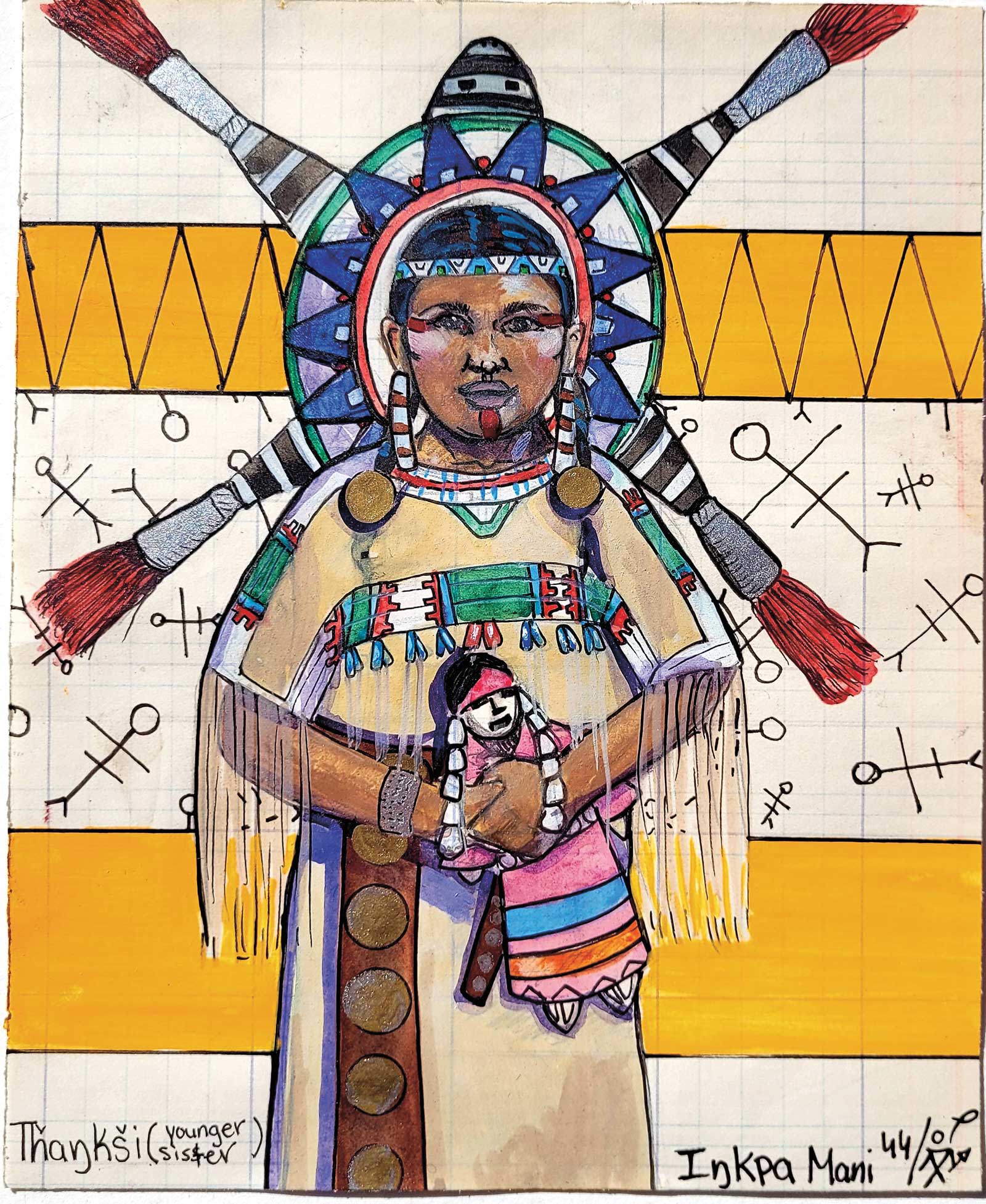 Inkpa Mani (Sisseton Wahpeton Dakota), Thankui “Younger Sister”“Earlier examples of ledger art were done for purely Native use, with no intention to make it palatable for non-Indians,” says Ross Frank, a Rhodes Scholar at the University of California, Berkeley, and the founder of the Plains Indian Art Project. “At Fort Marion, there was a ‘summer program’ that let these former warriors out for a bit and let townspeople hire them for yardwork, carpentry, dancing and so on. Ledger artists realized that the drawing was their intellectual property, which told the story of a warrior’s exploits, with the warrior owning the right to tell the story, but he also promoted his band or tribe by his actions. All of it is connected in very specific ways to ideas about the collection of cultural ideas and stories, active recasting of contemporary and recent historical events.”
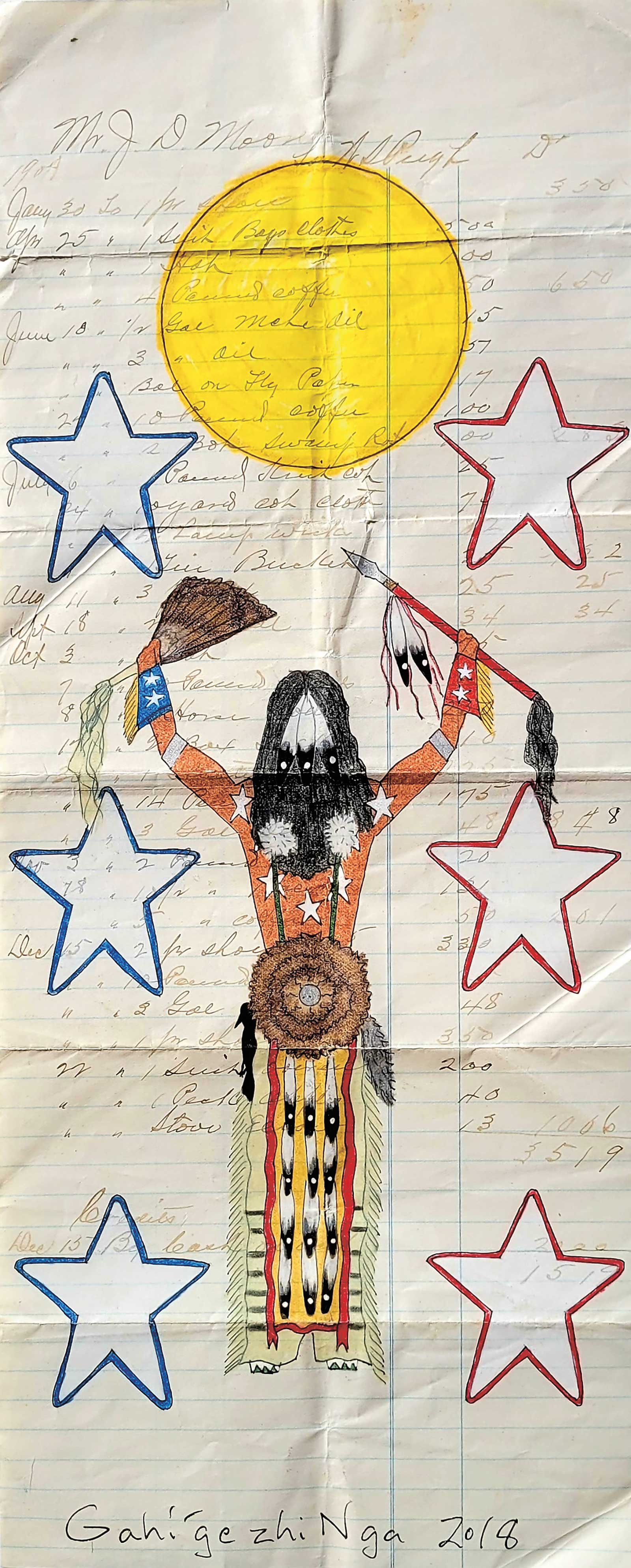 Gahigezhinge (Omaha), Ghost Dancer, on 1900 expense ledger, 16 x 5"
The art presented here is our effort to record Native American past, and to look onward into the future of Indigenous peoples in the entire Western Hemisphere, tribes in Africa, and Nomadic tribes in Asia. This grouping also contains living ledger artists that includes these tribes: Omaha, Ogalalla, Kiowa, Apache, Sisseton, Chiricahua Apache, Southern Cheyenne, Arapaho, Hopi and Tesuque Pueblo. This exemplary artwork is a reminder of the past, as well as a look into what is imperative that we avoid in the impending near future.
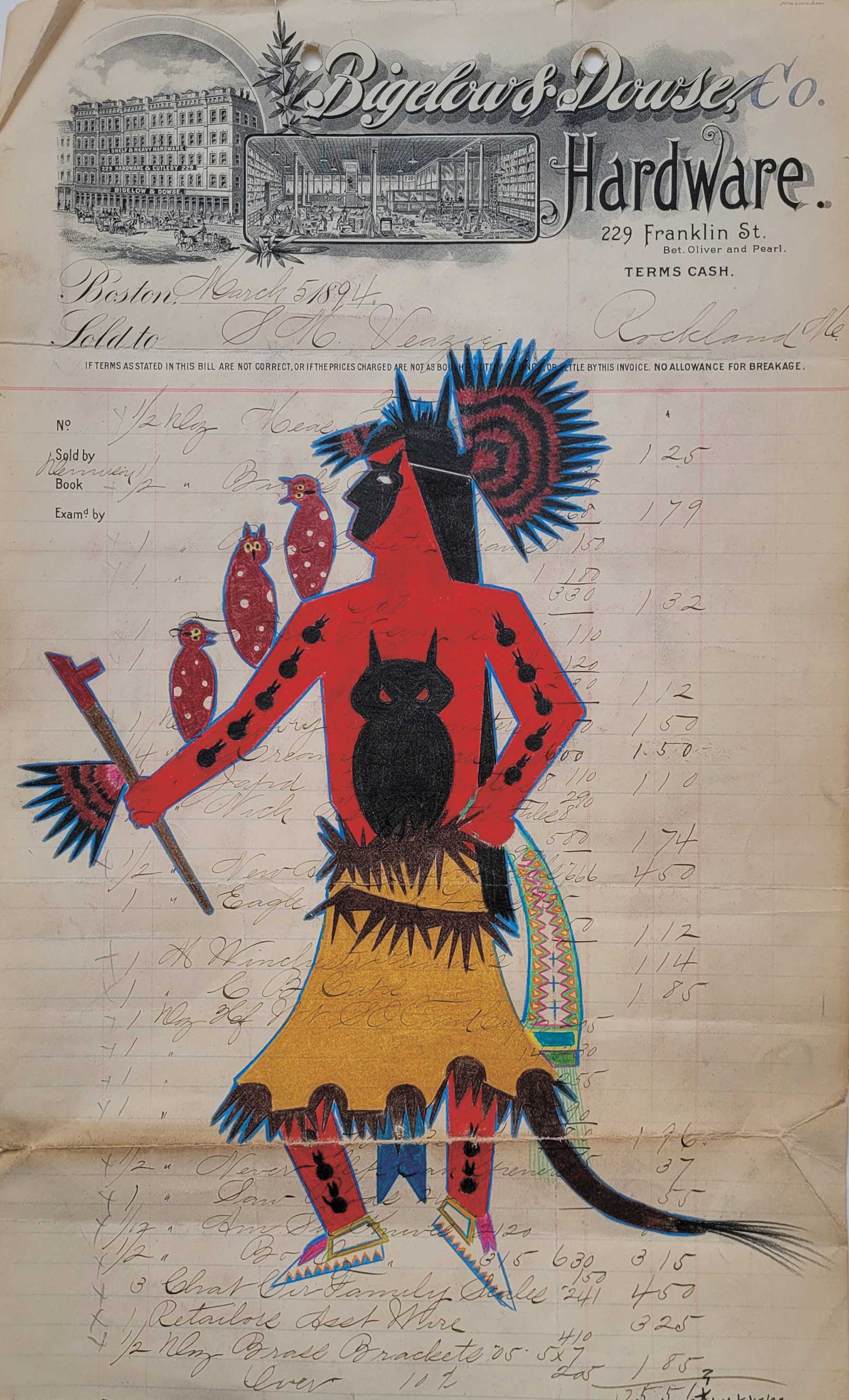 Bo Tsatoke (Kiowa), Kiowa Warrior and the Owls, work on 1894 receipt from Rockland Maine, 14 x 9"
=================================
Since 1980, Stephen Fox has owned New Millennium Fine Art, Santa Fe’s contemporary Native American gallery. For the past year, he has been working with the United Nations to open a branch of the UN in Santa Fe, with the imperatives of protecting Indigenous peoples’ health and culture, and to preserve original languages of North and South America. Other imperatives for UN Santa Fe will be the formation of an International
School (similar to the United World College of the American West and to the Woodrow Wilson International Affairs School at Princeton), removing harmful food additives, ending international child trafficking, preventing future pandemics and, above all, bringing to the Western Hemisphere a branch of the Hague’s International Courts. He is a 1969 graduate of Occidental College in Los Angeles, and is can be reached at (505) 983-2002.
Powered by Froala Editor