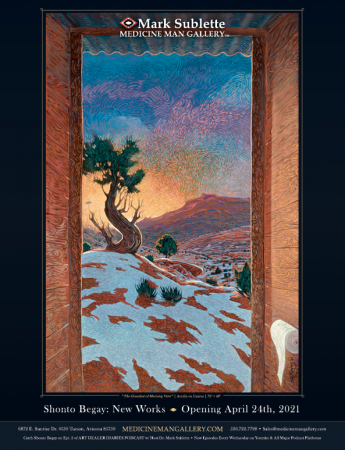
The transcendent artwork of Navajo neo-impressionist Shonto Begay is showcased in an autobiographical exhibition at the Wheelwright Museum of the American Indian, drawing upon the artist’s personal experiences and visions, and through a broader lens, the Native experience. “The idea behind the exhibition is art’s power to heal and balancing a lot of the content in the exhibit that has to deal with trauma and the dark history of the Native experience. It’s really about sharing the beauty of Shonto’s work, using his style of mark making and the content of his paintings as a metaphor for how art has helped him heal in a personal way,” says Zachary Miller (Chickasaw), the Wheelwright Museum 2019-2021 Andrew W. Mellon Foundation Curatorial Fellow. “[We wanted] to give a very broad perspective of Shonto’s work,” interim director Jean Higgins adds. “He deals with challenging issues as well as the beauty of where he grew up. He’s a very multifaceted person and his art really reflects that, so we’re trying to allow people to see all of those assets.”
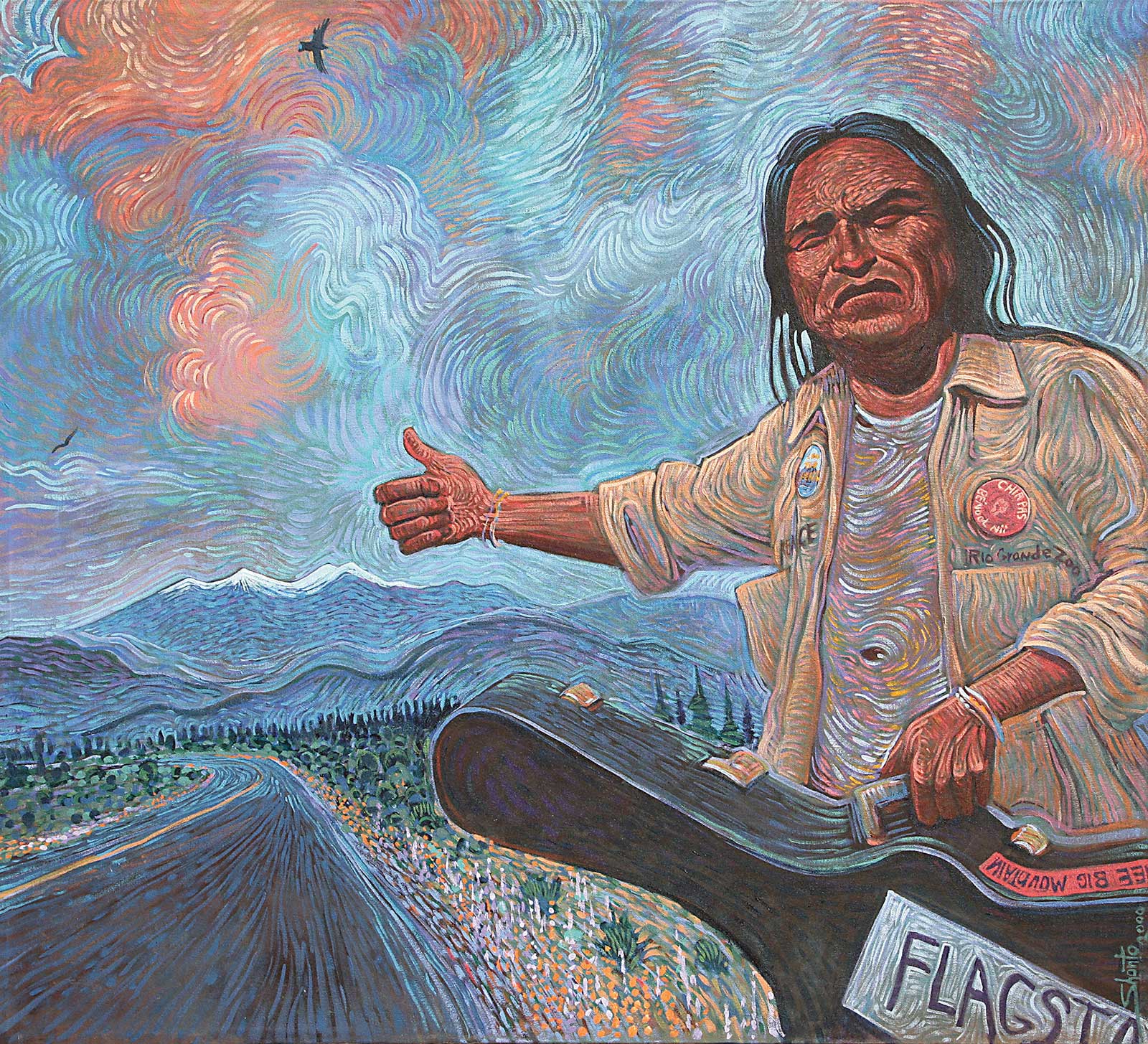 Rhythms from the Edge of the Rez, 2000, acrylic on canvas, 40 x 44". Photography by Medicine Man Gallery.
Shonto Begay: Eyes of the World will include 40 pieces by the artist, from his earliest work in the 1980s to the present day. Those who have followed Begay’s work closely throughout the decades and new viewers alike will notice the stylistic shift, from the rigid mark making in his early drawings to his fluid impressionist painting style, Miller says.
“It didn’t change by leaps and bounds, that’s for sure. It was slowly unfolding,” says Begay. “[My paintings contain] my comments on culture, nature, society and dreams through the years...I think like anything else, with age and time, we all grow as a society, and my own visions and views from inside a culture change. In the old days I was painting and doing my work in a more subjective way—you’d know what’s going on in the picture, and could give it a visual narration which is all good, but somewhere along the way I thought, ‘there’s got to be something I can delve into that’s deeper,’” he explains.
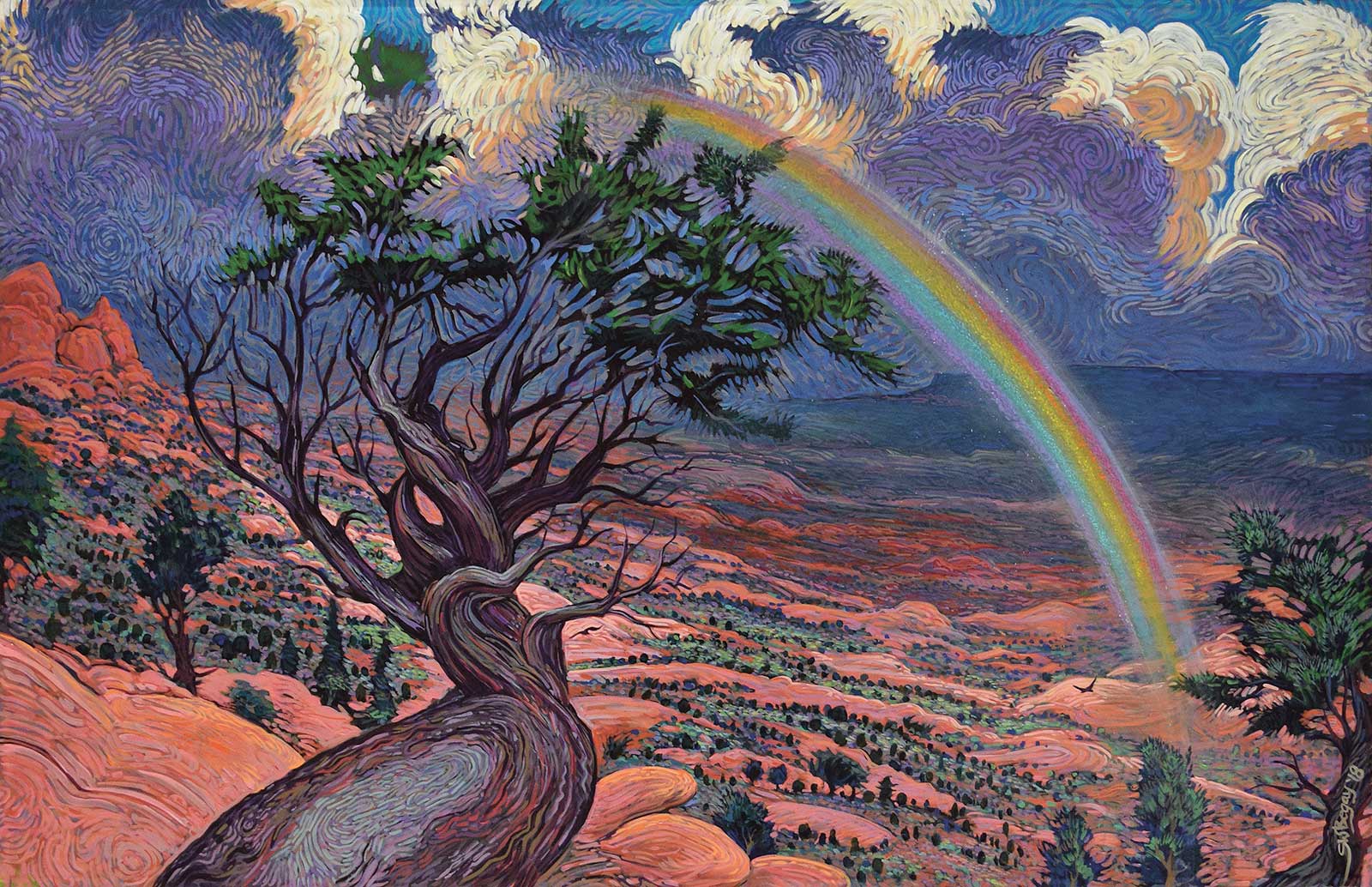 Promise of the Coming Storm, 2018, acrylic on canvas, 50 x 84". Photography by Medicine Man Gallery.
Growing up, Begay spent a lot of time at the feet of weavers, medicine people, shamans and seers. “So a lot of my views come from that world. The inclusivity of all,” he says. “I feel like each painting I do is a ceremony, a prayer, a petition to the spirit as a great universal kindness.” He explains that in the late ’80s he began sending visual chants and prayers into the universe through his paintbrush. “A lot of those little dots, lines, curves, circles and spirals, I think they came out in the form of an alphabet because each one of these brushstrokes turns into a syllable, a word, a sentence of a prayer,” says the artist. “I’ve found great comfort and great connectiveness [in art]. I approach my art more like a ceremony, respecting it and giving it a ceremonial context.”
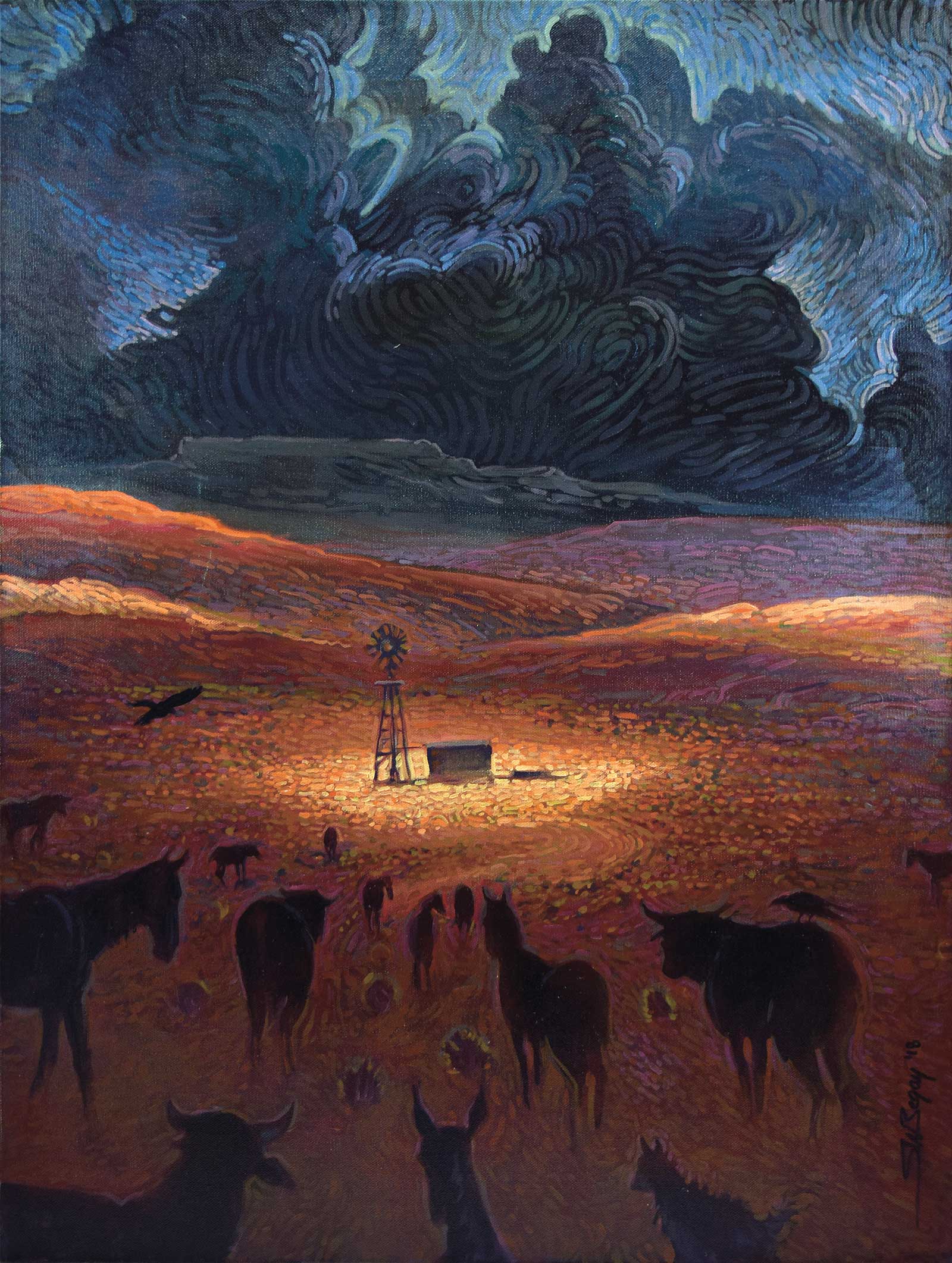 Drawn by the Light, 2018, acrylic on canvas, 28 x 20". Photography by Medicine Man Gallery.
Miller explains how he approached the flow and sequencing of the exhibition, which originally had a much larger scope but was downscaled due to the pandemic. In turn, the show became even more focused, with deliberate decisions affecting the overall flow of the show. They distilled it down, Miller says, and ended up with a tight-knit, powerful narrative. “[I came up with] this theme of the journey of the hitchhiker being picked up in a truck. People making their way down the road in the back of a truck—this is what I always think when I think of Shonto’s work.”
Having spent a great deal of time as a young man hitchhiking all across the American West, Begay says this concept resonates with him. “I learned a lot of great things on the road. I’m a dusty road scholar,” he says, laughing. “I’m constantly moving along with the kindness of strangers, helping each other progress…My work is continuously moving on and progressing, like putting miles behind you.”
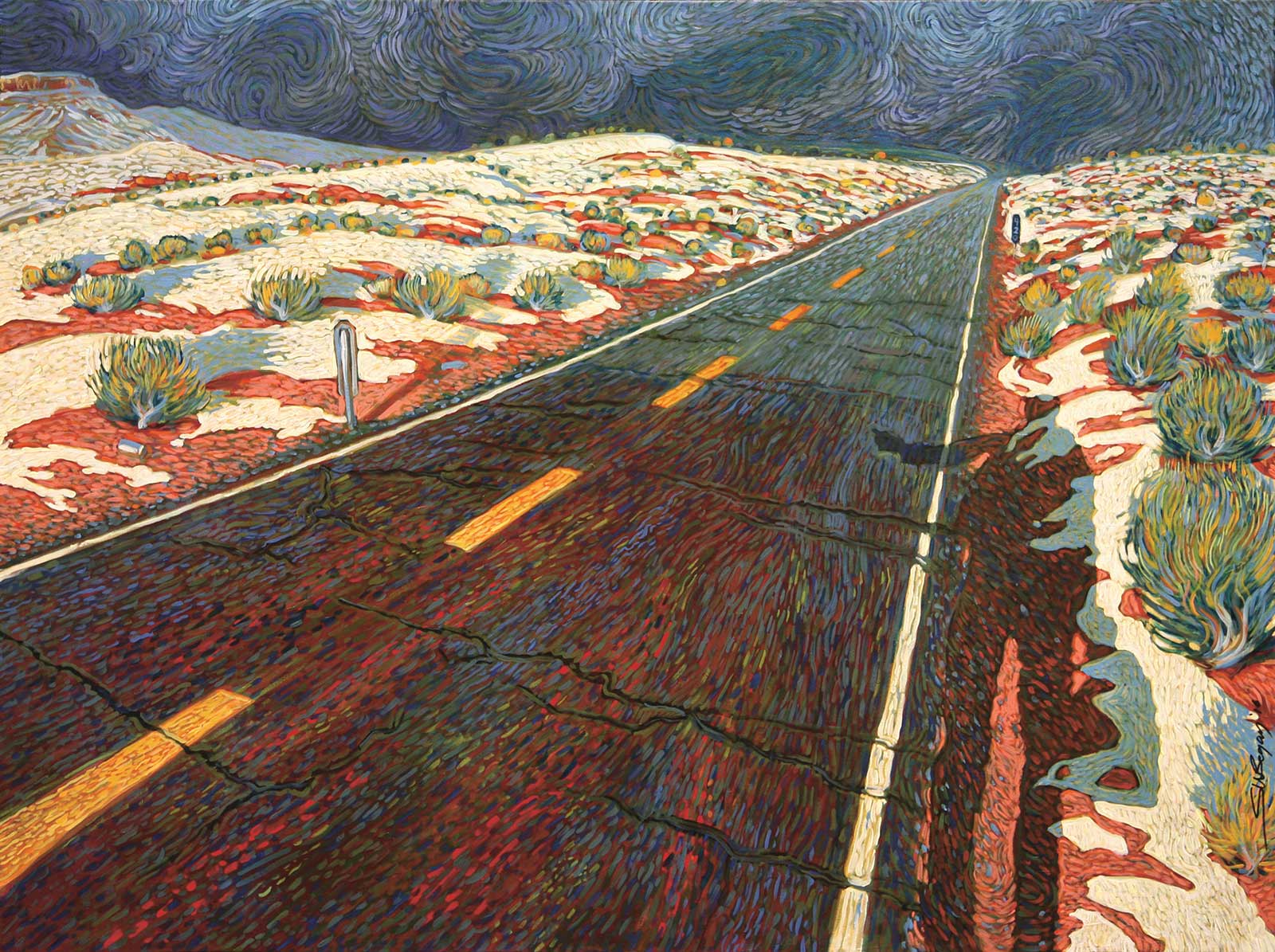 Homeward Bound, 2016, acrylic on canvas, 36 x 48". Photography by Medicine Man Gallery
The exhibition strives to make visitors feel as though they’re being picked up by one of these drivers, being guided through Navajo history—the Navajo Hero Twins story (an important story in Navajo mythology), moving into the Long Walk and “as you leave the exhibit, you end with the painting In the Days Following Sumner, and that’s the journey home after the Long Walk,” Miller explains. “And so as you’re leaving the exhibit, you’re going home as well. I was thinking about how that journey presents itself as you’re entering and leaving the exhibition.”
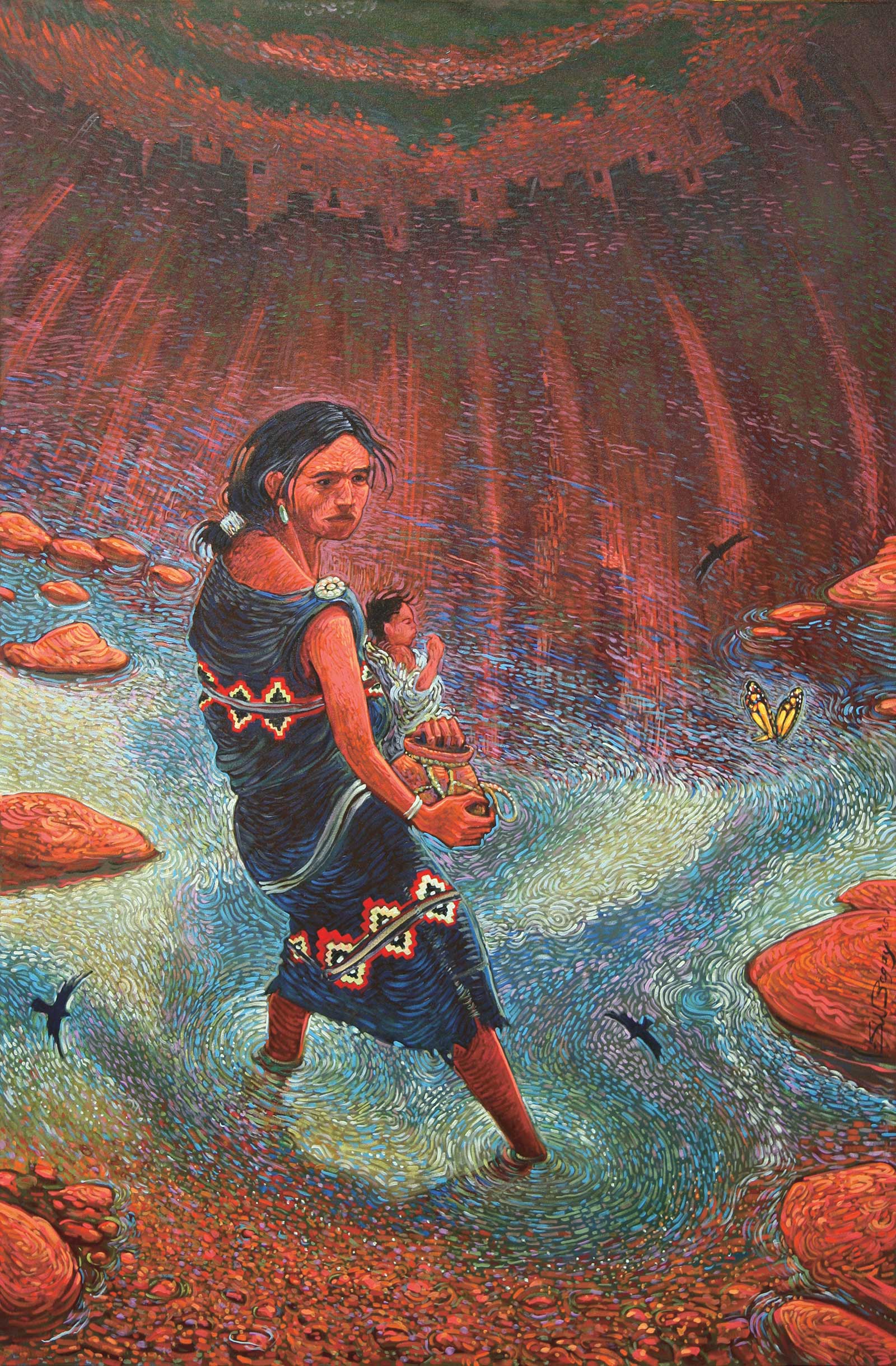 In the Days Following Sumner, 2015, acrylic on canvas, 72 x 48". Photography by Medicine Man Gallery.
In Rhythms from the Edge of the Rez, a man carrying a guitar case stands on the roadside, hand and thumb out in the well-recognized symbol asking for a ride, for help from a stranger. The man in the photo is Begay’s good friend and musician Clarence Toledo, and the piece actually started out as an album cover for Toledo, who was staying with Begay in his Flagstaff, Arizona, home. “It was about Clarence hitchhiking into the Sacred Mountain spreading music of hope and beauty. Wonderful Navajo music. I felt like what we both do [as artists is not so different from one another], so it’s about journeying into the Sacred Mountain and just continuing to move under the close gaze of the Sacred Mother,” says Begay.
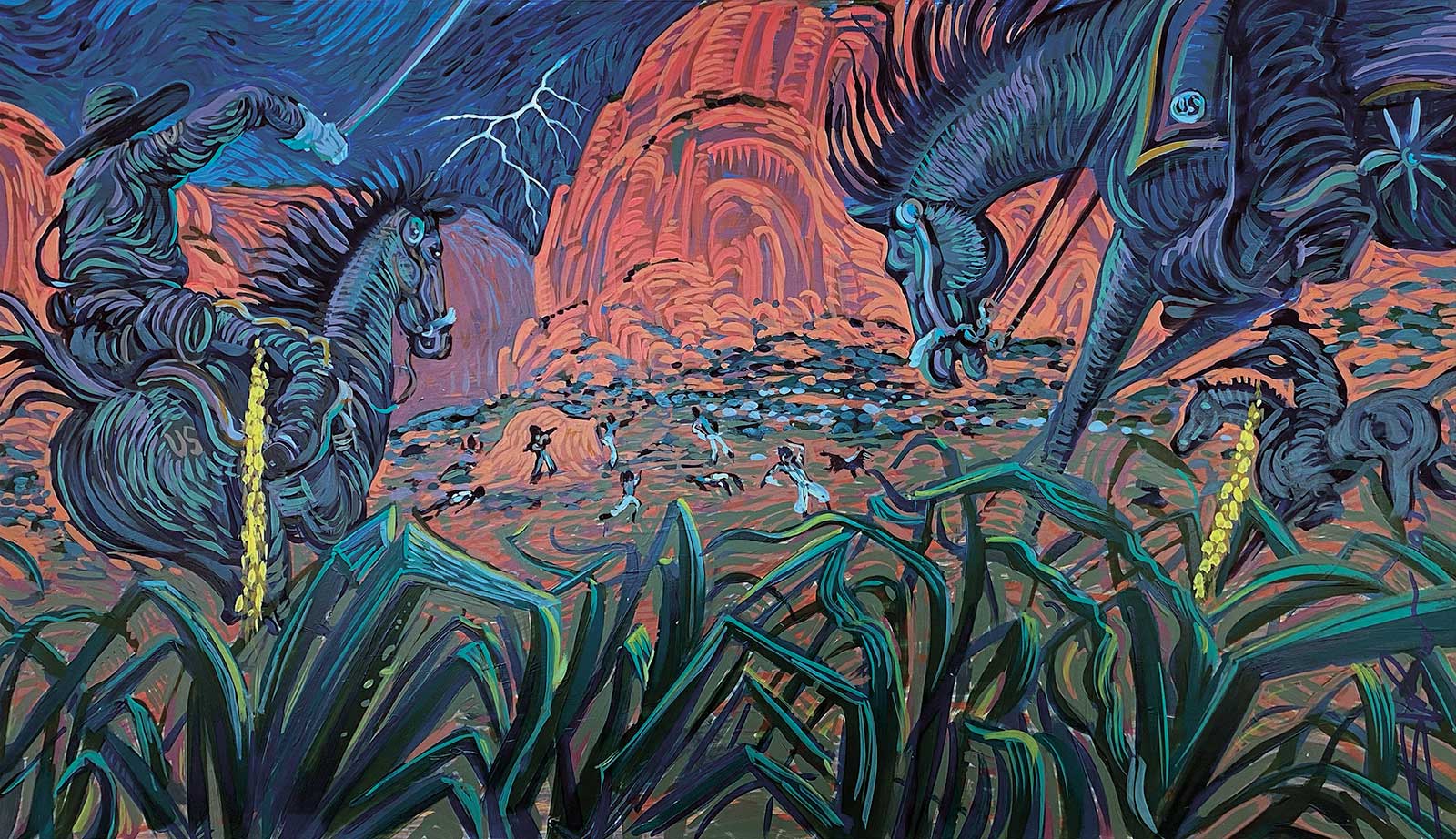 The Fearing Time, 2003, acrylic on paper, 18 x 24". Courtesy the Wheelwright Museum.
“He’s painted many iconic pieces about life on the rez. Pictures of families, pictures of Navajo people hitchhiking on the road,” Higgins adds.
A rainbow travels across a cloudy blue sky in Promise of the Coming Storm. “This was a view from my birthplace of Shonto on the Navajo Nation. The view you get after looking at a summer rain,” says Begay. “With the rain coming down, it was a beautiful way to commemorate my birthplace, my beginning, the land that forged me. All of the memories, the joy, the pain, lies there.”
Miller had the opportunity to travel to Shonto on the Navajo Nation, where Begay guided him through his homeland. Drawn by the Light, a vertical painting, depicts a crowd of different animals moving across the land under the dark gray atmosphere of a looming storm, drawn to a single source of sunlight shining down on a windmill and a building in the center of the composition. “When we were leaving the hogan, there were all of these horses and animals roaming together and the clouds overhead just created this feeling of peace, and the painting really showed that,” Miller says, citing a memory of his time exploring the reservation. “Some of his spiritual pieces are really exquisite...I think that’s such an important underlying component of who he is. Soothing and powerful,” says Higgins.
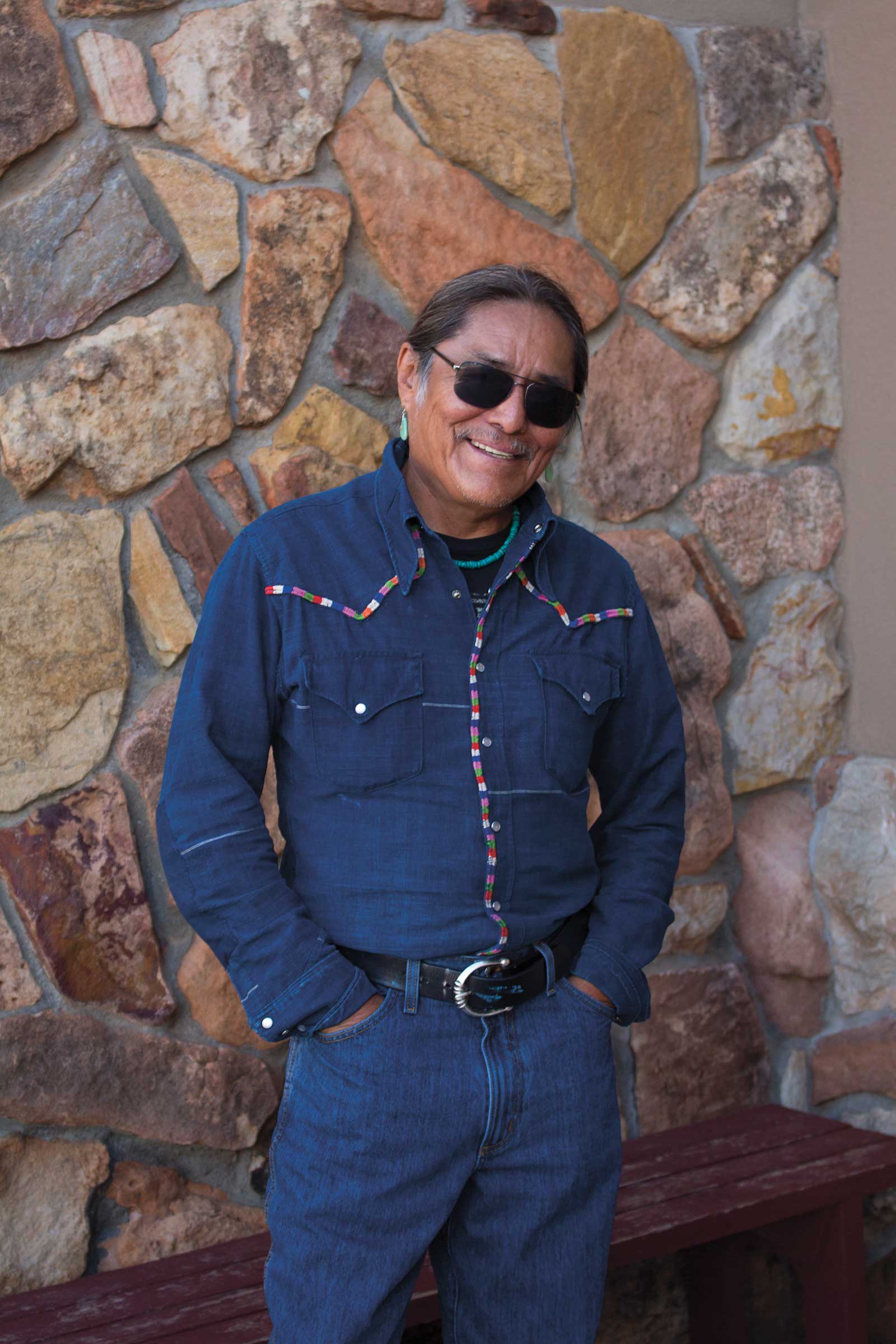
Art, for Begay, allows him to process his memories and experiences. “I remember things, so it’s a way to give them a bed, a space...The way I’ve been able to approach [my experiences] in a calm way is through the arts...There’s a lot of catharsis happening.”
A one-point perspective painting of a road cutting through snowy desert and vanishing into the distance, Homeward Bound is another way “to just keep moving forward.” You may not notice at first the shadow of a man on the side of the road beckoning for a ride, or maybe it jump outs at you right away. “Depending which direction you’re going, east or west, you see your shadow either behind or in front of you,” says the artist.
Shonto Begay: Eyes of the World will be enhanced by a “Guide by Cell” experience, numbered areas in front of each painting where visitors can dial a code on their phones and listen to a recording of Begay talking about the painting, his practice and his process. The exhibition will be on view from April 10 to October 3.
April 10-October 3, 2021
Shonto Begay: Eyes of the World
Wheelwright Museum of the American Indian
704 Camino Lejo, Santa Fe, NM 87505
(505) 982-4636, www.wheelwright.org
Powered by Froala Editor