Prior to the New Deal, education of Native American children focused on cultural annihilation and assimilation into white society. In her article “Dorothy Dunn and the Art Education of Native Americans: Continuing the Dialogue” in Studies in Art Education, Laurie Eldridge states baldly, “This cultural annihilation included preventing students from practicing their traditional religions and speaking their Native Languages. Creating images of their homes, rituals, or creating other aspects of their visual and material cultures also was discouraged. Consequently, art instruction was not usually a part of Indian education. However, some groups of people who were predominantly White Anglo-Saxons worked to change this government policy.”
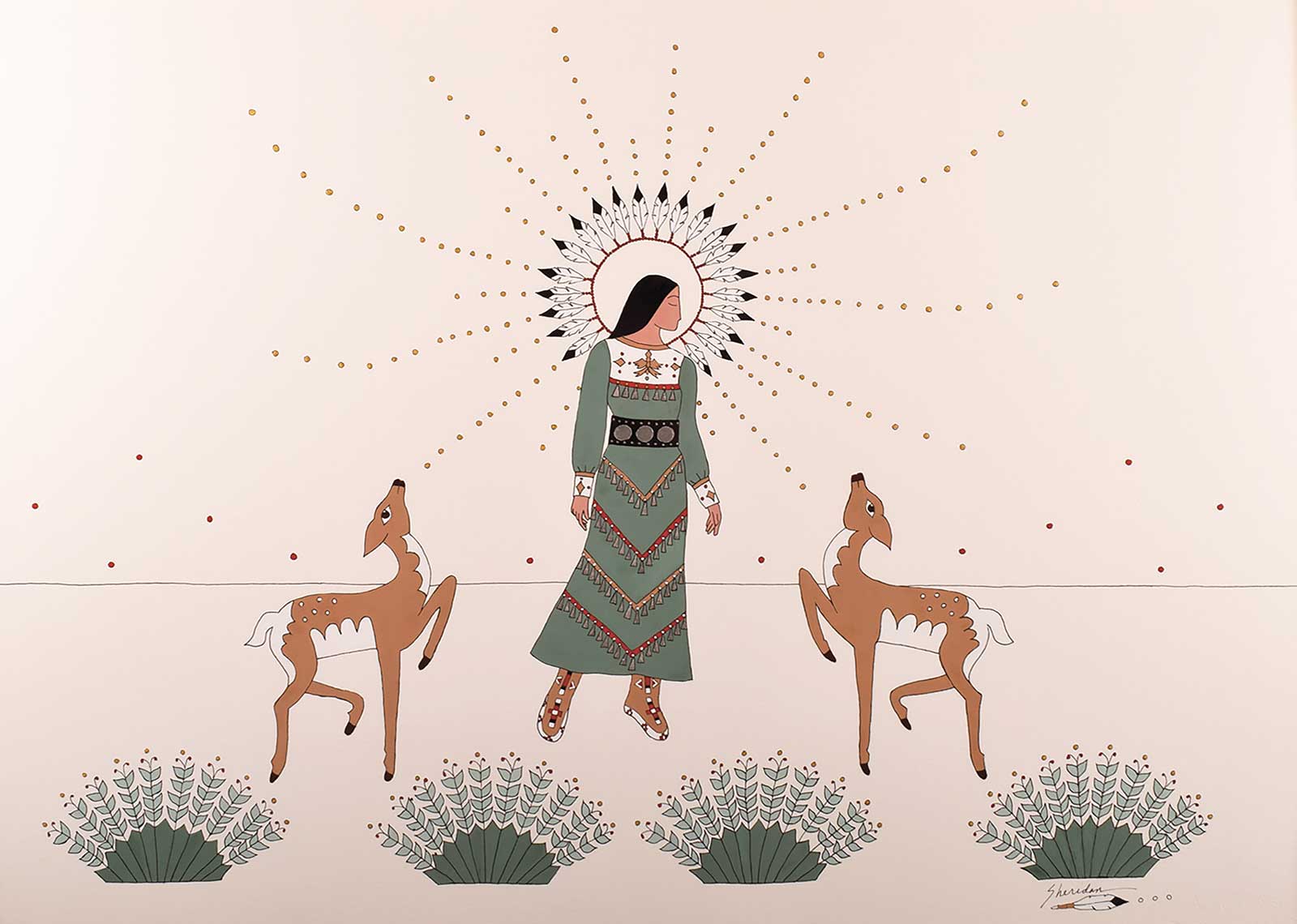 Sheridan MacKnight (Hunkpapa Lakota/White Earth Chippewa), Tawacin Wasté Win, gouache and ink on archival paper, 21 x 28¾"
Dorothy Dunn (1903-1992) first came to New Mexico in 1928 to teach second grade at the Santo Domingo Pueblo Day School. In 1930 she went to the San Juan Boarding School at the Northern Navajo Agency in Shiprock, New Mexico, before returning to Chicago to finish her studies at the School of the Art Institute of Chicago.
Her interest in Native American art was piqued by exhibitions at the Field Museum in Chicago, which had opened in 1921. While finishing her studies she submitted a proposal to the Santa Fe Indian School to teach art there. Her proposal was accepted and, in 1932, The Studio opened for classes. Inspired by Pueblo pottery, Plains hide paintings and petroglyphs, she directed her students to paint in a flat, two-dimensional style in outlined opaque watercolors. The subject matter, however, was to come from their experience of their lives and the rituals and ceremonies of their tribes. Dunn also discouraged realism and backgrounds, demanding that the paintings be “decorative–not realistic…symbolic…Pure symbolism with stylized natural forms,” according to Elise Chevalier in her University of Texas master’s thesis, “Lessons from Dorothy Dunn: The Studio at the Santa Fe Indian School, 1932-1937.”
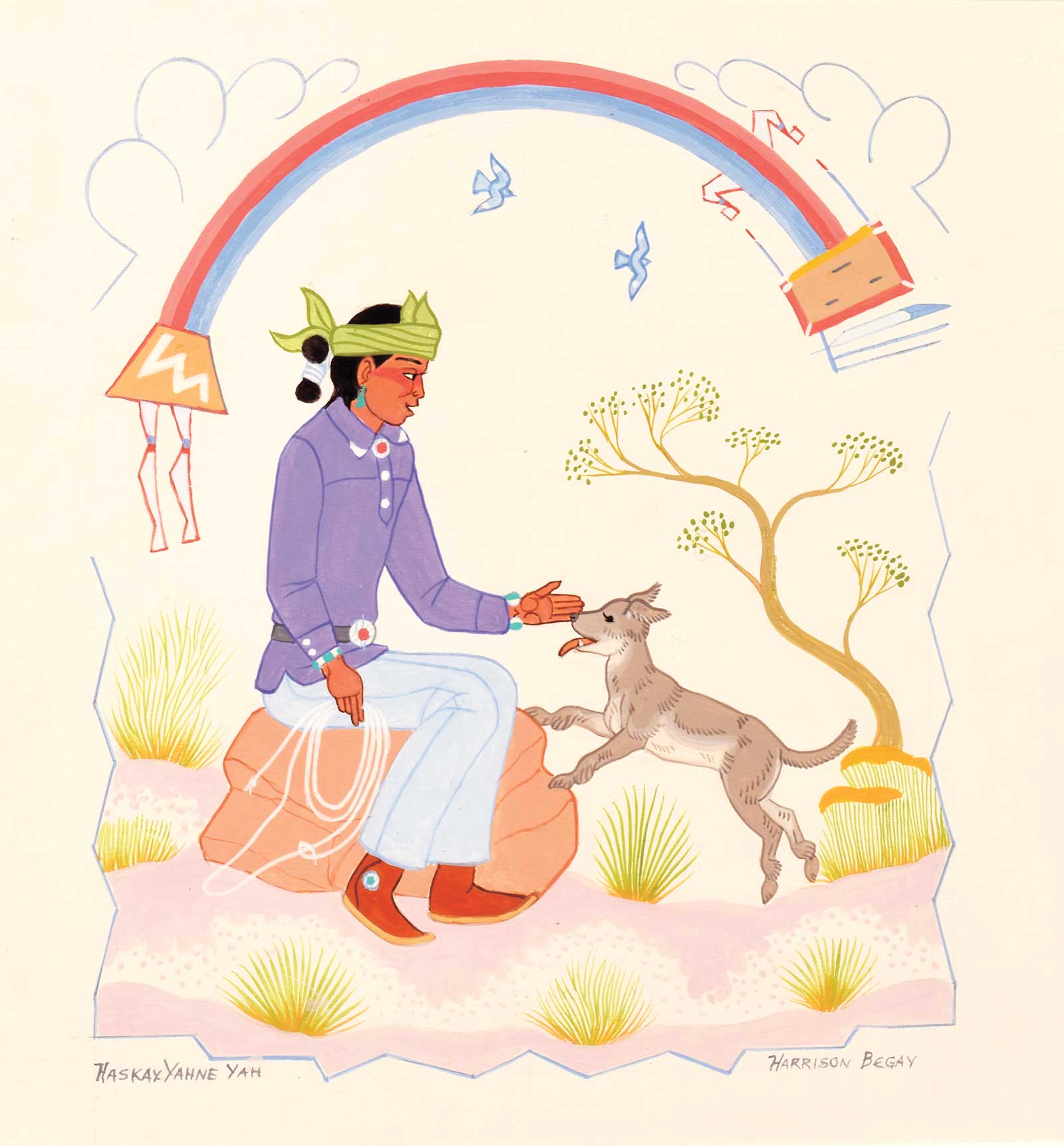 Harrison Begay (Diné, 1917-2012), Diné Children Under Rainbows (one of a pair), watercolor, 10 x 9½"Several decades earlier, Esther Hoyt had encouraged her students at San Ildefonso Pueblo Day School to paint the dances of the Pueblo—very much against government policy. The artists’ style was derivative of Pueblo mural and pottery painting.
The style Dunn espoused was heavily influenced by the San Ildefonso painters and became known as the Studio Style. Bruce Bernstein and W. Jackson Rushing, in their book Modern by Tradition: American Indian Painting in the Studio Style, comment that it was “a style that she believed, rightly or wrongly, was the only authentic painting style for Native American artists to follow.”
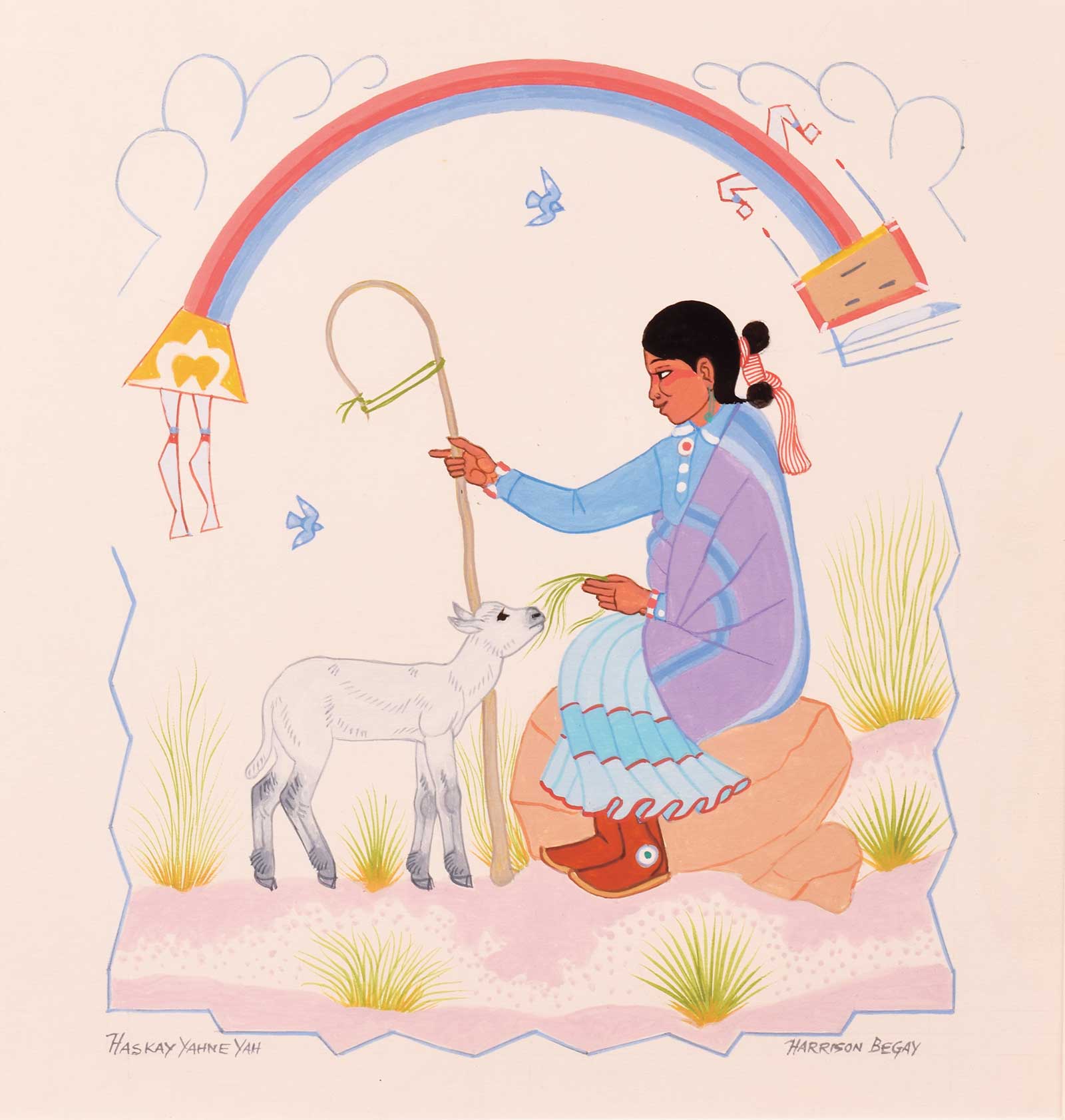 Harrison Begay (Diné, 1917-2012), Diné Children Under Rainbows (one of a pair), watercolor, 10 x 9½"
Dunn had her critics, both within and outside the Native community. Allan Houser (1914-1994), who would go on to receive a Guggenheim Fellowship and the National Medal of Arts, objected. “She trained us all the same way,” he said. “Her style lacked originality and creativity…I had something else in mind when
I came here. I didn’t want to do Indian-style paintings. I didn’t care for it at all, but that was the only way that I could get into the arts.”
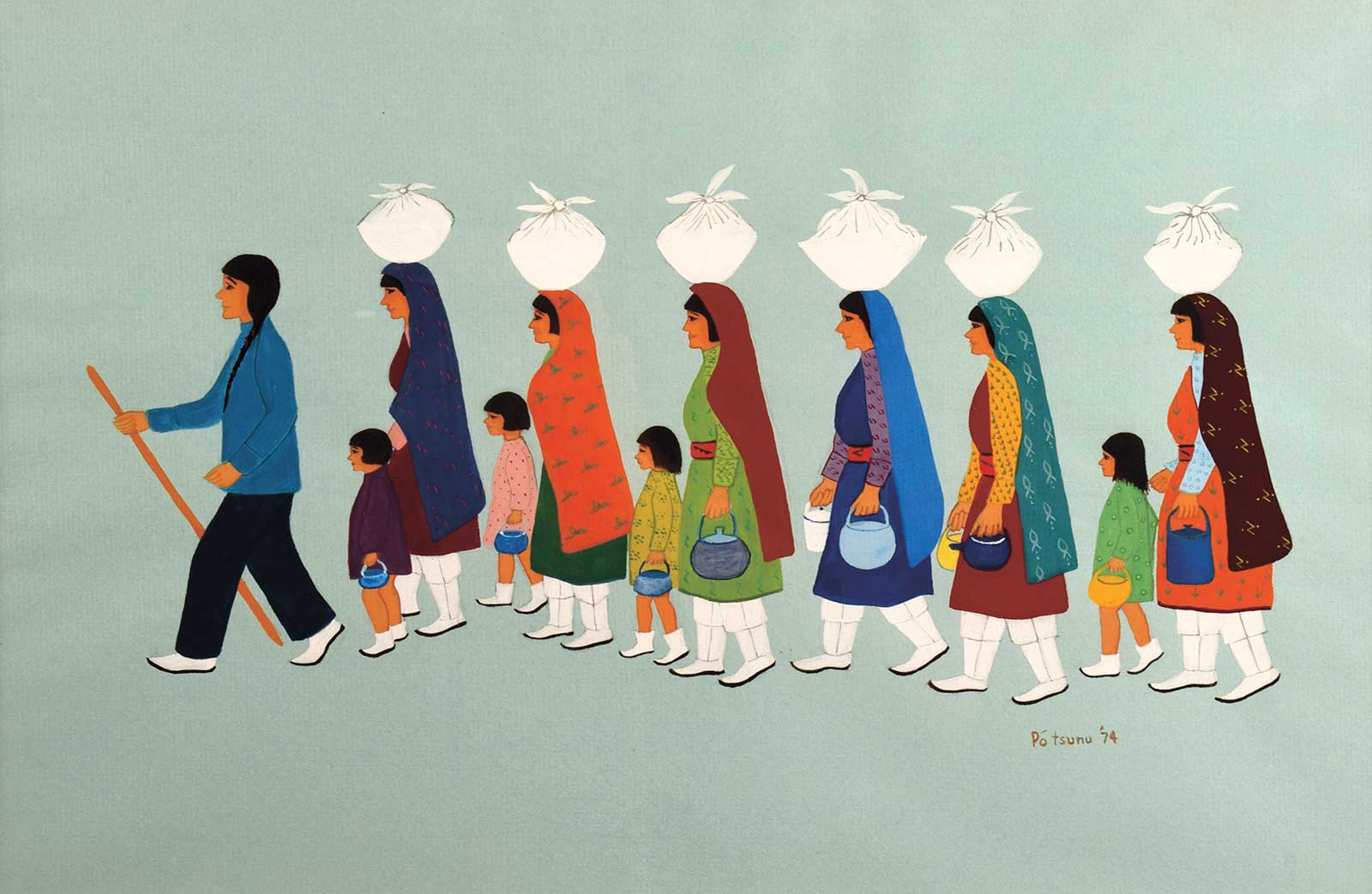 Gerónima Cruz Montoya (Ohkay Owingeh, 1915-2015), 11-Figure Painting, watercolor, 11 x 16"
Gerónima Cruz Montoya (Ohkay Owingeh, 1915-2015) was forced to go to the Santa Fe Indian School when she was 12 and tried to run away. The school’s strictures began to lessen and with the arrival of Dorothy Dunn, Gerónima was able to look into the traditions of her Pueblo. Dunn hired her as her assistant and, in 1937, she became her successor. She said that Dunn “did a lot for us. She made us realize how important our own Indian ways were, because we had been made to feel ashamed of them. She gave us something we could be proud of.”
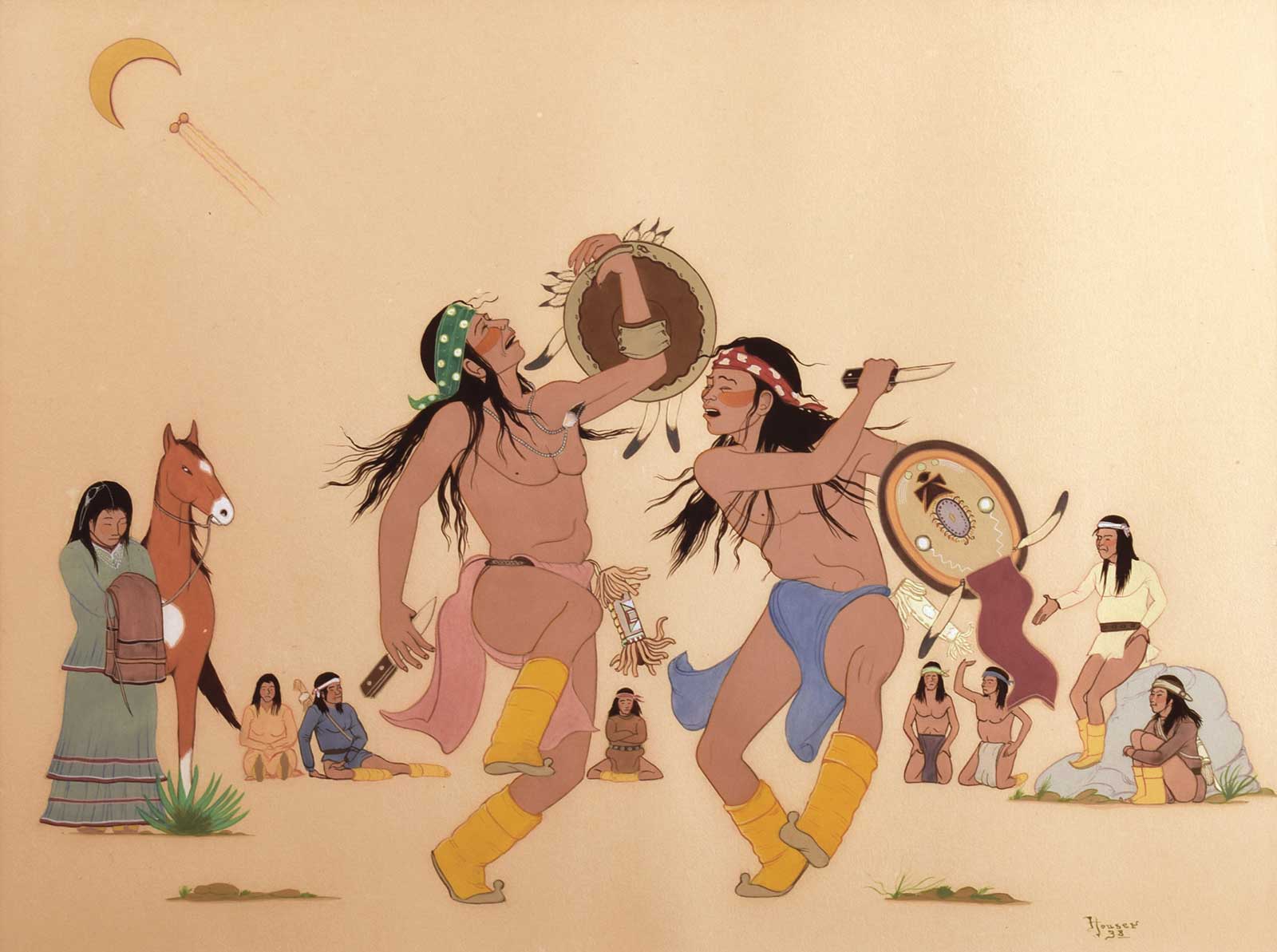 Allan Houser, Haozous, (Chiricahua Apache, 1914-1994), Fighting over Girls with Knives, watercolor, 11½ x 15¼"
Pablita Velarde (Santa Clara, 1918-2006) was Dunn’s first full-time female student at the Indian School. She commented, “Painting was not considered women’s work in my time. A woman was supposed to be just a woman, like a housewife and a mother and chief cook. Those were things I wasn’t interested in.” Dunn taught her to grind her own pigments from natural materials to make what she called “earth paintings”.
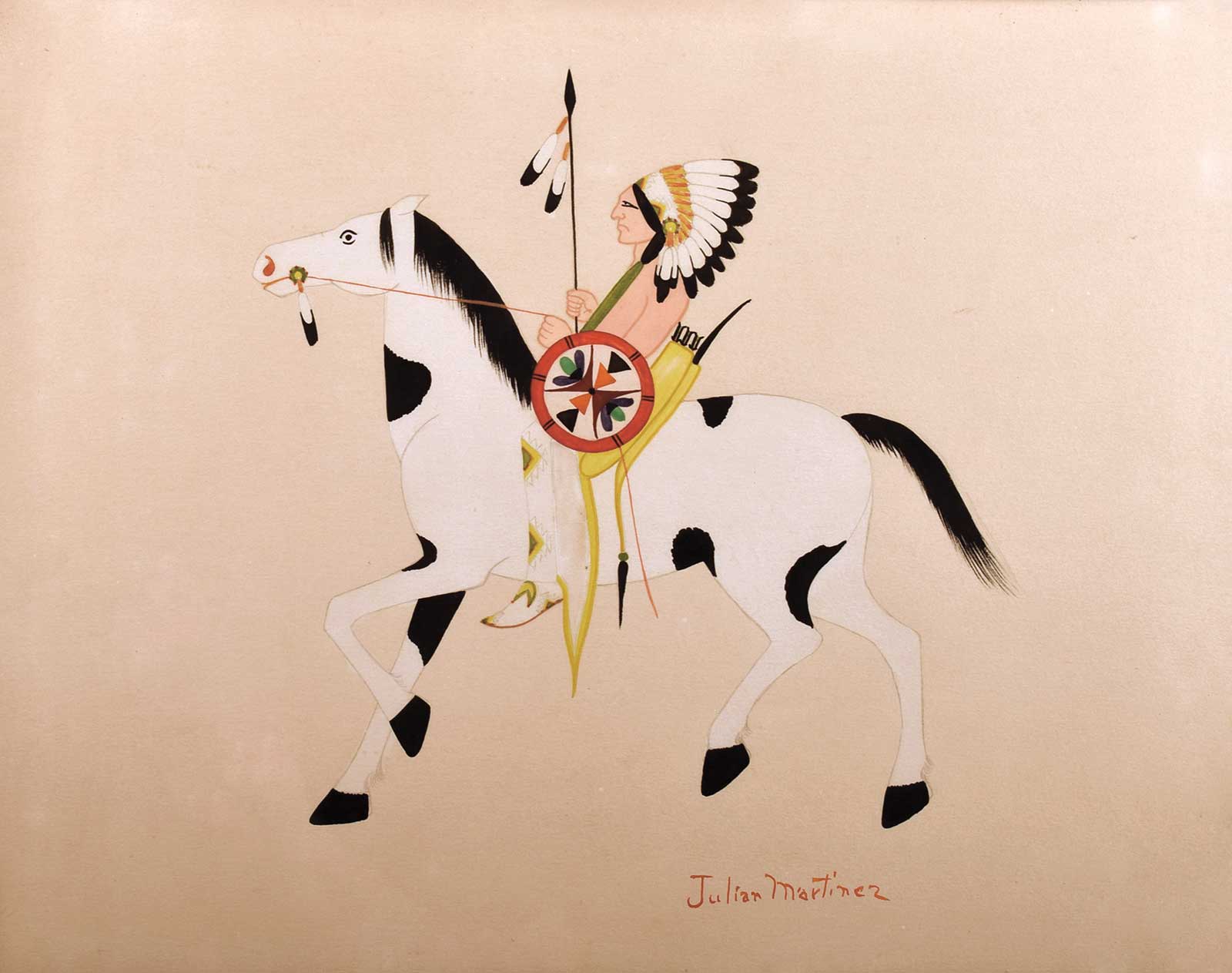 Julián Martinez (San Ildefonso, 1879-1943), Warrior on Horseback, watercolor, 107/8 x 135/8"
Laurie Eldridge writes, “Prevailing educational philosophy saw Native Americans as best suited for manual labor jobs and manual training was seen as key to the ‘Americanization’ of Native Americans. Dunn perceived her program as separate from the manual training and vocational education that constituted over half the school day for Native students. She believed that her students were already Americans, in fact, the original Americans, and that they possessed talents that could better earn themselves money in ways that were more dignified and in keeping with their cultures.”
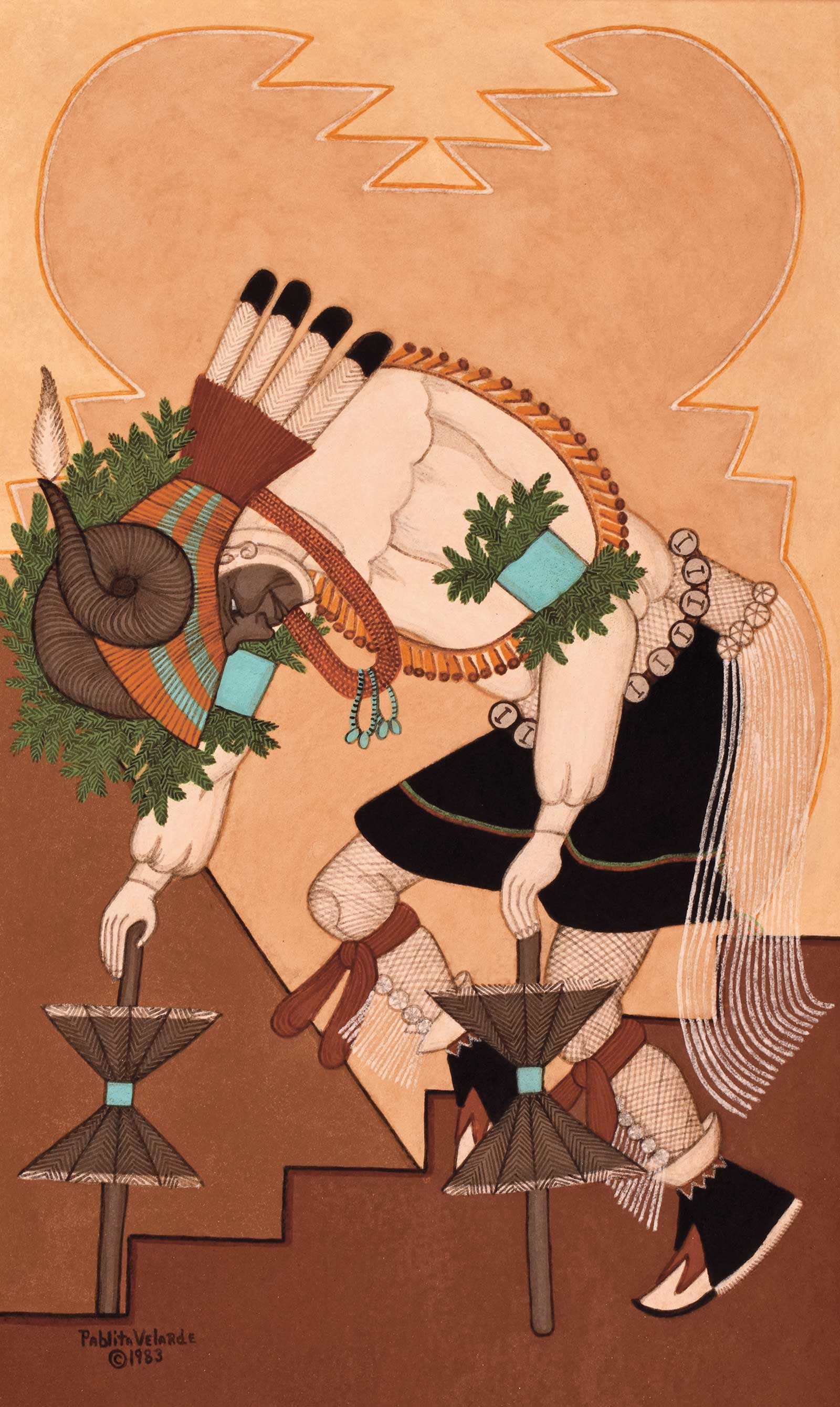 Pablita Velarde (Santa Clara, 1918-2006), Big Horn Dancer, mineral earth pigments on board, 19½ x 10¾".
All images courtesy Adobe Gallery, Santa Fe, NM.
Dunn recognized Julián Martinez (San Ildefonso, 1879-1943) as an innovator and hired him and three other artists to paint murals at the Santa Fe Indian School. Julián’s wife was the potter Maria Martinez (1887-1980) and had been encouraged to paint by Esther Hoyt.
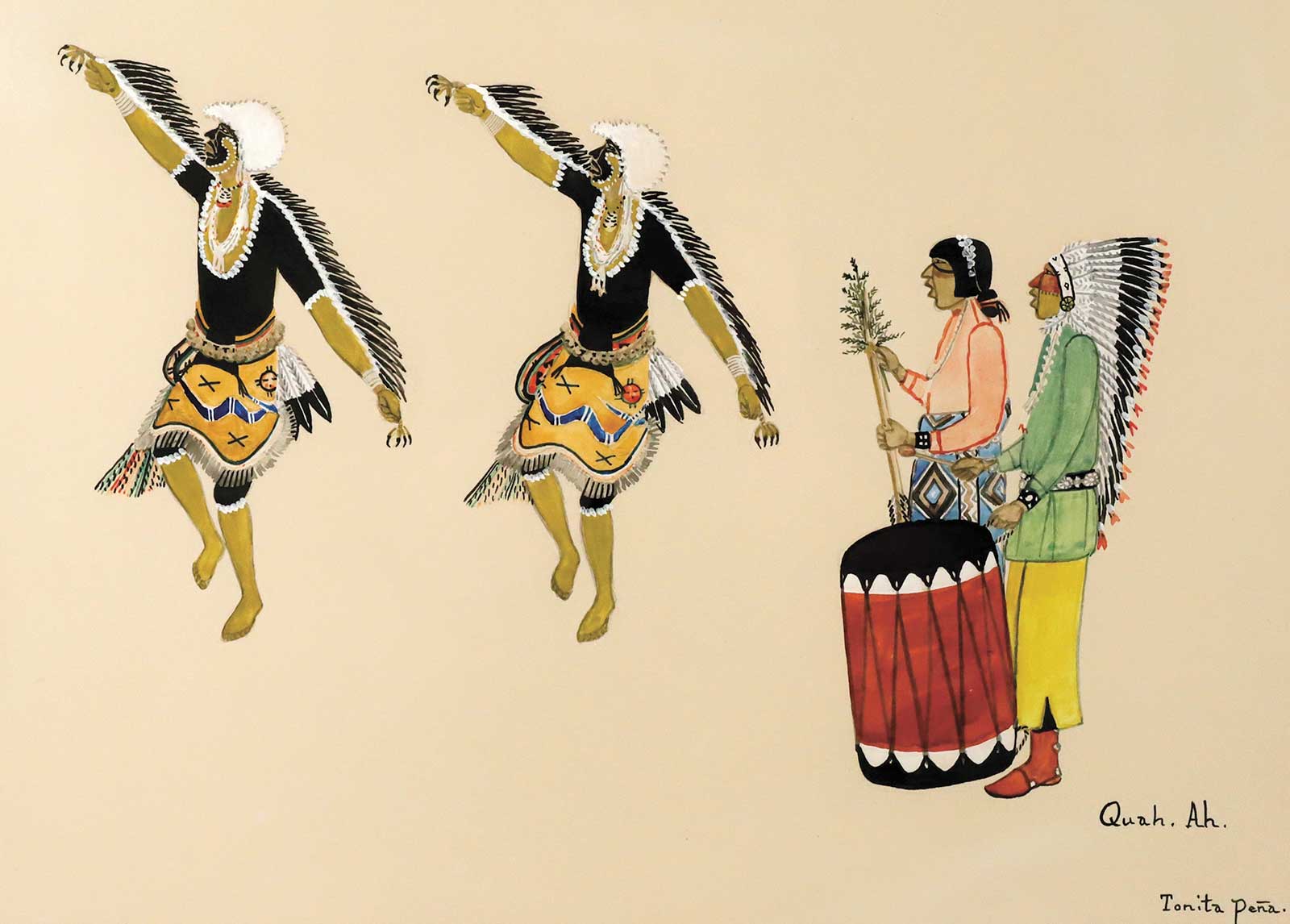 Tonita Vigil Peña, Quah Ah (San Ildefonso, 1893-1949), San Ildefonso Pueblo Eagle Dance, gouache, 9 x 12½"
The simple style is often associated with the influence of modernism. John Sloan first came to Santa Fe in 1919 and spent the next 29 summers here. He wrote, “These paintings are astonishingly modern in spirit, yet they represent the evolution of the Indian’s own traditions and are not borrowed from the white artist. In these pictures we see the object combined with the artist’s subjective response to it—a union of material and technique in a pattern both symbolic and intelligible…. Simplicity, balance, rhythm, abstraction, and virility, resulting from discipline, characterize the work of the Indian today…The Indian artist deserves to be classed as a modernist; his art is old, yet alive and dynamic…His work has a primitive directness and virility, yet at the same time it possesses sophistication and subtlety. Indian art is at once classic and modern.”
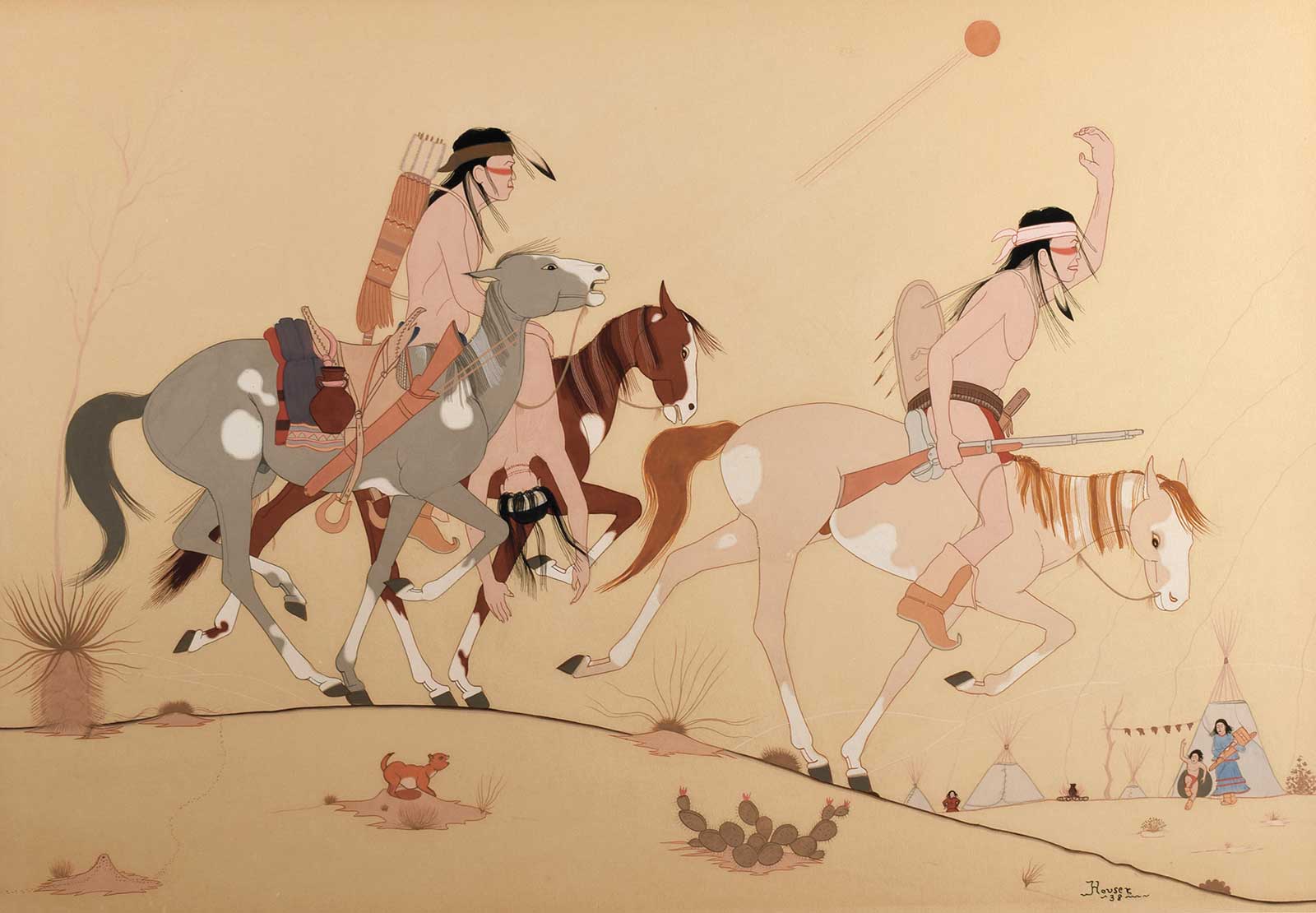 Allan Houser, Haozous, (Chiricahua Apache, 1914-1994), Home from War, watercolor, 14¾ x 21½". Private Collection.
Contemporary artist Sheridan MacKnight writes, “My work honors my Native American roots, and to the strong and spiritual devotions of my people. I am Lakota from the Hunkpapa clan and Chippewa from the White Earth Band. My images reflect the heart and emotion of my relations, be it historically or in the present time in the narration of the composition.” Her paintings carry on the tradition of Dorothy Dunn’s Studio Style and its emphasis on authenticity.
Powered by Froala Editor