
Large works of art—20-foot sculptures or paintings—can amaze by their very size and scale. Small works in metal attract attention by the shimmer of the materials that compose them. On closer examination, the technical skill required to accomplish the complexity in these works deserves consideration, and the ingenuity used to create them can be equally compelling. The exhibition Small Wonders at the Heard Museum will include a range of small-format rings and brooches, some with designs and compositions that might be familiar and others that are unexpected.
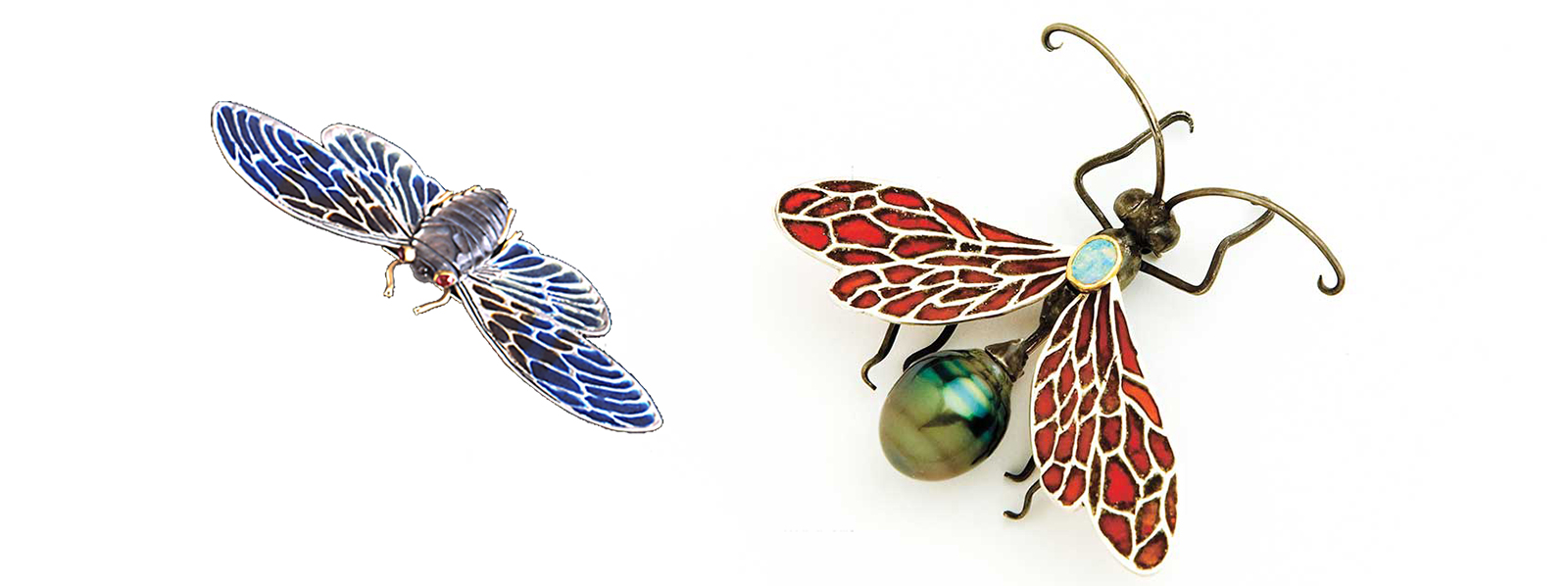 Left: Liz Wallace (Navajo/Washoe/Maidu), brooch, 2005, black lip oyster mother of pearl, ruby, plique à jour, silver, 14k gold. Heard Museum purchase, 4347-1. Right: Liz Wallace (Navajo/Washoe/Maidu), brooch, black pearl, opal, plique à jour, silver, 14k gold. Heard Museum purchase, 4528-1.
Included in the exhibition are jewelry pieces by Liz Wallace (Navajo/Washoe/Maidu), who has been incorporating plique à jour, one of the most difficult enameling techniques, into her jewelry for two decades. Her cicada brooches with outstretched enameled wings are dazzling simply for their inclusion of the colorful and translucent enamels. But, when one looks closely, it is also possible to see that the body of the cicada is carefully carved of shell, which has its own gleaming qualities.
In 2008, Wallace took a natural black pearl, somewhat elongated in shape, and used it to form the body of a wasp. The wings are formed of plique à jour, and Wallace placed a small luminescent opal on the back of the wasp, which is held in place by a gold bezel to further enhance the stone. The legs, curved as a wasp would position them while resting on a surface (hopefully, not a person), were shaped from silver. Wallace utilized several jewelry construction methods to form this small wonder of a brooch which she so meticulously crafted.
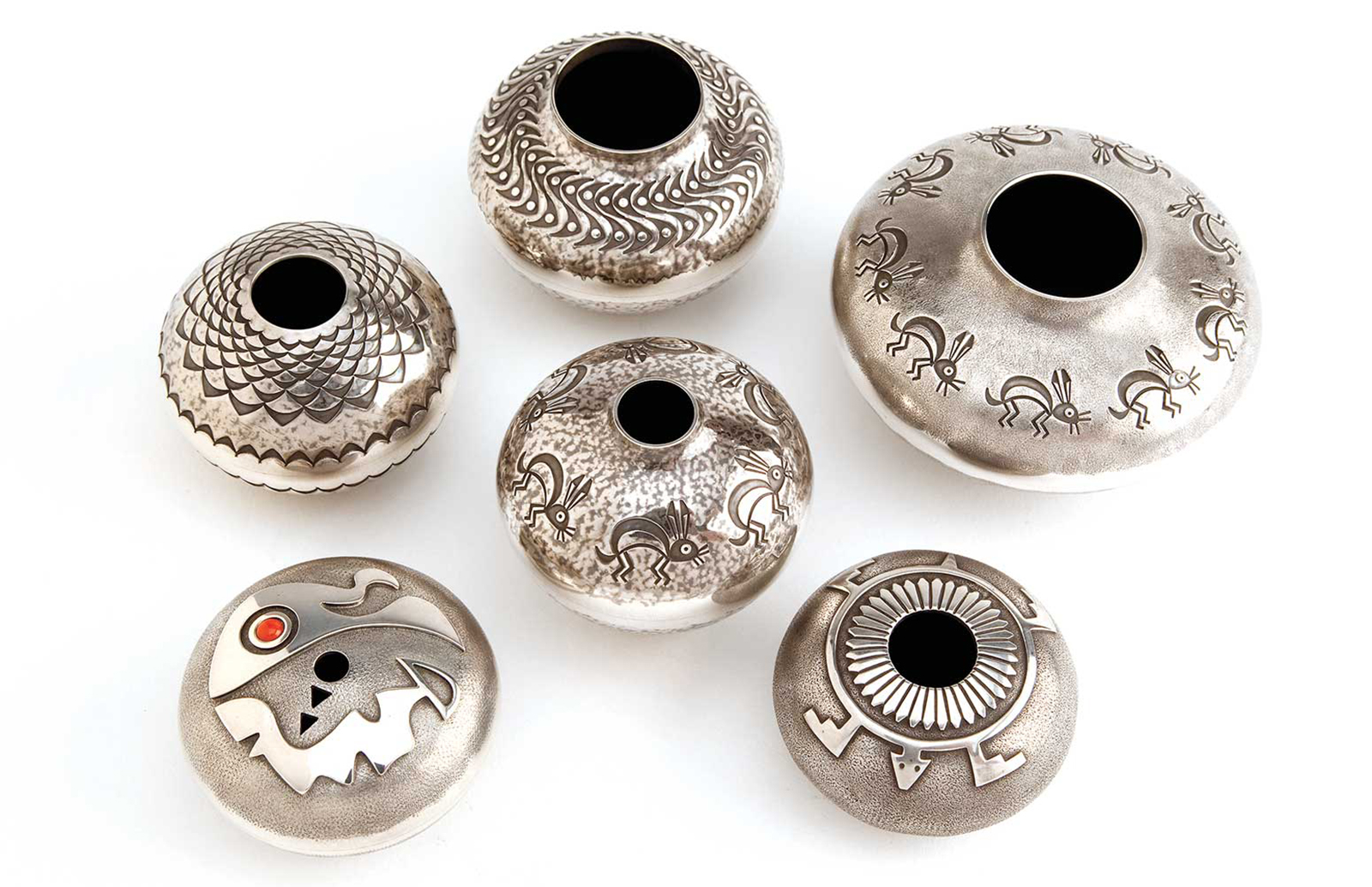 Norbert Peshlakai (Navajo), silver seed pots, 2000s, silver, coral. Heard Museum Collection, Gift of Norman L. Sandfield.
Wallace’s cicada and wasp join a larger group of insect and animal-themed brooches in the exhibition. Included are several butterfly brooches, from silver ones with intricate stamped designs to an 18k gold pair inset with Morenci turquoise made by Yazzie Johnson (Navajo) and Gail Bird (Santo Domingo/Laguna). The set was donated to the Heard Museum by American Indian Art Magazine in honor of the museum’s 75th anniversary.
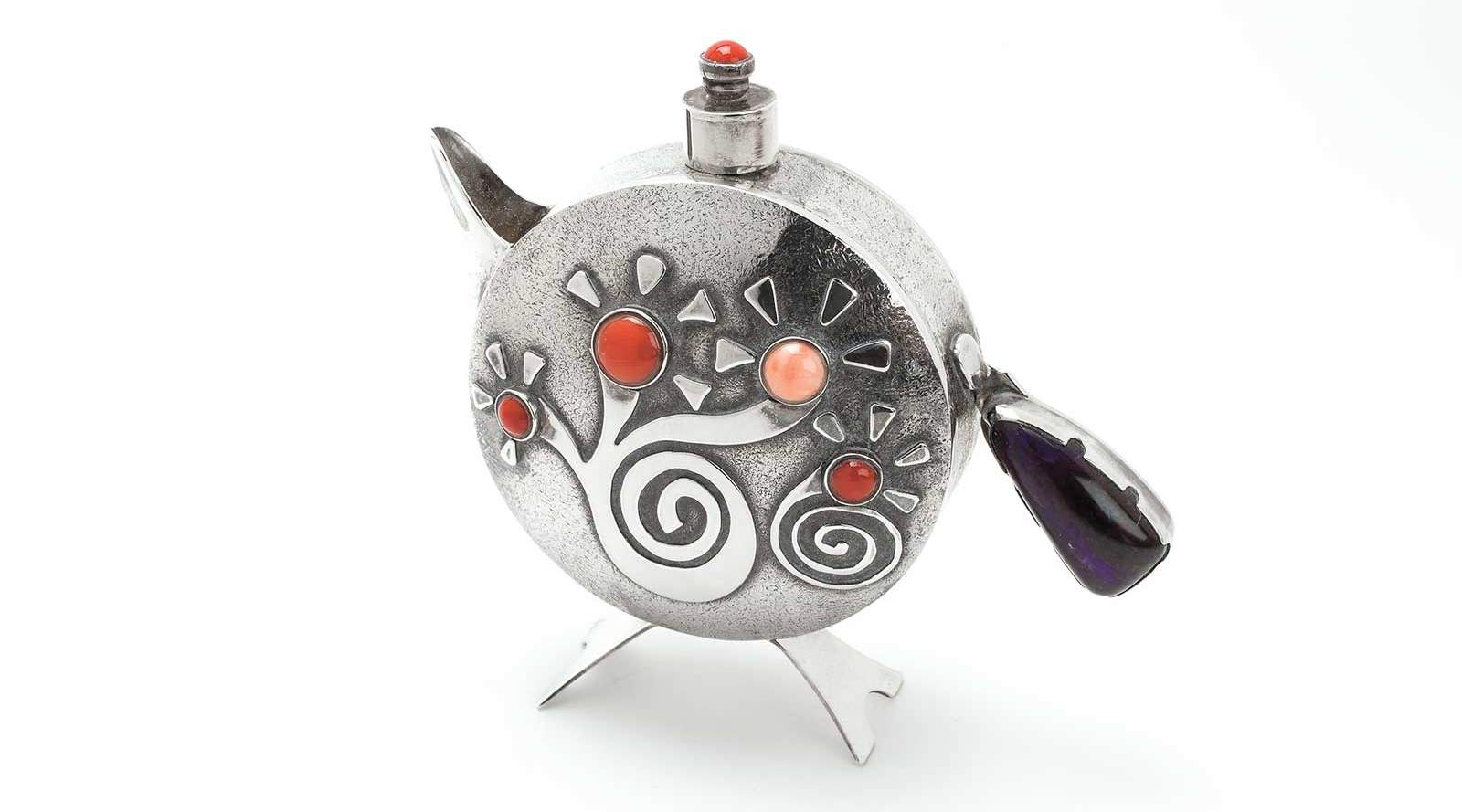 Darrell Jumbo (Navajo), Teapot, coral sugilite and silver. Heard Museum Collection, Gift of Carol Cohen, 4925-13 a, b.
Just as artisans develop new and unusual design concepts, they also develop new object forms and types. Around 1976, Norbert Peshlakai (Navajo) and Comanche artist White Buffalo, aka Mike Perez, worked on the same concept for a new artform. Each made a seed pot out of silver instead of the usual material, which is clay. The concept seems simple to the layman but it’s not particularly easy to accomplish flawlessly. The jeweler works with two sections of silver that are shaped into half-domes by hammering them into a recessed form, usually of wood. This is the same technique used to form silver beads for necklaces. A hole might be cut into one of the half-dome shapes to form the opening of the jar. The artisan might add a neck to the jar or make a lid. The trick is to accomplish all of this, including soldering the two half-domes together, so that the human eye cannot detect where they join. Silver seed pots are often decorated with inset stones or stamp work. The shape of a silver seed pot can be intentionally flattened or made almost perfectly round. Peshlakai has made seed pots primarily of silver, but also from gold and from mokume-gane, a Japanese metalworking technique of blending of different metals that results in a wood-grain appearance. Collector Norman L. Sandfield donated more than 200 silver seed pots created by numerous artists to the Heard Museum in 2005 and 2006. A vast selection of these will be included in Small Wonders.
In addition to jewelry made to wear and silver seed pots, Small Wonders also includes some intriguing silver miniatures. Darrell Jumbo (Navajo) made a silver teapot only 3 inches in height. Each side has a different design in silver appliqué with coral embellishments. The handle is made from a single section of deep purple sugilite. Complete with a lid, the little teapot has all of the characteristics of its full-scale counterparts but in a much smaller format.
Other miniatures have been made by Shawn Bluejacket (Shawnee). Bluejacket is known for making contemporary jewelry that combines intricate metalwork with a variety of interesting stones. But she also had a fascination with miniatures that she made in metal. These range from houses to flowerpots to tables and chairs. She fabricated each from silver and then painted them in bright colors. At times, as with the tiny dining table complete with candelabra, there may be a hidden treasure inside. The tabletop is hinged; when opened, it reveals a painted design of a bundle of carrots.
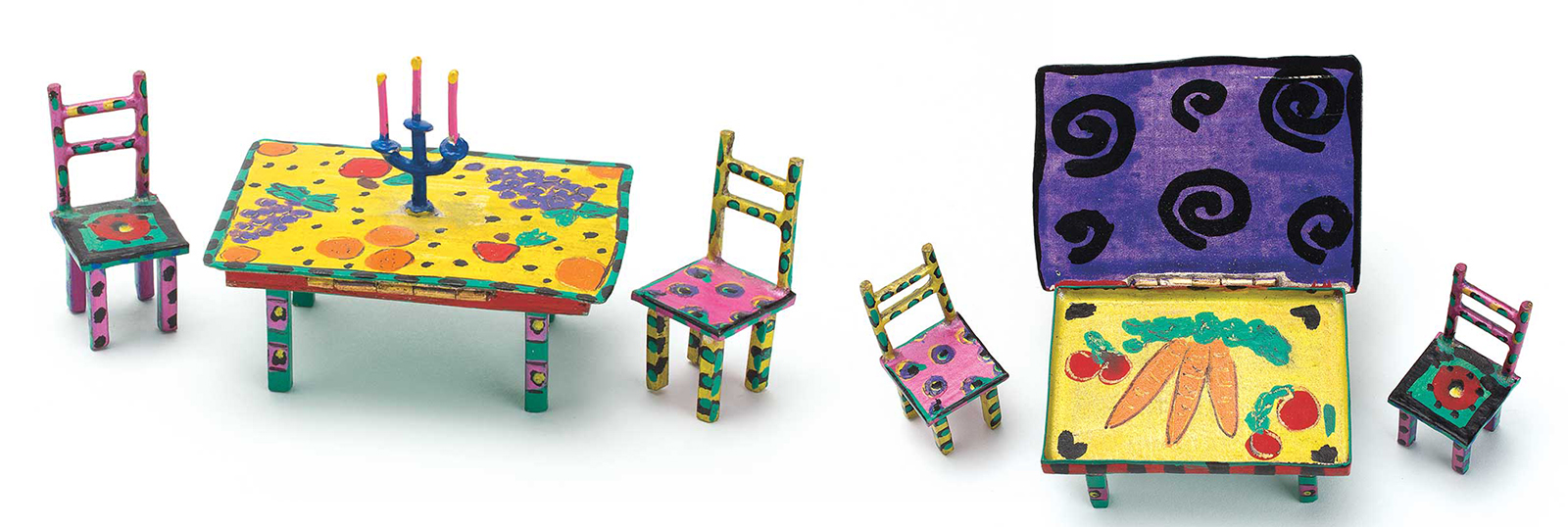 Shawn Bluejacket (Shawnee), Untitled (closed and open), silver, paint. Heard Museum Collection, Gift of Carol Cohen, 4925-9-11.
Just in case our visitors want to see those classically beautiful rings and brooches made in silver with Nevada turquoise, we have included an ample selection made by a range of talented artists.
Small Wonders opens March 18 in the Heard Museum’s Lovena Ohl Gallery and continues through summer 2021.
Opens March 18
Small Wonders
Heard Museum 2301 N. Central Avenue, Phoenix, AZ 85004
(602) 252-8840, www.heard.org
Powered by Froala Editor