All at once, hundreds of years of songs, prayers and tradition come together in every contemporary Navajo textile. All at once, an artist’s idea crystallizes. All at once, the artist’s years of training and practice combine to make the idea a reality. All at Once: The Gift of Navajo Weaving is the sum of many “all at once” moments.
In this exhibition, we feature 45 Navajo textiles from a major gift to the Heard Museum by Mark and Julie Dalrymple. The Dalrymples, longtime members and supporters of the museum, focused their collecting on textiles woven in the first two decades of the 21st century. They traveled throughout the Southwest, visiting leading galleries and art fairs, including the Heard Museum’s Berlin Shop and Gallery and the Heard Museum Guild Indian Fair & Market. Along the way they met many talented artists. The Dalrymple collection has great breadth; by not focusing on a single style, it succeeds in capturing the creativity that flourishes among present-day weavers.
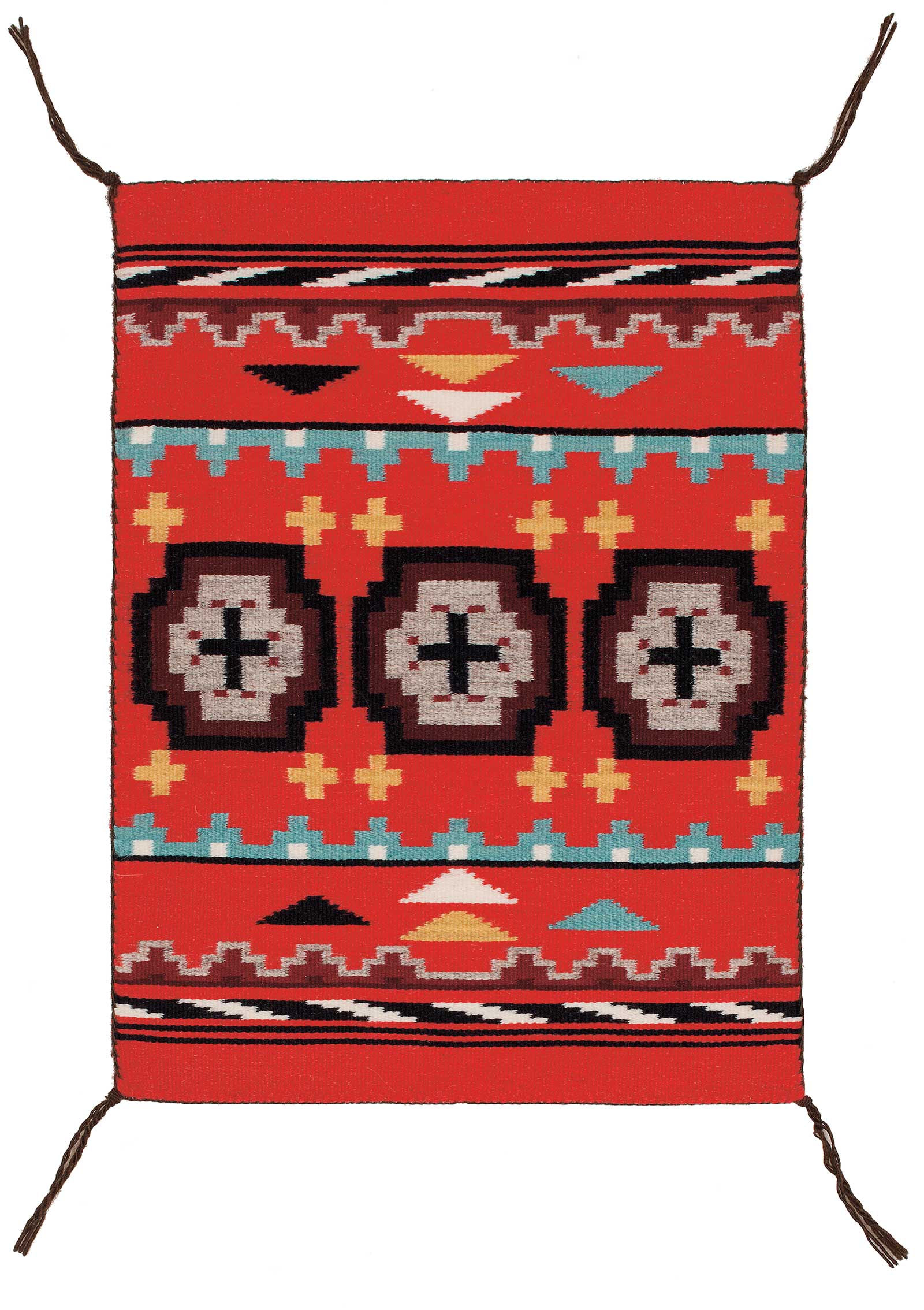 Lynda Teller Pete (Diné), Homage to the Navajo’s Long Walk, 2014, handspun wool, commercial wool, natural wool colors, vegetal and aniline dyes. Gift of Mark and Julie Dalrymple, 4951-70.
All at Once has five co-curators, including myself, assistant curator Velma Kee Craig (Diné) and three Andrew W. Mellon Fellows, César Esteban Bernal (Chicanx), Roshii Montano (Diné) and Ninabah Winton (Diné).
As we planned the exhibition, we realized that the Dalrymples’ superb records of their collection gave us an opportunity to reach out to the weavers to learn the stories behind their textiles. We spoke to several of the weavers at the Heard Museum Guild’s 2019 Indian Fair & Market. To date, 15 weavers have offered interesting and moving statements about 20 of their textiles. Frances Begay told us that, in her 38 years of weaving, this was the first time she had received a letter asking for an artist’s statement about her work.
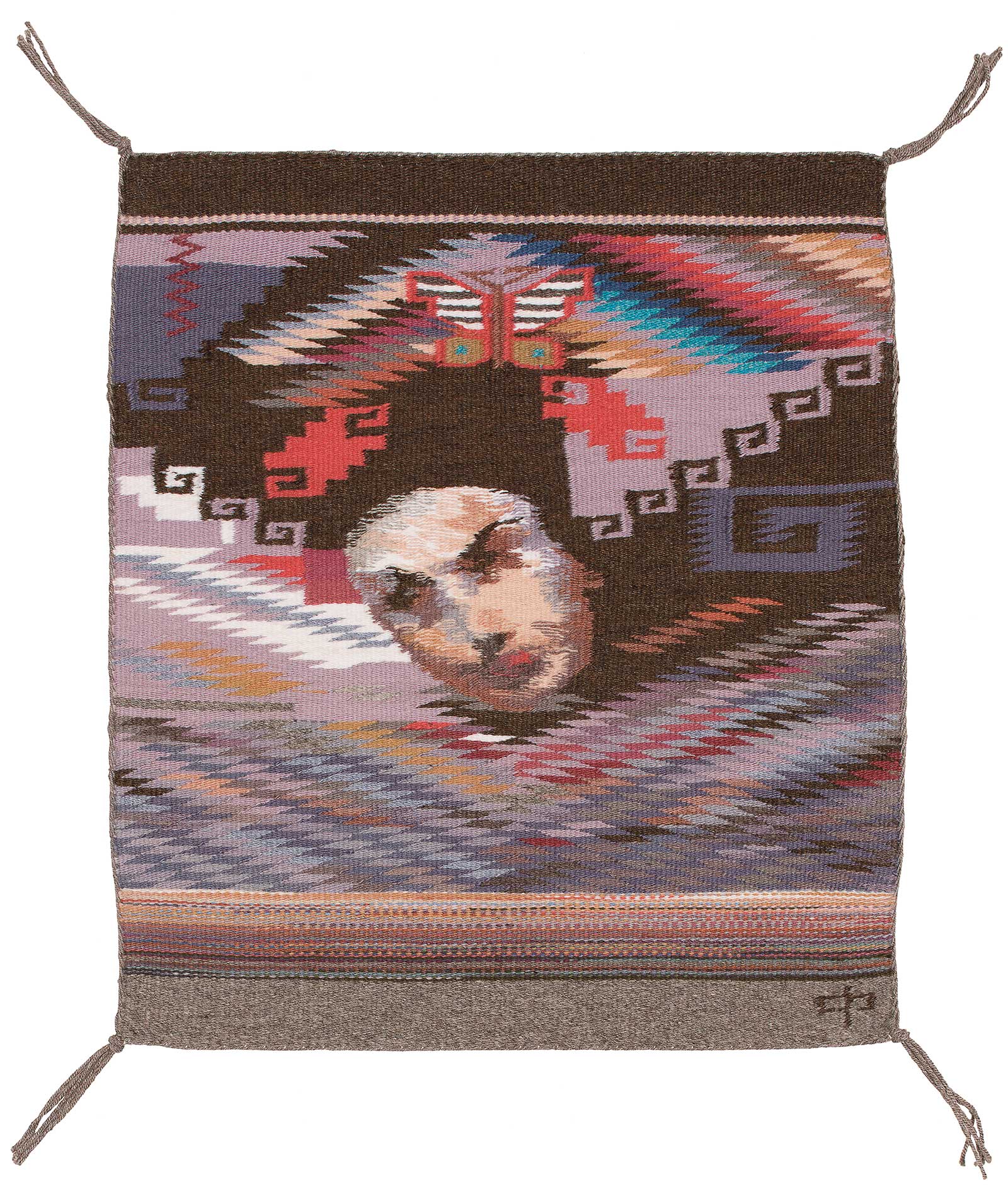 Marlowe Katoney (Diné), Scrap Girl, 2015, three-ply Germantown yarn, commercial wool,
aniline dyes, 18½ x 21". Gift of Mark and Julie Dalrymple, 4951-53.
Interviewed at the 2019 Indian Fair & Market, Marlowe Katoney discussed Scrap Girl, saying that after his early work, he became interested in portraiture. His practice as a weaver is to never throw away scraps. Describing the textile from the bottom up, he stated that the blue portion is an eyedazzler pattern for which he alternated cooler colors with warmer colors. He used his longer yarn scraps for this pattern. The portrait reflects weavers’ scraps of generational knowledge that are passed down. He originally intended to name the textile The Crowning of Scrap Girl, and to that end he created a crown-like butterfly and associated elements above Scrap Girl’s head.
Lynda Teller Pete’s story of Migration of Dragonflies describes family contributions that bookend the beginning and the completion of the textile. Before Pete started weaving, her sister Barbara Teller Ornelas untwisted and respun the processed yarn for her textile to achieve a thinner yarn, making it possible to achieve a count of 114 wefts per inch.
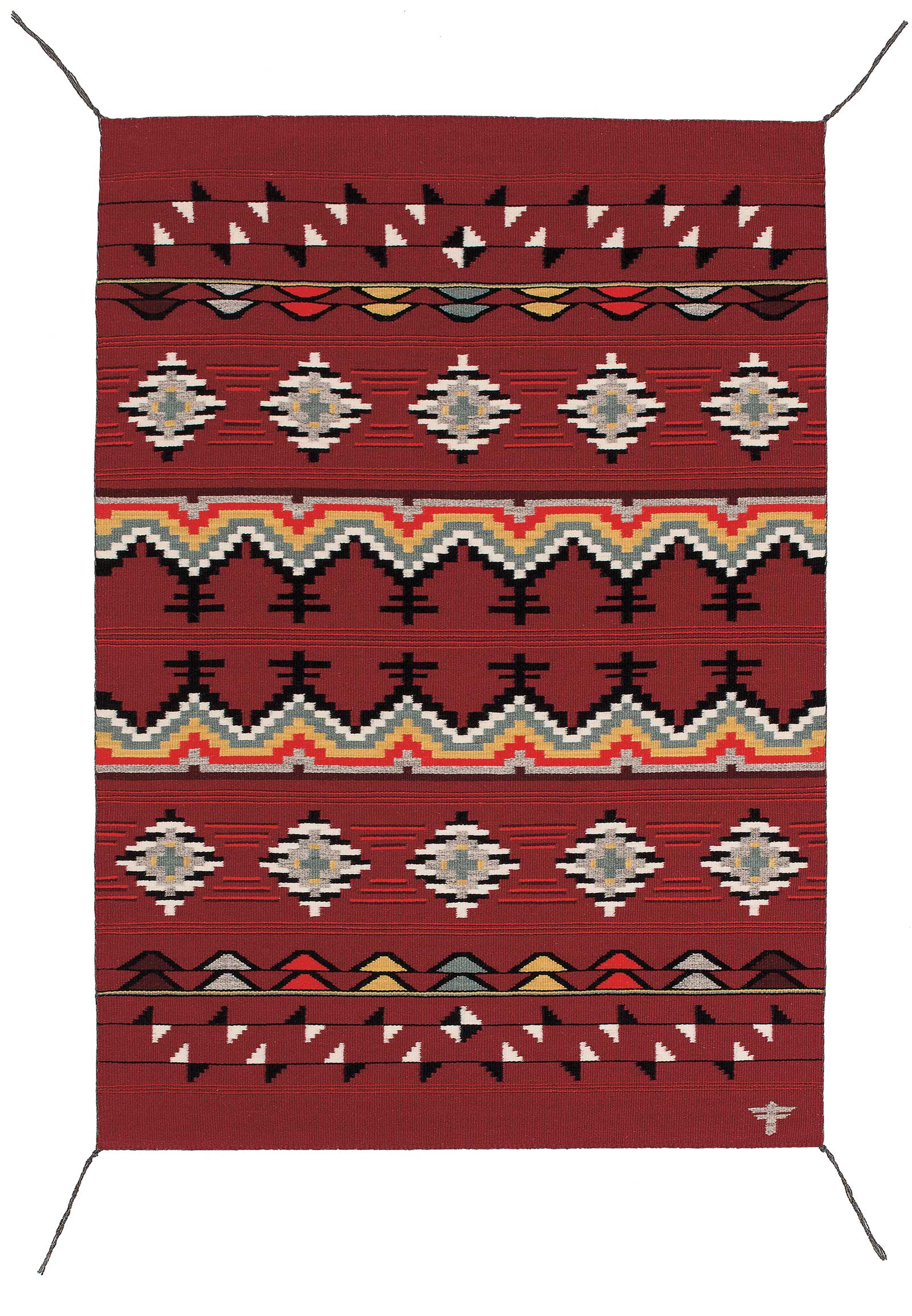 Lynda Teller Pete (Diné), Migration of Dragonflies, 2015, handspun wool, commercial wool, natural wool colors, vegetal and aniline dyes, 36 x 25½". Gift of Mark and Julie Dalrymple, 4951-57.
Pete’s description of the completion of the textile again involved family. She says, “The weaving took about five months, although it was on a loom for a lot longer because of my busy travel schedule. The last 6 inches I wove in Santa Fe, New Mexico. It felt like I was racing against time before the Santa Fe Indian Market would start on the weekend. My sister Barbara and my nephew Michael stepped in to help me weave while I took rest breaks. Felt like we wove around the clock to get it done. This kind of project gives me a great feeling because I wasn’t alone in finishing, and it has the energy of my sister and nephew in the textile.”
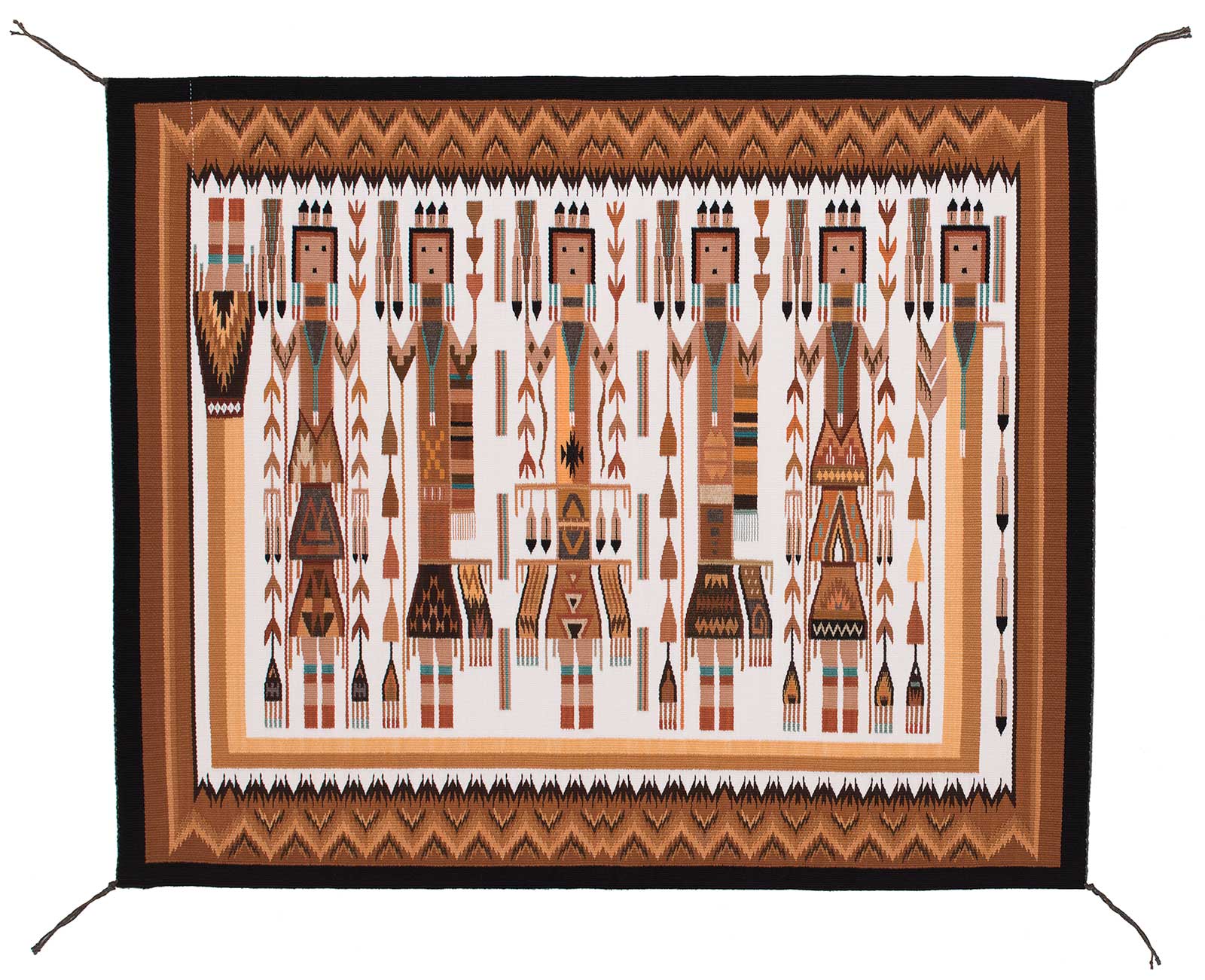 Alisa Ann Peacock (Diné), Rebirth, 2013, handspun wool, vegetal dyes, 27 x 33". Gift of Mark and Julie Dalrymple, 4951-8.
Pete wove a story of migrating dragonflies flying in small groups over mountains and lakes. “The small black and white design fans on the top and bottom of the textile are the dragonfly nymphs,” she says. “After they mature, they fly back north over the colorful mountains depicted in the next two rows. The black and white diamond with insets of gray crosses represents frozen ponds. Some dragonflies can be seen flying under the ice. The middle of the textile shows mature dragonflies atop colorful foliage.”
Alisa Ann Peacock, a fourth-generation textile weaver, can pinpoint the month that she became a weaver. “It was my grandmother who introduced weaving to me back in May 1994. She made a wool warp for me, and she taught me the skills and gave me free rein to the many designs she worked with. She would come by my house every day to see how far I was progressing, and she was happy about how fast I had picked up the skills and techniques. My grandmother left this world in September of that same year. Within those four months of tutelage, I learned much from my grandmother, and I took that as a sign that my grandmother passed her weaving on to me to carry on her legacy and cultural heritage. A lot of my inspiration comes from the style of Ye’ii textiles that my grandmother wove, because that particular style belongs in our family history. She was definitely a master weaver.” Peacock named her textile Rebirth to recognize the detailed Ye’iis her grandmother wove into a textile in 1992 or 1993. She says, “More than 20 years ago, my grandmother wove a textile using this Ye’ii design, and I wanted to weave my rug as a spiritual awakening of the constructions and patterns of her weaving.”
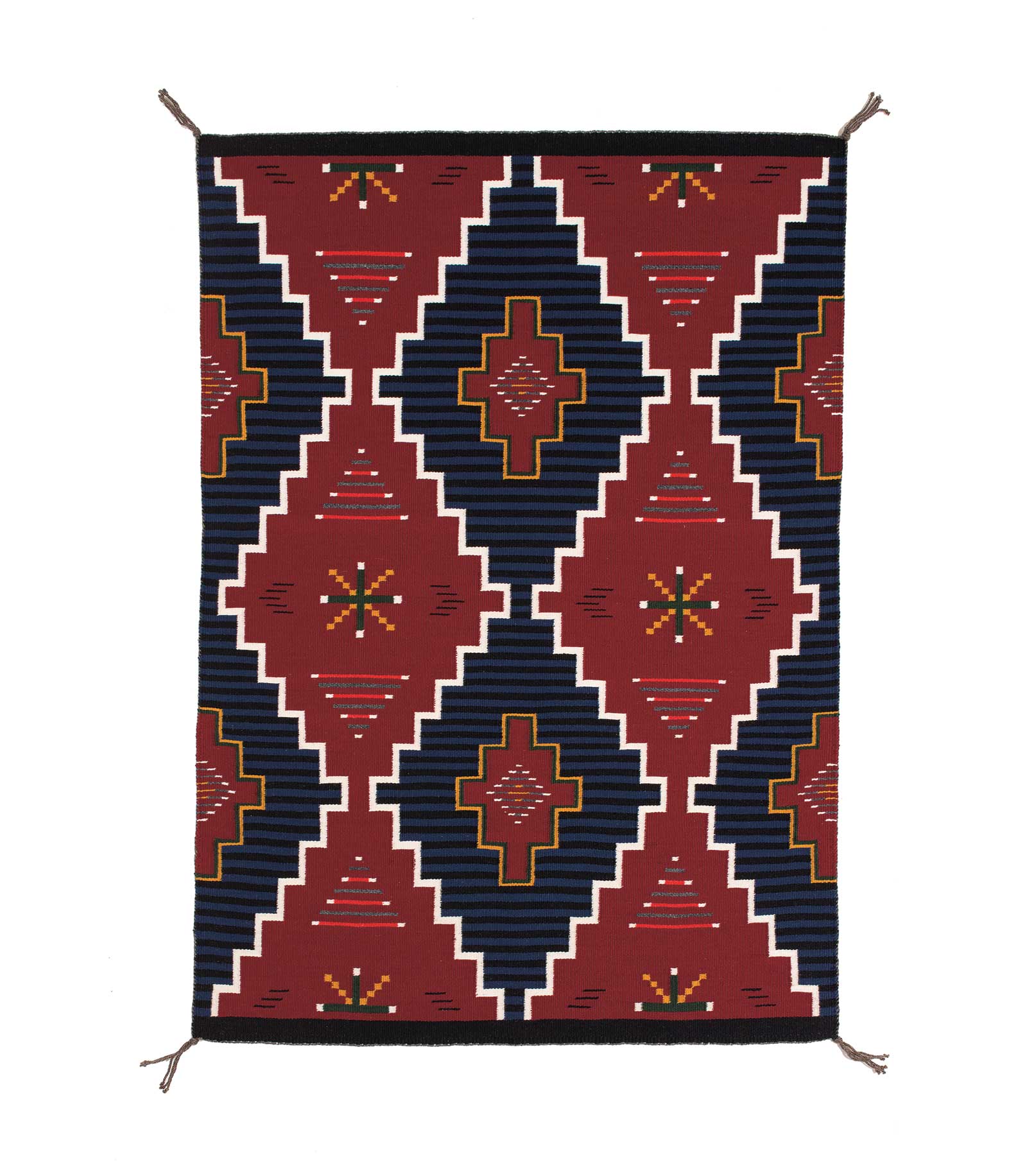 Elverna Van Winkle (Diné), Revival textile, collected 2013, commercial wool, aniline dyes, 40 x 28". Gift of Mark and Julie Dalrymple, 4951-15.
Before becoming a full-time weaver, Elverna Van Winkle was in the military and then had a nine-to-five job. Speaking to Velma Craig, she says, “Nothing beats being self-employed and weaving full time.” She “has time to be with family and can pick up and go anytime and take work with me. I love what I do.” Van Winkle has tremendous love for her grandmother and becomes emotional when she recalls her grandmother’s words, “You should always have a rug set up and on the side to fall back on.” Her grandmother told her this, knowing that Van Winkle and her siblings would most likely have full-time jobs, schooling or family to keep them busy. She wanted her grandchildren to keep weaving, despite everything else going on in their lives.
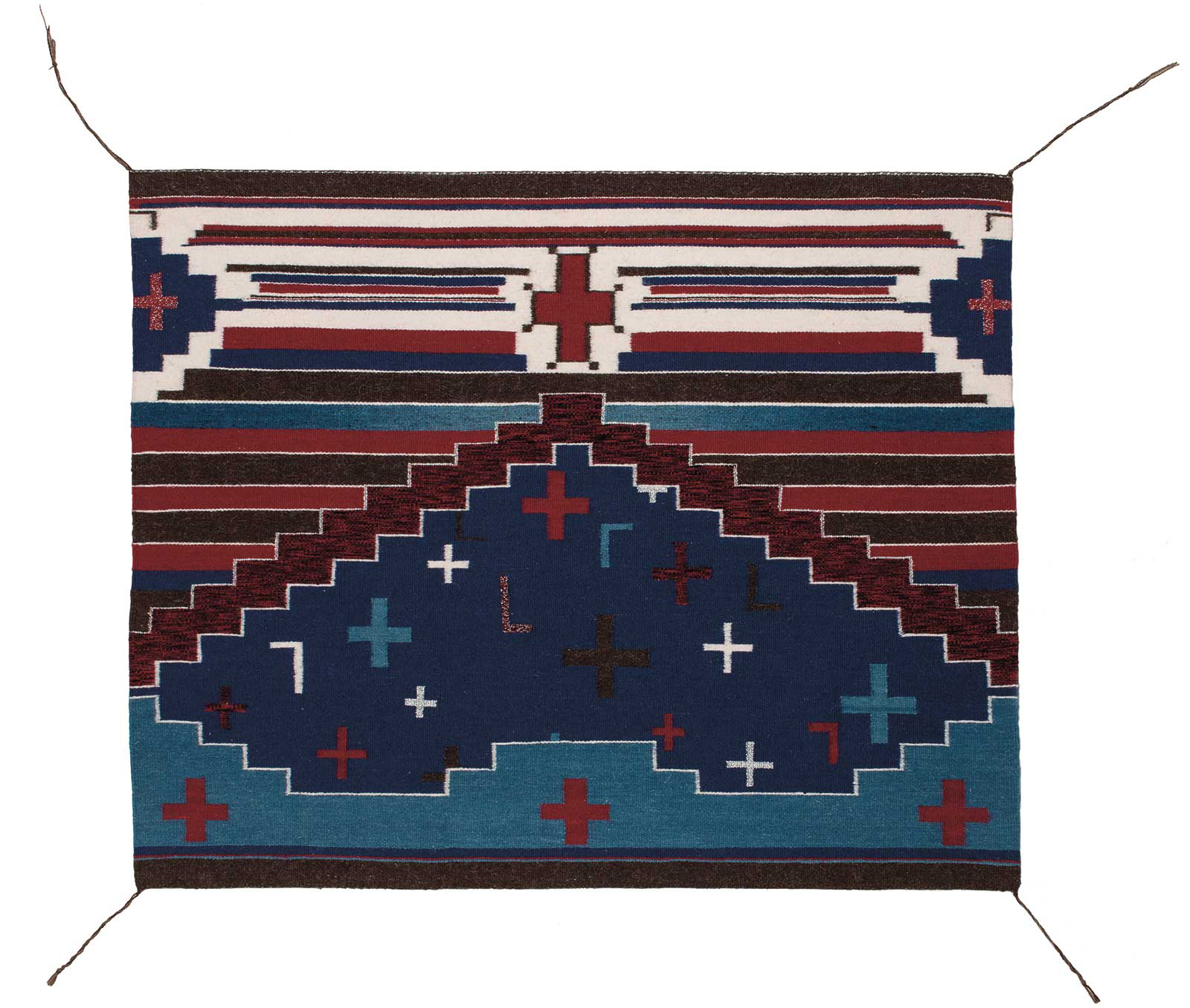 Marilou Schultz (Diné), Infusion: Contemporary Wearing Blanket, 2017, Churro handspun wool, metallic thread, cochineal dye, indigo dye, aniline dyes. Gift of Mark and Julie Dalrymple, 4951-71.
Regarding the inspiration behind the textile design, Van Winkle explains, “It’s not that I came up with the design. These designs have already been. I just put them together the way that I want them to be put together.” She says that the designs she weaves “my grandmother used. My mother used them…When I put a design together, I see my designs [in my head] before I put it to life. So, when I start weaving, when I put it to life, if I see then that a color doesn’t work in life the way it did in my mind, I take it out. I put a new color in there.”
When the design comes to life on the loom, this is the exciting part for Van Winkle, as she believes it is for all weavers. Van Winkle is describing an “all at once” experience. We hope that visitors to the exhibition have their own “all at once” moments.
Through Fall 2021
All at Once: The Gift of Navajo Weaving
Heard Museum
2301 N. Central Avenue, Phoenix, AZ 85004
(602) 252-8840, www.heard.org
Powered by Froala Editor