In 1906, the federal government placed Blue Lake and the surrounding area, sacred to Taos Pueblo, under the jurisdiction of the Forest Service and declared the lake an area for multiple use. After years of negotiations, the area was returned to the people of Taos Pueblo in 1970. At the time, President Nixon said, “This is a bill that represents justice, because in 1906 an injustice was done in which land involved in this bill, 48,000 acres, was taken from the Indians involved, the Taos Pueblo Indians. The Congress of the United States now returns that land to whom it belongs.” Taos Pueblo regained sovereignty over its land and its use.
On the 50th anniversary of the return of Blue Lake, the Couse-Sharp Historic Site in Taos has put together an exhibition, Stitched in Sovereignty: Contemporary Beadwork from Indigenous North America. It is planned for an opening in June with programming planned for October.
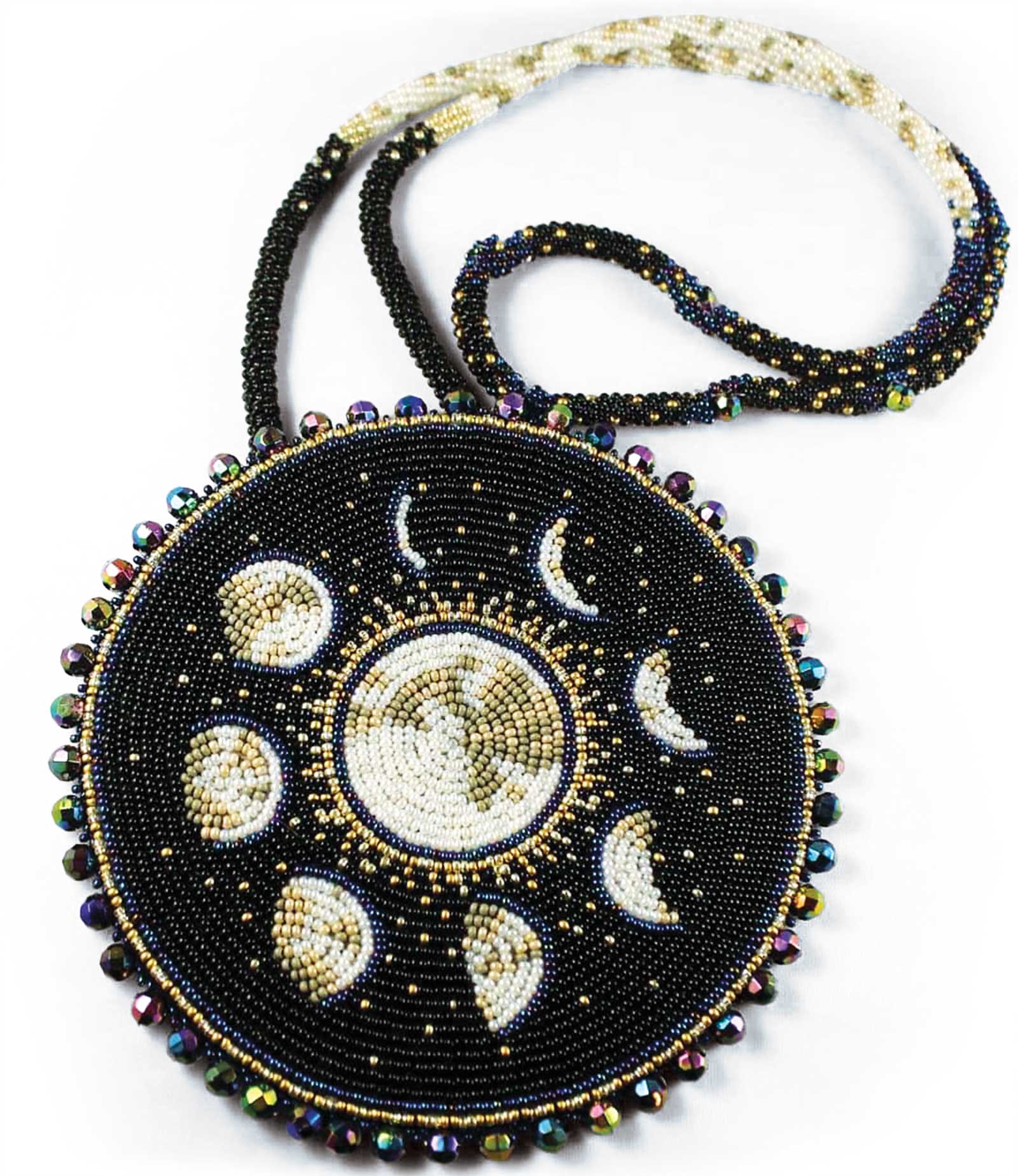 Brit Ellis (Onondaga), lunar phase medallion, 2019, glass beads on hide, 8” diameter
Chelsea M. Herr (Choctaw), the exhibition’s guest curator, explains that it “highlights how Indigenous peoples maintain control of their own cultures, social and governing systems, belief and knowledge systems, and relationships with other sovereign groups. These concepts are expressed in the materials and processes of beadwork, a medium that has a long tradition in Indigenous North America and continues to evolve today.”
A PhD candidate in Native American Art History at the University of Oklahoma, she has chosen the work of six artists, Molly Murphy Adams (Lakota descent), Katherine Boyer (Métis), Brit Ellis (Onondaga), Samantha Jacobs (Seneca), Shelby Rowe (Chickasaw), and Kellen Trenal (Nez Perce) to be in the exhibition. Noting that “Indigenous beadwork is a material expression of Indigenous peoples’ determination to maintain their identities and agency,” she explains that the artists from across the U.S. and Canada approach their work in unique ways yet demonstrate a certain solidarity, some having established careers and some just beginning.
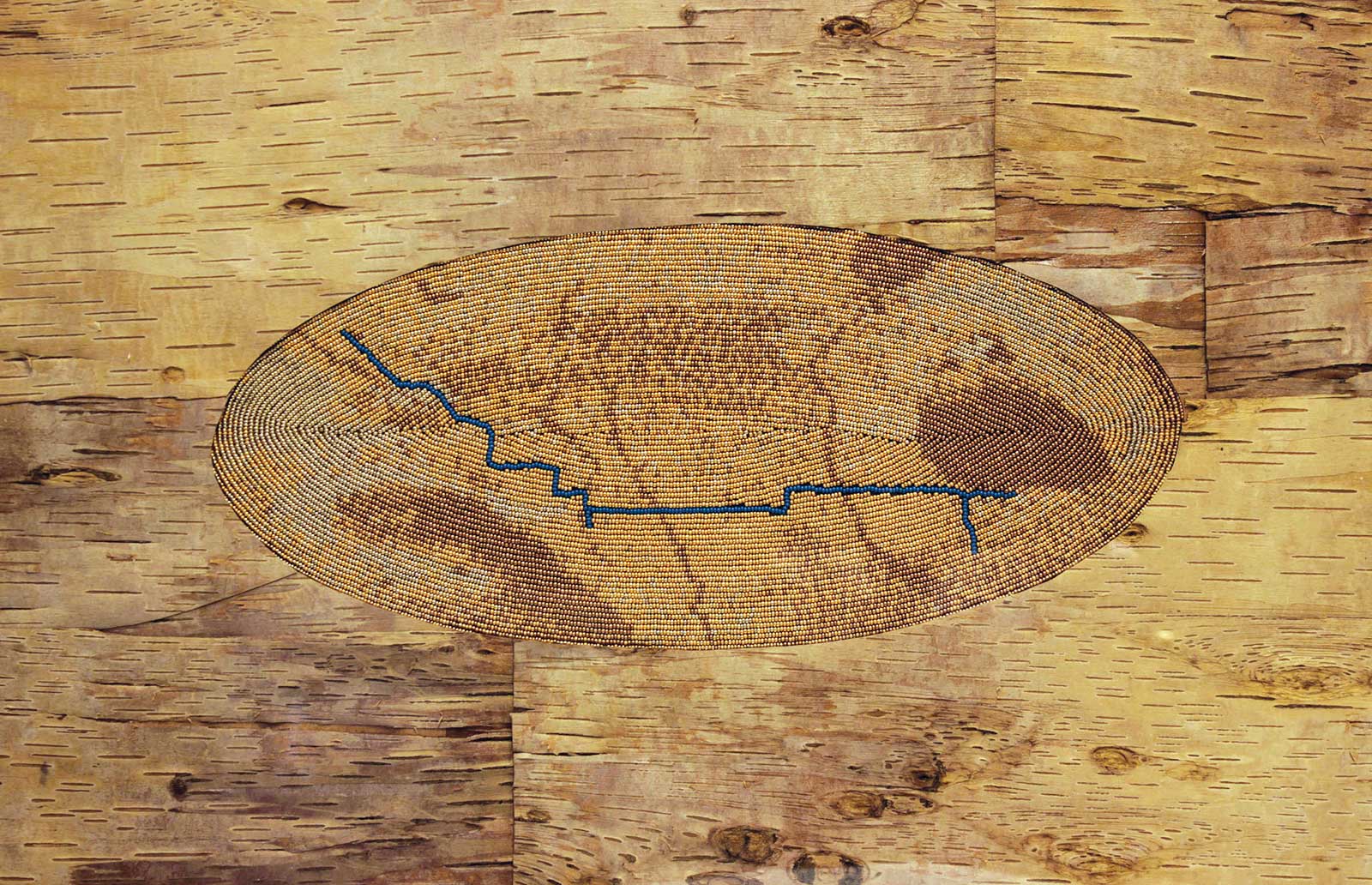 Katherine Boyer (Métis), Ma Famille, Les Voyageurs, 2015, acrylic beads and birch bark, 17 x 31”
Trenal (Nez Perce) has both Native American and African American ancestry and is a 2009 graduate of Notre Dame. Trenal comes from a long line of bead workers. “Through my great grandma, I received invaluable exposure to traditional practices that empower the artwork I put forward today. She is my direct link to the past of the NiMiiPuu (Nez Perce people) and a cherished figure in my life.” Commenting on beadworking today he says, “Exploring the intersection of tradition and innovation—the simplest yet most powerful way of describing my artwork. For all my artists out there pulling from their cultural heritage, please stay encouraged in your endeavors. Some may speak against your work while others may encourage its unique perspective. No matter the outside forces, remain true to the inner voice that motivates your purest moments of inspiration. It’s there to forge a pathway for all you hold inside to enter into the physical world. You’ve got this. We’ve got this.”
 Molly Murphy Adams (Lakota descent), Beaded Hide Robe, Deconstructed, 2015, beadwork on Bristol board, mounted on canvas, approx. 72 x 15” (9 separate panels each measuring 4 x 15 x 2”)
Trenal’s work incorporates many contemporary references. He is represented in the exhibition by pieces melding his own heritage and honoring Beyoncé and Michelle and Barack Obama.
Boyer is a well-established artist and is assistant professor at the University of Manitoba, School of Art. A multidisciplinary artist, her art is rooted in her research into Métis history, material culture and personal family narratives.
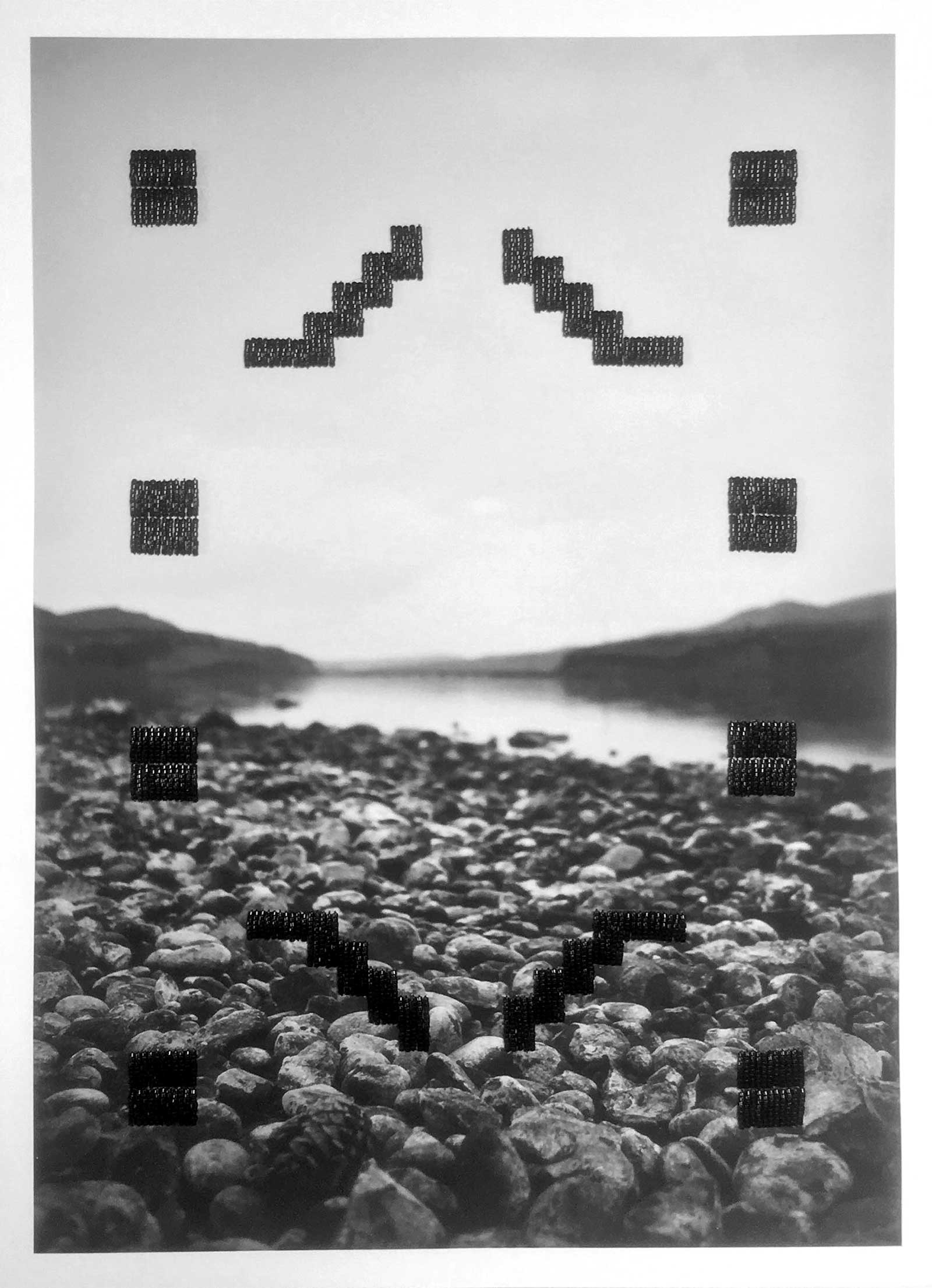 Molly Murphy Adams (Lakota descent), River Rocks, 2016, beadwork on archival photo, 18 x 14 x1”
Whereas beadwork has traditionally been wearable and transportable art, her piece in the exhibition is a 17-by-31-inch panel of beadwork and birch bark. In Ma Famille, Les Voyageurs, the earth colors of the appliquéd beadwork recall the colors of the birch bark and, running through the middle of the beadwork is a blue line representing a river. Birch bark was used to build canoes to navigate the rivers that often crossed and re-crossed borders and was used to record cultural references. Native people also drew maps on the bark to be used by voyageurs, French-Canadian fur traders in the 18th and early 19th centuries.
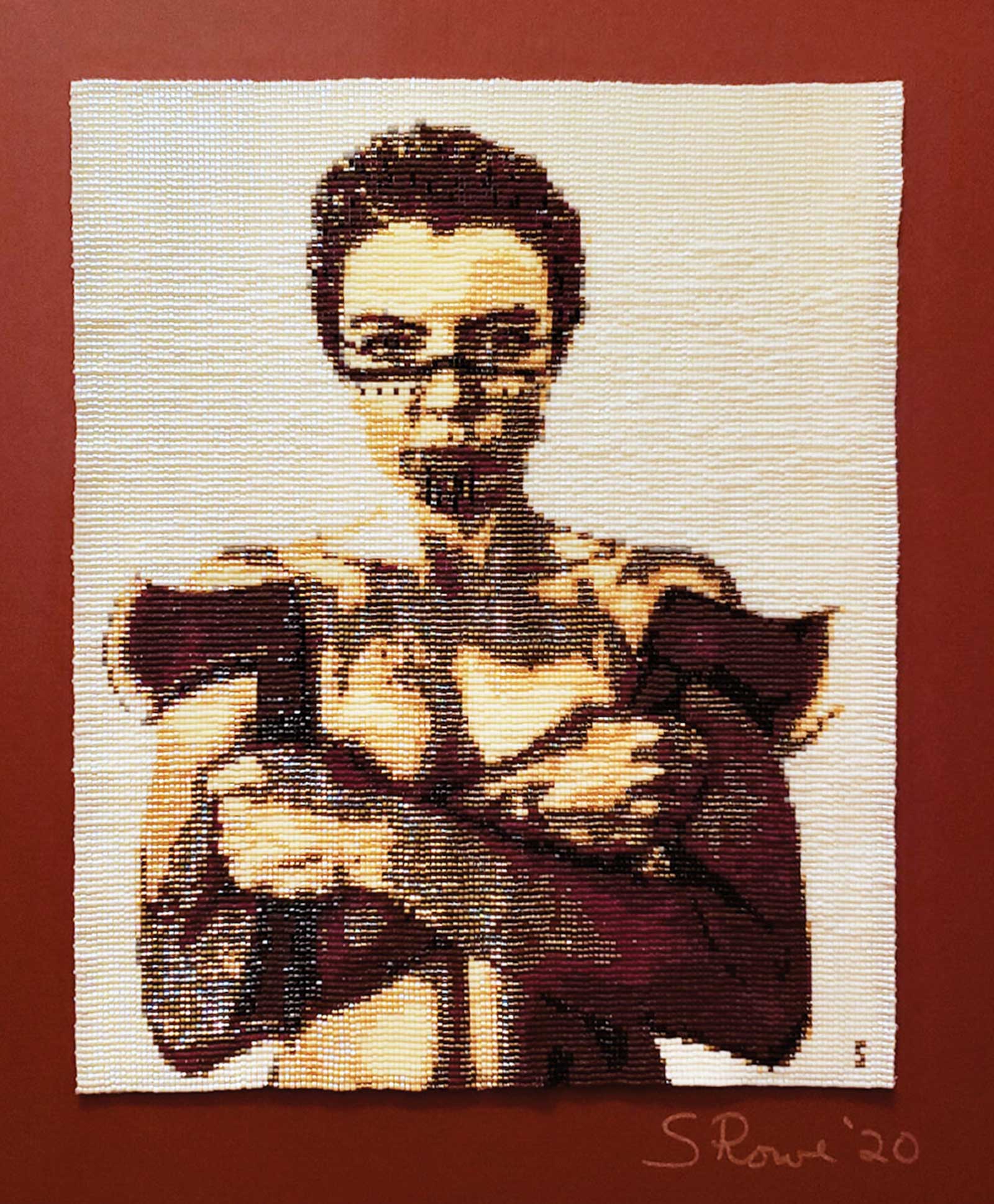 Shelby Rowe (Chickasaw), 21st Century Chickasaw Hatchet Woman, 2020, glass beads, thread, 12 x 8” (unframed)
The Métis people date from the 1700s when voyageurs married Indigenous women. They formed a distinct culture among the Aboriginal peoples of Canada. Herr notes that the piece “speaks to the importance of waterways. The Métis had to struggle to maintain their water rights as well as access to the rivers for passageways.”
Rowe, a self-taught bead artist, is manager for the Oklahoma Department of Mental Health and Substance Abuse Services. In 2016, she was honored as the Chickasaw Nation Dynamic Woman of the Year.
Herr is particularly pleased to have an example of Rowe’s beadwork in the exhibition because it was woven on a loom rather than being the more traditional appliqué. She notes, “Shelby’s rapid development as a beadworker and artist is quite phenomenal.”
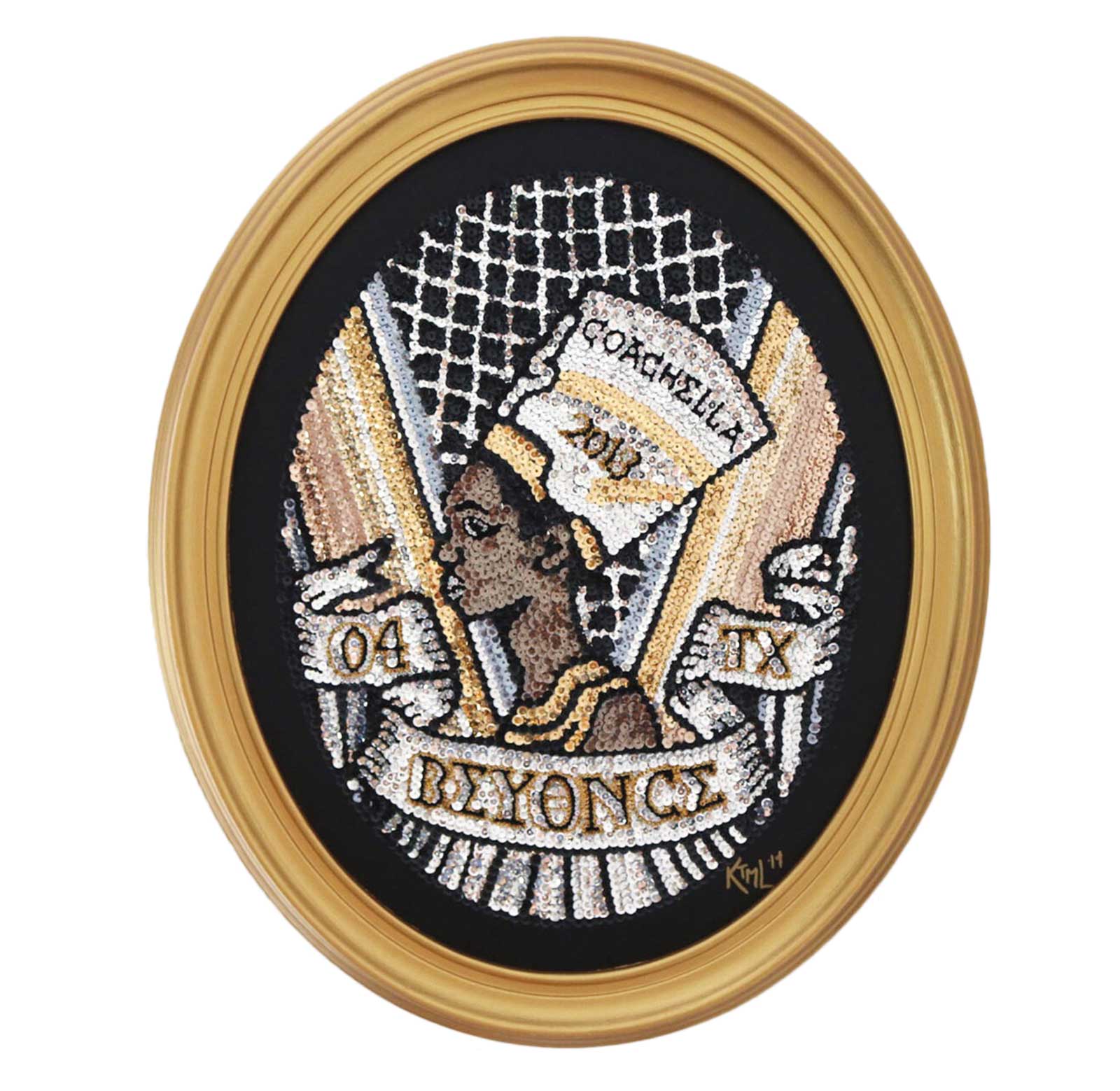 Kellen Trenal (Nez Perce), Beychella, 2019, beads and sequins on canvas, 16 x 11”
21st Century Chickasaw Hatchet Woman references a battle during the French and Indian War of the mid 1700s when Chickasaw women went into battle singing war songs and wielding hatchets, routing the invaders.
Painted and beaded buffalo hide robes often depicted a tribe’s or a warrior’s history. When I commented to Herr that Adams’ Beaded Hide Robe Deconstructed looked like ribbons on an American military person’s uniform, she told me that Adams had adapted the patterns from the hides that “speak to the achievements of an honored person’s life.” Some of the beads Adams used are translucent. They are beaded on white Bristol board and glow as the light reflects back through them.
Chelsea M. Herr, exhibition curator
Chelsea Herr, a citizen of the Choctaw Nation of Oklahoma, begins her position this May as the first curator of Indigenous Art & Culture at the Gilcrease Museum. Born and raised in Southern California, Herr is currently based in Norman, Oklahoma, and is a recent PhD graduate from the University of Oklahoma’s Native American Art History program. After realizing she could combine her passion for Native art and science fiction, she completed her dissertation on Indigenous Futurisms in the work of Native North American artists. This interest can currently be seen in the Museum of Contemporary Native Art’s exhibition, Indigenous Futurisms: Transcending Past/Present/Future, which Herr co-curated with Suzanne Newman Fricke and Manuela Well-Off-Man. Her work with the Couse-Sharp Historic Site began in 2016 when she worked as a collections intern to catalog and store historic collections of beadwork and pottery. From there, she was given the opportunities to co-author The Couse Collection of Native Beadwork with E. Jane Burns and to curate Stitched in Sovereignty.
In other work, Adams commissioned a photographer, Leroy Grafe, to record the sweeping landscape of eastern Washington onto which she beaded traditional geometric patterns. She writes, “My work serves as a cultural narrative, an expression of personal experience, and an exploration of form and function. I choose to use specific materials and designs as a way to connect with tribal art forms from antiquity while embracing the reality of my mixed heritage. My designs originate from older, more traditional sources while material choices reflect the effect trade goods had on Native aesthetic and fashion. The liberties I take with materials, line quality and design elements reflect my interest in contemporary art and the development of abstraction in the Western art tradition. I use the visual language of color and shape to articulate new observations on politics, history and identity.”
Opens June 2020
Stitched in Sovereignty: Contemporary Beadwork from Indigenous North America
Couse-Sharp Historic Site
146 Kit Carson Road, Taos, NM 87571
www.couse-sharp.org
Powered by Froala Editor