In early 2019 I was asked to be the co-curator of Apsáalooke Women and Warriors by Apsáalooke scholar Nina Sanders. At this point I had only been at the Field Museum for about nine months as a post-doctoral researcher for the renovation and reimaging of the museum’s Native American Hall. I was assigned the curatorial duty of contemporary art curator, a completely new territory for me, considering my background in history and anthropology. Though I was a fan and follower of many wonderfully talented artists on social media I was a tad concerned that I could do the job justice. However, after I expressed my worry to Sanders, she simply replied, “You got this.”Together we created a roster of artists that embodied the Apsáalooke spirit of art and creativity, ultimately reaching out to Bethany Yellowtail, Birdie Real Bird, Della Bighair Stump, Elias Not Afraid, Kevin Red Star, Ben Pease, Del Curfman, Allen Knows His Gun, Adam Sings in the Timber, and Mona Medicine Crow. 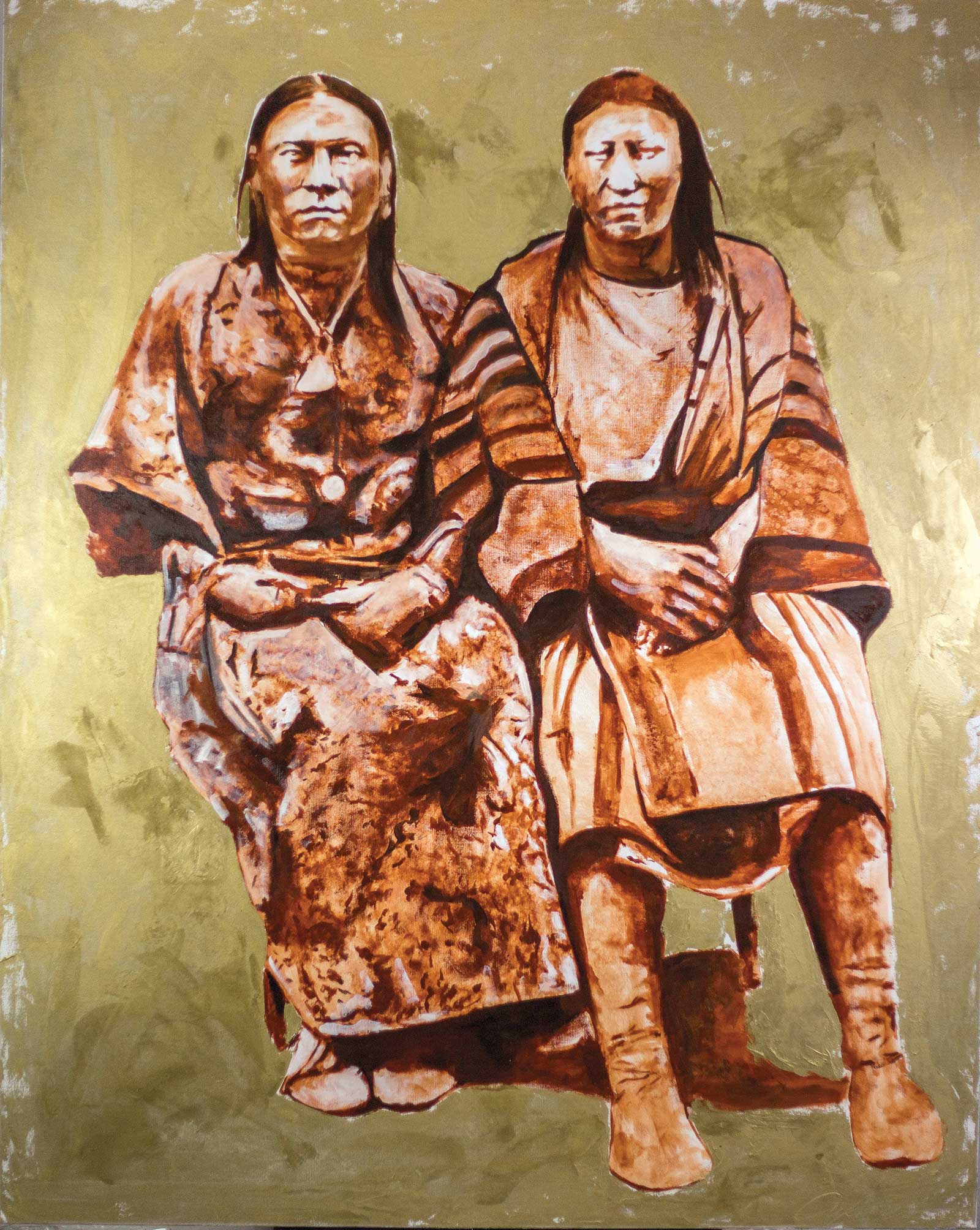 Del Curfman (Apsáalooke), Baté Pride, oil on birch board
However, one important aspect of Apsáalooke culture to know is that no one sings their own praises. To do so could bring harm to you and your family. This explains why one of the greatest honors an Apsáalooke person can receive is through the celebration of their accomplishments by someone in their community. Keeping this concept in mind, we selected male artists, who were not only raised by independent, strong and dynamic women, but who have chosen to honor their mothers, grandmothers, sisters, aunties and cousins through their artwork. This theme ultimately became the structure of the exhibition. 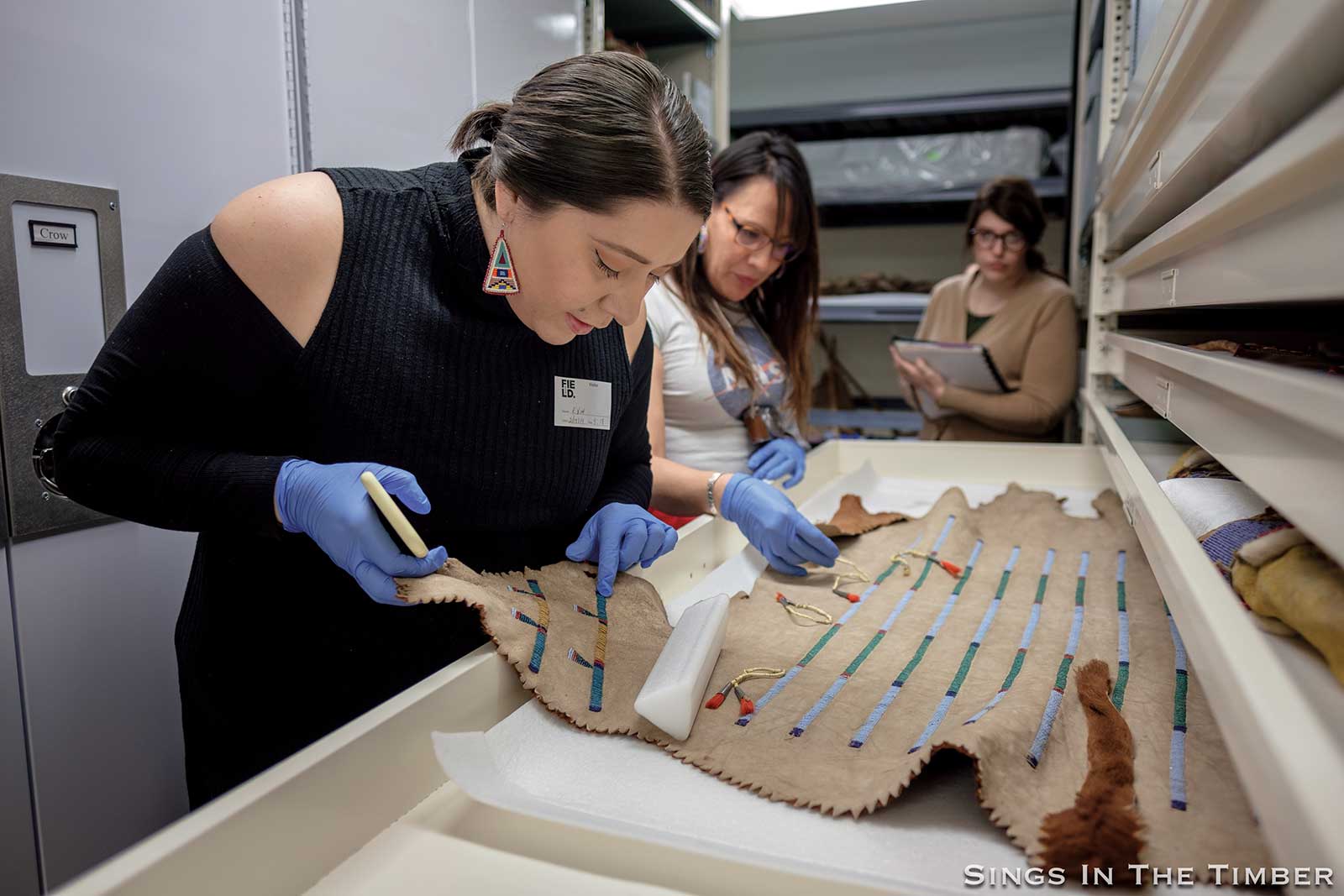 B. Yellowtail, curator Nina Sanders, and exhibition developer Meredith Whitfield looking at Apsáalooke beadwork at the Field Museum in February 2019. Photo courtesy Adam Sings In the Timber.
To give everyone the opportunity to commemorate this essential message, we asked each artist to come to the Field Museum to spend time in the Apsáalooke collection to be inspired to create new work. Sanders and I hoped that by examining the collection, the artist could create new works that demonstrated just how much the past influenced their contemporary world. We also anticipated that they would unearth never-before-seen patterns or techniques so that they could revitalize them for the exhibition. Although not all of the artists we worked with could make it to the museum last winter, their work is still indicative of the exhibitions’ mission in celebrating Apsáalooke culture and traditions, including recognizing the role of batee, or two-spirited people by a painting done by Curfman. This piece not only challenges Western concepts of gender, but also encapsulates Curfman’s goal of inspiring non-Native audiences to learn about the many people who have helped the Apsáalooke prosper. For those that did get a chance to view the collection, I think it is safe to say the experience was life changing.I will never forget the moment in February 2019 when I first met Apsáalooke/Northern Cheyenne fashion designer Yellowtail. Having followed her on social media, the fangirl in me could not calm down. So, as we walked into the Field Museum’s collections space, two floors below the museum’s ground level, I intently focused on not tripping over myself. I eventually regained my composure upon the opening of a cabinet that housed a war shirt collected by the museum in the early 1900s. It is important to note that war shirts were not typically worn by a man into battle. Rather women made them to celebrate a man’s achievements; which explains why these shirts are decorated with beautiful beads and patterns.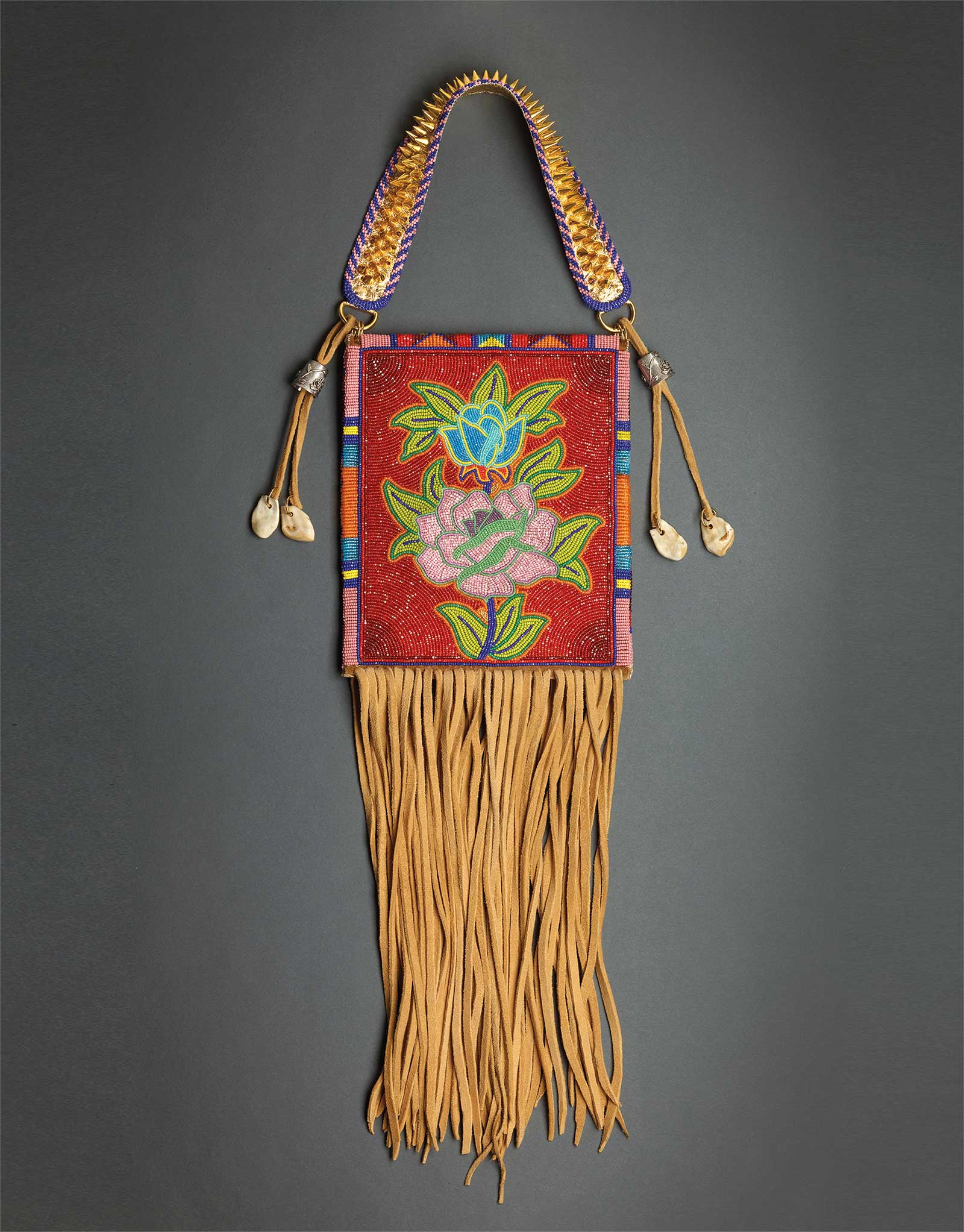 Elias Not Afraid (Apsáalooke), beaded bag, deer hide, elk ivory teeth, glass beads, Italian leather. Photo courtesy John Weinstein at the Field Museum.
When Yellowtail first walked up to the shirt, which will be on display in the exhibition, she immediately commented on the lavender beads that line the shirt’s shoulders. I overhear her as she comments on how the woman who created this shirt, must have cared for its owner very much; for it is the only way to describe making something so beautiful. It was at that moment that the excitement of meeting Yellowtail because of her celebrity shifted to admiring her for the obvious affection she has for her community. As I watched Yellowtail examine all of the different items we pulled from collections, she never just focused on the aesthetics of a piece. Rather, she openly questioned who those items might have belonged to and how she could recreate some of what she looked at into her own designs. A few months after her visit, Yellowtail shared concept images of the new line she hoped to debut for a holiday 2020 release. What stood out to me the most was how she incorporated lavender in a number of clothing options as a way to invoke strength and elegance. These designs truly capture the same amount of love the war shirt creator showed to its owner. Yellowtail hopes that her work “will continue to represent, affirm, and proclaim the beauty, strength, and power of Apsáalooke women.” A selection of Yellowtail’s designs, alongside a historic dress made by her great-grandmother, stand at the end of the exhibition as a celebration of all the things that make Apsáalooke people beautiful.
In April 2019 artists Red Star, Not Afraid and Pease arrived at the Field Museum. As I escorted the group toward the collection of Crow material, all three men immediately noticed a beaded martingale that is dated as coming to the museum around the 1890s. Not Afraid was particularly enthralled by the piece, as well as all the other beaded items in the aisle. He very carefully lifted each piece out of its box to examine every stitch. He marveled at the vibrancy of the bead colors and questioned where the maker acquired them. When he happened upon a floral beaded pouch, Not Afraid gasped with excitement. He immediately pulled out an arm cuff he just finished beading to show us just how much his pattern and colors correlate to the pouch in the collection. 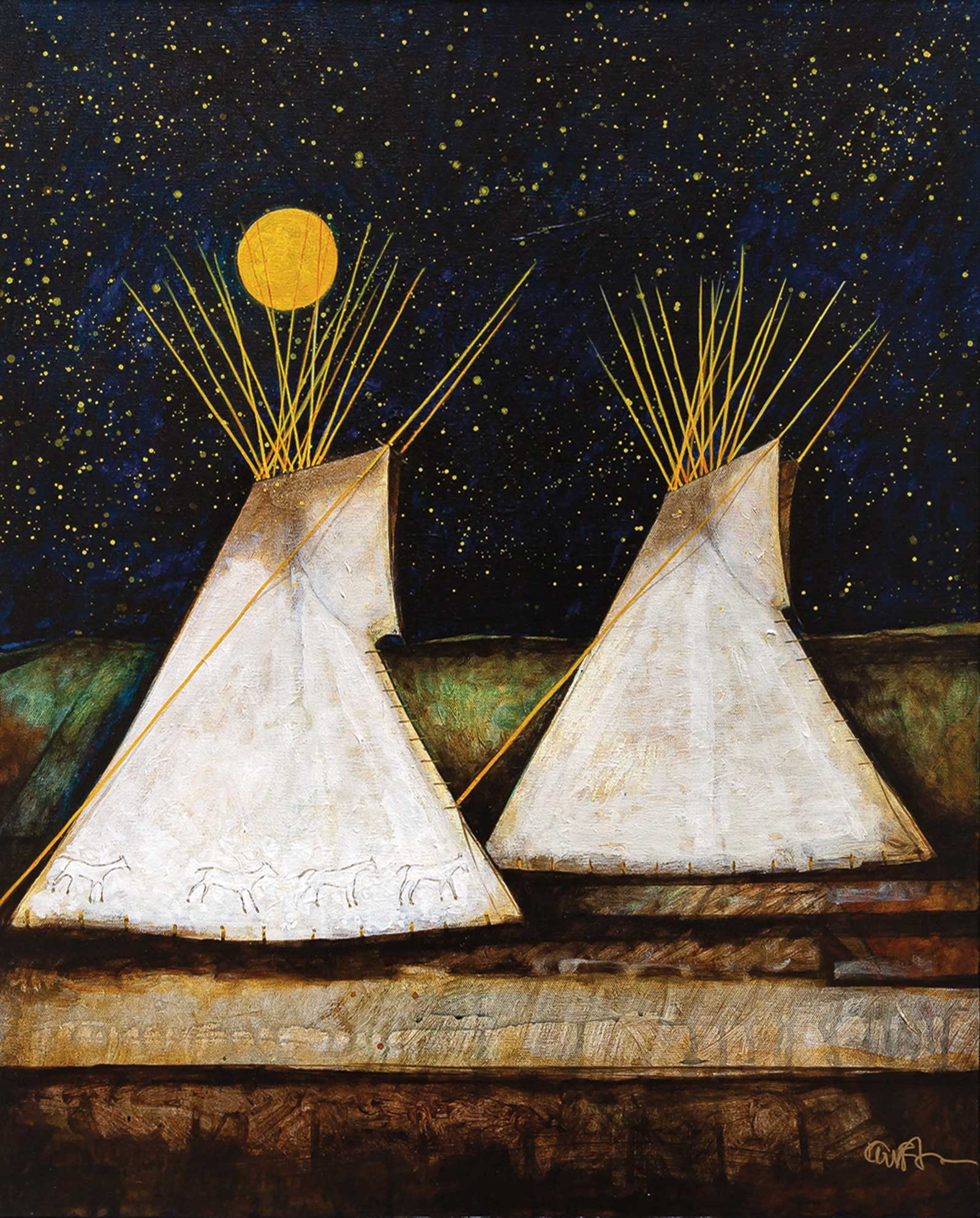 Kevin Red Star (Apsáalooke), Evening Lodges, 2017, acrylic on canvas, 25 x 31½” (framed). Courtesy Stapleton Gallery. Photo courtesy Robert Chase Heishman.
Later in the day as we sit for lunch, I ask Not Afraid about why being able to look at the collection, and finding that pouch, was so important. He tells me that this visit gives him a deeper understanding of how his ancestors were able to create such beautiful items, especially considering how they did not have access to the same tools we have today. This explains why his favorite objects in the collection ones are left unfinished, for they offer a glimpse of techniques and methods his ancestors used. He notes on how “some used stencils, some drew freehand on the buckskin, some beaded from right to left or left to right, and some tacked the beads without going through the whole hide.” He also comments on the techniques he had never seen before because they died out a long time ago. Therefore, Not Afraid incorporated a number of these reclaimed techniques to the pieces he created for the exhibition, including a beaded floral spiked bag that blends traditional Crow floral designs with a touch of high fashion color.
In November 2019, Not Afraid brought the bag with him to the museum to put the finishing touches on it. As he worked, our in-house media team recorded him for a video that will play in the exhibition. In the section that honors Apsáalooke people as creators, Not Afraid acknowledges that while women are typically the ones who bead, he is working on shattering these rigid gender roles. He honors the work of the women who came before him, but he is also attempting to pave a new way for future Apsáalooke bead workers, female/male/non-binary. Not Afraid’s work seamlessly blends tradition, couture and innovation.
The same day I talk with Not Afraid in April 2019, I accompany the rest of the group back to their Airbnb. We are all euphoric from the day’s events and are looking forward to unwinding with some takeout. Before we can decide what to order,
I sit with Red Star and Pease. I immediately feel out of place, mostly because I feel that I do not have a creative bone in my body. Instead of excusing myself though, I listen to both men as they converse about the role of Native American art in today’s society. Red Star, who was among the first group of students at the Institute of American Indian Arts in Santa Fe, reflects on his decision not to explore with media beyond paint. As he talks, he grabs a piece of parchment from the table and starts to sketch. He tells Pease and me that painting is the only way he feels he can adequately show the public the beauty of Crow culture, and all of the different aspects that are distinctive to their community. Over the course of the conversation, we realize that in many ways Red Star’s paintings represent the founding principles of Apsáalooke Women and Warriors: he ensures his works depict Crow women as strong, fortuitous and powerful. The Field Museum show includes four of Red Star’s paintings, with a fifth hanging at the exhibition companion site at the University of Chicago.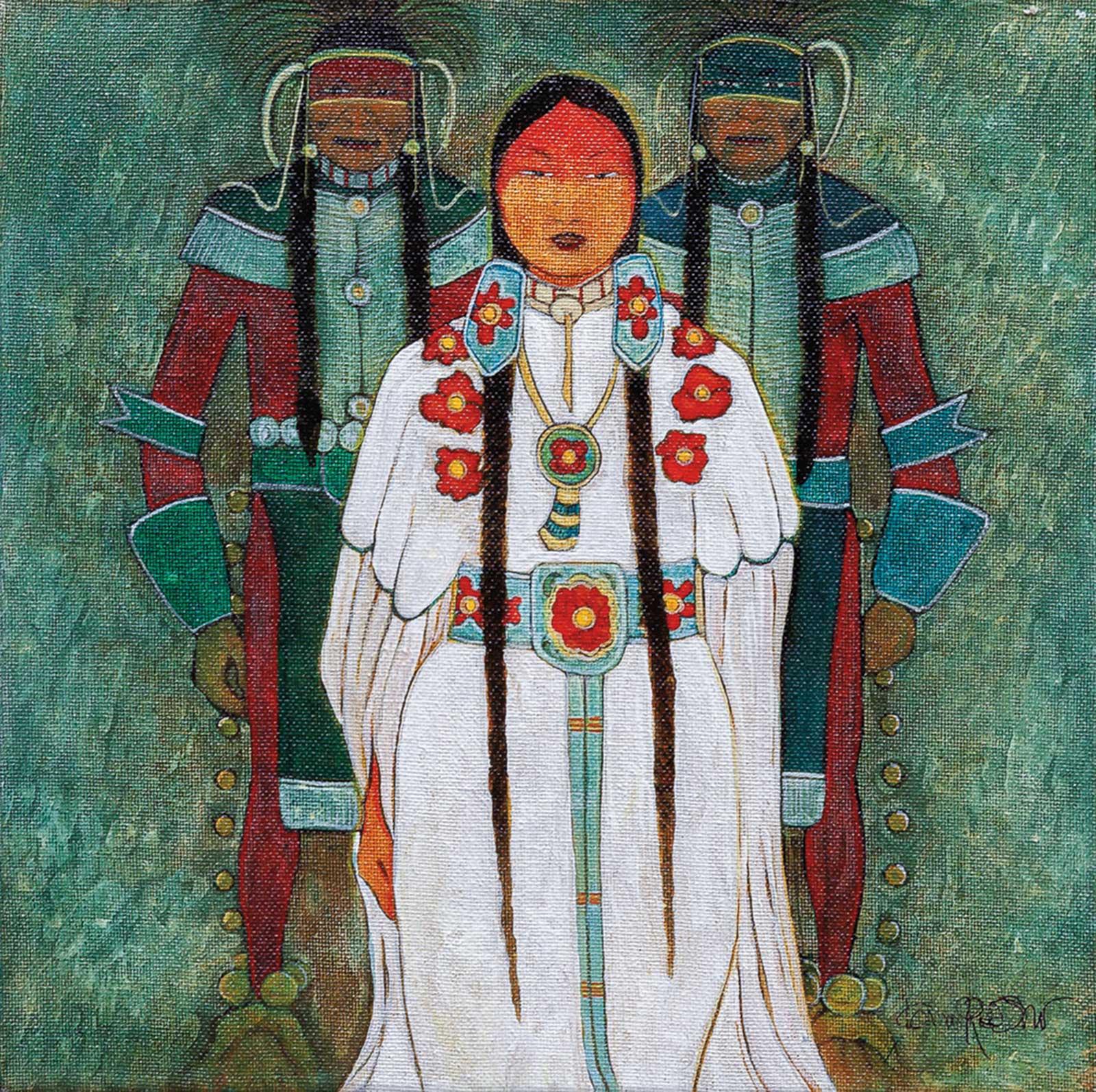 Kevin Red Star (Apsáalooke), Proud Crow Warrior and Provider, 2019, acrylic on canvas,48 x 60”. Courtesy Stapleton Gallery. Photo courtesy Robert Chase Heishman.
As he continues to sketch, Red Star comments that this next generation of Native artists is the best equipped to address the more hard-hitting issues many communities currently experience. He looks to Pease and gives him a slight nod of recognition, to which Pease responds that he would not be where he was without Red Star. They each try to out-compliment the other, but to no avail. They only laugh and keep talking. Suddenly, Red Star signs his name onto the parchment and hands it to me. “For you,” he says. I quickly see that he has drawn me three Apsáalooke tipis, which are some of Red Star’s most iconic images (see his painting as reference). At that moment, I learn that to be Apsáalooke is to be generous. You thank those you appreciate the most with representations of your highest self. This understanding helps me to understand the dynamic nature of Red Star’s paintings: every brush stroke is a gift from him to his audiences, and every woman depicted is an acknowledgment of love.
When Red Star excuses himself, I am left sitting at the table with Pease. While in the collection, I learned Pease’s silence was not meant to be ostracizing, rather it was an indication that he was absorbing the knowledge being shared with him. When I later see the work he created for the exhibition, I notice how Pease characterized the strength, integrity and beauty of Apsáalooke women, topics which were discussed that day at the Field Museum. However, these concepts have never been foreign to Pease or his artwork. He is the first one to acknowledge that it is because of the unwavering support of his mother, grandmother, sisters and aunties that he has been able to accomplish so much at such a young age (Pease is 30). His appreciation of their encouragement is why a majority of Pease’s current work portrays Apsáalooke women as sacred beings, ideas captured in the paintings Ishbínnaache Ítchish Daasátchuchik/Pretty Shield, the Strong-Hearted and Wherein Lies the Beauty of Life. These paintings will be included in the Field Museum exhibition, and a portrait of his grandmother, Amy Yellowtail, will hang at the companion exhibition site at the University of Chicago.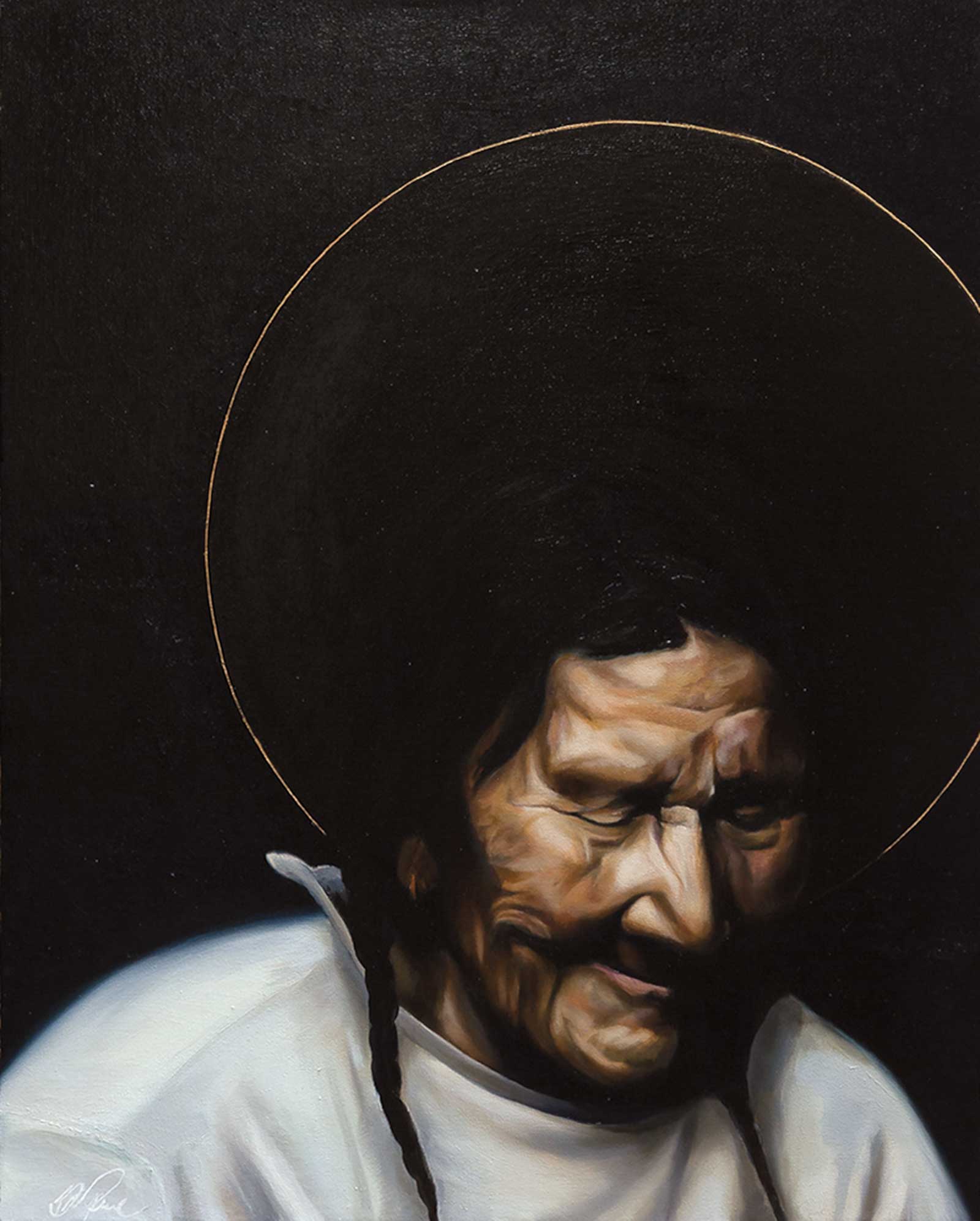 Ben Pease (Apsáalooke/Northern Cheyenne), Ishbínnaache Ítchish Daasátchuchik/Pretty Shield, acrylic and oil on canvas, oil pastel ink, 24k gold leaf, velvet paper and ink. Photo courtesy Robert Chase Heishman.
I am forever thankful for Sanders and the trust she bestowed upon me. Not only has she shared her family with me, she has allowed me to work alongside some of the most prolific Apsáalooke artists of this generation. I am also forever indebted to each of the participating artists, including the many I have yet to formally meet. At different points in the exhibition’s development they all taught me how their work is embedded with ancestral stories and contexts that will help the next generation of Apsáalooke thrive.
So, please come to the Field Museum to view Apsáalooke Women and Warriors! It would be my honor to welcome you and to continue to sing the praises of a community who has gifted me with a new sense of beauty. –
March 13, 2020-March 2021
Apsáalooke Women and Warriors
Field Museum
1400 S. Lake Shore Drive, Chicago, IL 60605
(312) 922-9410, www.fieldmuseum.org
Powered by Froala Editor