
Susan Totty met our collectors when she was working at Gallery 10 in Santa Fe, New Mexico. She is now the proprietor of Blue Sage Gallery in Cave Creek, Arizona, and counts the collectors among her
long-time friends.
While on holiday at the Boulders Resort in 1992, the couple saw a desert property that attracted them. “We aren’t impulsive,” the collector explains, “but we bought it and began planning the design in the spring with architect Lee Hutchison. Our ideas were important and he incorporated them into the design. The house works as a home magnificently.”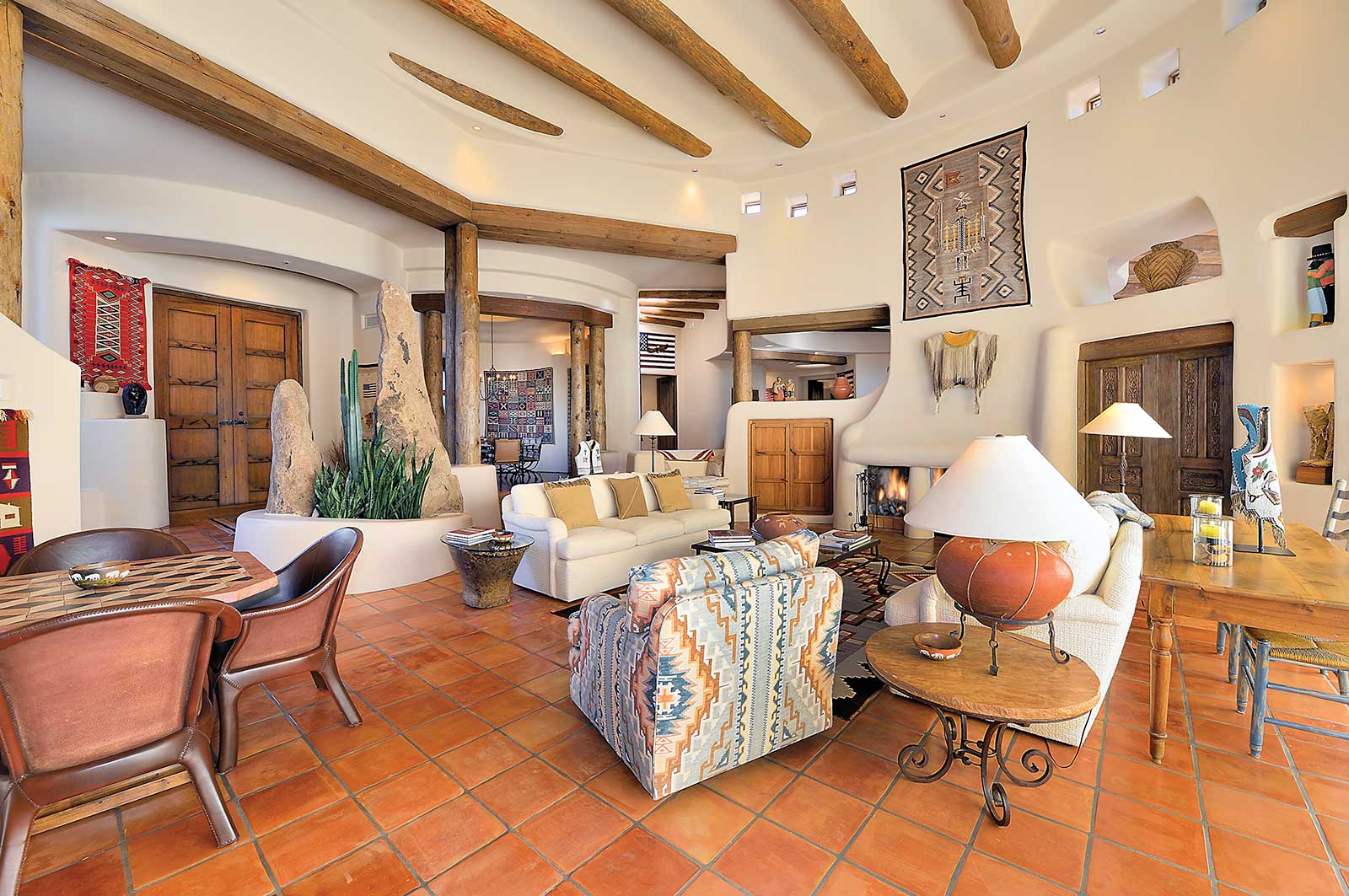 The view from the great room highlights a variety of contemporary and antique Native American art.
Totty began working with them at about the time when they were building the house. “I took them on trips to Indian Country,” she says. “Their fascination continued to grow as they learned. They began with Navajo weavings and expanded their interests from there. They like historical as well as contemporary work, depending on the medium. Their first purchase was a weaving from the 1890s that has her initial in the center.”
“Susan has been instrumental in our collecting,” the collector says. “She cares about us and what we collect and buy. She would stop us from making horrible mistakes. Our home has been the framework for what my husband calls an accidental collection. Over time, a group of objects has become a unified collection. They are meaningful things that we like. We felt they belonged in our home and we’ve loved them.”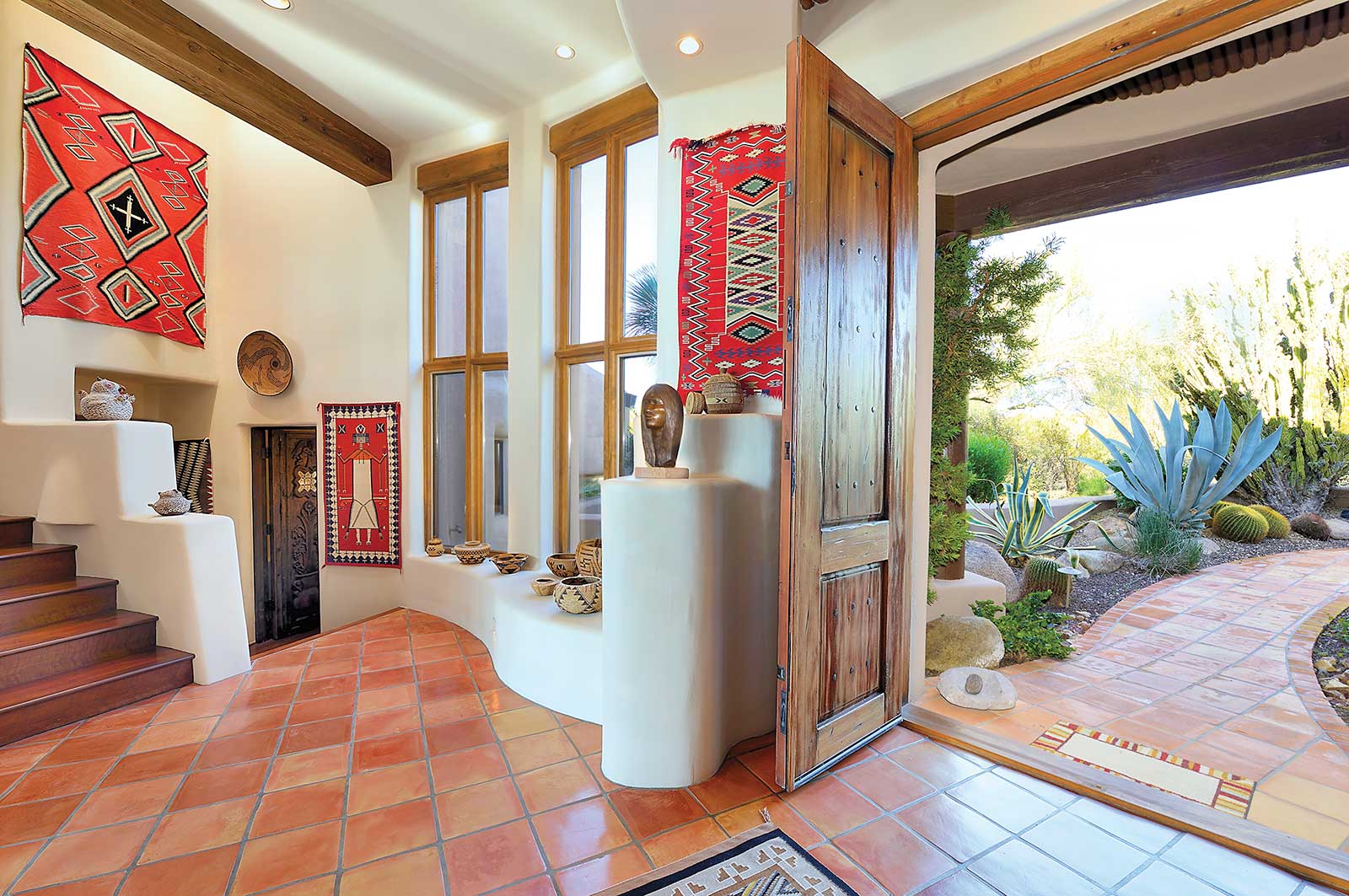 Germantown textiles from the late 19th century adorn walls throughout the house.
Totty credits the husband with having “a feel for things. It has nothing to do with training. He just has an eye—an eye for quality and uniqueness. His wife is the reader and the studier.”
His wife explains, “The collection has a unifying theme of high-quality textiles and folk art with eagle and American flag motifs. My husband has accumulated a large number of baskets that are both important and beautiful. We started picking pottery pieces that we liked and found we had assembled a collection of miniatures by first rate potters. We have also collected fetishes and a number of Medicine Bears since, with a large family, we need a lot of protection.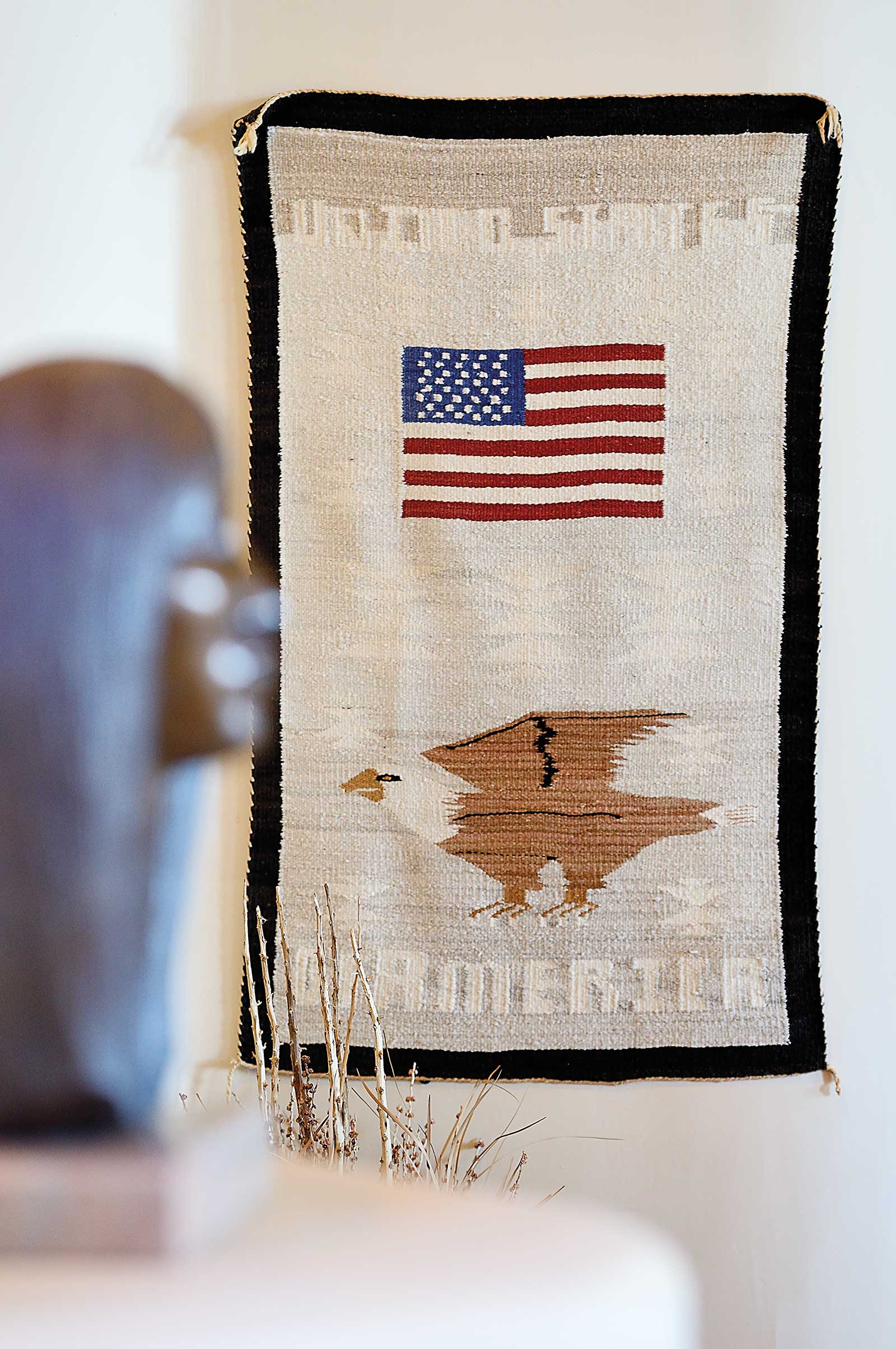 Iza, 1985, bronze by Allan Houser (Chiricahua Apache, 1914-1994) in front of a Navajo pictorial weaving, United States of America, circa 1945-55, with a background of woven squash blossoms
“Our interest in textiles began with a friend who was a quilt dealer,” she continues. “We bought three or four Amish quilts, and our daughter and I would look for quilts when we were traveling. We started out slowly and modestly and our interest in textiles grew. It’s a steep learning curve.”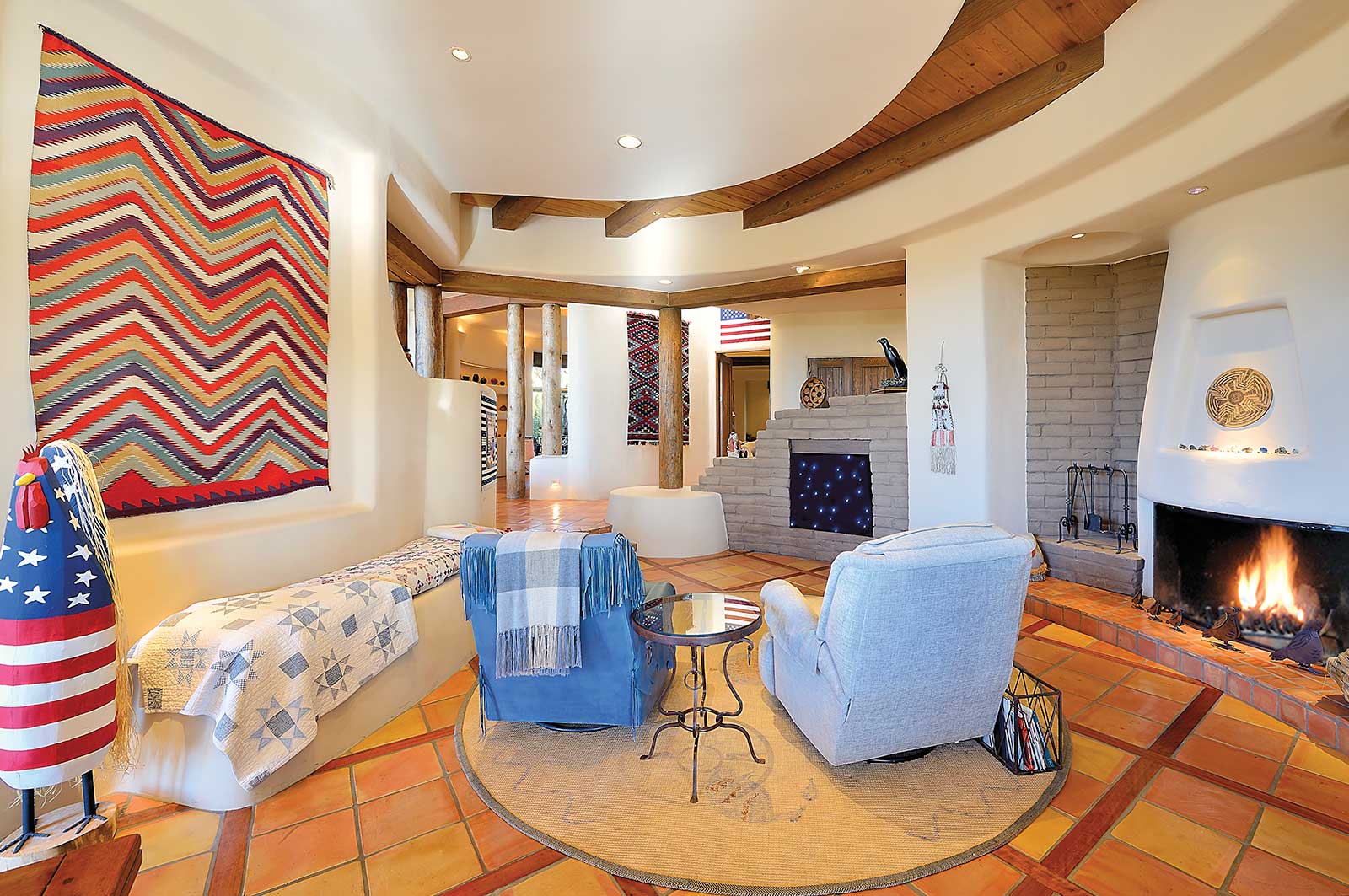 The couple refers to this room as “simply our space”, thus there are only two chairs. The room is dominated by a Germantown Eye Dazzler weaving which hangs above a selection of Amish quilts.
She had “always wanted a wedge weave,” and had been the underbidder for one at an auction 15 years ago. Last year she acquired a spectacular red, white and blue wedge weave by the young Navajo weaver Kevin Aspaas. He cleans, spins and dyes his own wool and has been reviving the technique which has a zig-zag motif that had been popular in the late-19th century. She had seen the piece at the Heard awards preview where it had received First Place and Best of Class awards, two of the many awards it has won. She asked her daughter to be first in line at Aspaas’s booth when the sale began the next morning. When her daughter arrived she found she was second in line and the person in front of her was a curator at an important museum. At the appointed time they entered the booth and found they were each after different pieces.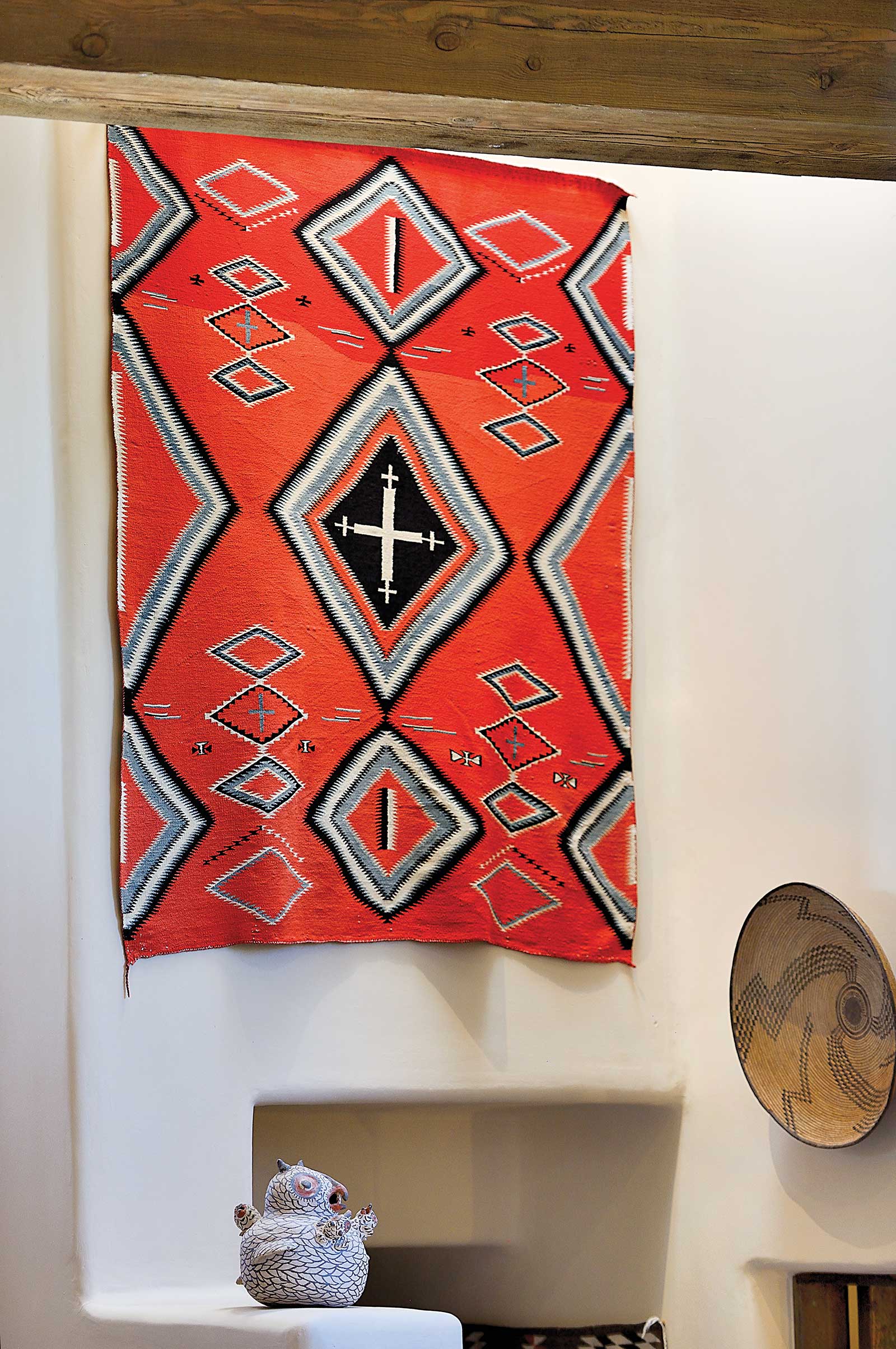 High above the entry to the master suite is an 1880s Navajo blanket. To the right of the blanket is a deep Apache tray, 22 inches in diameter.
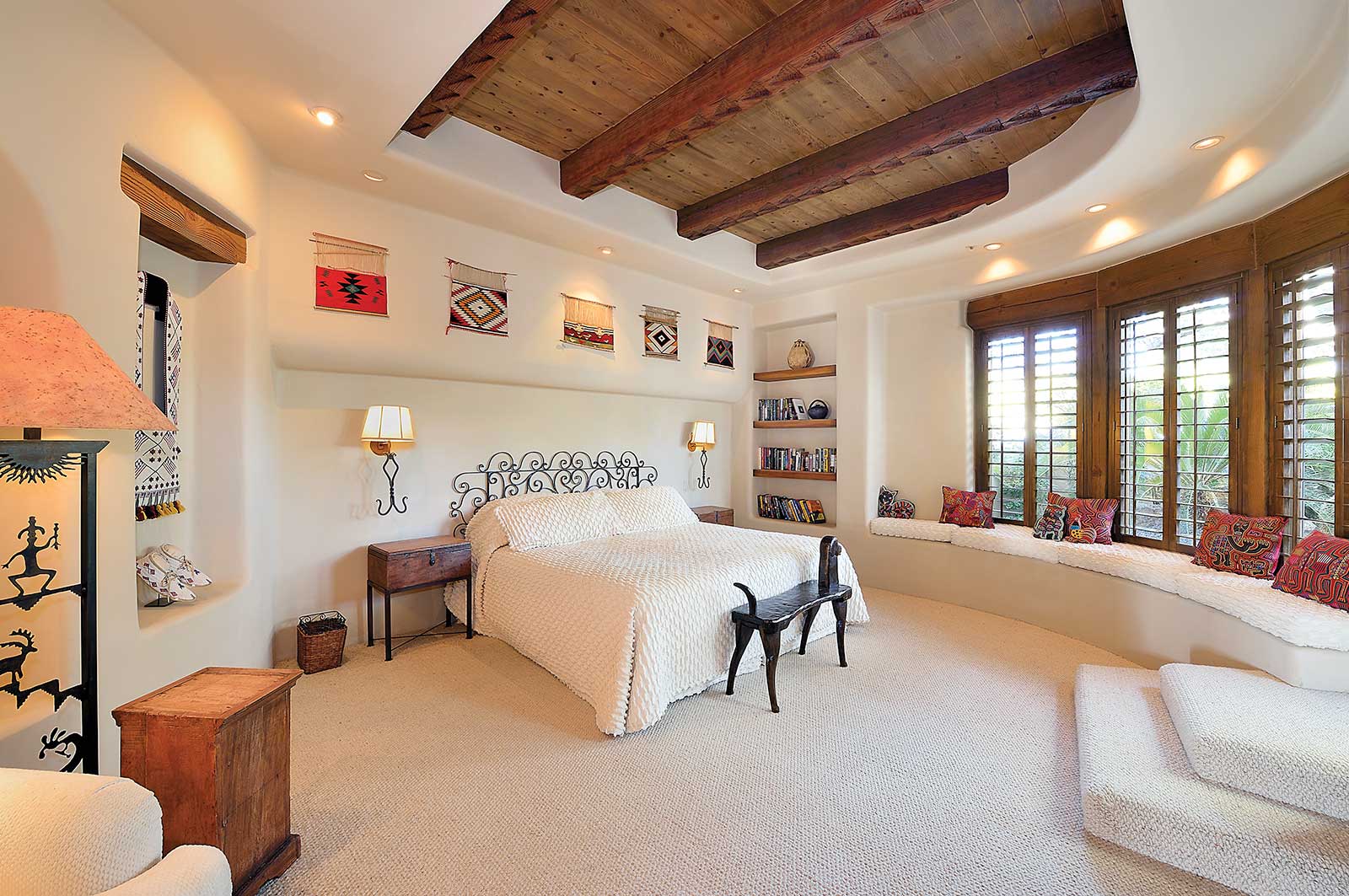 Five 19th-century Germantown loomers hang on the soffit over the bed in a guest room.On a trip to reservations with Totty, they saw wood carvings by Lawrence Jacquez (Navajo). “We purchased a carving of a woman holding a sheep. The carving was of his grandmother. I asked Susan to contact us if he ever did a carving of his grandfather which he did two or three years later. The male figure was much smaller than the female. He had followed his sense of literalism and said, ‘She was much taller than he was.’”
Since I always learn something new talking with collectors, I asked about the unfinished textiles on small looms displayed in a guest room. They are 19th-century Germantown loomers. Commercially processed wool was being produced from the Mid-Atlantic states to New England, with many centered around Germantown, Pennsylvania. The aniline dying process allowed for a wide variety of colors. The yarn companies would parcel out small amounts of wool for the weavers to demonstrate their skills. A large Germantown sampler commands the dining room and was acquired in a private treaty sale at Sotheby’s in the 1980s.
The couple continues to collect, although slowly. “We don’t go out and buy buy buy,” she explains. “We look at Sotheby’s or for a bargain on eBay. I tend to find everything and then ask my husband,” she says. “He’s a color person and I’m more 3D. We sometimes trade up for something that’s much better and more pleasing aesthetically. The master bedroom uses a late classic third phase blanket as a “headboard.” The shelves display some of the large collection of Zuni bear fetishes and Navajo folk art pottery by Silas and Bertha Claw.
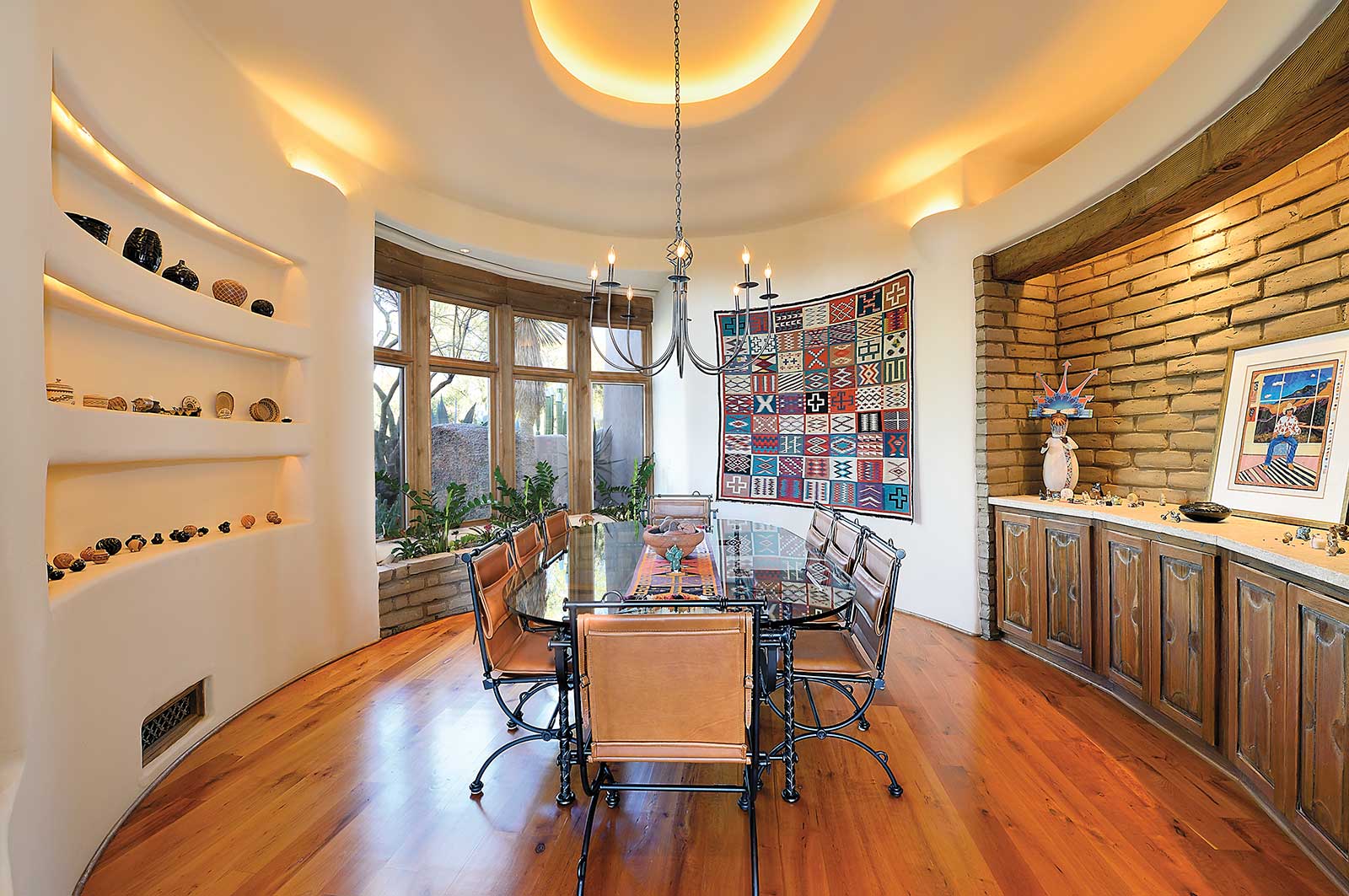 The dining room of the house is filled with Native American art including a collection of miniature pots.“Our interests are family and philanthropy,” she continues. “We don’t want to be owned by what we own. Two of our children and three or four of our grandchildren have become truly interested in Western art and are becoming more and more knowledgeable. Our children will receive some small pieces from the collection and the rest will go to Yale University.” —
Powered by Froala Editor