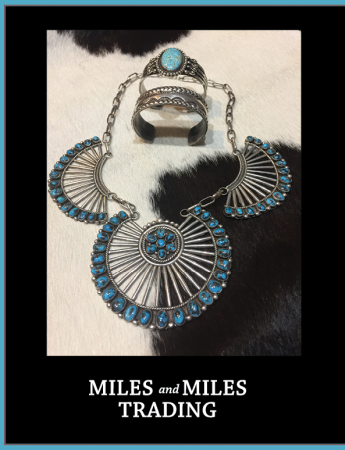
One of the greatest design successes of our modern era has been the iconic pairing of turquoise and silver in American Indigenous adornment. Over the course of 150 years, Native-made jewelry has moved from regional ethnic craft to international artistry. The road to artistic distinction has taken various twists and turns but has always retained one constant: Turquoise lies at the root of this achievement. A recounting of some lesser-known key historical factors will help explain how this melding of two materials—gemstone and precious metal—triggered a creative outpouring of sacred, cultural and personal vision that reached well beyond the American Southwest.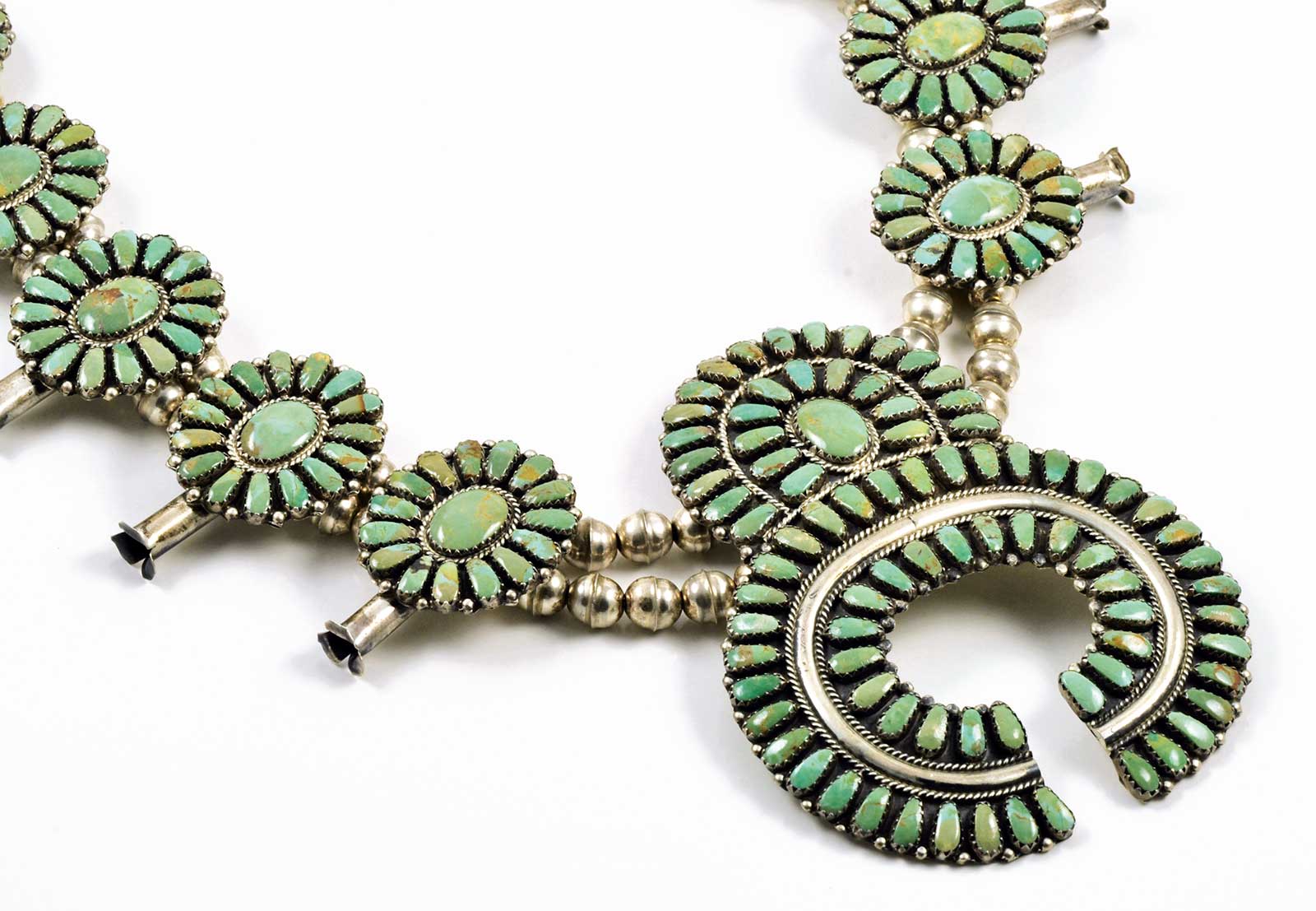 Larry Moses Begay (Navajo), turquoise and silver cluster squash blossom necklace, ca. 1970s.
Native Americans of that region, most particularly Navajos and Pueblos, called turquoise a “jewel” in stories and songs. The Pueblo Indians already possessed a long tradition of using regional turquoise for adornment. But they had no experience with precious metals until the Spanish entrada of the 1540s. Over the years of conflict, as first Spain, and then Mexico, ruled the territory, its Native peoples recognized the potency of silver as a symbol of wealth. They paid special attention to the silver ornaments on horse bridles and headstalls, and the fine detailing of colonial Spanish filigree decorations. After 1870, once the Pueblos were finally allied with their Navajo neighbors, they both turned to an effort never before performed by Native peoples in North America—they became silversmiths.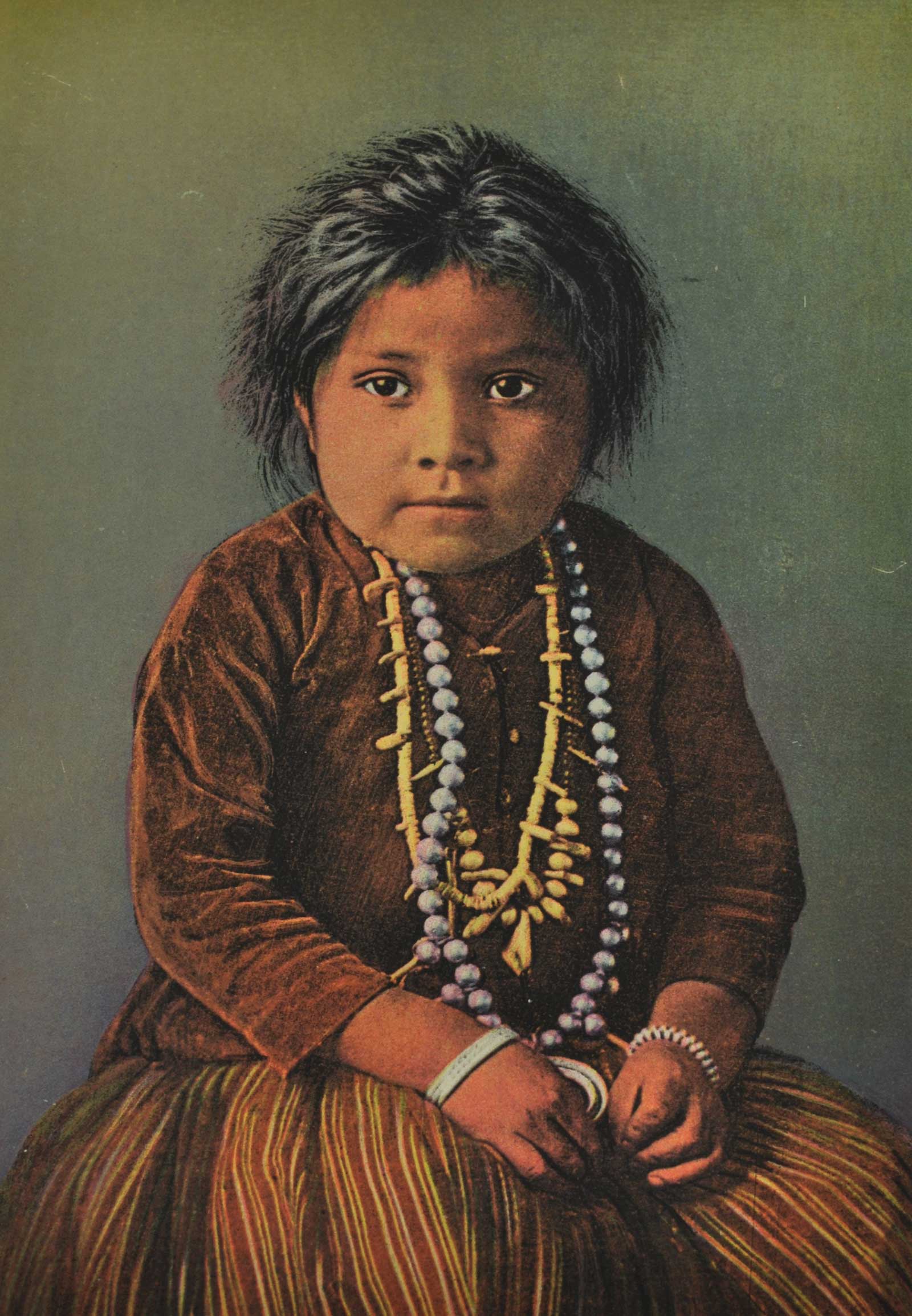 Postcard of a Navajo girl wearing separate turquoise and silver necklaces, ca. 1910s-1920s.
The deeply successful results affirmed the importance of this new skill. Silver represented an opportunity for desperately needed material gain. When the United States took over the Southwestern territories after the war with Mexico, its goal was to open this frontier for Anglo settler expansion. By the 1860s, the Pueblo peoples had made an uneasy peace with these new overlords, so much so that President Lincoln sent the Pueblo governors silver-headed canes as a reward for their support. On the other hand, Navajo raiding and lack of cooperation received the sort of reprisal that would mark the Indian wars of the 1870s and 1880s. When the Navajos, or Diné, returned to Dinétah after the Long Walk and imprisonment in the Bosque Redondo, their shared knowledge of silversmithing aided their economic recovery. The jewelry they fashioned allowed them to produce “hard goods” for barter and trade.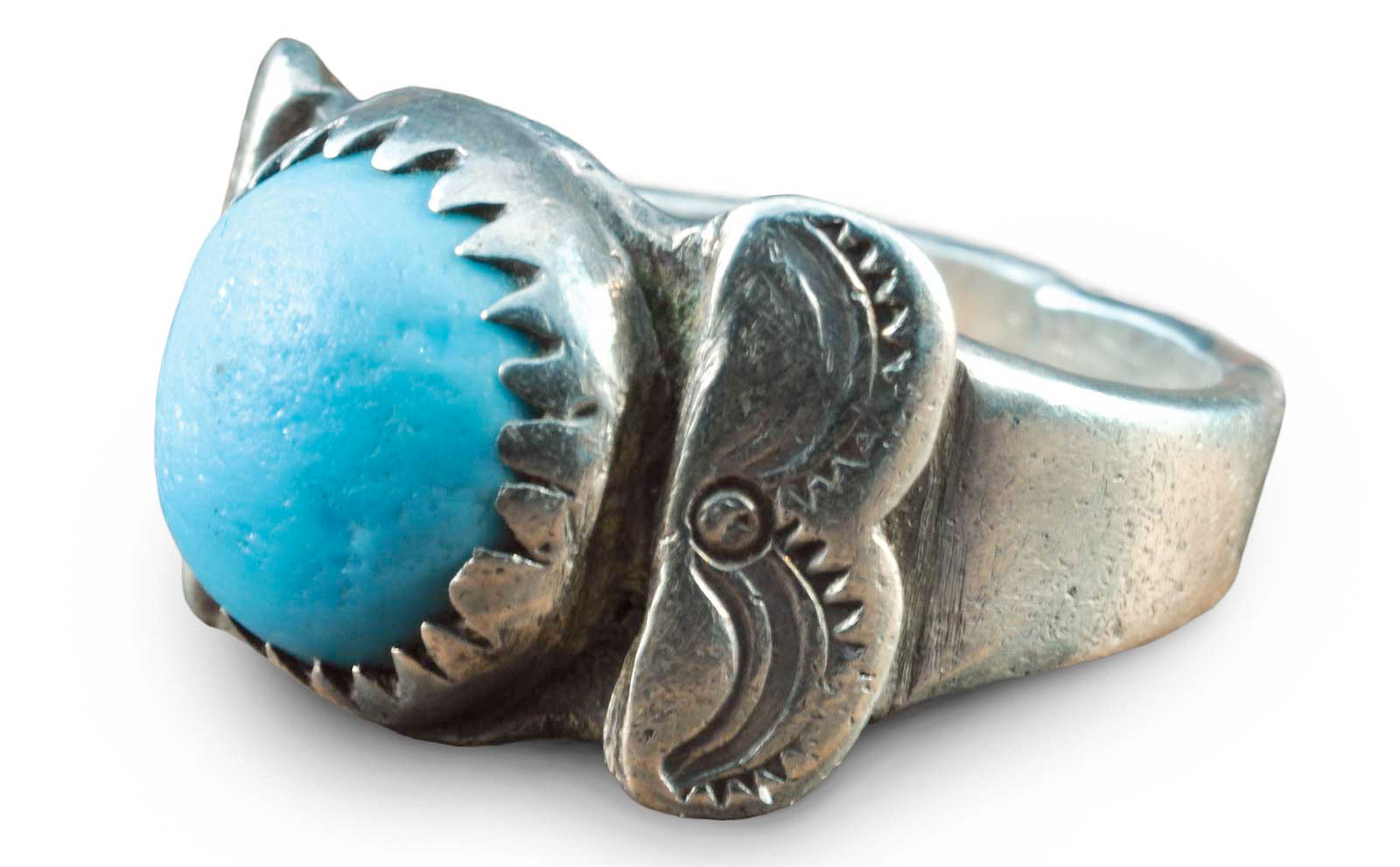 Silver ring set with Hubbell glass bead, 1910. Courtesy Karen Sires.
Pueblo jewelry making had changed little from its pre-contact origins; artisans still laboriously handcrafted beads made from bone, shell, wood and turquoise. Their fine work was prized by neighboring tribes. Once silver adornment became available, however, it was immediately popular. Photographs from the 1860s and after frequently illustrate Pueblos and Navajos, adults and children, wearing separate strands of turquoise beads and silver beads that often ended in silver naja or cross pendants. During the 1880s and 1890s, Native smiths took the next step and boldly integrated turquoise and silver together into distinctive designs.
What made this merger of materials so desirable? The answer lies in the aesthetic appeal of silver as it was made during the 19th century and the meaningful attributes and colors of the gemstone. Native peoples of the American Southwest called turquoise the “sky stone” and found it to be charged with spiritual significance. Turquoise possessed sacred healing properties and its range of blue-green colors reflected the life-giving nature of water. As part of adornment, silver and turquoise also denoted wealth and prestige, along with simply making the wearer look more attractive.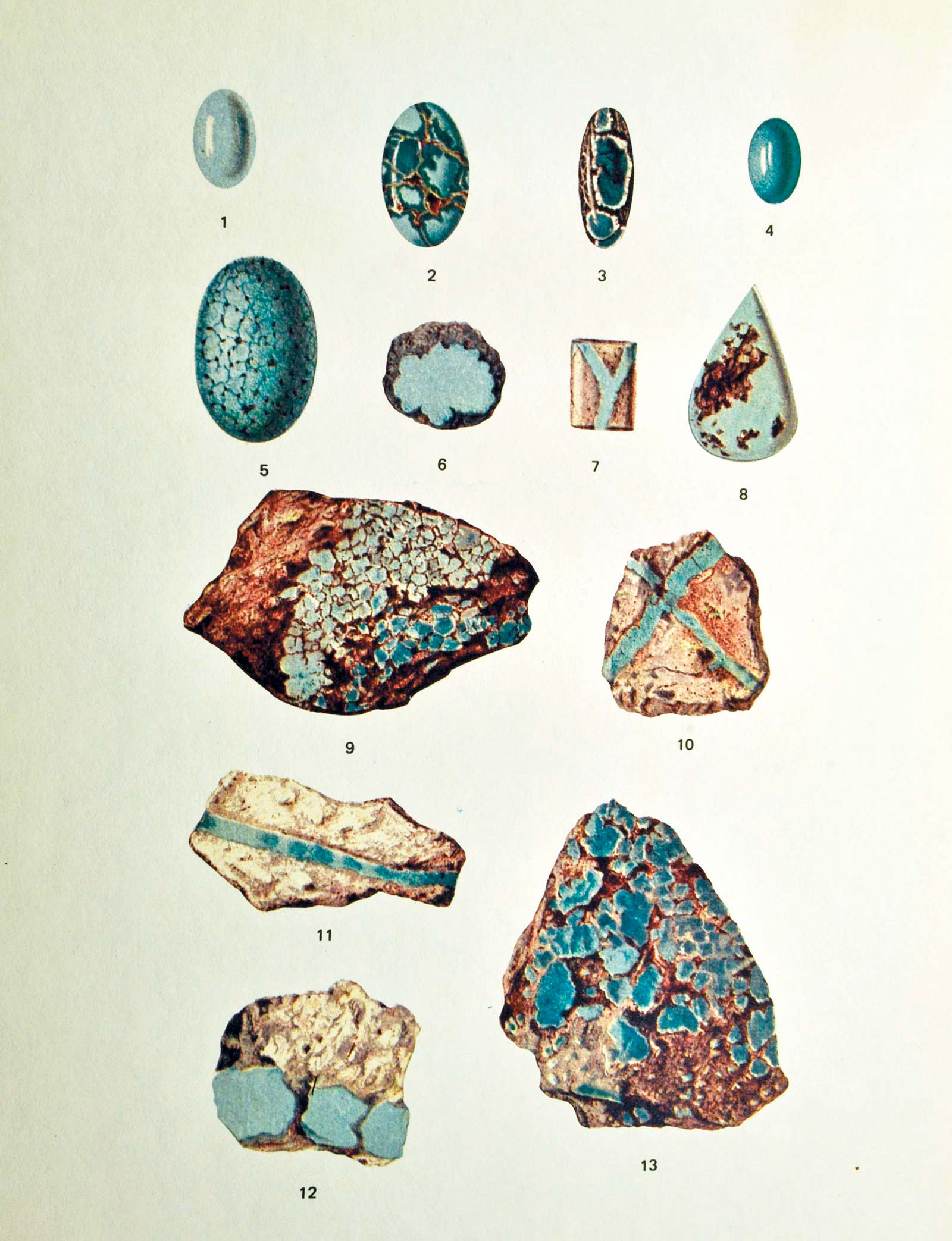 Plate from endpapers of reprinted edition of Pogue’s The Turquois, 1915.
By the end of the 19th century, new interest on the part of Anglo settlers buoyed the search for turquoise mines. Turquoise at this time was not particularly popular in European and American Victorian jewelry settings. A semiprecious gemstone, turquoise was not faceted but cut into cabochons or carved. European turquoise of the 1600s and 1700s was almost always paired with gold. The novel concept of putting turquoise together with silver intrigued non-Natives at this time. Therefore, when American settlers searched for mining opportunities in the Southwest, mainly for gold, silver or copper, they also paid attention to any turquoise deposits they uncovered.
The first Spanish explorers had reported, among other things, that the Indigenous inhabitants gathered turquoise from the Cerrillos Hills south of what would soon become the village of Santa Fe, New Mexico. When non-Native miners first visited these sites, they were amazed by the labor of the Indians. They’d created a large pit carved from solid rock over the centuries using only stone picks and axes. Stones, varying from dark green to bluish green, along with pale and richer blue hues, were taken from deposits at nearby Mount Chalchihuitl and Turquoise Hill. Turquoise from early mines in New Mexico and Arizona was extensively traded in the pre-contact era to other areas in North America and as far south as Maya territory.
Non-Native mining started slowly. After the Civil War, more American prospectors moved in to the region. The General Mining Act of 1872 permitted U.S. citizens to file claims to mine specified minerals on public lands. A small boom of sorts developed in the Four Corners region where mines were excavated from the late 1870s through 1910. Between 1892 and 1899, the New York City-based Tiffany Company established mine rights to Turquoise Hill and extracted $2 million of turquoise before that particular vein played out. While turquoise had not previously been judged as an important resource by gemologists, visits on their part to the Southwest in the early 20th century brought about a change of heart.
The supply of regional turquoise, however, wasn’t as extensive as desired. When the Indian traders established trading posts in the last quarter of the 19th century, they quickly became aware of this shortage. John Lorenzo Hubbell, the trader at Ganado, Arizona, along with some colleagues, started importing Persian turquoise around 1895 to boost jewelry production. Some of the early traders even shipped raw turquoise to New York and Europe so it could be professionally cut and polished. Since Native Americans of the Southwest had a genuine fondness for glass trade beads, imports from Eastern Europe were another way to supply turquoise-like substitutes, especially the immensely popular pale blue “Hubbell beads” the trader supplied.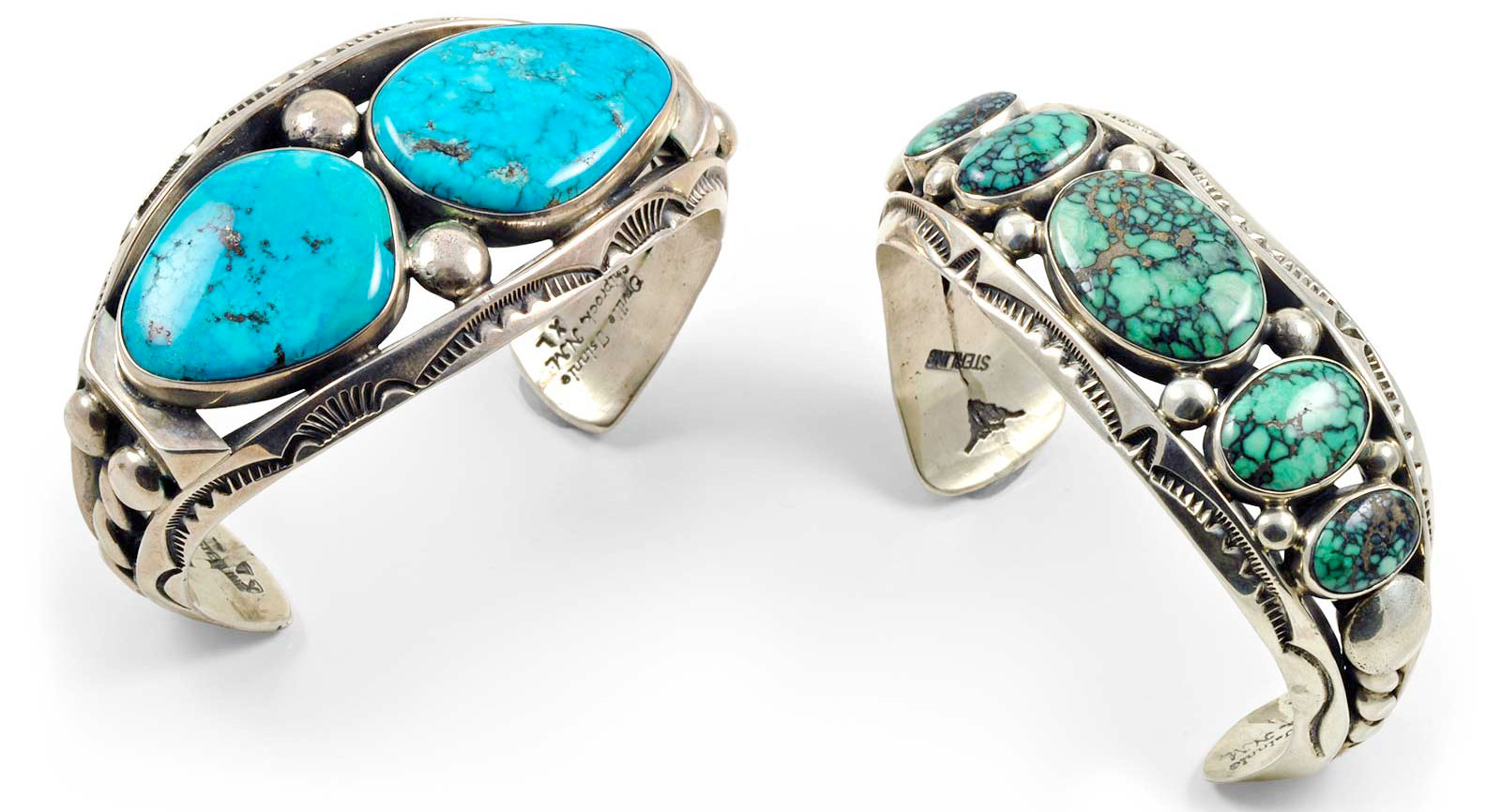 Orville Tsinnie (Navajo), heavy gauge silver and turquoise bracelets: Morenci (left) and Carico Lake (right) , 1990s-2000s.
From the beginning, Native-made silver jewelry showed a strong sense of physical design form and shape. The earliest pieces possess a lack of decorative embellishment, indicating their makers’ concentration on the mechanics of working silver. This kind of effort in the 1870s was slow and labor-intensive as the smiths learned and developed the processes of hammering, annealing, and soldering. Casting techniques were in place by 1875, helped by the regional availability of volcanic tufa to create molds for cast work. Molten silver was poured into designs carved into the molds. From the start, non-Native observers were impressed by Indian ingenuity, and their ability to “make do” with very rough equipment.
Silver jewelry was made from coins in these early decades. This included U.S. silver dollars and the Mexican peso, which was also called the “dobe dollar.” The peso was especially popular through the 1880s because of its lighter metal alloy composition, making it easier to melt and hammer. Metal produced from the peso had a hue that ranged from a silvery white to a yellowish tinge. The luster of the American silver dollar coin was generally extra blue in tone, and pieces made from this period could take a strong, high polish; this affinity for surface brilliance has remained an admired choice for Navajo and Pueblo jewelry makers over the years. Pieces made during the 1880s and 1890s often show original coin markings on their undersides, in places where the smith did not hammer them out completely.
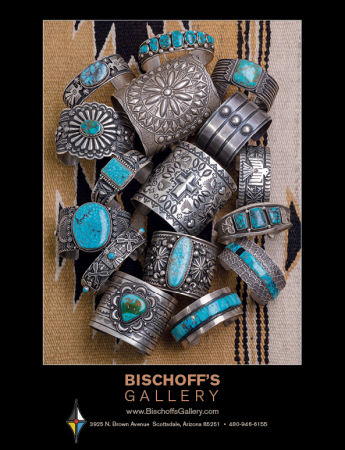
The addition of turquoise on silver jewelry during those decades demonstrates how important its makers regarded the stone. Bracelets in particular became palettes for setting turquoise in well-designed patterns. Smiths continuously experimented with turquoise placement. Bezel creation developed to a sophisticated level in a short amount of time. In addition to plain settings, smiths soon created sawtooth bezels. Clusters with multiple stones emerged more regularly in the 1890s, while single large stones continued to be popular. By the end of the century most pieces carried a stone or multiple stone settings.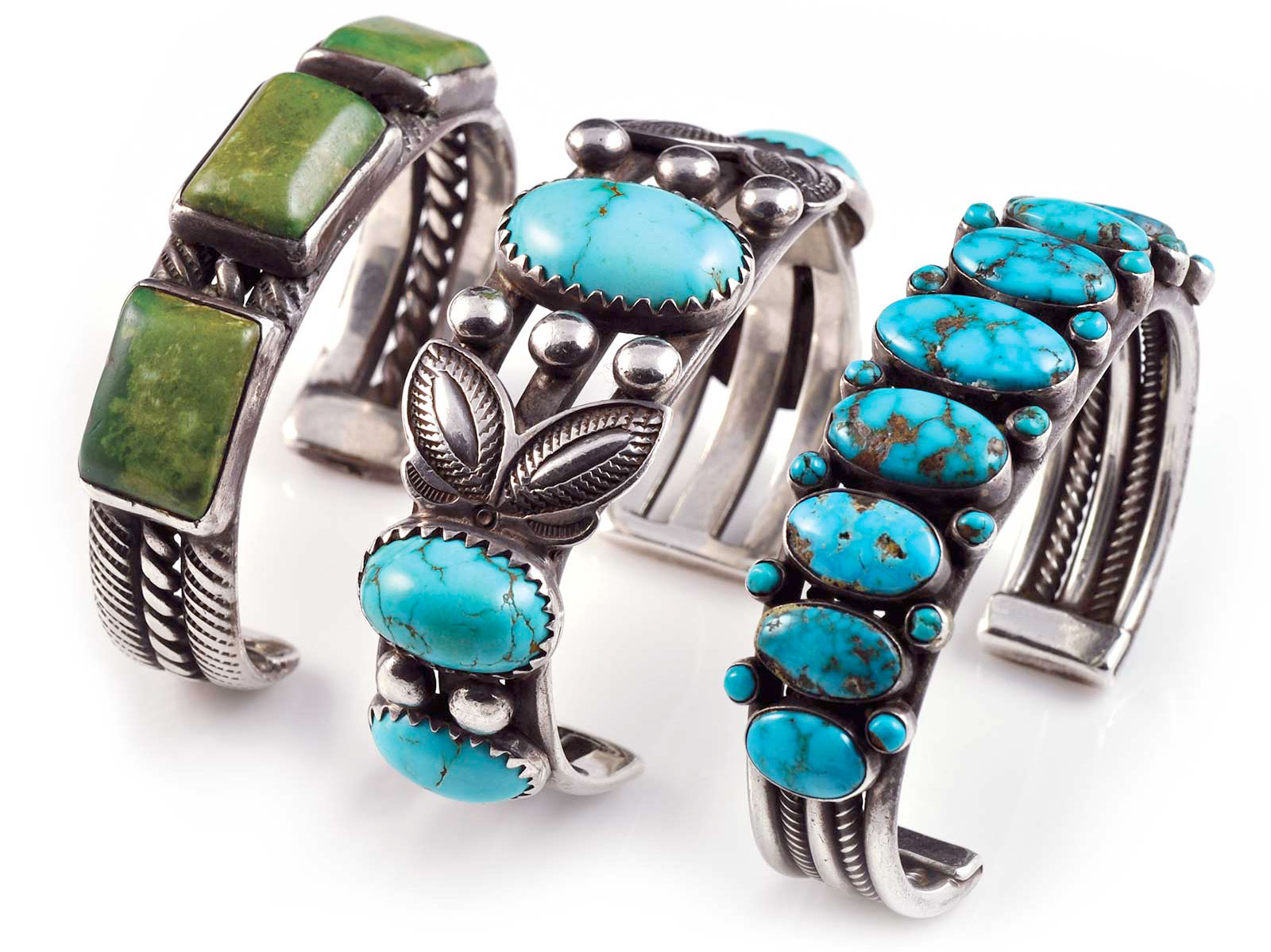 Three classic design silver and turquoise bracelets, 1900-1930. Courtesy Karen Sires.
What made turquoise and silver such a good combination? Natural turquoise possessed various hues, making color and tone vital elements, even after these untreated stones faded and changed color over time. The shape of stones is another element with impact. Both smoothly polished cabs and nugget turquoise settings offered texture as another primary element. When jewelry construction, finish and patterning grew more sophisticated, its makers achieved the elements of balance, unity and harmony that reflected their highest spiritual goals.
The spread of interest in Indian-made turquoise and silver jewelry has been well documented through the efforts of the tourist industry, especially the Fred Harvey Company and key New Mexico curio stores. However, two early 20th-century non-Native authors also did much to attract collector awareness; their books focused on issues of quality. (In contrast, many later writers on the subject provided less than objective information.)
The collector’s passion for turquoise itself in America would be sparked in 1915 by the publication of a key work, Joseph Pogue’s The Turquois. This book, initially published in a scientific society manual, brought together a number of considerations about the emerging importance of the turquoise industry and tied the stone firmly to Native American culture. Ranging from the geological to the ethnological, The Turquois helped build a growing body of collectors. These individuals established a solid market for high-quality Southwestern mine turquoise set in Indian silver jewelry by the midcentury.
Two years later, in 1917, another book provided thought-provoking and significant descriptions of Navajo silver making in particular. The author, George Frederick Kunz, was a noted New York City gemologist who had become a vice president at Tiffany & Co. at age 23. He made a trip to New Mexico in 1916 where he was so impressed by Navajo silver and turquoise creations that he illustrated a page of ring designs made at the Grand Canyon. His popular text, Rings for the Finger, praised Navajo design and noted that its makers possessed a personal vision that many
non-Native jewelers failed to reproduce in their own works. Kunz was able to cut through contemporary popular culture prejudices to perceive that Navajo hand-wrought silver and turquoise designs were inherently individualistic. He was one of the first experts to understand the potential of Southwestern Indian design artistry.
Silver and turquoise jewelry, along with other Native arts, received a resounding accolade in 1941 when the Museum of Modern Art in New York held an exhibition titled Indian Art of the United States. All forms of Americana were being boosted at this time since war-torn Europe was closed to the usual tourist and scholarly excursions. The exhibition exposed viewers to a distinctive range of silverwork, including a magnificent twisted wire bracelet set with square-cut turquoise. The Indian Arts and Crafts Board, one of the show’s sponsors, made arrangements to have Indian jewelry sold in the city’s major department stores, advertised in regional newspapers and mentioned in such publications as Women’s Wear Daily as part of a strategically targeted publicity and retail sales campaign.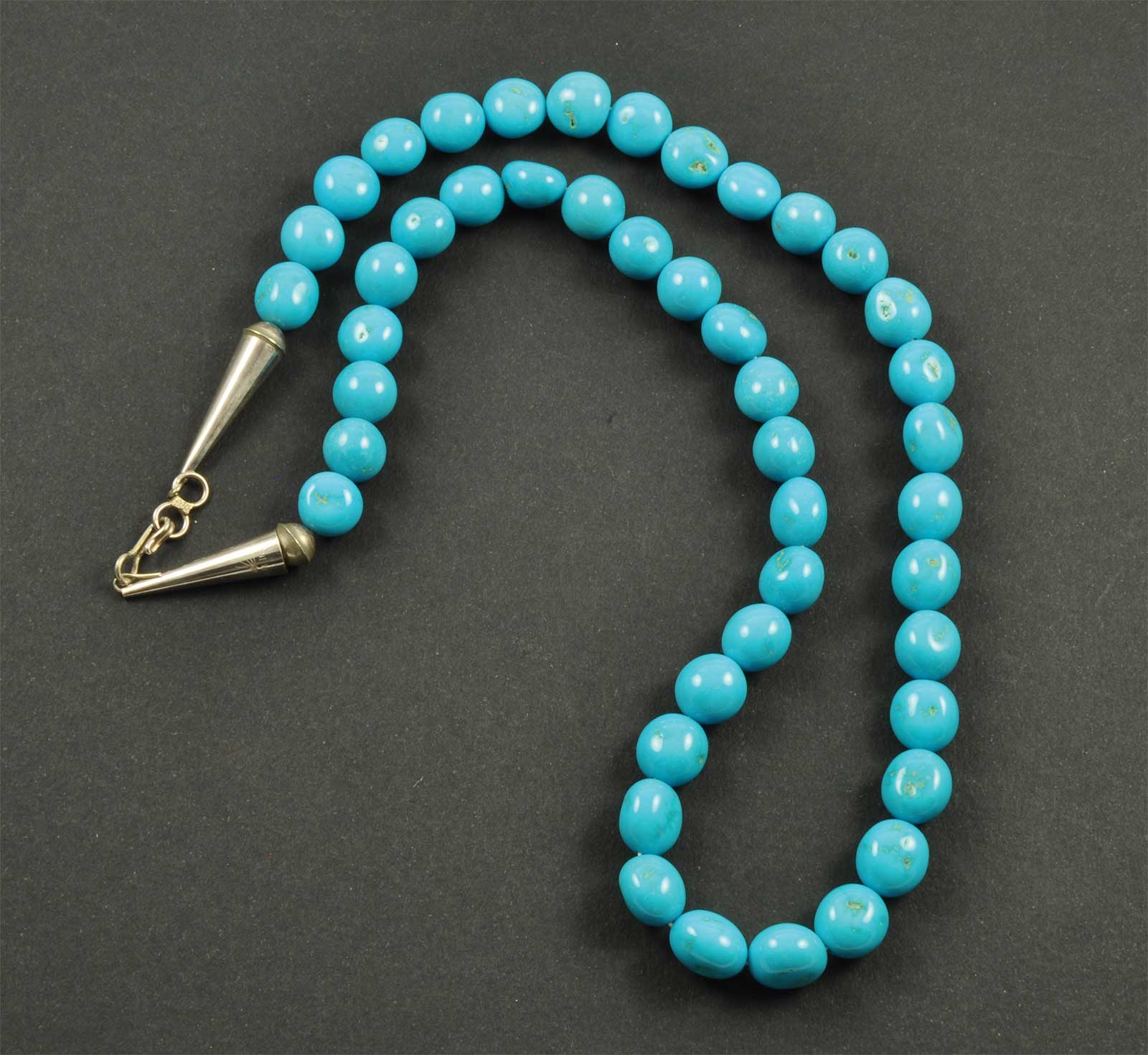 A strand of Sleeping Beauty turquoise beads straight from the mine, ca. 2010.
Frederic H. Douglas and René d’Harnoncourt, organizers of Indian Art of the United States, were influential scholars in their own right, and they were more interested in presenting an aesthetic approach to Indian arts as opposed to the standard ethnographic evaluation of Native-made objects. One of the comments they made in the exhibition catalog about the artistic relevance of Navajo jewelry is particularly pertinent: “The most striking evidence of the affinity between traditional Indian art and modern art forms can be seen in Navaho (sic) silver.” Their words were prophetic, but mainstream popular culture was not yet ready to call Southwestern Indian jewelry true art forms.
The MoMA exhibition also helped to link silver and turquoise together as essential design features. The 1950s and 1960s were a time of great experimentation, and Native artistry received a shot in the arm with the opening of the Institute of American Indian Arts in 1962. Its location in Santa Fe confirmed the importance of the Southwest as a center for Indian arts. Turquoise collecting was well established by this time, with collectors dedicated to finding increasingly rare high-quality stones. Acquiring such items was a concern since Southwestern mines had a fitful history of activity, and many of the best-known and highly regarded mines became largely played out by the mid-to later 20th century.
For example, two of the main mines in Colorado, yielding King’s Manassa and Cripple Creek turquoise, became inactive by the late 1940s. New Mexico, which possesses the oldest mines (active since pre-contact times), along with a few of the newest ones in operation, had trouble sustaining steady production. Three of Arizona’s mines irregularly produced classic turquoise: Bisbee, Morenci and Sleeping Beauty. Nevada had the largest number of mines, including Lander Blue, believed to be the rarest high-grade turquoise on the market. Some of the Nevada mines are actively worked on occasion, and they are a roll call for impressive stones: Lone Mountain, Fox, Carico Lake and Blue Gem. No. 8 Spiderweb, known for its unique matrix patterns, remains valued by Native jewelers and collectors. Stones from the Royston and Stormy Mountain mines have cachet, along with the Indian Mountain mine (discovered in the 1970s).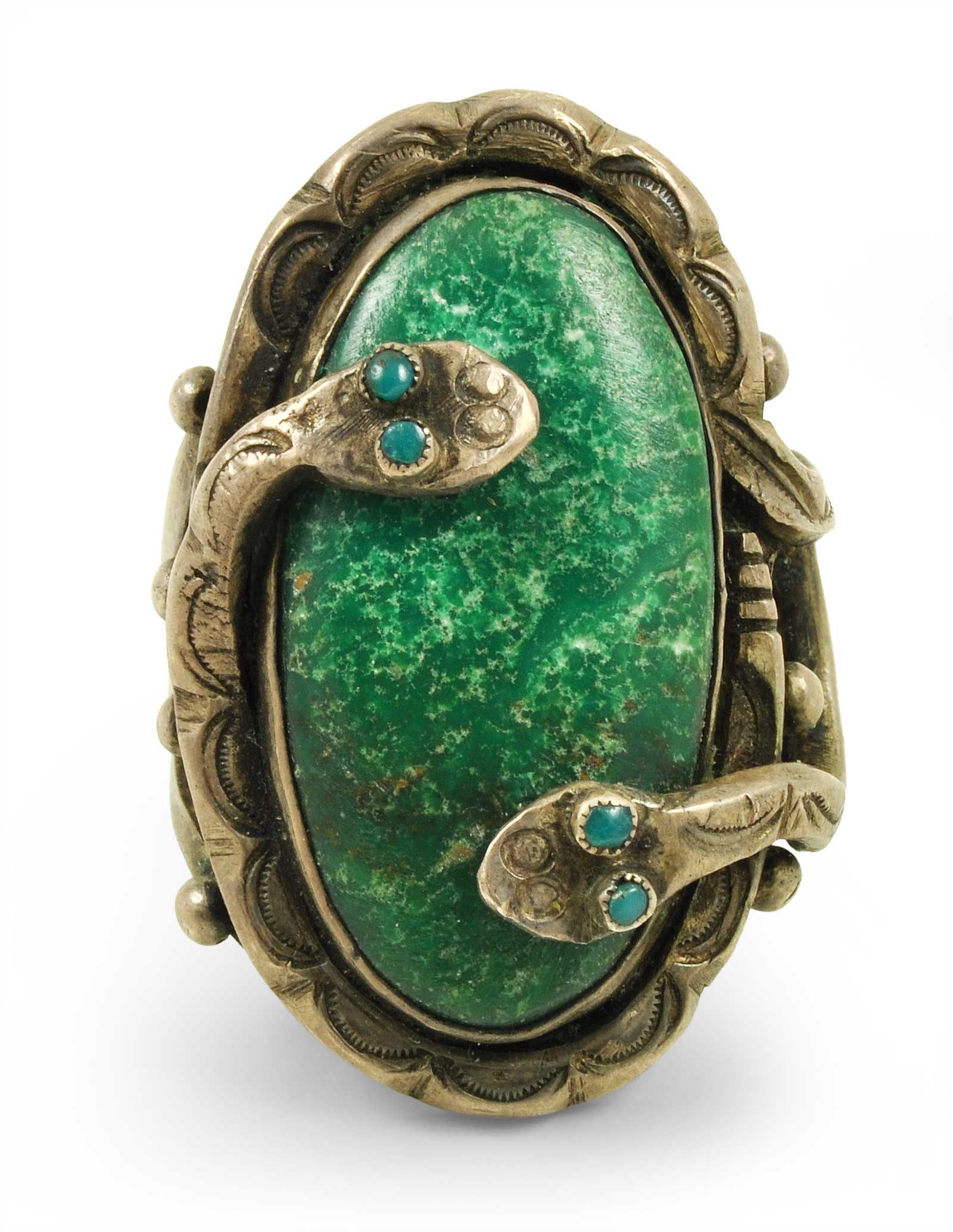 The color of this Zuni ring has faded to a deep green, ca. 1900. Photography by Barry Katzen.
By the 1970s, however, the amount of genuine turquoise from American mines had significantly dwindled, making imported turquoise more important for Indian jewelry making purposes. The most plentiful supplies came from the Middle East and China. Tibetan turquoise, usually green in color, gained popularity. Chinese turquoise, with the largest, more affordable amounts from the provinces of Hubei and Shanyang, has overtaken other imports and dominated the import trade since the 1980s.
Nevertheless, discerning collectors of historic, vintage and contemporary silver and turquoise jewelry continue to derive great satisfaction knowing their silver creations are set with authentic turquoise from a Southwestern American mine with a pedigree. Devotees of fine turquoise work to educate themselves about the material, and they patronize dealers and artists who can provide the genuine article. A number of high-end artists specialize in working with the best stones that can be found, while others have established a reputation for seeking out fine turquoise, even older repurposed stones, for their designs. Quality is definitely a factor in the prices for both old and new pieces. Collectors value their individual turquoise and silver pieces, to the point that when a good stone cracks, the owner may ask a smith to build a silver band across the stone to hide the crack. Often the crowning aspect of a piece of Native-made jewelry today is the radiant blue or green stone set in a shining bed of the “metal of the moon.” —
Powered by Froala Editor