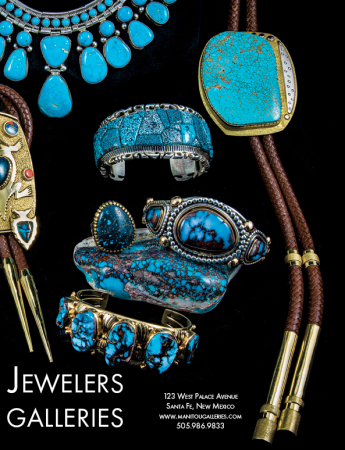


Bisbee Blue turquoise is unquestionably a favorite for many turquoise fans. Navajo jewelry artist Darryl Dean Begay, who spent 12 days in Japan, recently saw that firsthand. “It’s got a really good reputation,” he says. “Even in Japan! They really like the Bisbee turquoise out there. It’s one that’s really nice and high grade and has a really blue-blue…and the chocolate matrix! It’s very popular worldwide.”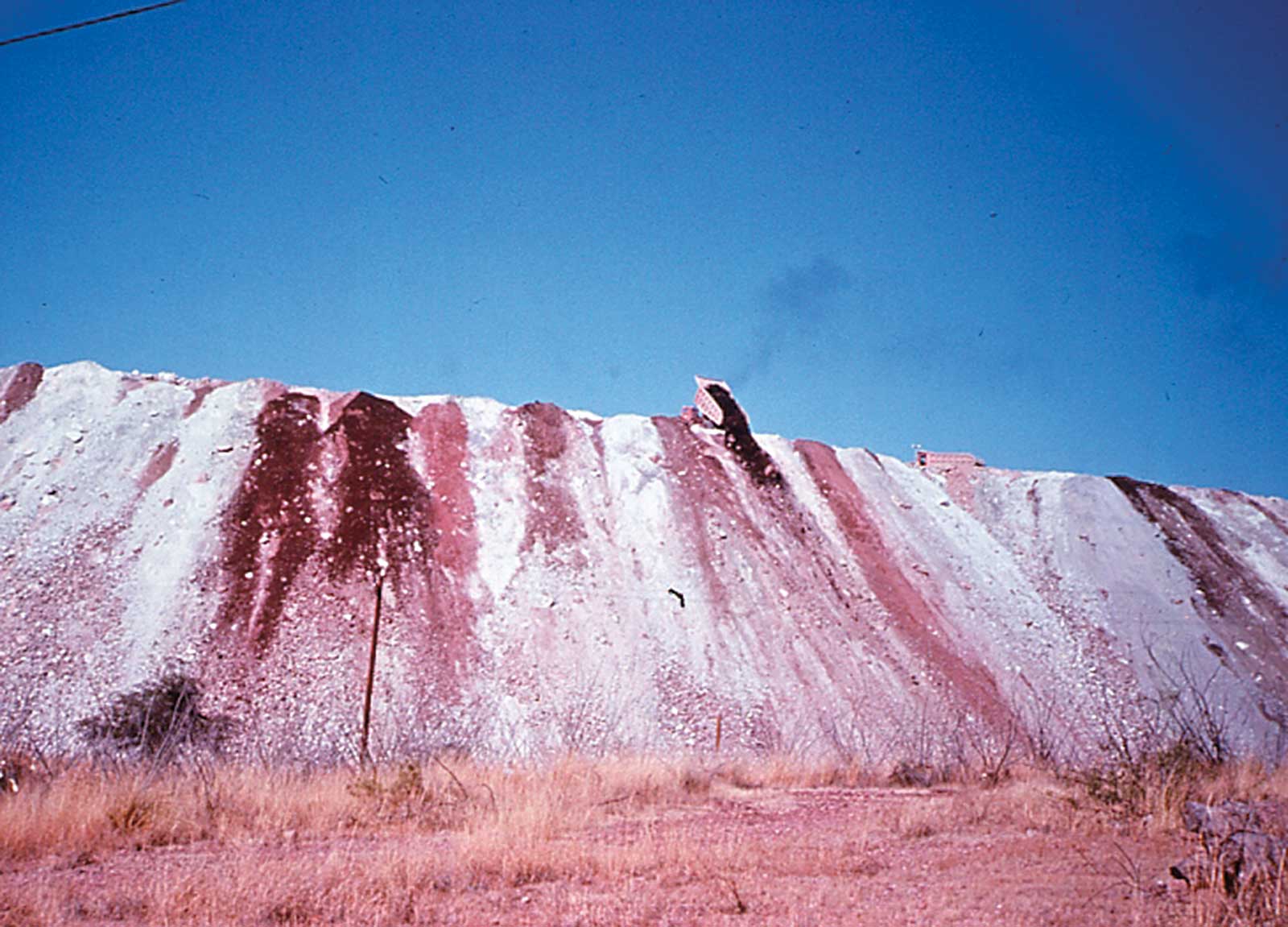 A truck dumping a load of rocks and waste from the Lavender Pit into the Number Seven Dump, showing the enormity of the dump, which grows higher as the pit grows deeper, circa late 1960s/early 1970s. Courtesy of the Bisbee Mining & Historical Museum, Nancy Stallcup Collection. Photo by Colonel Zim Brown.
Emerald Tanner, with Tanner’s Indian Arts in Gallup, New Mexico, loves to tell a story about a business trip her father, Joe Tanner, took in the early 1960s to New York City. “He visited Cartier and Tiffany’s and asked them to see their best representation of turquoise, and…” Her dad, Joe, chimes in, “They brought out from the vault the very best Persian quality, Persian turquoise. And I looked at it and thought ‘Ha! Bisbee’s better!’”
And yet, it’s almost by accident that Bisbee Blue turquoise is so widely known and sought after. Yes, it does come from Bisbee, and yes, it originated from a mine, but probably not how you normally think of a mine.
There is a long history of copper mining in the Mule Mountains around Bisbee, Arizona, going back to the 1870s. By the 1920s, the value of the minerals pulled from the Copper Queen mines were in the tens of millions of dollars. With all the copper ore deposits in the area, it was determined those were in limestone traps, with the limestone formed on top. What began as a shaft in 1911 turned into the first open pit mine in Bisbee in 1917, as Sacramento Hill became a pit eventually, with 10 million tons of copper ore hauled out.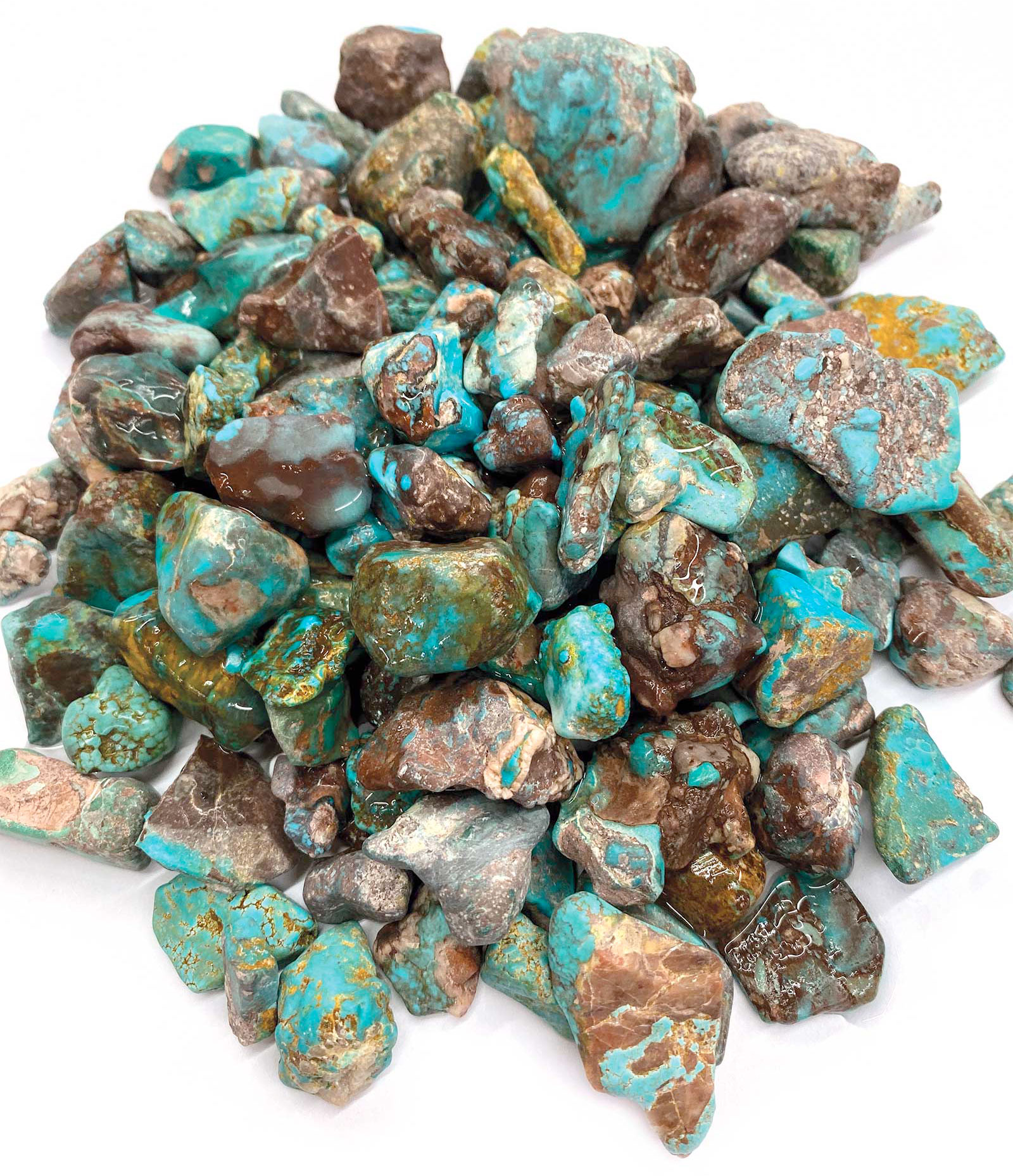 Rough Bisbee turquoise nuggets. Courtesy Tanner's Indian Arts.
Other underground mines were developed in the following years by different owners, getting not just copper but now primarily lead and zinc during the 1940s, with over a million pounds of lead and well over two million pounds of zinc. Phelps Dodge Corporation became the primary owner and saw some real opportunity here when by 1950 as the Korean War broke out, the government needed more copper. That’s when the mining company scrambled to develop an eastern extension of the old Sacramento Pit, with this new project named the Lavender Pit. The name wasn’t because of the color, but from Harrison Lavender, who was vice president of Phelps Dodge and in charge of western operation. The first blasting started in the early 1950s, and by August 1954, actual production from the Lavender Pit began.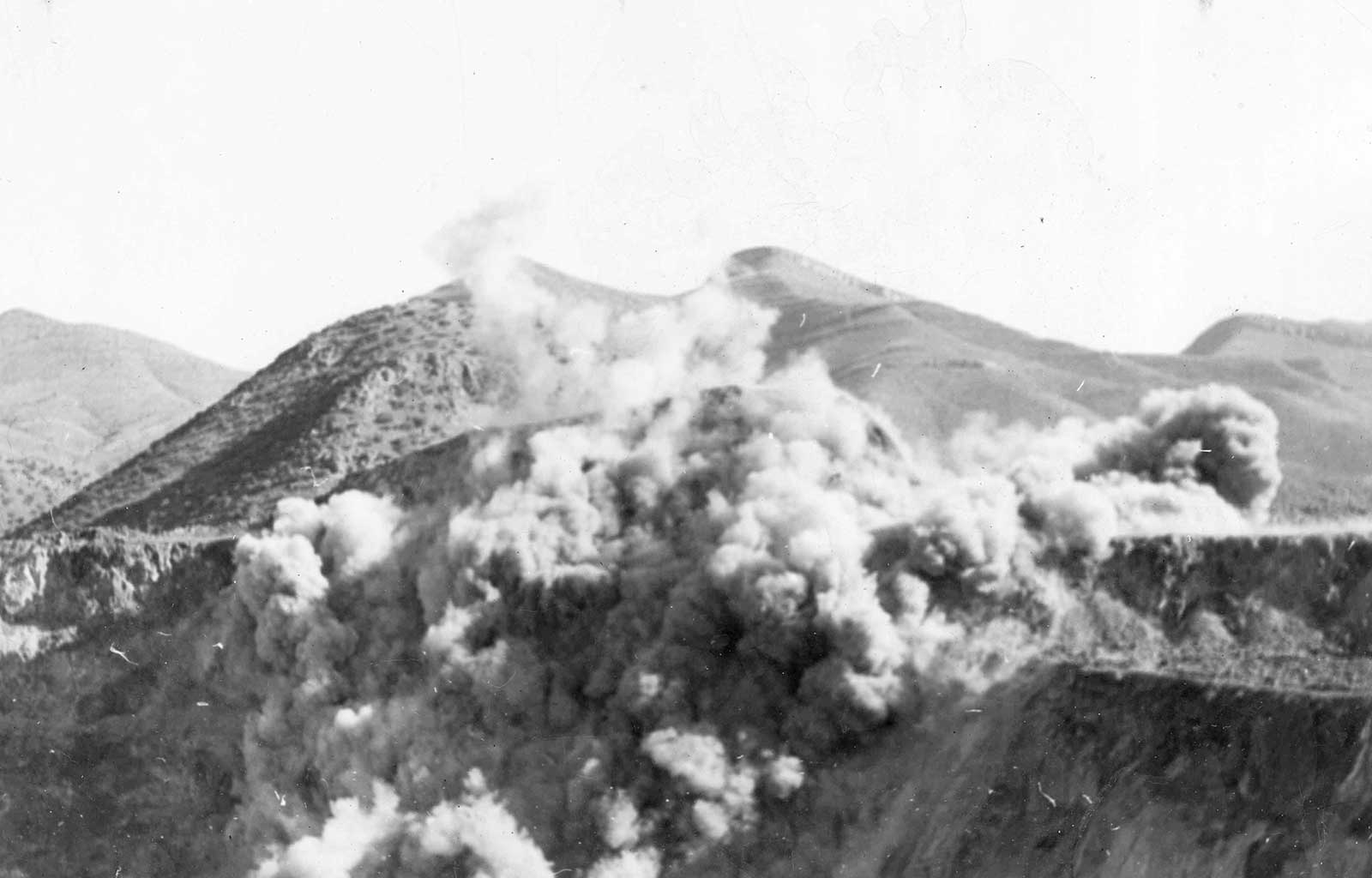 A view of one of the first blasts to start development of the Lavender Pit. Courtesy of the Bisbee Mining & Historical Museum, Stanley Wright Collection.
Train cars loaded with rock and leach materials headed to the Number Seven Dump, which was nearby and outside of the pit. Sixty-five-ton trucks also hauled waste material over to this particular dump, which grew higher as the pit grew deeper. The copper ore was shipped to a Phelps Dodge plant in Douglas, with annual production more than 32 million tons.
Something else, though, was being excavated along with the copper and then discarded as waste…something blue.
It was first found between 1952 and 1953, as the Lavender Pit was being developed. Minor amounts were seen as a pale blue, often powdery substance. As the pit deepened, the quality of this blue material improved. It was found in what’s called the “Glance Conglomerate.” A conglomerate is a particular sedimentary rock, with rounded pebbles and sand, held together by other minerals. The Glance Conglomerate is essentially a channel of this rock running through southeastern Arizona, including where the Lavender Pit was developed along the pit’s eastern wall.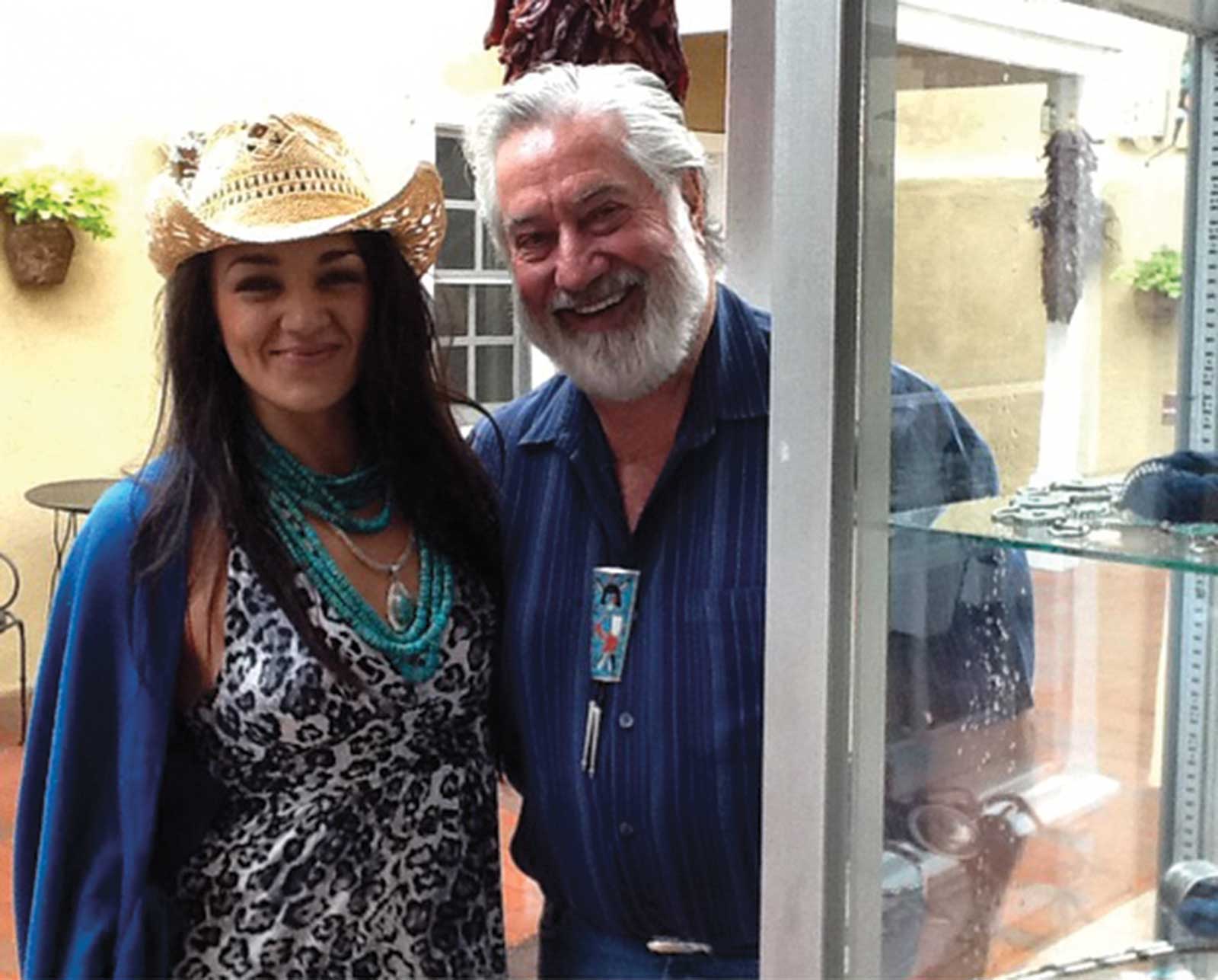 Emerald Tanner and her father, Joe Tanner, of Tanner’s Indian Arts in Gallup, New Mexico.
Doug Graeme, whose family has been mining in Bisbee since 1883, says the discovery of turquoise was accidental. “It was just intercepted while they were mining it,” he says. “They started stripping the waste in ’50, and started getting it in about ’52…they got deep enough where they were starting to get turquoise.”
The miners certainly noticed it, and before too long, they were taking chunks of rock containing turquoise home, tucked inside of lunchboxes and pails. And at that point, according to Graeme, the mine’s owner, Phelps Dodge, considered the turquoise to be, essentially, garbage. “Early on they really didn’t care if guys started taking it out. It was no big deal,” he says. “But, as they got deeper into [the pit], the Glance Conglomerate isn’t stable. It’s just a bunch of pebbles that had been glued together. When you’re mining open pits, you’ll have what we call high walls…50-foot tall walls. And since the Glance was unstable, it was constantly moving, and they didn’t want people getting the turquoise, because they didn’t want them next to the high walls. They were worried that somebody’s going to be hurt taking it.”
Joe Tanner is a fourth-generation Southwest Native American art dealer and has worked nearly his entire life with turquoise. He says his family started buying this Bisbee Blue turquoise when it was coming out in little “drips and drabs” from the Lavender Pit in the 1950s. “There’s always been the individual hordes,” he explains. “The workers in the mine or visitors to the property picked up a few pieces, or quite a few pieces. And they would collect it, rock hounds, if you will.”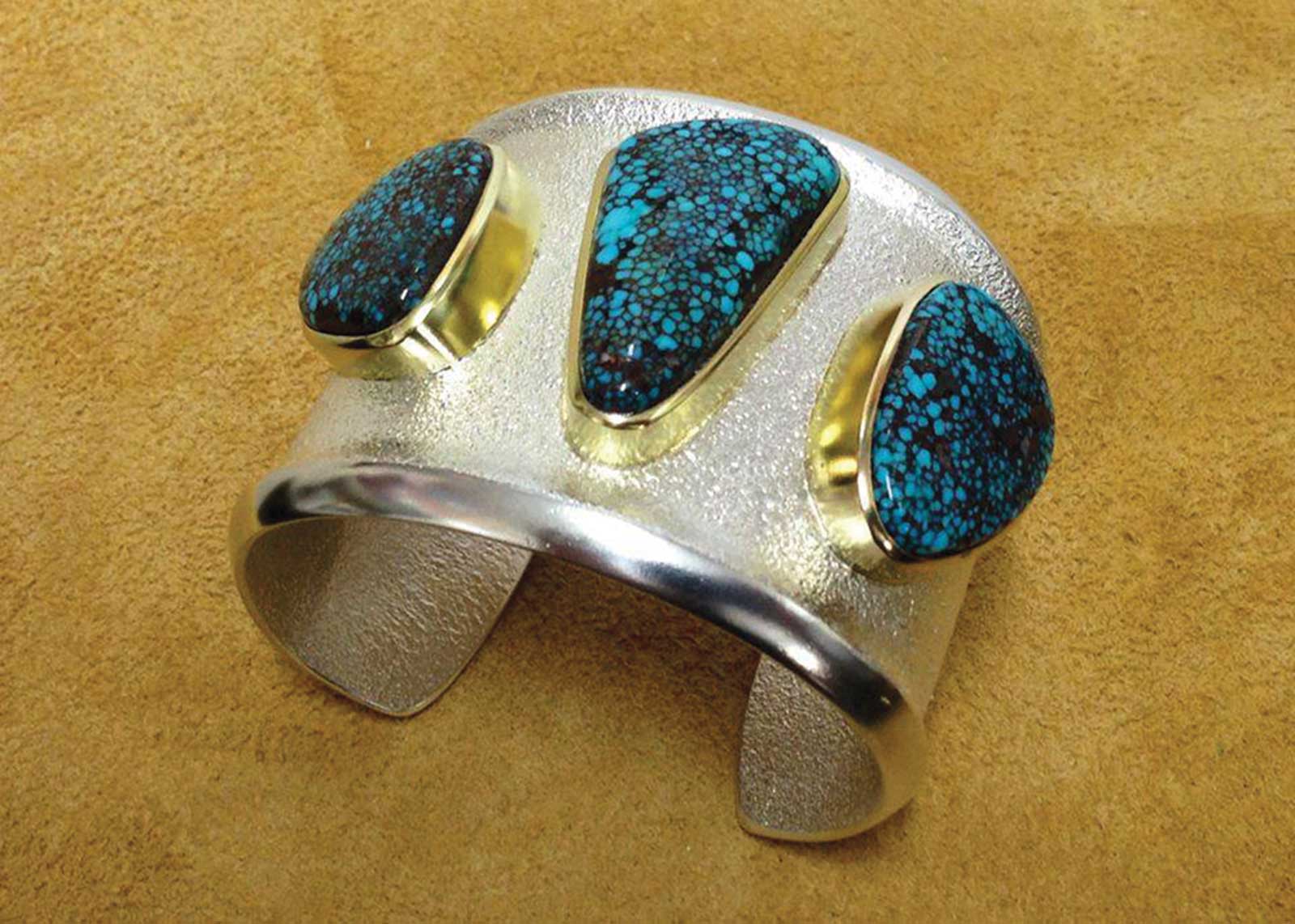 Darryl Dean Begay (Navajo), rare webbed Bisbee turquoise cuff
Those pieces then were sold to different traders and dealers who worked with Native American jewelers and were drawn to this deep blue stone with a beautiful chocolate matrix running through it. This was different, stunning, eye-catching—something artists wanted to work with and collectors wanted to buy.
John Hartman, who founded Durango Silver Company in 1972, was first exposed to Bisbee turquoise years earlier. He and his wife had a stone cutting shop in Albuquerque in the late 1960s and they would look for it. “We’d find it in a little, gem-type shows. They’d have it in the jewelers’ supply. We bought our first large amount of Bisbee turquoise from J.C. Zachary, who was probably one of Bob Matthews’ biggest customers,” says Hartman.
Remember that name, Bob Matthews, because he played a major role in Bisbee turquoise.
Born in Missouri in 1927, Matthews was the son of a carpenter and moved West as an adult. Those who knew him saw different sides of the man, but all agree he knew how to talk his way into just about anything. In the late 1960s, Matthews was living in Durango, Colorado. He looked at Bisbee turquoise and apparently saw opportunity. That may have been thanks to his brother-in-law, Cecil Mickelson, also in Durango. Mickelson was a jeweler and worked with turquoise, which at that time came primarily from a Colorado mine, Villa Grove.
Hartman remembered Mickelson Jewelry just north of Durango in the late 1960s. “I used to go in there,” he says. “They casted and made inlay Bisbee [turquoise] into all kinds of settings, bracelets, rings, earrings…
I went hunting around for Bisbee.”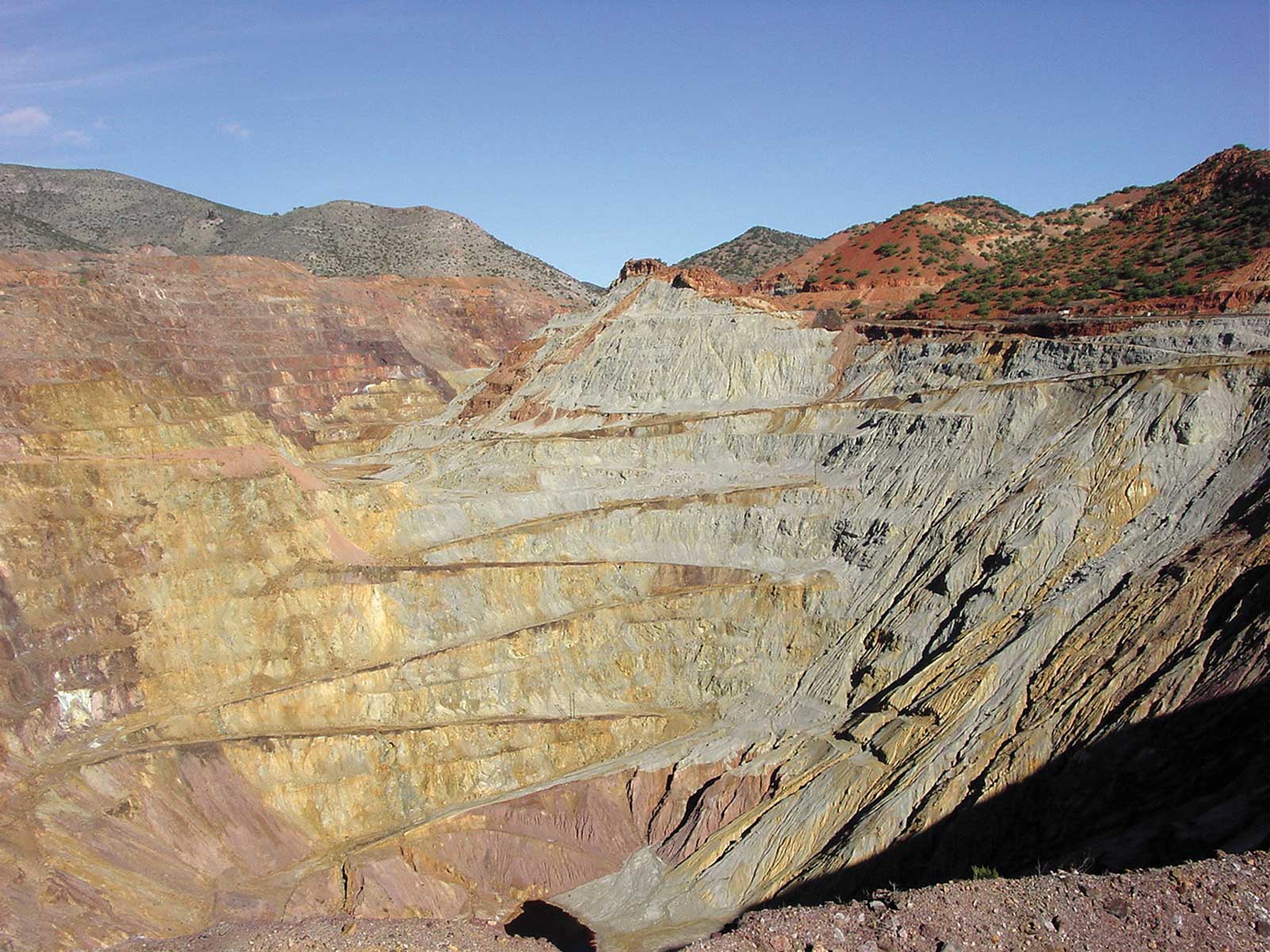 A view of the Lavender Pit. Courtesy of the Bisbee Mining & Historical Museum, Delores Reynolds Collection.
“Well, Bisbee was hot, and it would have been in the 1960s time period,” according to jeweler Bill Anderson who started out learning the trade with Mickelson in the ’60s. “Bob, being the promoter he was, went down to Bisbee and somehow came up with the rights to get the turquoise out of the mine.”
Graeme thought it was closer to 1974, when the Lavender Pit was shut down, that Matthews got his operation underway. What everyone agrees on, though, is Matthews was the only person who is documented as holding legal rights to collect the turquoise on the copper mine property. This wasn’t just from the Lavender Pit, but more importantly out of the nearby Number Seven Dump where the waste was hauled over to.
“They took it on top of Number Seven Dump. And it was segregated,” Graeme says. “There’s a waste part, where the turquoise went, and there was a leach side, where they were still trying to get the copper from.” According to Graeme, “Bob had the rights to go up there and process it, and look for the turquoise… And he had the Bisbee Blue Turquoise [and Mineral] Store.”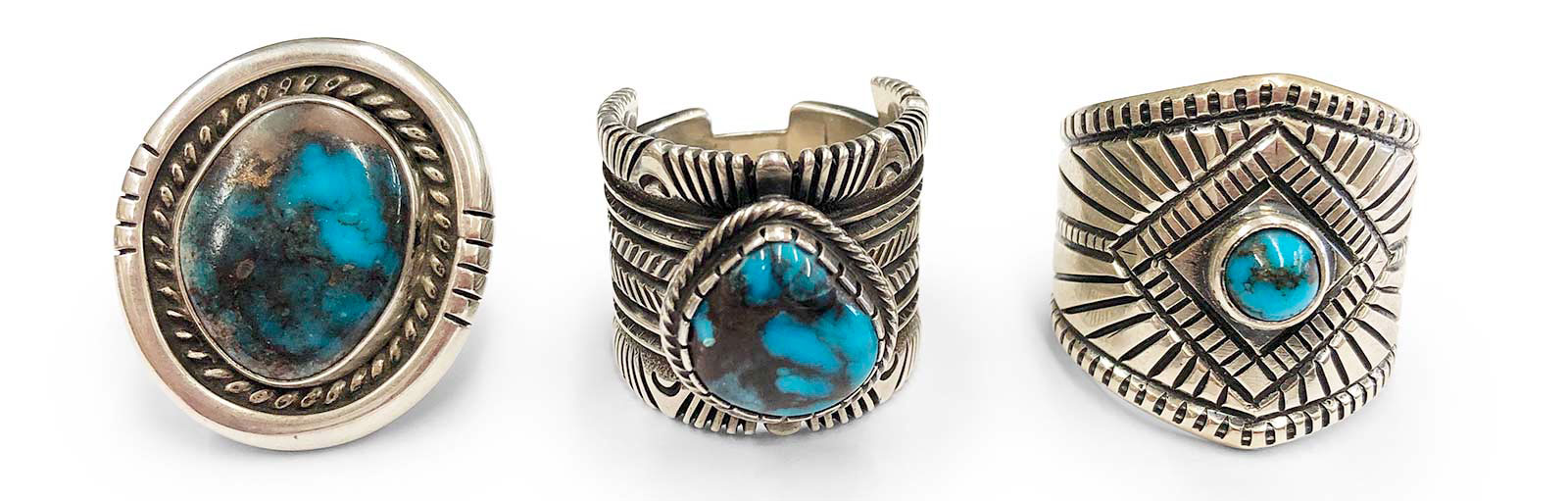 Sterling silver rings by, from left, Navajo artists Ed Shirley, Ron Bedonie and Harrison Jim. Courtesy Tanner's Indian Arts.
The building for the store is still standing, overlooking the pit itself. Anderson remembers this is when Mickelson kept his own store going in Durango, but eventually went down to work in the Bisbee store while his brother-in-law was hauling out stones. “We got a little bit of [Bisbee turquoise] in the operation in Durango,” Anderson recalls. “But almost all of it…ended up being cut and processed in Bisbee.” Cecil would remain in Bisbee until 1976 when he returned to Durango.
Getting the stones out of the dump was pretty much a one-man-band operation, as it was going through the growing Number Seven Dump with a backhoe, conveyor belt and a truck. Graeme says this involved going through layer after layer. “When they dump, with the dump-trucks, things get layered like an onion. You’ll have turquoise in one layer, no turquoise in the next, then you may have turquoise again. It all depends. Mining companies didn’t really care. They were just dumping waste.”
As the popularity of this turquoise grew in the 1970s, there was never a shortage of customers wanting the Bisbee Blue stones. Joe Tanner was one of their customers, buying cut and raw stones from both men. Emerald Tanner says her dad would provide turquoise to established artists and cutters like Preston Monongye (1927-1987), Cheryl Yestewa and Lee Yazzie, as well as newer talents he considered “up and coming.”
“It gave them the opportunity to get their hands on this wonderful stone, and some would do beads, some would do lapidary work, some would cut them into finished cabochons,” Emerald says. “Dad would furnish the turquoise for the artists, and together they would collaboratively create finished collectible jewelry.
“He’s always had a great love and respect for the stone,” she continues. “The artists know they can come to him and find good turquoise to work with.”
Anderson, who was eventually a jeweler himself and foreman for Carl Mickelson at the Durango store said this was quite the operation. “It got processed, cut into stones down there, and sold worldwide,”
he remembered.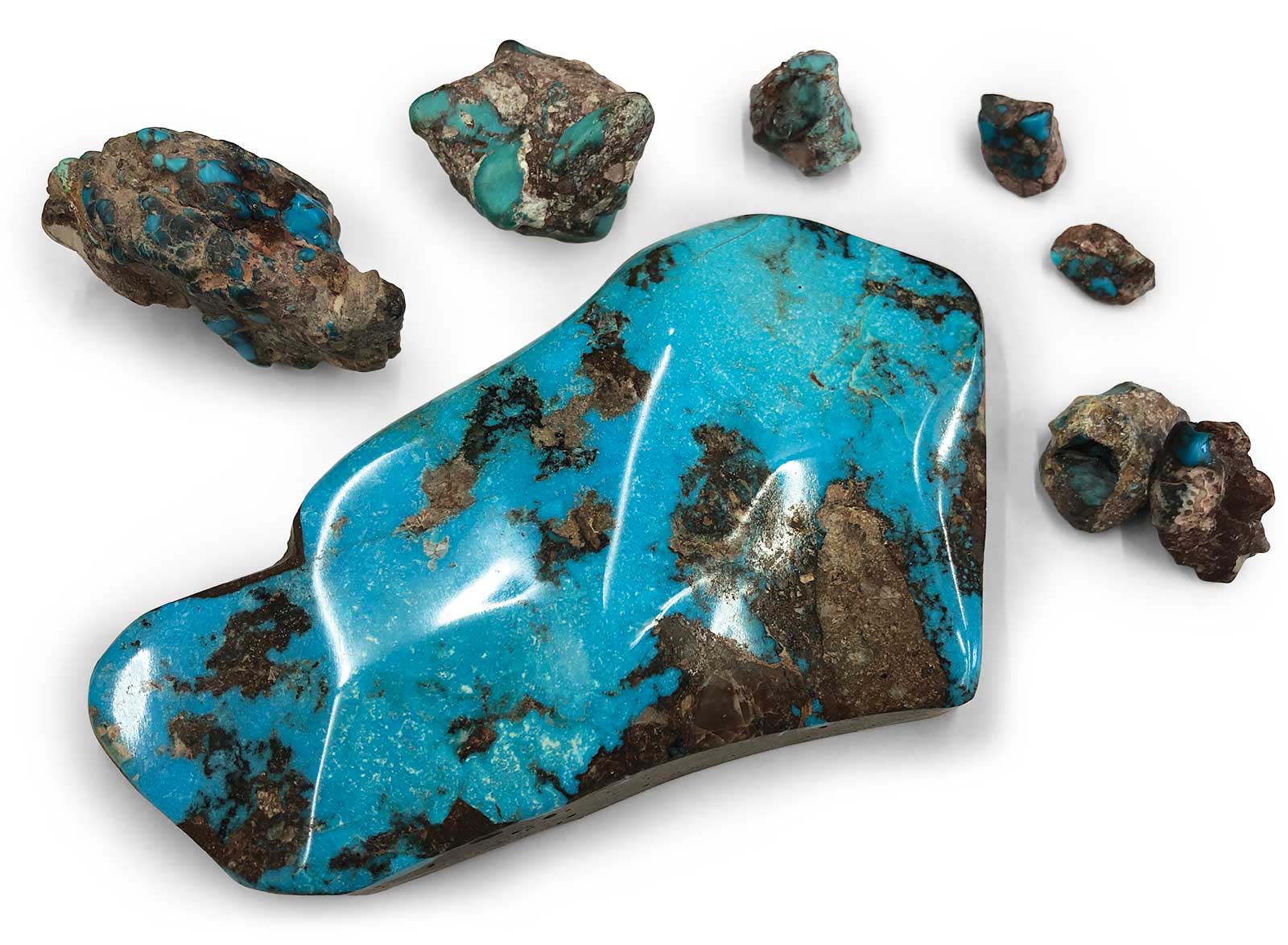 A large gem-grade Bisbee specimen surrounded by rough Bisbee nuggets. Courtesy Tanner's Indian Arts.
The Lavender Pit copper mine was shut down by Phelps Dodge in 1974, but apparently Matthews was just getting started because he kept at it for several more years, sifting the material from the now mammoth Number Seven Dump. And he did very well.
By now Hartman had a gallery in Durango and was also a customer of Matthews. “Bob came in a lot, and I bought turquoise, Bisbee from him.” He also remembered Matthews as a businessman, or as he described him, “a strict businessman.” Hartman says, “If you were speaking his language, you know, he was a very nice man. He was very nice to me, but I had friends who said they couldn’t deal with him.”
“He was a little bit of everything,” recalls Anderson. “He was a licensed electrician, and he did a lot of home building, spec houses. He’d build a home and sell it.”
Matthews also had his eye on developing and used some of his turquoise profits to buy Dalton Ranch in Durango, which later grew into a community with homes and golf course. There were many other business ventures, but he always found time for golfing in Sun City, Arizona, when he moved there in 1994. Fishing was what he did in the summers in Ilwaco. Washington, where he owned a yacht and a fishing charter business.
He died in Sun City in 2012, at the age of 84. His obituaries in Durango, Phoenix and Ilwaco, Washington, spoke of how he made friends with people from all walks of life: “He was a man of many talents and abilities…always ready to help family, friends or strangers if he heard of their problems.”
His brother-in-law Cecil Mickelson, the jewelry artist who started working with turquoise and drew Matthews’ attention to it, died in Durango several years earlier in 1999.
Graeme believes both Bob Matthews and Cecil Mickelson are extremely important when it comes to Bisbee turquoise. “They were shakin’ and movin’ on this, making money on it. If they hadn’t done it, you know, Bisbee turquoise, nobody would have really known anything about it. There wouldn’t have been that much saved, People would have gotten bored with it and just let it go. Bisbee turquoise is what it is today, due to those guys,” he says.
Hartman bought up what remained of the Mickelson/Matthews collection of rough turquoise in the early 2000s, which weighed hundreds of pounds, along with all the molds, machinery, everything from Mickelson’s jewelry production. You might think, except what comes out of that Mickelson/Matthews collection, there would be no more rough stones of the legendary Bisbee Blue turquoise turning up. Not quite. Some of the old stuff that came out of the Lavender Pit copper mine in lunch buckets so long ago are actually still coming up for sale.
“There’s always been the individual hordes,” Joe Tanner says. “The workers in the mine or visitors to the property, picked up a few pieces…Those stashes are forever coming out of the wood work. The minute we think we’ve seen it all, the best piece shows up.”
That’s something that would have pleased Cecil Mickelson, and certainly Bob Matthews, as another opportunity tied to Bisbee Blue presents itself. —
Powered by Froala Editor