We had the unique opportunity to chat with jewelry artist Wes Willie and learn about his history as an artist, as well as some of the motivating factors within his work, much of which includes magnificent turquoise stones. Willie, who currently lives and works in Phoenix, was born in Blackrock Point, Arizona, on the Navajo Nation. “I’m what is called the Folded Arms People or the Mountain People…the Bear Clan…that’s who I am,” he says of his heritage. “I was born for the Deer Spring People.” His work is highly sought after and collected, and his insights on Native American jewelry, as well as turquoise, provide an important narrative about where the category may be headed. 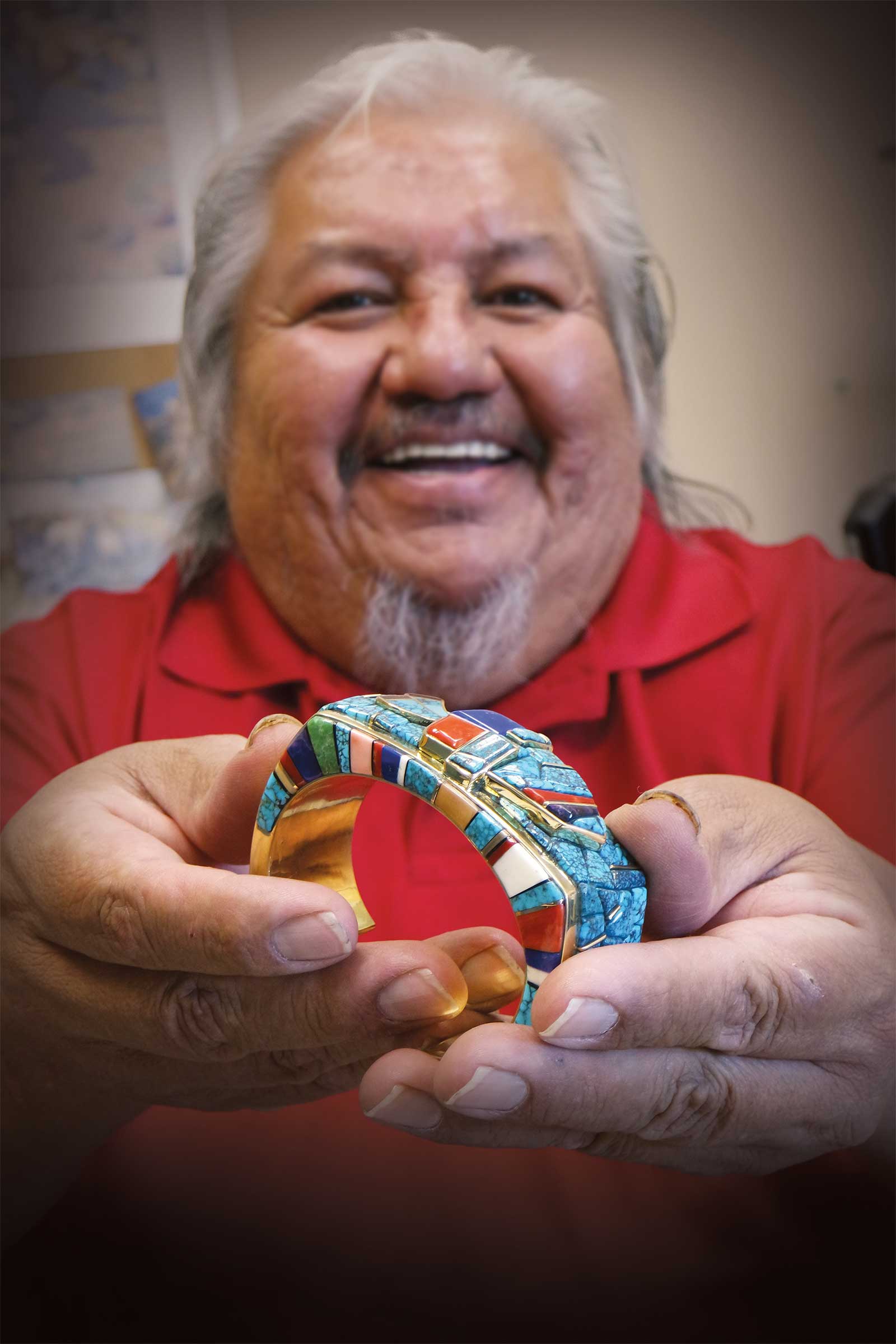 Navajo jeweler Wes Willie holding one of his intricate bracelets.
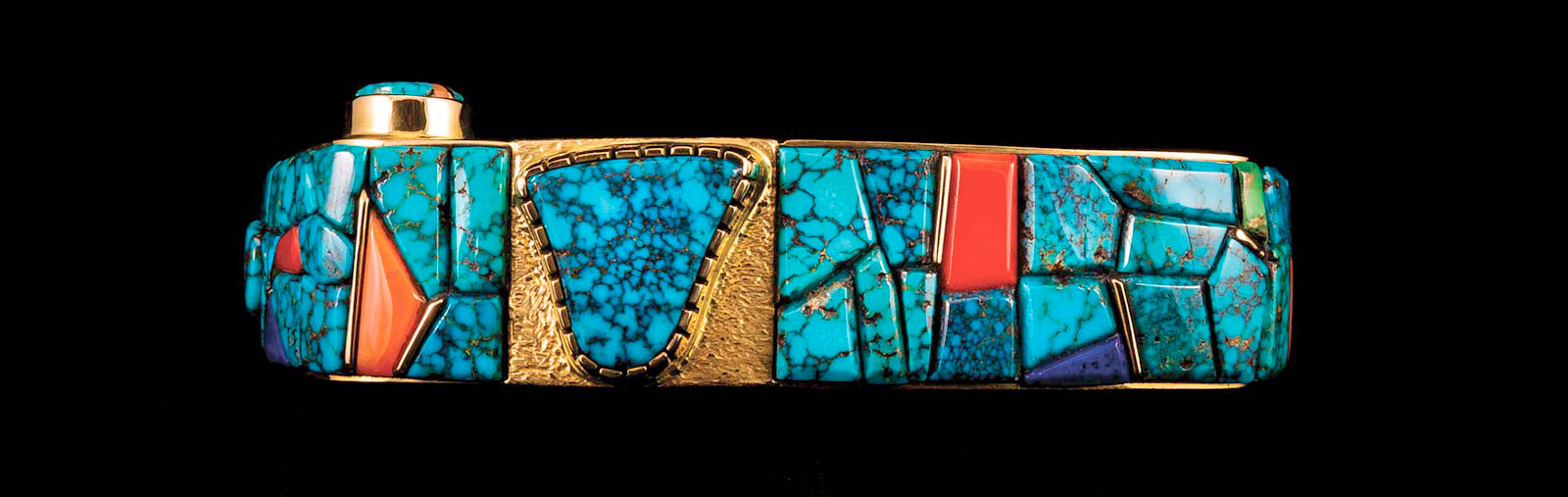 Bracelet made with Lander Blue turquoise #8, Black Web Lone Mountain. Photo by John Boland.
What made you realize that you were going to become Wes Willie the jeweler?
Well, I guess it has been a longtime coming. I built my first ring in 1971 when I was in junior high in shop class. I built a lost-wax ring with the help of my shop teacher. By 1974 I was in high school, and I worked at a truck stop and the guy that I worked for…my employer…was also a rock dealer and he was selling turquoise, high-end turquoise like Spiderweb, Lone Mountain, high-end Bisbee…that’s when I first saw that and it was a beautiful stone, not like all the rest of what people were selling—like Sleeping Beauty was all over the place, but this guy had some deep blue turquoise. And that’s what caught my eye, was the high-end turquoise. That’s how it stuck in my head, my memory. And it wasn’t until about 21 years later that I started making jewelry in 1995. Just as a hobby in between jobs. I was a pipeline welder running a welding truck and a lot of the jobs were short. I had seen a lot of people selling jewelry at the Four Corners Monument, so I started making bolo ties. And that’s how I got started. I then started looking for those stones I had seen back then when I was in high school, but I couldn’t find them. Nobody had them. Until I ran into this Turquoise Museum in Albuquerque, [New Mexico], and they had some of the high-end Lone Mountain and it surprised me that they were $15 a carat, which was high back in the ’90s. I could afford to get two small stones. That’s how I got into jewelry, just by turquoise.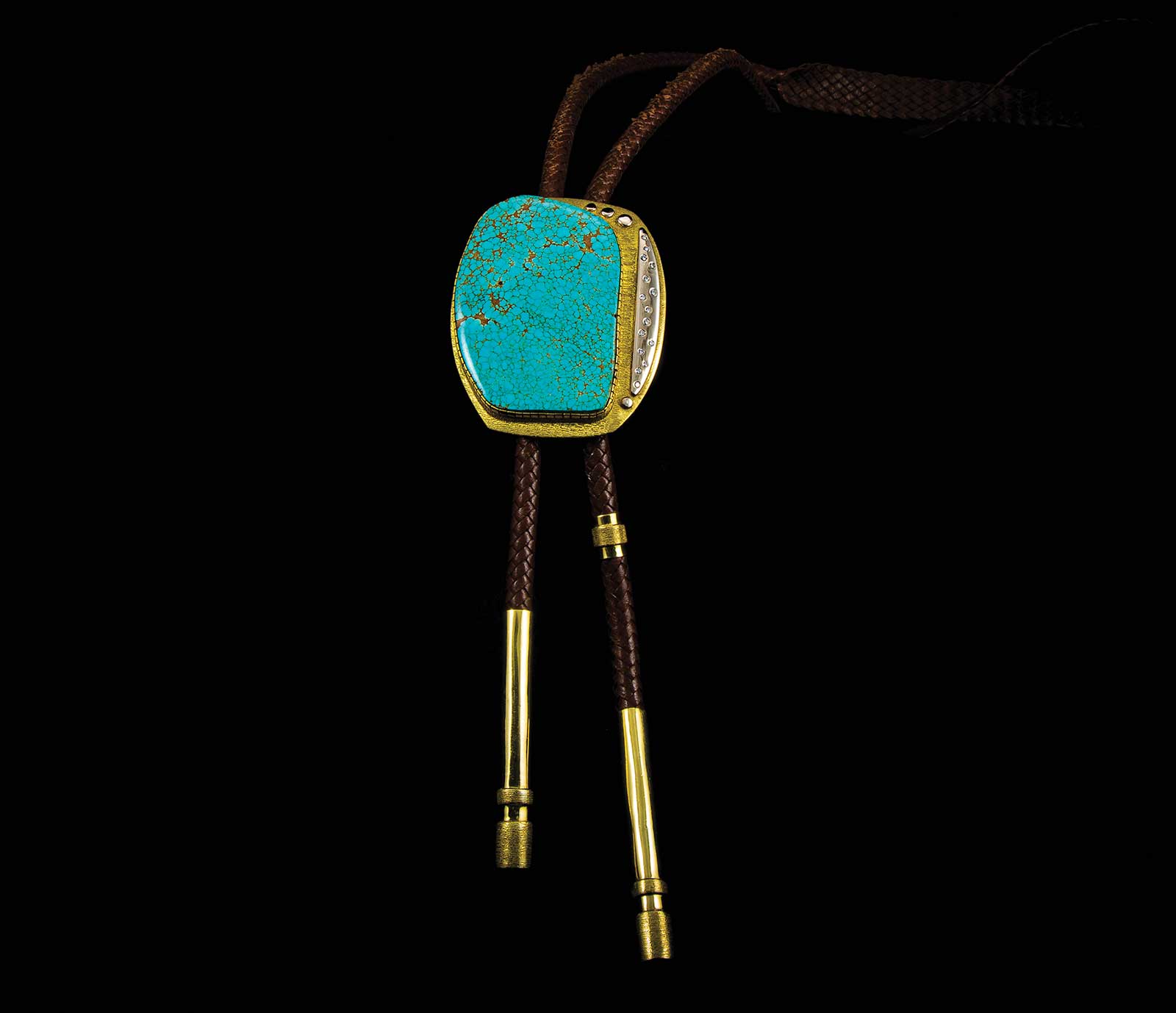 Bolo tie made with Lone Mountain turquoise and brown leather. Photo by John Boland.
What makes you decide on one type of turquoise over another?
For me it’s just how intense the blue can get. That’s why my favorite stone is Bisbee. Some of it can get real intense like high almost cobalt blue and with the smoke in it. So it’s just a real deep blue natural turquoise. That’s what caught my eye.
Did you have a family member or a mentor who inspired you in the jewelry world?
My sister-in-law made jewelry. When I was in high school she was making jewelry and working for a shop. They were pushing a bunch of jewelry there. Maybe 20 workers and they were shipping to Japan. My aunt worked there, too. They both did work on the side making pieces. We bought pieces from them. Suddenly everything died out. There was no more mass production of jewelry so the shops shut down. That’s where I learned there are people wanting jewelry all over the world.
What piece have you done that you’re most proud of and why?
I’d say the bolo tie I made that has that horned toad on it. It’s got the high-end Lone Mountain inlay and the lightning bolts and the arrowhead has high-end Bisbee and a rare piece of #8. Then the center stone is Lander Blue—just the really contemporary look on it. I like that it’s kind of simple but elegant. I love that piece.
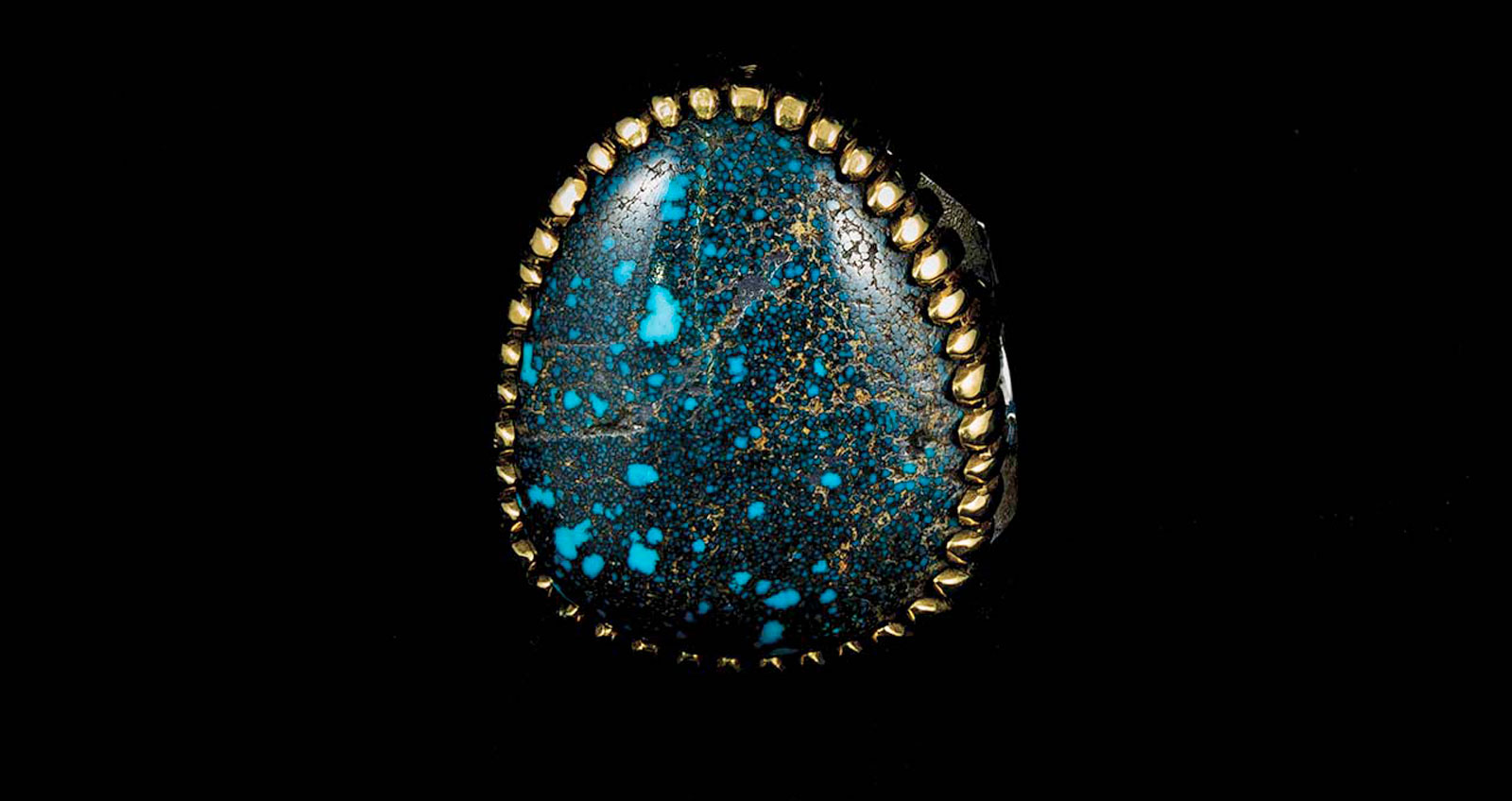 Ring made with Lander Blue turquoise #8. Photo by John Boland.
Do you consider yourself a master? If not, what will it take?
At what? I don’t know what a master is really. I’m not really a master. I’m still learning. To become a real smith like Ray Scott, Liz Wallace, Jennifer Curtis…all the stuff that they do and put out…just the real unique style and a lot of hammering that takes place in addition to using the inlay—if I could do that. Most of my work is more contemporary design and more on the simple side but those people are doing a lot of smithing. I believe they’re masters based on what they’re doing. I don’t consider myself a master because of that. If I were able to use all the techniques that those artists do along with what I do then I’d be considered a true “smith.”
What is a goal in this industry you haven’t accomplished yet but would like to?
I’d like to be able to design some pieces that award me Best in Show at the Santa Fe Indian Market. I think that’s everyone’s goal, but I don’t have the funding yet to create those pieces so I always fall short regardless of my efforts. Not that I didn’t try. I just know that I don’t have the right materials to get that type of award yet.”
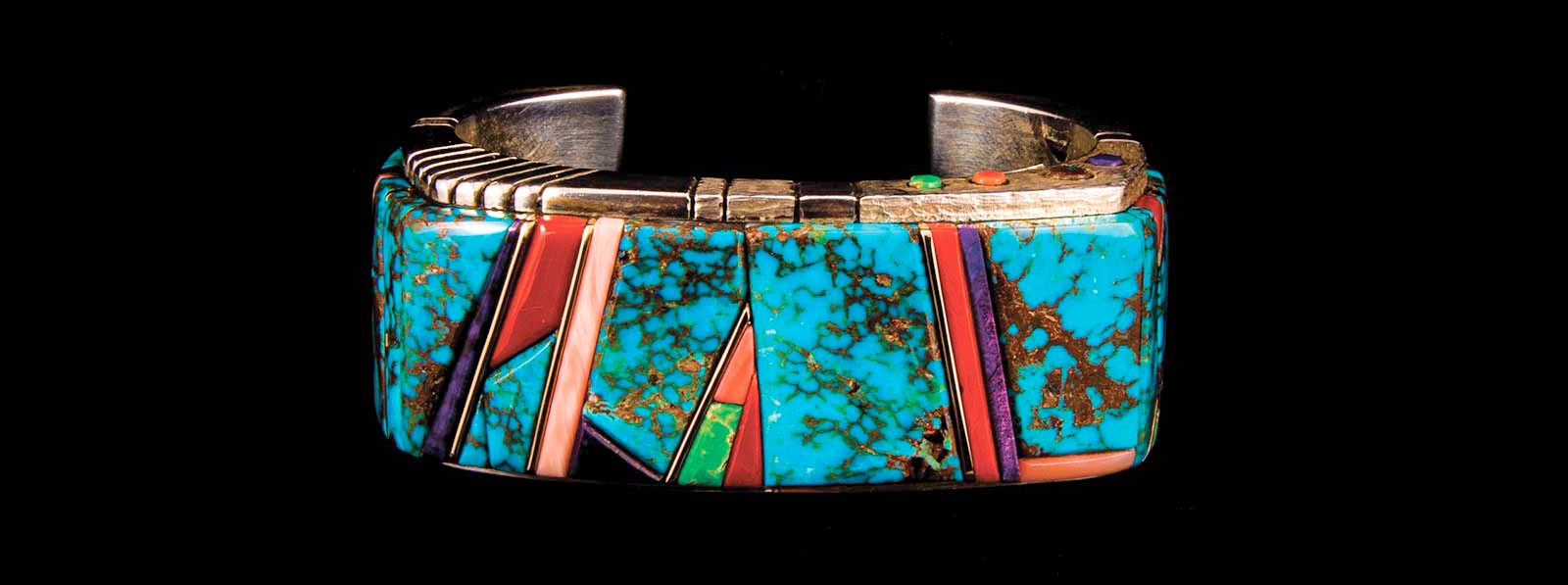 Bracelet made with Candelaria turquoise, pink coral and red coral sugilite. Photo by John Boland.
Tell us about your life. Military? Boarding school? College?
I went to boarding school from age 6 to 12, then I came home for junior high and high school. After high school, I enlisted in the armed forces. I wanted to be a pilot but they told me I needed two years of college. Next door was the Marine Corps recruiting office so I enlisted but was rejected during the physical because of my feet so I just started working. One day I asked this guy that was fueling up every day at the truck stop what he was doing, and it just so happened that he needed some people to help him so I jumped on the opportunity and he hired me. That’s how I got to travel with the drilling rig and eventually became a driller. Then a position opened up for pipe welding school so I applied and got in. That’s how I became a pipe welder.
What’s a new type of turquoise you would consider using?
Just to do something different, I’ve done some high-end Egyptian turquoise and it came out fantastic! We just sold one here last week that I had created about a month ago. I finished it right after Indian Market.
Have you been to a turquoise mine? What was your impression of it?
I’ve been to a mine, the name I can’t remember, over in New Mexico between Santa Fe and Albuquerque. It’s a little family-run mine so there wasn’t any big machinery. They were using just simple tools, but it was still impressive to see where the stones are coming from. I understand in Nevada they are using heavy machinery and blasting to get to the turquoise. I bet that’s quite a sight.
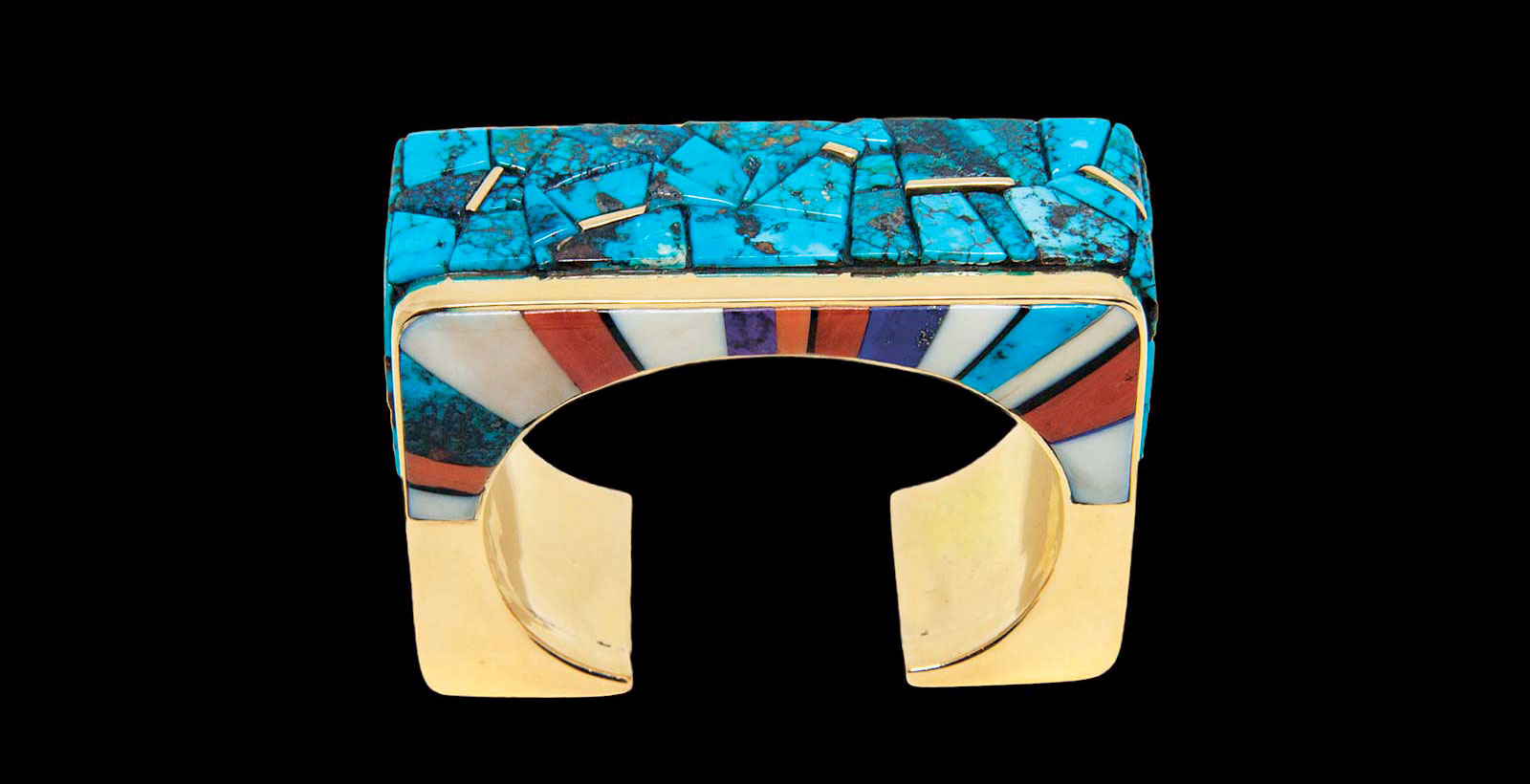 Bracelet made with Red Mountain turquoise and inlaid stones.
Do you buy stones in bulk or do you buy only what you need for the piece you’re working on?
I don’t buy in bulk simply because I tend to need just certain high-end stones for the pieces I’m working on. I also tend not to mess with those lower-end stones because my customers want the high-grade stones. Nothing against the lower-grade material—that’s where I started—I just know what my collectors expect. I won’t even use some of the lower-grade stones for inlay, which some artists do—I use high-grade stones even there. Also the lower-end stones tend to be less colorful. There is a market for everything, from the lower-end stuff to the high-grade. But generally, I don’t buy in bulk. Sometimes a dealer will offer me a good price for more stones, so then I will end up with more than I need, but that doesn’t happen often. Much earlier in my career I would sell stones, but then turquoise went way up in price and I could no longer justify selling a stone that was going to be difficult to replace.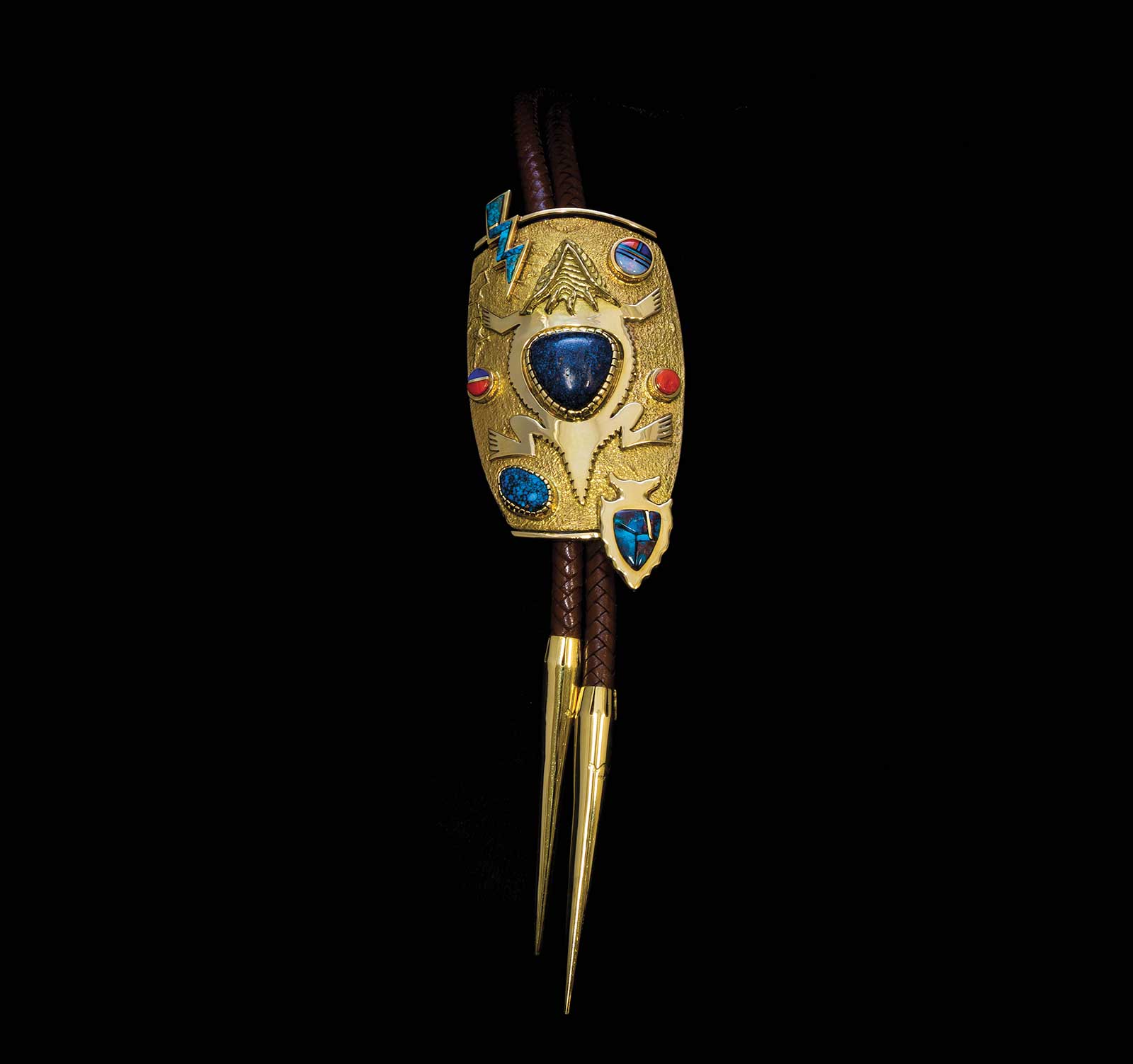 Horned toad bolo tie made with Bisbee turquoise. Photo by John Boland.
When purchasing your turquoise, do you prefer to buy polished cabs or raw stones?
Since I work with real high-ends stones, they are often already in cabs. Sometimes, when I’m working with the miners themselves, they have raw material. Those Lone Mountain guys, I work with them a lot, and they usually have some really nice natural stone that’s still mostly raw. They’ll tumble the stones with some water and it usually just knocks the dirt loose. I prefer the rough material, especially when I’m doing inlay work. I don’t typically use finished cabs for that because cutting into them can get kind of pricey when you’re using cabs just for inlay. And cutting turquoise isn’t hard. It’s usually comes down to a really nice blade. Sometimes I’ll get a big five-pound bucket of turquoise and all of it is rough. Once you start digging into it, roughly 60 percent is waste, but then you get some rocks that have specks of blue on them and you know there is likely some good stuff in there. You just have to work with the rocks and see what you get. With Bisbee, for instance, it comes in these red rocks with just a little speck of blue. But if you cut into it there could be a whole cab there waiting for you, or even just nothing. You end up chasing these things because it’s fun. —
Powered by Froala Editor