When it comes to geology, scientists work on such grand scales it can be hard to even fathom. The age of the Grand Canyon, for example, has been estimated at 6 million years. Yosemite’s Half Dome is pegged at 65 million years old. Monument Valley is the wise old grandpa at 270 million years. By those measurements, turquoise is one of geology’s younger children at roughly 30 million years old.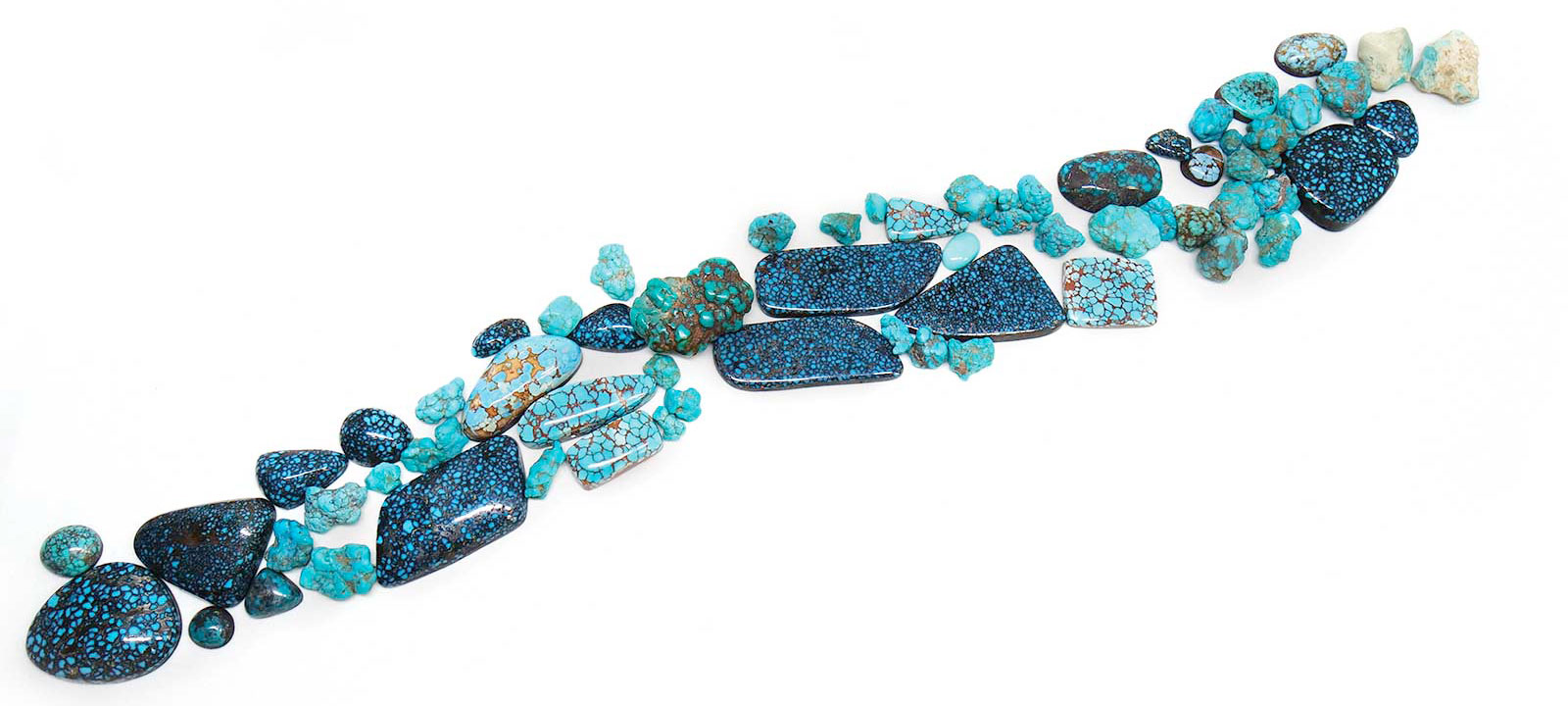
Formed after moisture trickles down through copper- or aluminum-rich rock, turquoise grows slowly, feeding off the oxidation of the source rock. It’s sort of a zombie stone, eating away at the material around it and creeping out in all directions in veiny paths that are chasing a slowly occurring chemical reaction. It’s here, within another rock, turquoise grows. And waits.
Until one day it’s blasted, hammered, carved or scraped from the ground. And then begins an exciting journey—one that can take just days—to go from the earth to the hands of a jeweler. “It’s amazing how fast it happens once it’s out of the ground,” says Tony Otteson, a third-generation turquoise miner based in Arizona. “We can mine the rock in Nevada and have it on a truck to Arizona pretty quick. Once it’s in the shop being processed, it can take just a day or two to go from raw material to a polished stone ready for a piece of jewelry.”
Otteson is currently working two Nevada turquoise claims, Apache Blue and Blue Moon, both of which are producing jewelry-quality stones. He and his family—the Ottesons are the stars of INSP’s Turquoise Fever reality TV show—own nearly 60 claims, including Black Hills, Crazy Horse, Danny Boy, Montezuma and Thunderbird. They search for turquoise by surveying the land and looking for mineral deposits, which are usually telltale signs that something colorful lurks beneath the surface. Sometimes they strike out, and sometimes they strike it rich.
“When we’re doing the prospecting, where it all starts, we’re just looking for any sign that turquoise is there. We can spend $15,000 to $20,000 just opening up a pit to find out there’s nothing in it. Other times we’ll open it up and get lots of super high-grade usable turquoise in it. You just never know until you open it up,” Otteson says. “Our mines aren’t necessarily large productions, but we do usually have heavy equipment so we can move 500 or 600 tons of rock. You have to move a lot of rock to get to the turquoise. If we went in by hand we might pull 15 or 16 stones out of there in a month, but what would be the point if it took so long?”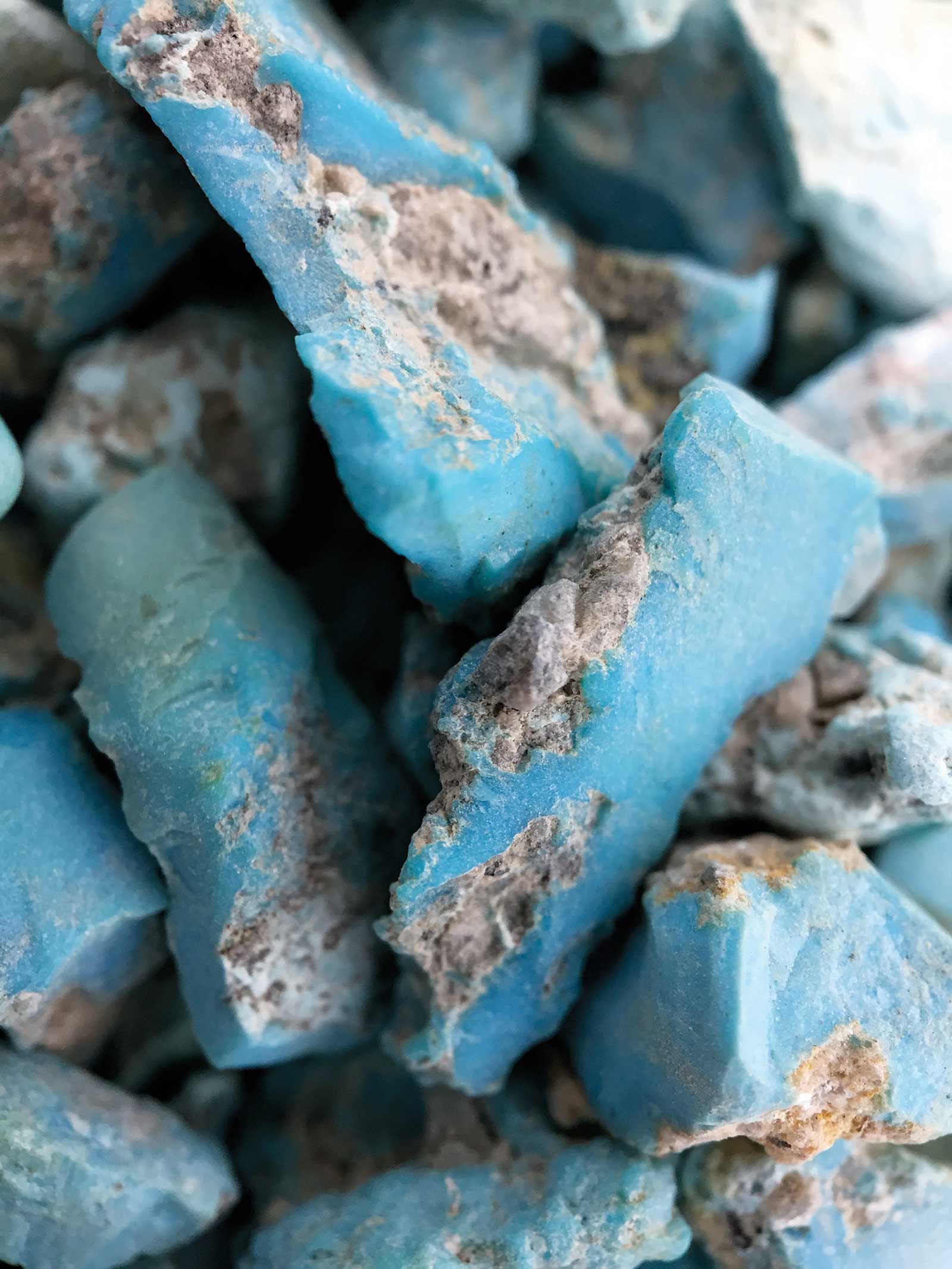
After digging and blasting, Otteson and his small team of miners, many of them family members, will sort through anything that has some color and separate it out from the rest of the rock. Anything that looks better than average gets sent to a shop in Mesa, Arizona, where it will be processed. The stones are first cut into quarter-inch slabs using a diamond-tipped steel sawblade and this is where the rocks spill their secrets for the first time, revealing the turquoise’s color, matrix and hardness. At this stage, the cut turquoise, even hard gem-quality stone, is still quite fragile so a backing is applied with a two-part epoxy. It’s as thin as a dime, but strengthens the stone for the next phase of its journey, which includes further cutting and shaping the turquoise. Once a desired size and shape are achieved, the turquoise is polished with increasingly fine polishing paper, ending with an 8,000-grit paper, which is the equivalent to three microns (a blood cell is five microns in diameter). These finished pieces are called cabochons, or cabs, and their next stop is the open market.
For Otteson, and many other miners as well, the best clients are the people who use turquoise on a regular basis: jewelers. He estimates 90 percent of all the turquoise he mines goes directly to jewelry artists, with a very small amount going to furniture builders who use turquoise inlay in their furniture designs. “The rarest of the rare we only sell to clients. We don’t sell to stone flippers. That’s cutting your own throat,” Otteson says. “And we also try not to sell too much rough stone, but we do if we know the artist and know they aren’t going to cut up the stone for resale.”
Before the stone can hit the market, though, it needs a price. This is usually set by the miner, and it’s usually set at an amount that reflects the quality and rarity of the stone. Brilliant color, beautiful spider webbing, the hardness of the stone—all this is a factor in how the stone is graded. And since Otteson is the owner of the Apache Blue Mine, and he controls how much of it is available, he largely gets to set the price for Apache Blue, which is anywhere from $100 to $150 a carat. Once a mine closes and stops production, the price is usually set within the market by the artists, gallery owners and gem dealers who control the stone’s supply.
Demand, though, that is another beast altogether.
For jewelry artist Olin Tsingine (Hopi/Navajo), it’s the top-quality stones that he seeks out for his jewelry pieces. And when he needs something special for a piece, he typically reaches out to the miners directly. “If the mine is still active, the miners are the best source for the material I’m looking for. Some of the mines that are closed—like Bisbee, for instance—you have to go through antique dealers to find those stones,” Tsingine says. “But all I’m really looking for is that high-grade turquoise. I’ll go anywhere to get it, even if it means buying old jewelry and taking it apart. I call it recycling.”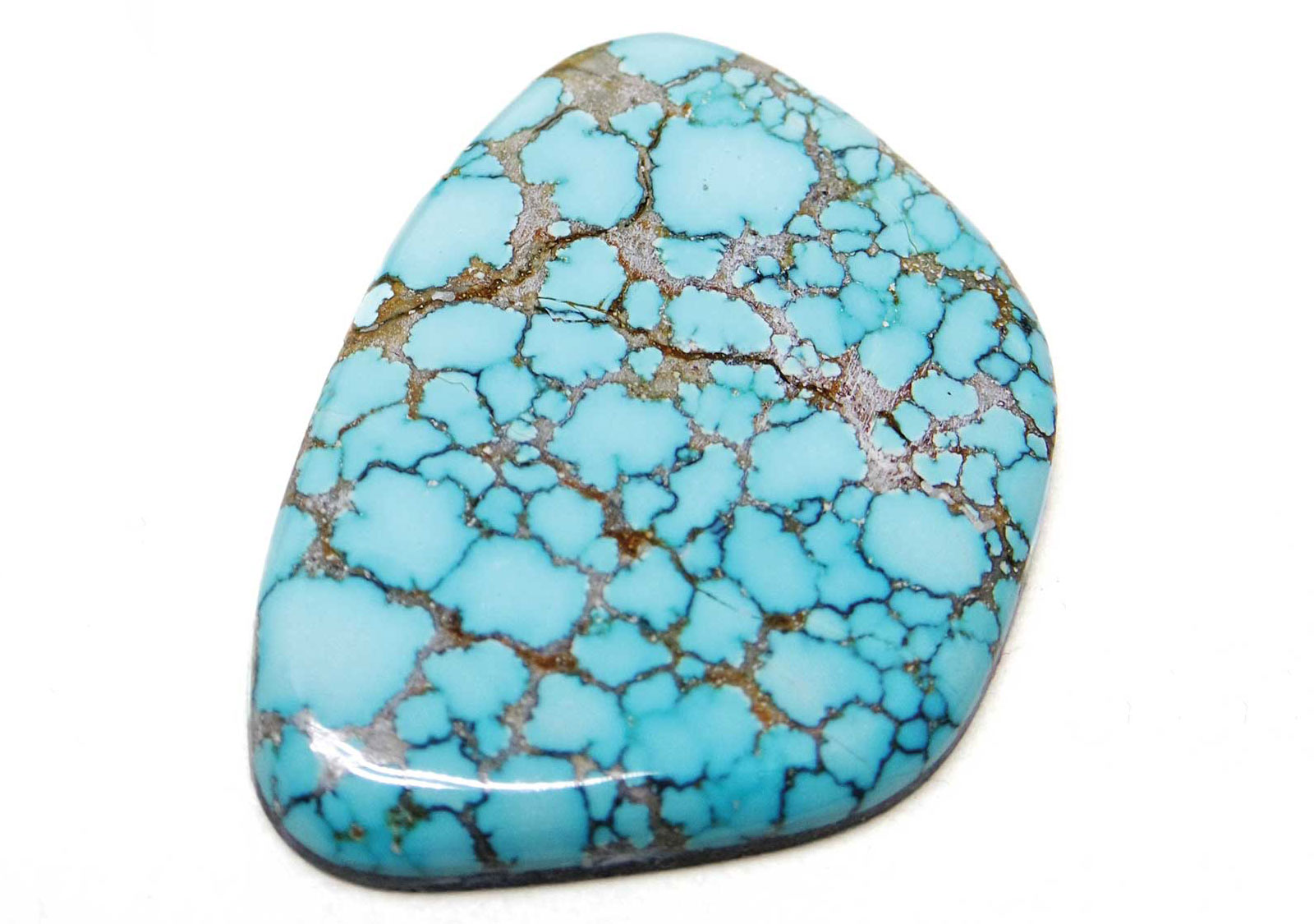
And just as much as artists are seeking out the miners, the miners are seeking out the artists. It’s not an uncommon sight to see turquoise miners hopping from booth to booth at Santa Fe Indian Market, offering their newest stones to all the best jewelers. For artists buying jewelry this way, Tsingine urges caution: buy from trusted sources. It’s not uncommon for questionable dealers to prey on artists who can’t tell a lower-grade turquoise from a higher-grade piece. “I’ve gotten good so I can pretty much tell by looking at the stone what kind of quality it is. You cut enough turquoise and you know what’s high-grade stone and what’s not. I’ve made mistakes and I’ve bought enough bad turquoise to learn to not make those mistakes again,” he says. “Where a lot of people get scammed is with Lander Blue. There’s a stone that comes from China, as well as turquoise from American mines, that can pass as Lander Blue, so you have to be cautious. They only pulled something like 100 pounds of Lander from the mine, but yet if you added up all the Lander available it would be way more than that. So some people are passing off fake stuff as Lander. I like that stone, but I also like Lone Mountain and Bisbee because they’re harder to fake than other stones.”
Like many artists, Tsingine will buy both finished cabs and rough stone, or “whatever I can get a deal on.” He admires the work that the miners do. “I was out at Royston many years ago and I was impressed how big it was and how many people were working it. When they heard I was an artist they welcomed me with open arms. They even let me light the fuse during one of the blasts,” he says. “Mining is extremely hard work. And I grew up on the reservation knowing what hard work was, and mining…that’s hard work.”
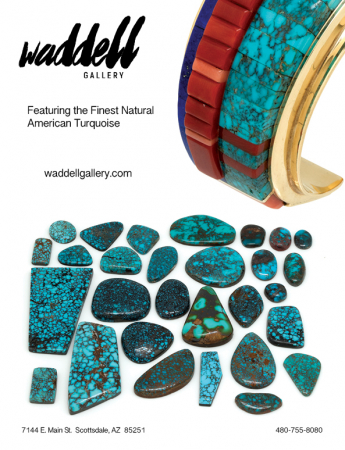
Another way artists get stones is from their galleries, which often work with the mines directly to get the best prices and stones. Gene Waddell, owner of Waddell Gallery, works frequently with mines, and he also owns a piece of Lone Mountain. Waddell has the capital to buy the stones, especially the high-end stones treasured by the best collectors, and he can then offer them to his gallery artists, jewelers such as Wes Willie, Don Supplee, Charles Supplee, Lee Yazzie and others. He also has opportunities to buy collections of stones, as he did several years ago when he purchased the turquoise that had belonged to Charles Loloma.
“We’re in a great place to buy the best stones coming out of the ground anywhere. We can also buy collections. Just three years ago we purchased Charles Loloma’s turquoise from his widow. It had a great provenance, and I knew it all because I knew who Charles was buying from back them,” Waddell says, adding that provenance, quality and rarity are helping take Native American jewelry to the next level. “The best artists want the best stones. And the best collectors want the best stones. It’s common for these pieces to end up in museums, including some of the best museums, so it makes sense that the materials will need to be the best available to the artists.”
Waddell also stresses that, while his gallery deals in the higher-end market, there is still an important role to be played by the mid- and lower-tiered artists, many of whom aren’t using the highest grade of turquoise. “I’ll get people who come in and see a necklace for $15,000 and they can’t afford it, but they can afford lots of amazing pieces by other artists,” he says, adding that the turquoise economy allows for all budgets.
When it comes to new stones from new mines, Waddell likes to wait and see what the mine produces, knowing that the first batch of turquoise might not indicate what is below it. “When a new mine pops up you’re not sure where the high-grade stone is yet. Is it the stuff coming out of the mine first, or is it going to be found later,” he asks. “I like to wait and see what else the mine reveals before I jump into a new turquoise.”
Waiting also has another benefit: rumors will die down, and facts become clearer. This is, after all, the internet age and rumor and false hope can run rampant if left unchecked. It’s somewhat common for a new stone to hit the market and before long it has an inflated presence, with artists and collectors—as well as an excitable Asian market, which has fallen head over heels for turquoise—buzzing about its possibilities.
“What I tell myself is simple, ‘Buy what you see, not what people tell you,” Waddell says. “It hasn’t let me down yet.” —
Powered by Froala Editor