The story of the American West in the 19th and early 20th centuries comes to life through the more than 100 paintings and sculptures by artists that include Thomas Moran, Frederic Remington and Charles M. Russell that are on display in SMoW’s ongoing exhibition, Courage and Crossroads: A Visual Journey through the Early American West. On loan from the Peterson Family Collection and located in the Zaplin Lampert Gallery, these works attest to collector and SMoW Board of Trustee Tim Peterson’s interest in collecting important artwork. His collection is primarily focused on the fur trapper period and the challenges faced during the early days of frontier expansion. Peterson’s early acquisitions were Western art prints, and eventually he purchased original paintings and bronzes and has expanded in more recent years into collecting and loaning Native American art. 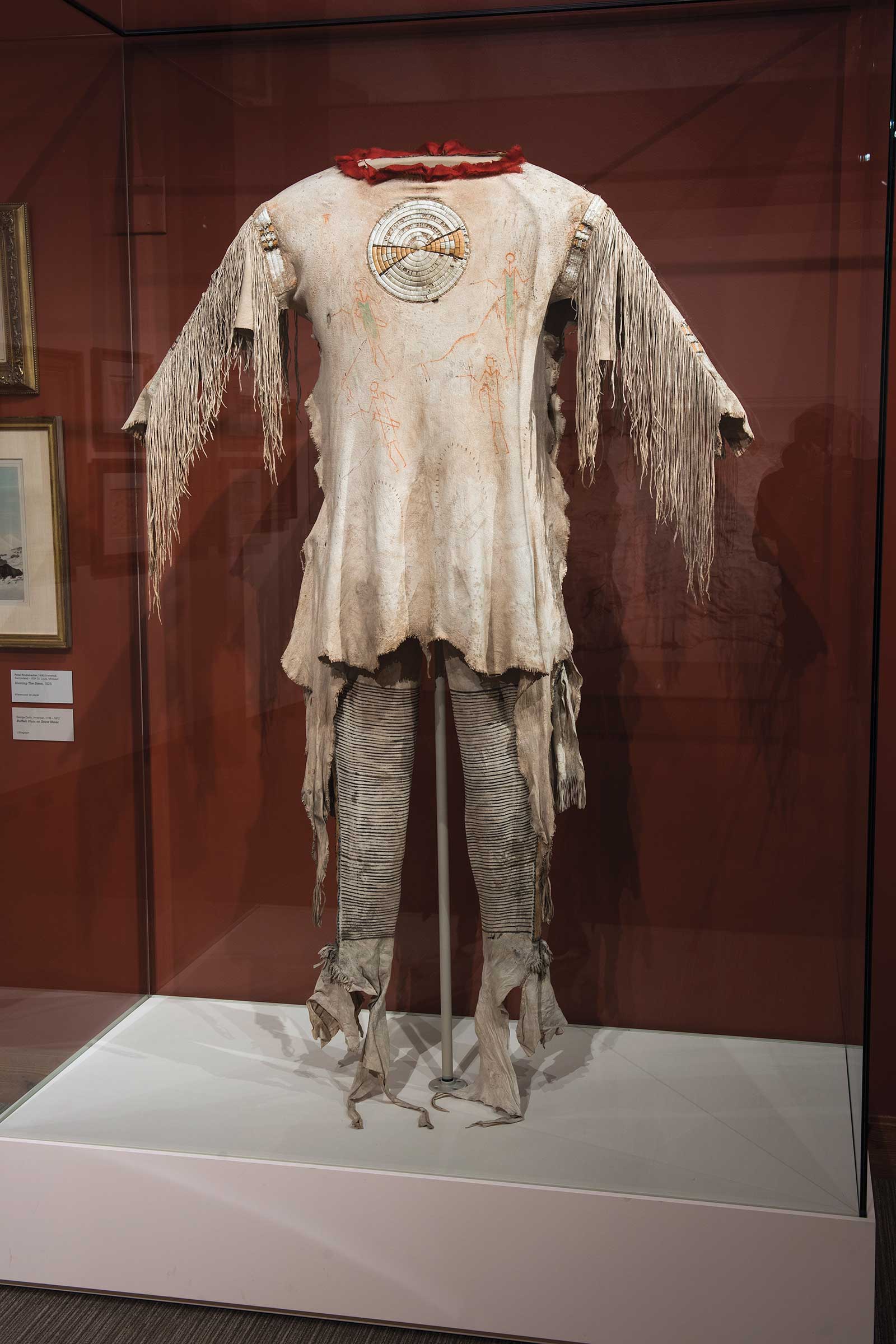 Rare Northwest Plains war shirt with bottom tab leggings (ca. 1800-1820)
Important recent additions to this exhibition include Indigenous artworks that are located within the context of the iconic artists of American art that help unpack the complexities of Native life and offer multiple narratives of America’s past as we celebrate the achievements of artists from diverse cultures. These artworks include Sitting Bull of the Oglala Tribe’s 1874 autobiographical ledger drawing, Brave Buffalo Bull’s autobiographical ledger drawings, robes, pouches and garments such as a war shirt and leggings. These works bring greater societal awareness of the diversity of Western perspectives and the experiences as told by Indigenous peoples. The powerful artistic forces imbued in these pieces afford us an opportunity to see the West from differing points of view.
The autobiographical ledger drawing by Sitting Bull of the Oglala tribe (1835-1876) was made in 1874 for the first Oglala Agent, Dr. John J. Saville. Sitting Bull was a grandson of Bull Bear, the Oglala Lakota Head Chief whose portrait was painted by artist Alfred Jacob Miller in 1837. Sitting Bull was a major leader, and although he was the ninth of 38 men to sign the treaty of 1868, he is little remembered today due to his untimely death at the age of 41. Sitting Bull is often confused with his Hunkpapa contemporary of the same name, who was immortalized by the Battle of the Little Bighorn.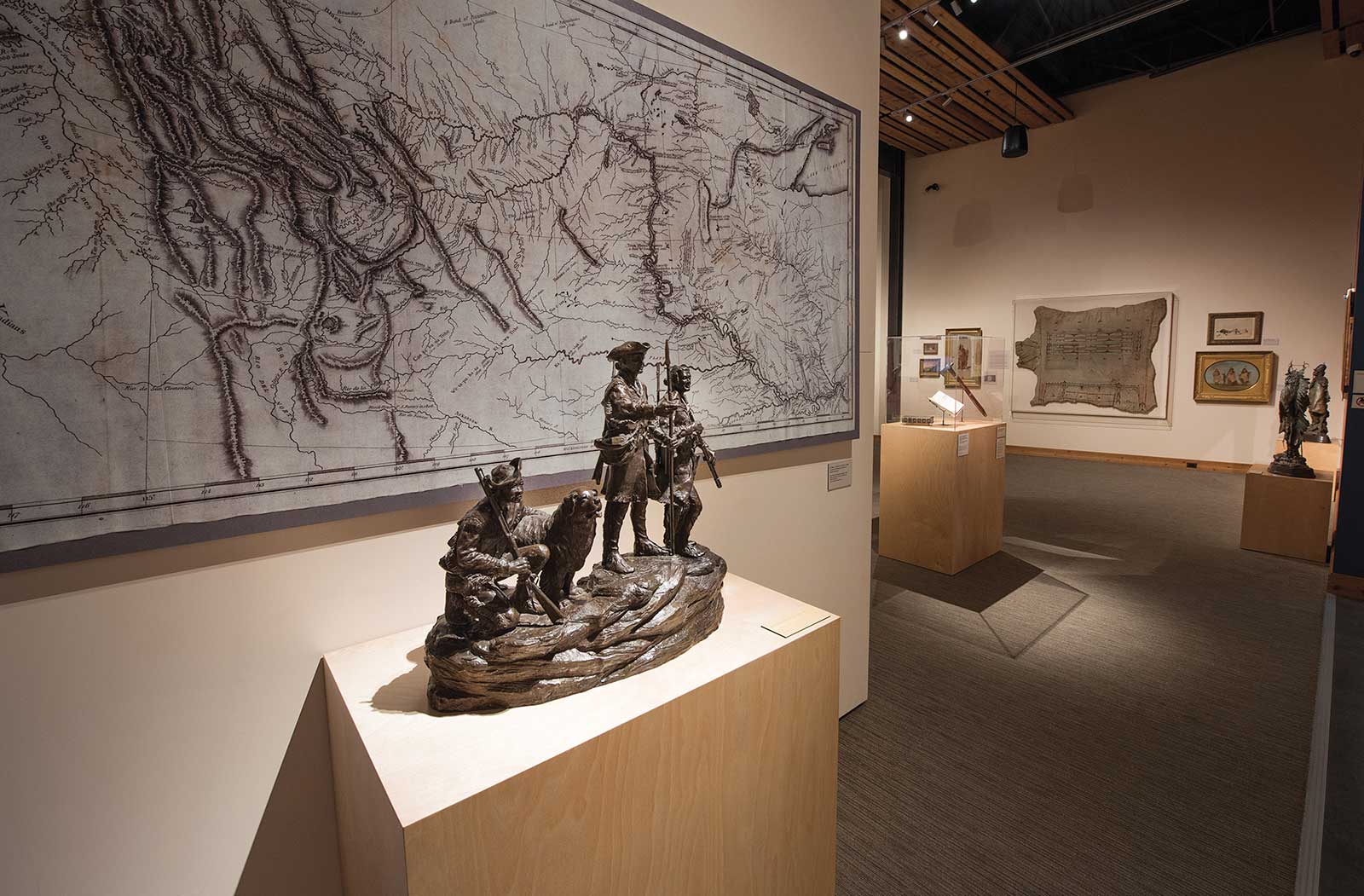 Western and Native American artworks share museum space at Courage and Crossroads: A Visual Journey through the Early American West.
In 1873, Saville was appointed by President Ulysses S. Grant as the agent for the Native Americans at Red Cloud Agency, Wyoming Territory. During the 1870s, when people of the Oglala Tribe were being moved to the reservation, Sitting Bull was instrumental on at least three occasions in saving Saville’s life by risking his own. In this ledger drawing, Sitting Bull depicts himself sometime between 1855 to 1864, passing by an entrenched war party of Pawnees, his face decorated with red circular paint. Scholar and researcher Mike Cowdrey, who has made an in-depth study of this drawing, suggests that in this depiction Sitting Bull portrays himself wearing a breechcloth and dentalium choker necklace. The disc at his throat might be made of silver or a conch shell. The black triangle atop his head and the two similar triangles affixed to his battle lance represent cone-shaped clusters of clipped crow feathers. The lance is decorated also with two pendant panels of red wool cloth to which three eagle feathers are laced. 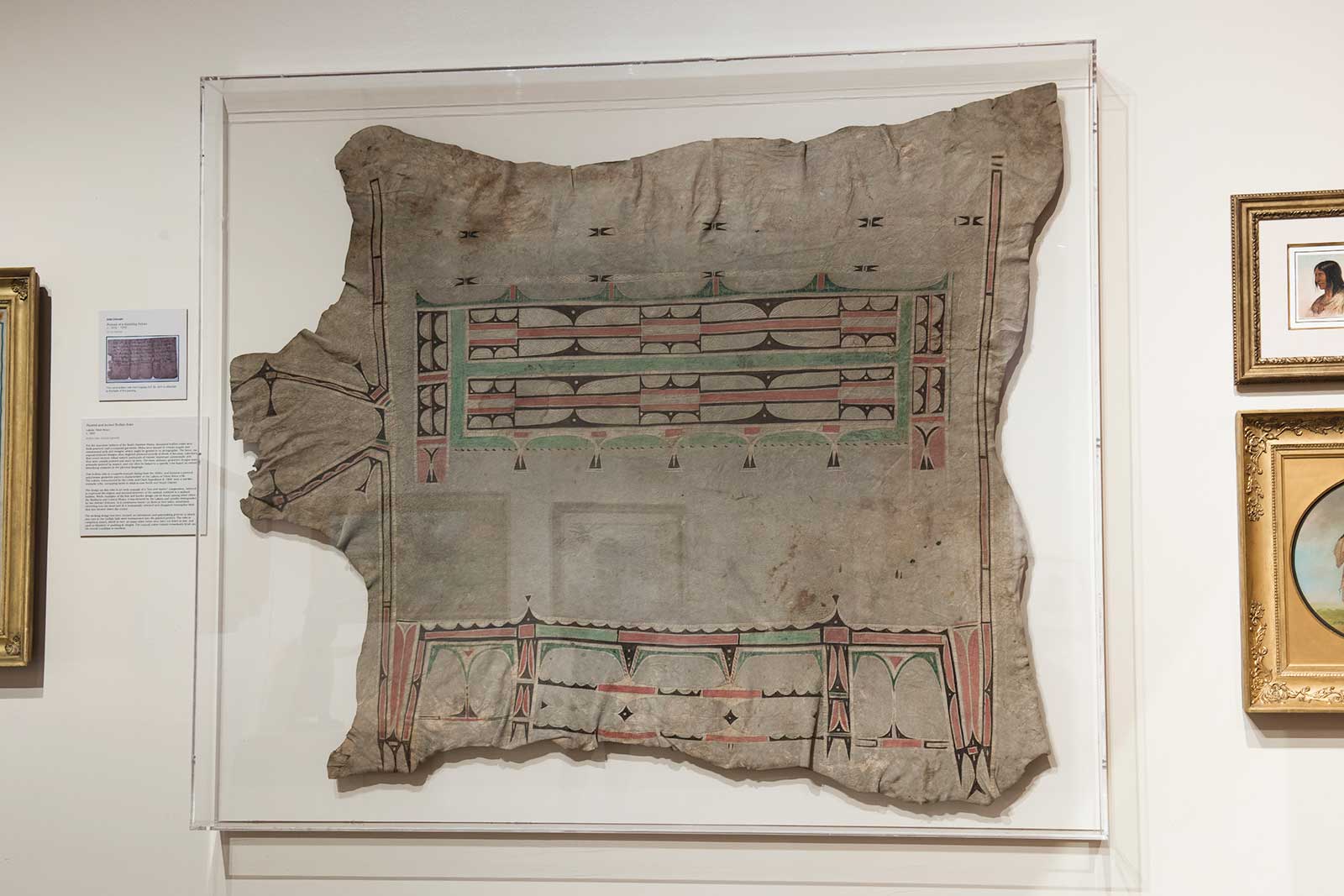 An 1830s bison robe, attributed to the Lakota or Teton Sioux tribe, on view within the gallery.
Sitting Bull helped save the lives of a platoon of U.S. Soldiers at Red Cloud Agency in 1874 and was instrumental in saving the lives of the Peace Commission of 1875. He accompanied the Oglala Delegation of 1875 to Washington, D.C., where his courage was acknowledged by the personal gift of an engraved Henry rifle from President Grant as an expression of gratitude from the U.S. government. The rifle resides at the National Museum of the American Indian, Washington, D.C. In 1876, Sitting Bull led a party of six to negotiate with U.S. representatives near Miles City, Montana, and while returning to Pine Ridge they were attacked by Crow scouts, and he was killed along with four other chiefs.
Two remarkable ledger drawings by Brave Buffalo Bull, who was born sometime around 1839 near present-day Pollock, South Dakota, have been recently included in the exhibition. According to Cowdrey, these are the only known examples of Brave Buffalo Bull’s drawings, and they illustrate what are probably sequential events of a battle and the subsequent victory parade. When they were mounted together in their frame the victory parade was placed on top and the battle was placed on the bottom. In one of the drawings Brave Buffalo Bull depicts himself riding a blue horse. He wears a cape of red wool trade cloth and dark blue wool leggings that are painted as black, with a decorative stripe that might be seized cavalry pants. In his left hand he holds a crooked lance wrapped with strips of otter skins and hung with golden eagle feathers. The enemy force is shown positioned along a curved line to his right that represents a defensive terrain feature, probably land along a stream or possibly a ravine. 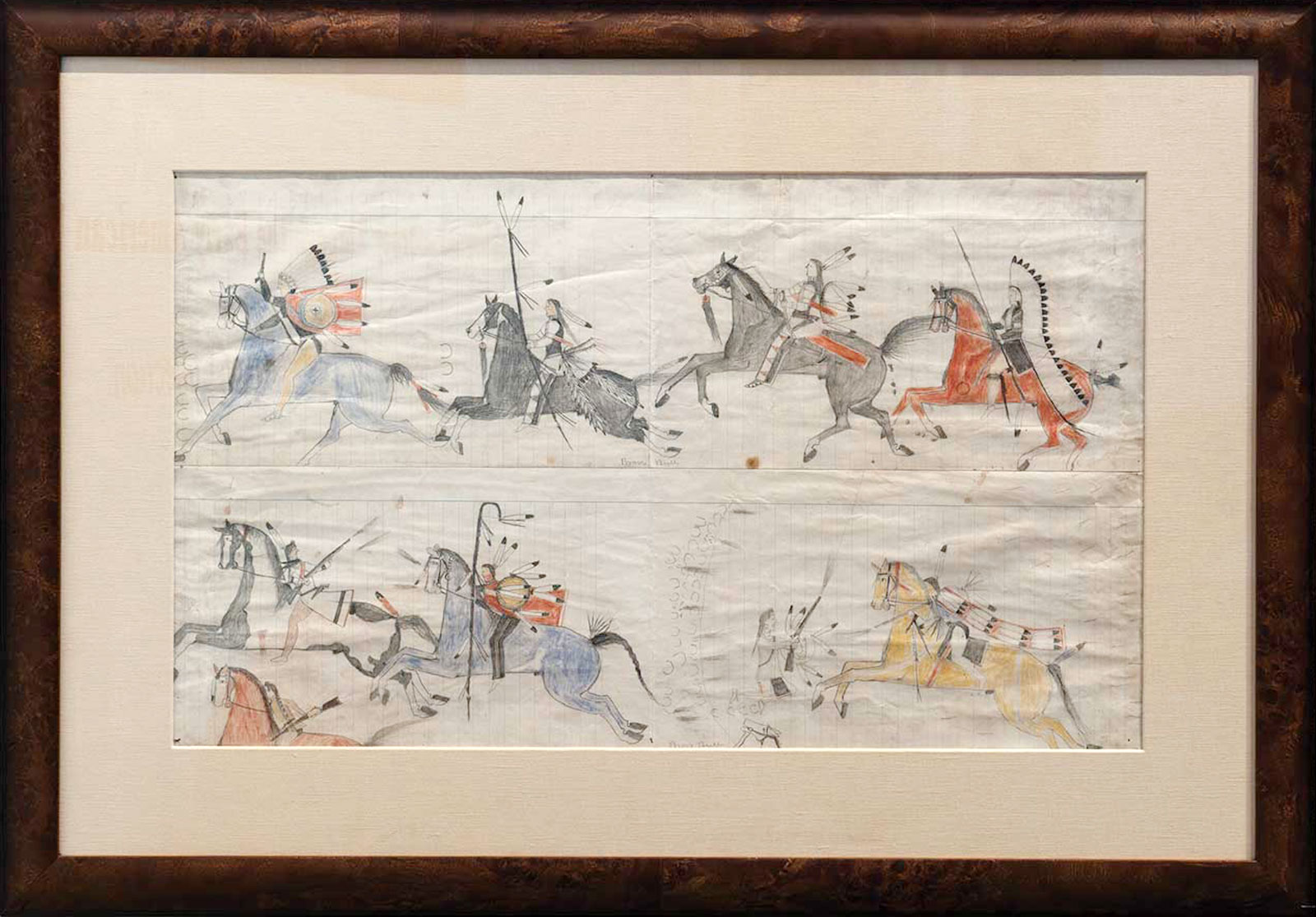 One of two Brave Buffalo Bull ledger works now on view.
Featured in Courage & Crossroads are two important decorated robes. These garments were both practical and ceremonial. An 1830s bison robe is attributed to the Lakota or Teton Sioux tribe, and is painted with a geometric pattern. The design on this robe is an early example of a “box and border” composition, believed to represent the organs and internal structure of the animal, outlined in a stylized fashion. The natural colors remain remarkably fresh and the striking design has been incised, an uncommon and painstaking process in which tiny cuts in the buffalo hide were incorporated into the painted pattern. The robe is completely intact, which is rare, as many were later cut and reduced in size and used as blankets or padding.
Another robe is of Northern Plains origin and possibly Crow, having been made before 1850 of bison or elk hide. Fewer than 12 Crow exploit robes from this early period survive. This robe is an extraordinary visual document of the life of a Crow warrior, and an outstanding example of Plains artistic achievement. Exploit robes memorialize the accomplishments of a single individual, usually the artist. It was collected by Lieutenant Frederick Charles Denison, who was a soldier, author and politician active during the 1869 to 1870 Red River Rebellion. He likely collected the garment while on a trip to the Red River region in what is now the Canadian Province of Manitoba. Denison remained in Manitoba after the uprising for nearly a year as aide-de-camp to Lieutenant Governor Adam George Archibald. 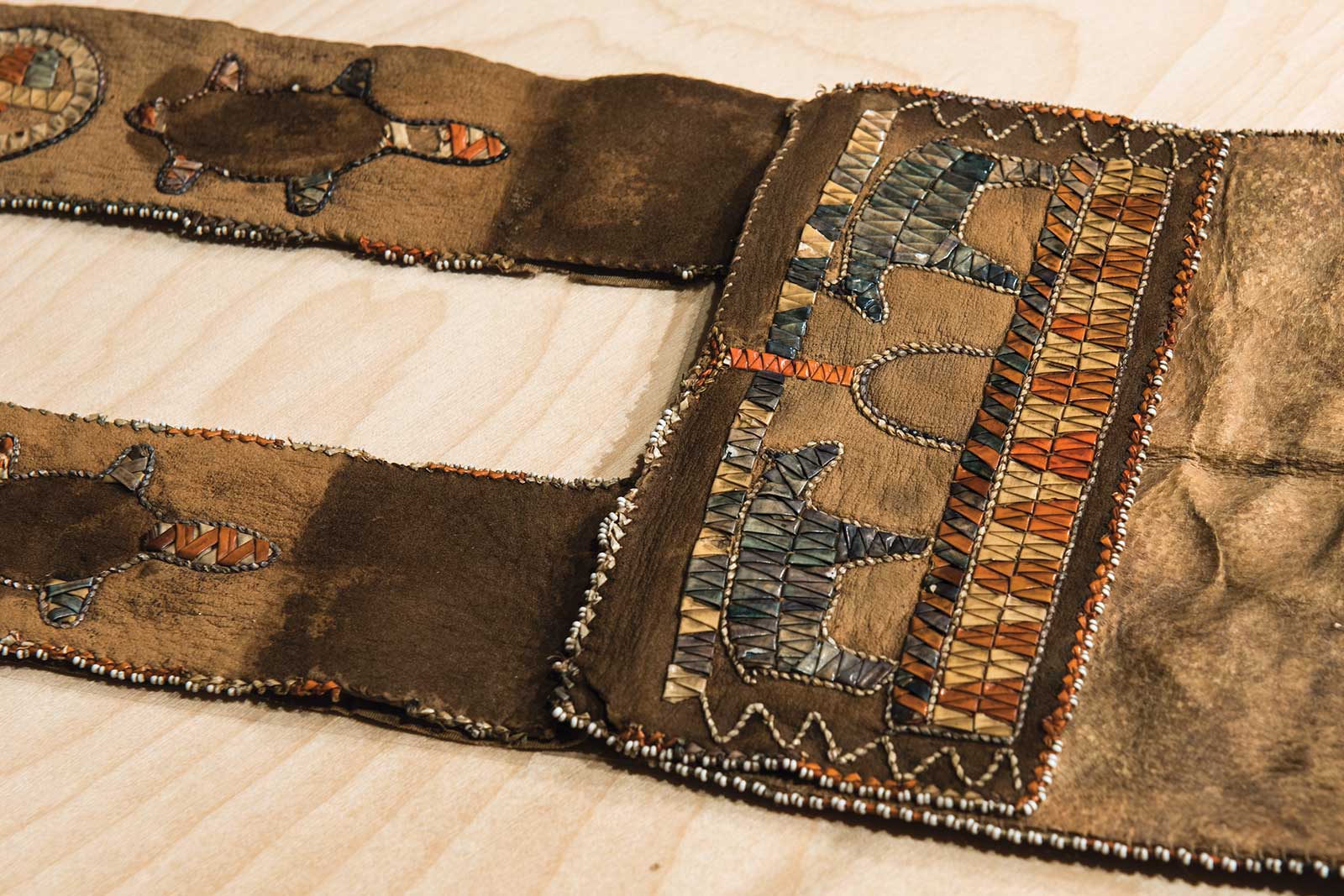 Woodlands, Eastern Great Lakes or possibly Huron quilled and beaded pouch from the mid-18th century.
Depicted are a series of encounters or events experienced over several years, and the unrecorded artist always portrays himself on the right, his body painted blue. The images include several rarely found in Plains pictography, such as barefoot warriors and a Northwest Coast dagger portrayed in two separate vignettes. The dagger is depicted with a large triangular blade, the shaft carved to represent a zoomorphic image, possibly a bird. This suggests intertribal trade between the Pacific Northwest and the mountain interior of present-day Wyoming.
An uncommon Woodlands, Eastern Great Lakes or possibly Huron quilled and beaded pouch, from the mid-18th century in the manner of a bandolier bag, but on a smaller scale depicts a pair of opposing bears separated by a half-circle motif. Silk trade cloth backs the beaded strap, with alternating quilled beaver designs, whose bodies were enhanced with a stain possibly made from the inner bark of the black walnut or red maple tree. The pouch was collected by Sir Francis Bond Head, who served from 1835 to 1838 as the Sixth Lieutenant-Governor of Upper Canada. During his short tenure beginning in 1835, he oversaw the 1836 Treaty of Manitoulin Island with the Chippewas, Ottawas and Ojibwa Peoples, as well as the 1837 Upper Canada Rebellion.
A rare Northwest Plains war shirt with bottom tab leggings (ca. 1800-1820) made of two soft-tanned deerskins, probably from prong-horned antelope or white-tailed deer, has the construction techniques, painting styles and quillwork that suggests they were made in the early 19th century. Probably of Blackfeet origin, for many years the shirt and leggings were housed in a Belgian Jesuit mission founded in the 18th century, therefore scholars feel that a missionary initially took them to Europe. 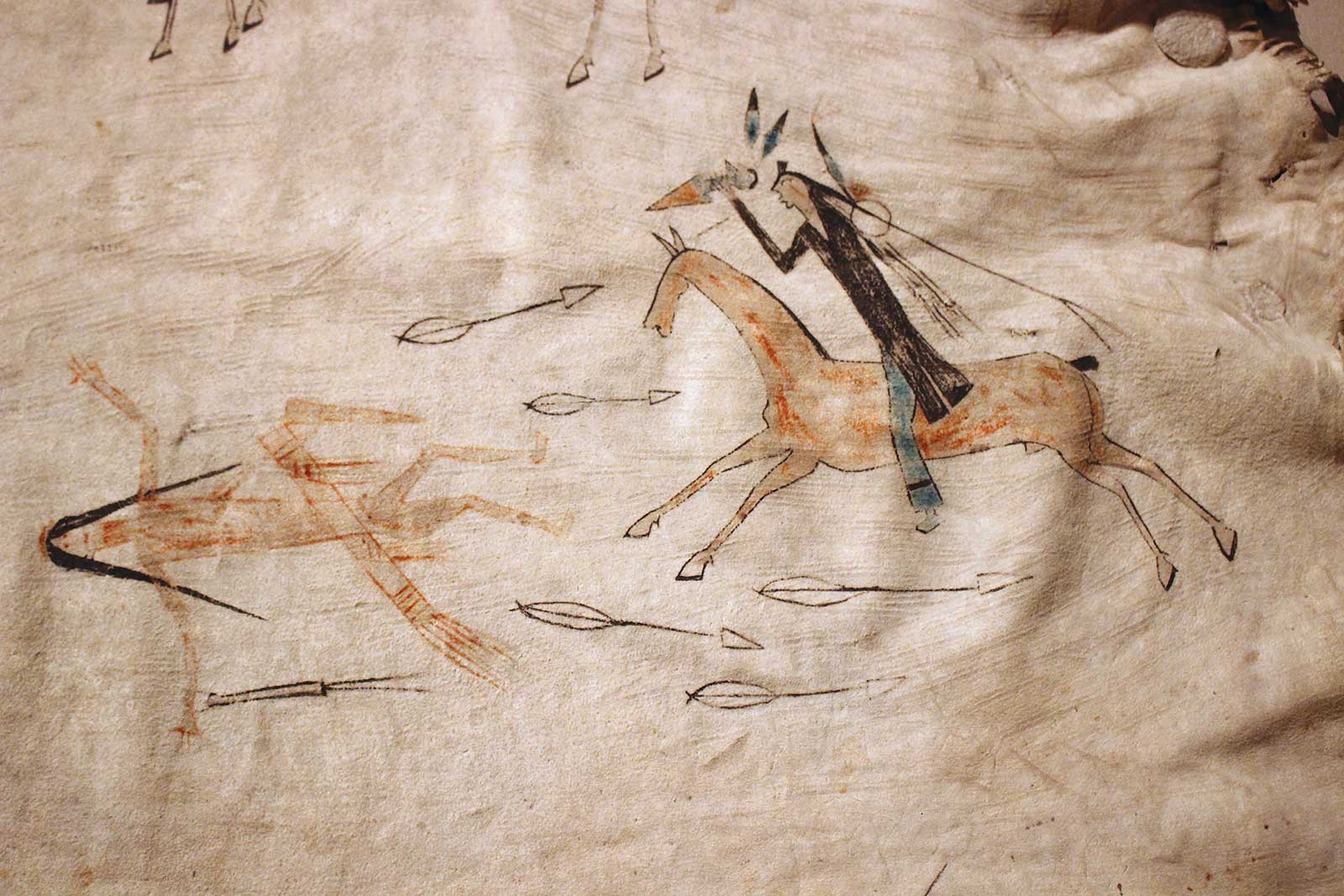 Detail of a buffalo robe, possibly Northern Plains or Crow, made before 1850.
The pictographic exploits painted on this shirt identify it most likely as of the type that would have been worn by a high-ranking individual with high shamanistic and military status. Striking pictographic depictions include ten human figures, weapons, guns, bows, spears and axes. All are outlined in red. Eight of the human figures show a predominance of greenish-blue paint on their bodies; two figures are outlined in red; and one carries a U-shaped quiver. This figure carries a feathered calumet, with the carefully rendered black tips of eagle feathers. Attached to his head is probably an otter skin. Such a feature occurred on a shirt collected by the artist-explorer Paul Kane in the 1840s. The V-shaped human figures are distinctive, and it is possible that the ‘V’ feature conveys a type of body covering, which may have been the hide armor worn by the Plains Indians that was first described in 1804 by Lewis and Clark.
Within the colonialist expansion of the “New World” and Western North America, often only the historical narratives written from the perspectives of Euro-Americans have been told. Native American accounts of conflicts such as those depicted by the war shirt and leggings, ledger art drawings, exploit robe and other artworks have survived within the oral histories, which are not often heard by those outside the culture. The stories conveyed through these works on display in Courage & Crossroads help us appreciate and better understand the cultural perspectives from the past that continue to inform us today and beyond. —
Ongoing
Courage and Crossroads: A Visual Journey through the Early American West
Western Spirit: Scottsdale’s Museum of the West
3830 N. Marshall Way, Scottsdale, AZ 85251
(480) 686-9539 · www.scottsdalemuseumwest.org
Powered by Froala Editor